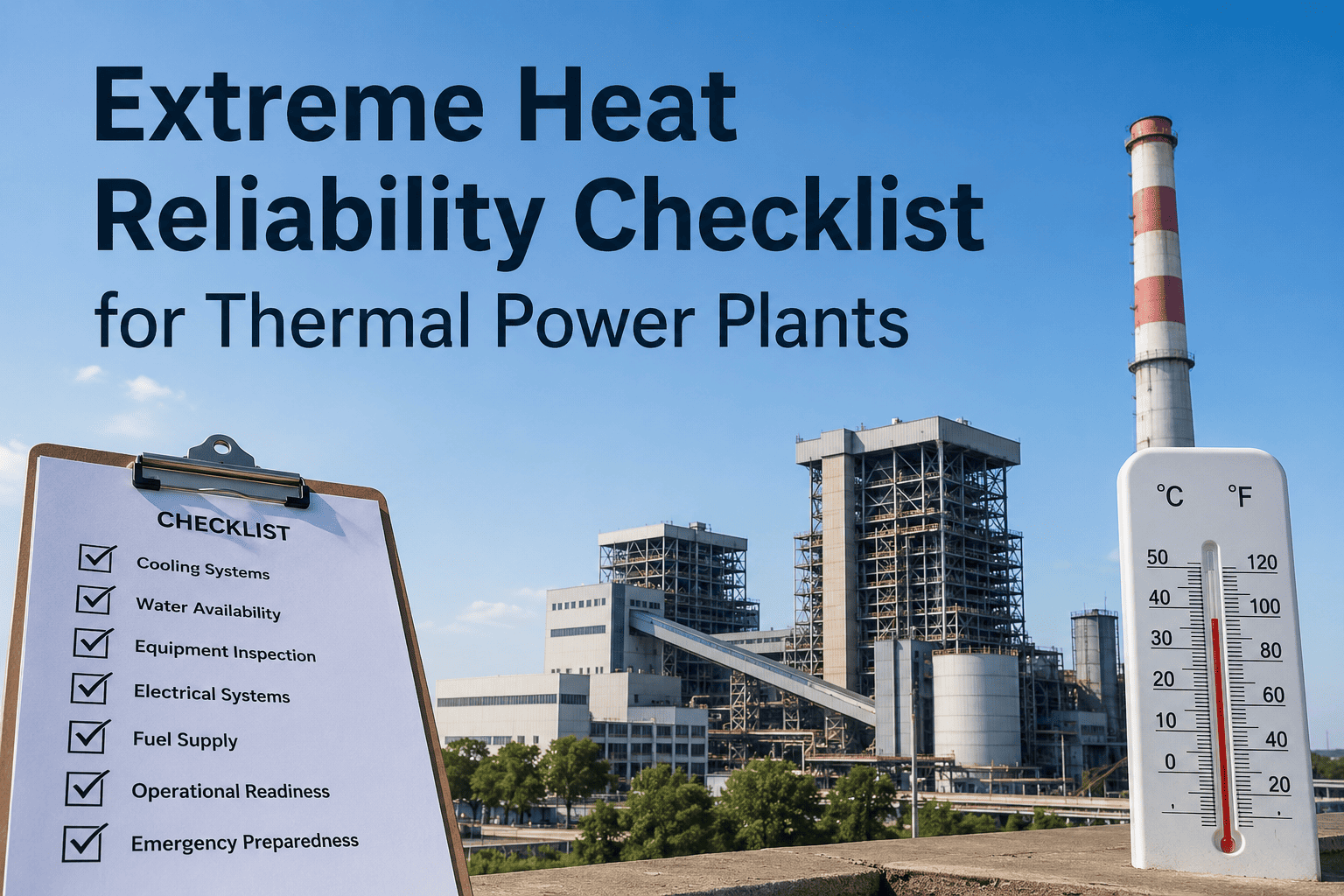
When ambient temperatures exceed 40°C, power plant cooling systems face their most punishing test of the year — condenser backpressure climbs, circulating water pump efficiency drops, cooling tower fill media degrades faster, and a single missed inspection can cascade into a forced turbine derate within hours. Plants without a structured heat-season maintenance program routinely lose 3–8% generation capacity during peak summer months, while those running CMMS-guided inspection protocols maintain full load dispatch even through prolonged heat waves. This checklist gives your operations, maintenance, and reliability teams a complete framework for extreme heat readiness — covering cooling towers, condensers, circulating water systems, auxiliary cooling circuits, and heat rate monitoring — structured so every inspection feeds directly into your OxMaint CMMS preventive maintenance workflow with a timestamped audit trail.
Power Plant · Climate Resilience · Cooling System Checklist
Extreme Heat Maintenance Checklist for Power Plant Cooling Systems
A field-ready checklist for operations and maintenance teams covering cooling towers, condensers, circulating water systems, and auxiliary cooling circuits — built for plants targeting full-load dispatch through peak summer heat waves.
40°C+
Heat Stress Threshold
8%
Capacity Loss Without Prep
95%+
Condenser Availability Target
24 hrs
Pre-Heat-Wave Alert Window
Why It Fails
What Goes Wrong During Extreme Heat — and When
Cooling system failures during heat waves follow a predictable cascade. Understanding the failure sequence is the foundation of an effective heat-season inspection program.
Hour 1–6
Basin Temperature Rise
Makeup water demand spikes, evaporation rate doubles, biocide residuals deplete faster than normal dosing schedules replenish them.
Hour 6–24
Fill Media Fouling
Biological growth accelerates in warm stagnant zones. Partially blocked fill reduces effective heat transfer area, further elevating condenser water return temperature.
Day 2–4
Condenser Backpressure Creep
Rising circulating water temperature degrades condenser vacuum. LP turbine exhaust enthalpy rises, blade stress accumulates, and heat rate climbs 2–4%.
Day 4+
Forced Derate or Trip
Condenser backpressure exceeds turbine design limit, forcing automatic load reduction or unit trip. Dispatch obligations unmet and replacement power costs triggered.
PREPre-Season
DDaily
WWeekly
HWHeat Wave Active
MMonthly
Section 1
Cooling Tower Pre-Season Readiness
Pre-season inspections must be completed before the first forecast above 38°C. Finding fill media damage or basin chemistry problems during a heat wave leaves no time to correct them without unit derating.
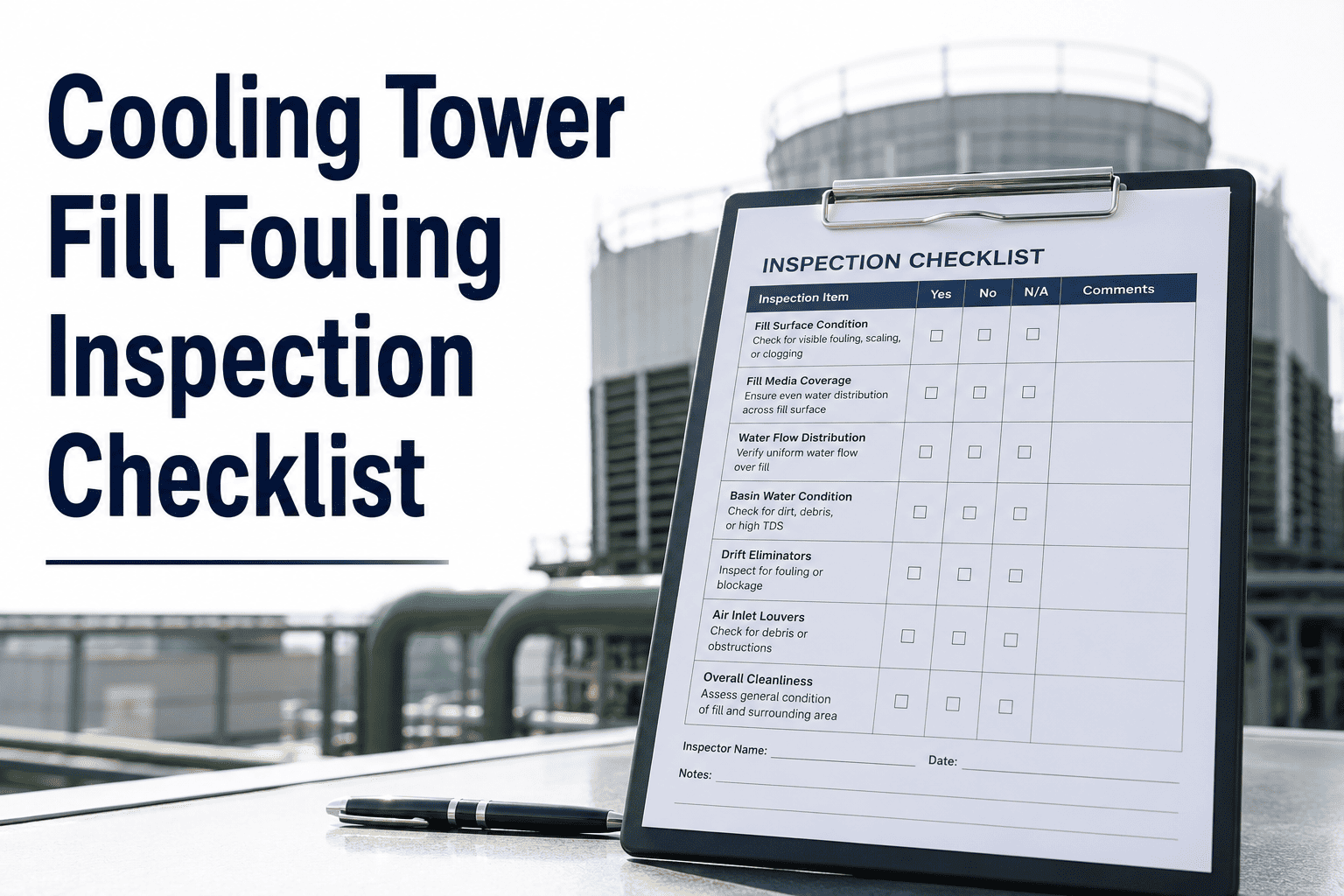
Cooling tower fill media inspected for biological fouling, scaling, sagging, or collapsed sections — any cell with more than 10% blocked fill area scheduled for cleaning or replacement before heat season onset
PREMechanical Technician · CMMS asset inspection record
Fan blade pitch angle verified at design specification for all tower cells — incorrect pitch reduces airflow by up to 30%, directly degrading cold water temperature by 2–4°C under peak load conditions
PREMechanical Technician · Fan inspection log
Gearbox oil changed and oil level confirmed at sight glass — gear tooth wear documented, vibration baseline recorded for all fan drive gearboxes before seasonal high-load operating period begins
PRELubrication Tech · Gearbox inspection report
Distribution nozzles and spray headers flushed and verified clear — blocked nozzles create dry spots in fill media that accelerate biological growth and reduce thermal performance disproportionate to their size
PREOperations Technician · Nozzle inspection log
Basin cleaned and inspected — silt, biological deposits, and scale removed; basin drain valve operation confirmed; makeup water float valve calibrated to maintain correct basin level at maximum evaporation rate
PREOperations Tech · Basin cleaning work order
Water treatment chemical inventory confirmed sufficient for full heat season — biocide, scale inhibitor, and corrosion inhibitor stock verified at 120% of maximum projected consumption to cover extended heat wave demand
PREWater Treatment Engineer · Chemical inventory record
Section 2
Daily Heat Season Inspection Workflow
Daily checks during summer months must be completed every shift, not once per day. Cooling system conditions can deteriorate within hours when ambient temperature is sustained above 40°C.
Condenser Backpressure vs Ambient Temperature Comparison
Log actual backpressure against the design curve for current ambient temperature. A deviation of more than 5 mmHg above expected value triggers immediate investigation of condenser tube fouling or cooling tower performance degradation.
Cooling Tower Cold Water Temperature Verification
Measure and log cold water temperature at basin outlet. Compare to design approach temperature for current wet-bulb conditions. Rising approach temperature above 2°C above design indicates fouling, reduced airflow, or water distribution failure.
Basin Water Chemistry Sampling
pH, conductivity, and biocide residual measured and logged. During heat waves, biocide depletion rate doubles. If residual falls below minimum effective concentration, increase dosing frequency rather than waiting for scheduled treatment cycle.
Circulating Water Pump Differential Pressure Check
Pump discharge pressure and flow confirmed against operating curve. A flow reduction of more than 5% below design at the same head indicates impeller wear, inlet strainer blockage, or cavitation onset from elevated water temperature.
Fan Motor Winding Temperature and Current
Motor winding temperature confirmed within rated limits for ambient — high ambient conditions reduce motor thermal margin significantly. Current draw logged to detect blade fouling or mechanical binding that increases load on motor at worst-case temperatures.
Condenser tube inlet water temperature logged against previous shift — a rising trend exceeding 1°C per shift without corresponding ambient increase triggers tower inspection the same shift
DShift Operator · CMMS mobile checklist
Cooling tower fan vibration amplitude confirmed below 2.5 mm/s on all operating cells — any cell showing vibration increase of more than 0.5 mm/s versus previous reading escalated to reliability engineer before next shift
DShift Operator · CMMS vibration log
Auxiliary cooling circuits for lube oil coolers, generator hydrogen coolers, and seal water heat exchangers confirmed operating within temperature limits — all auxiliary cooling water flows verified against design values
DShift Operator · CMMS checklist
Makeup water flow rate logged — a sustained increase above expected evaporation-compensating rate indicates basin leak, cooling water loss, or excessive blowdown requiring immediate investigation
DShift Operator · CMMS flow log
Heat rate deviation calculated from DCS data — a heat rate increase above 2% from baseline with stable generation output, without corresponding fuel change, indicates cooling system degradation requiring same-day investigation
DShift Engineer · Performance monitoring dashboard
OxMaint generates shift-specific cooling system checklists, tracks condenser backpressure trends against design curves, and alerts reliability engineers the moment a heat-related anomaly exceeds threshold — before it becomes a forced derate.
Section 3
Heat Wave Active Protocol — Elevated Frequency Checks
When forecast ambient temperatures exceed 40°C for 48+ hours, normal daily inspection frequency is insufficient. The following checks are required every 4–6 hours during active heat wave conditions.
All standby cooling tower cells placed in service and confirmed operational — do not wait for primary cell performance to degrade before starting standby capacity; pre-load sharing is essential during sustained extreme heat
HWShift Operator · CMMS operations log
Biocide dosing increased to heat wave protocol — automatic dosing timer reconfigured to 1.5× normal dose frequency; biocide residual re-checked within 2 hours of dosing change to confirm effective concentration maintained
HWWater Treatment Tech · Treatment log in CMMS
Condenser backpressure monitored against turbine trip setpoint — if backpressure reaches 80% of turbine protection limit, shift engineer notified immediately to prepare for controlled load reduction before automatic protective trip
HWShift Engineer · DCS trend review
Fan gearbox temperature checked hourly — gearbox oil temperature above 85°C requires immediate speed reduction or cell shutdown to prevent catastrophic bearing failure during peak heat event when no replacement time window exists
HWShift Operator · CMMS hourly log
Water intake screen differential pressure confirmed within normal range — elevated river or lake temperatures during heat waves accelerate biological growth at intake screens, restricting cooling water flow faster than normal seasonal rates
HWShift Operator · CMMS checklist
Section 4
Condenser and Heat Exchanger Maintenance
Condenser tube fouling has a direct, quantifiable impact on unit output. A 10% increase in condenser terminal temperature difference typically raises heat rate by 1.5–2%, equivalent to significant fuel cost increase at full load operation across a summer season.
Condenser terminal temperature difference calculated from hot well, CW inlet, and CW outlet temperatures — a rise of more than 3°C above design value for current load and CW inlet conditions triggers tube fouling assessment
WPerformance Engineer · Heat rate calculation sheet
On-load condenser tube cleaning system (sponge ball or brushes) operation confirmed — cleaning system flow rate and return rate of cleaning elements verified; missed cleaning cycles compound tube fouling rapidly during high heat load periods
WShift Operator · Cleaning system log
Lube oil cooler outlet temperatures confirmed within specification for turbine, generator, and all driven equipment — a rising lube oil temperature trend under stable ambient conditions indicates cooler fouling requiring maintenance scheduling
DShift Operator · CMMS mobile checklist
Generator hydrogen cooler differential temperature reviewed — reduced cooling delta-T with stable hydrogen pressure indicates fouled cooler tubes requiring back-flush or chemical cleaning to prevent generator winding temperature alarm
WReliability Engineer · Generator performance log
Circulating water pump seal and bearing temperatures confirmed within limits under elevated flow conditions — heat waves require maximum pump output sustained for days; bearing fatigue risk increases with sustained high-speed, high-temperature operation
DShift Operator · CMMS mobile checklist
KPIs
Heat Season Performance Targets
FAQs
Frequently Asked Questions
Why do power plants lose generation capacity during extreme heat?
Cooling system thermal performance degrades as ambient and wet-bulb temperatures rise — cooling towers cannot reject heat as efficiently, condenser backpressure climbs, and LP turbine blade stress limits require load reduction. Without proactive inspections, a 40°C day can reduce plant output by 3–8% before any alarm activates. OxMaint tracks heat rate deviation in real time so teams act before derating becomes mandatory.
How often should water chemistry be tested during a heat wave?
Biocide residuals should be tested every shift during sustained heat above 40°C, not once daily. Evaporation rates double in extreme heat, diluting inhibitor concentrations faster than standard dosing schedules replenish them. Legionella risk and scaling both accelerate when chemistry drifts, so increasing check frequency is non-negotiable during prolonged heat events.
What is condenser terminal temperature difference and why does it matter?
Terminal temperature difference (TTD) is the gap between turbine exhaust saturation temperature and cooling water outlet temperature. A rising TTD indicates condenser tube fouling or waterbox air ingress, both of which reduce condenser vacuum, increase turbine heat rate, and reduce generation efficiency. During summer, a 3°C TTD rise translates to roughly 1.5–2% higher heat rate. Book a demo to see how OxMaint tracks TTD trends automatically.
When should standby cooling tower cells be started during a heat wave?
Standby cells should be started before primary cell performance degrades — not after. When a 40°C+ forecast is confirmed, bring all available cells online at the start of the heat event and share the load. Starting a standby cell after condenser backpressure has already risen gives you no time to condition the cell water chemistry or verify mechanical readiness under load.
How does a CMMS improve heat season cooling system reliability?
A CMMS auto-escalates inspection frequency when ambient temperature thresholds are breached, tracks backpressure trends against design curves, sends alerts when chemistry parameters drift out of range, and creates a documented audit trail of every check. Manual rounds with paper logs cannot match this speed or coverage across a multi-cell cooling tower array. Start your OxMaint free trial and deploy heat season protocols within a day.
Ready to Deploy This Checklist?
Every Cooling Check Logged. Every Heat Wave Managed. Every Megawatt Protected.
OxMaint equips your operations and maintenance teams with automated shift checklists, real-time backpressure and heat rate alerts, shift-to-shift trend visibility, and escalation pathways that engage reliability engineers within minutes of a threshold breach — so your plant dispatches full load through peak summer heat waves while competitors are curtailing output.