Cooling water chemistry failures are among the most expensive hidden problems in power generation — causing condenser tube corrosion, heat exchanger fouling, cooling tower fill collapse, and forced derating events that can cost a plant hundreds of thousands of dollars per incident. Unlike mechanical failures, chemistry excursions develop slowly and silently, with weeks or months passing between the first out-of-spec reading and visible equipment damage — unless a structured inspection and response system catches them at the source. OxMaint's Inspection Management platform digitises your cooling water chemistry programme — tracking readings against control limits, escalating excursions to corrective work orders, and maintaining the chemistry log required by equipment OEMs, ASME guidelines, and environmental discharge permits. Book a demo to see how power plants prevent chemistry-driven outages with OxMaint.
Checklist · Power Plants · Water Systems · Inspection Management
Cooling Water Chemistry Inspection and Work Order Flow for Power Plants
A complete cooling water chemistry inspection framework — open recirculating systems, once-through cooling, closed loops, and condensate circuits — with chemistry control limits, sampling procedures, excursion response workflows, and automatic work order generation.
Up to 40%
reduction in condenser heat transfer when biofouling is left uncontrolled in an open recirculating system
2–4x
corrosion rate increase when cooling water pH drops below 6.5 or rises above 9.5 for extended periods
Legionella
risk begins at water temperatures above 20°C with inadequate biocide treatment — regulatory requirement in most jurisdictions
Daily
minimum sampling frequency required for open recirculating cooling systems under significant load variation
Cooling Water System Types and Inspection Priorities
Open Recirculating (Cooling Tower)
Water is recirculated through the condenser or heat exchanger, cooled by evaporation in the tower, and returned. Evaporative loss concentrates dissolved solids — cycles of concentration must be controlled by blowdown. Primary chemistry risks are scale, corrosion, and Legionella.
Key parameters: pH, conductivity, cycles of concentration, LSI, biocide residual, microbiological count, inhibitor levels
Sampling: Daily for pH, conductivity, biocide; weekly for microbiological and inhibitor analysis
Once-Through Cooling (River / Sea Water)
Raw water is drawn from a river, reservoir, or sea intake, passed through the condenser, and discharged. Chemistry control focuses on intake screening, antifouling treatment at the intake, and monitoring discharge temperature and chemistry for environmental permit compliance.
Key parameters: Intake turbidity, chlorination residual, discharge temperature, discharge pH, biofouling organisms
Sampling: Continuous discharge temperature monitoring; daily chlorination residual; monthly biofouling
Closed Cooling Water (CCW) Systems
A sealed loop cools auxiliary equipment — lube oil coolers, generator air coolers, exciter coolers. No evaporation means no concentration, but corrosion and microbiological growth still occur. System is filled once and maintained with inhibitor — chemistry drifts slowly but persistently if not monitored.
Key parameters: pH, inhibitor concentration, nitrite or molybdate level, dissolved oxygen, corrosion coupon data
Sampling: Monthly for pH and inhibitor; quarterly corrosion coupon retrieval
Condensate and Feedwater Chemistry
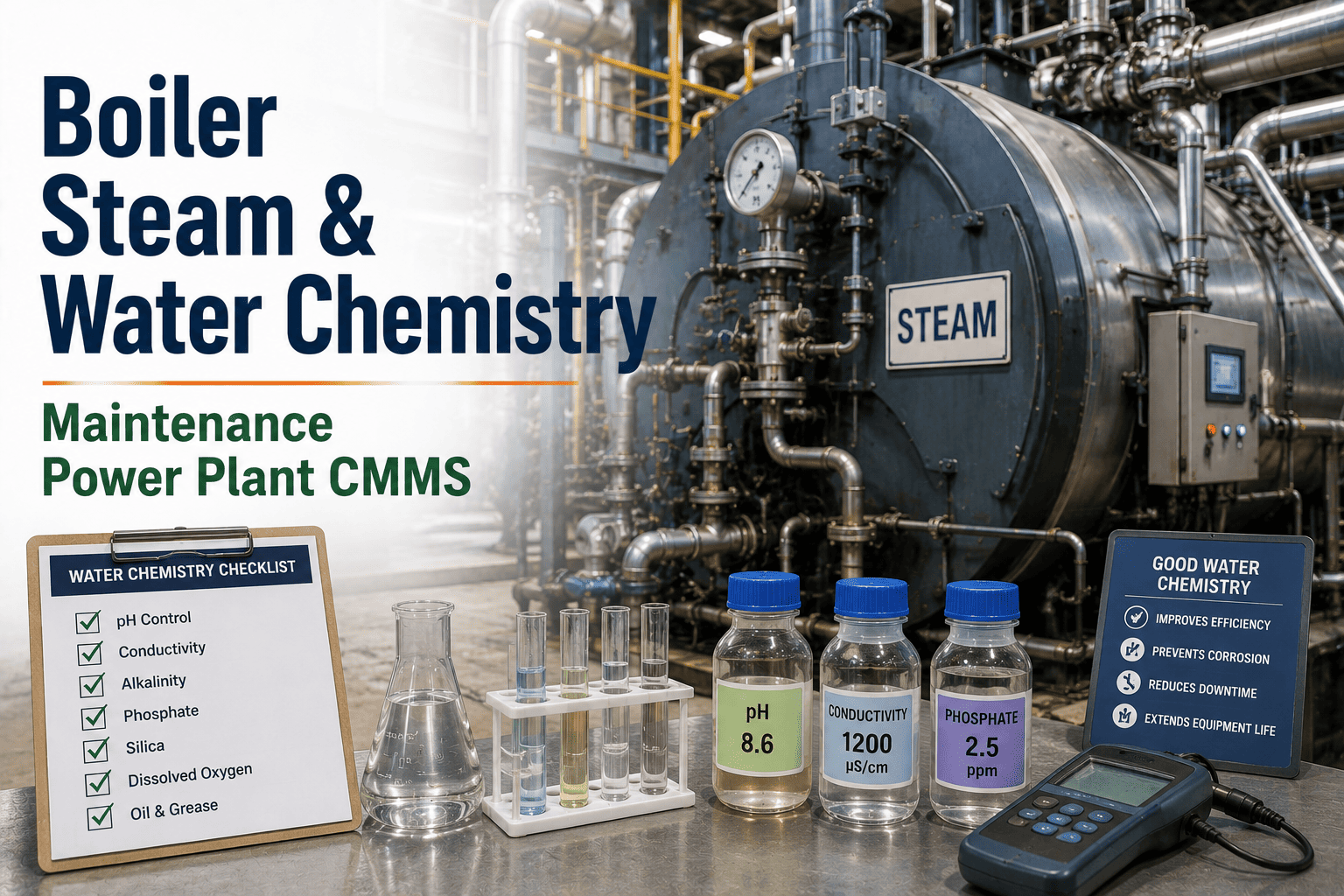
Boiler cycle water chemistry in steam plants governs corrosion in the condenser, hotwell, feedwater heaters, and boiler tubes. ASME guidelines specify tight control ranges for pH, dissolved oxygen, conductivity, cation conductivity, and sodium that are tighter than any other cooling circuit.
Key parameters: Cation conductivity, pH, dissolved O2, sodium, hydrazine or oxygen scavenger residual, iron
Sampling: Continuous on-line analysers; daily manual verification of key parameters
Daily Chemistry Sampling and Logging Checklist — Open Recirculating System
Daily
Open Recirculating System — Shift Chemistry Log
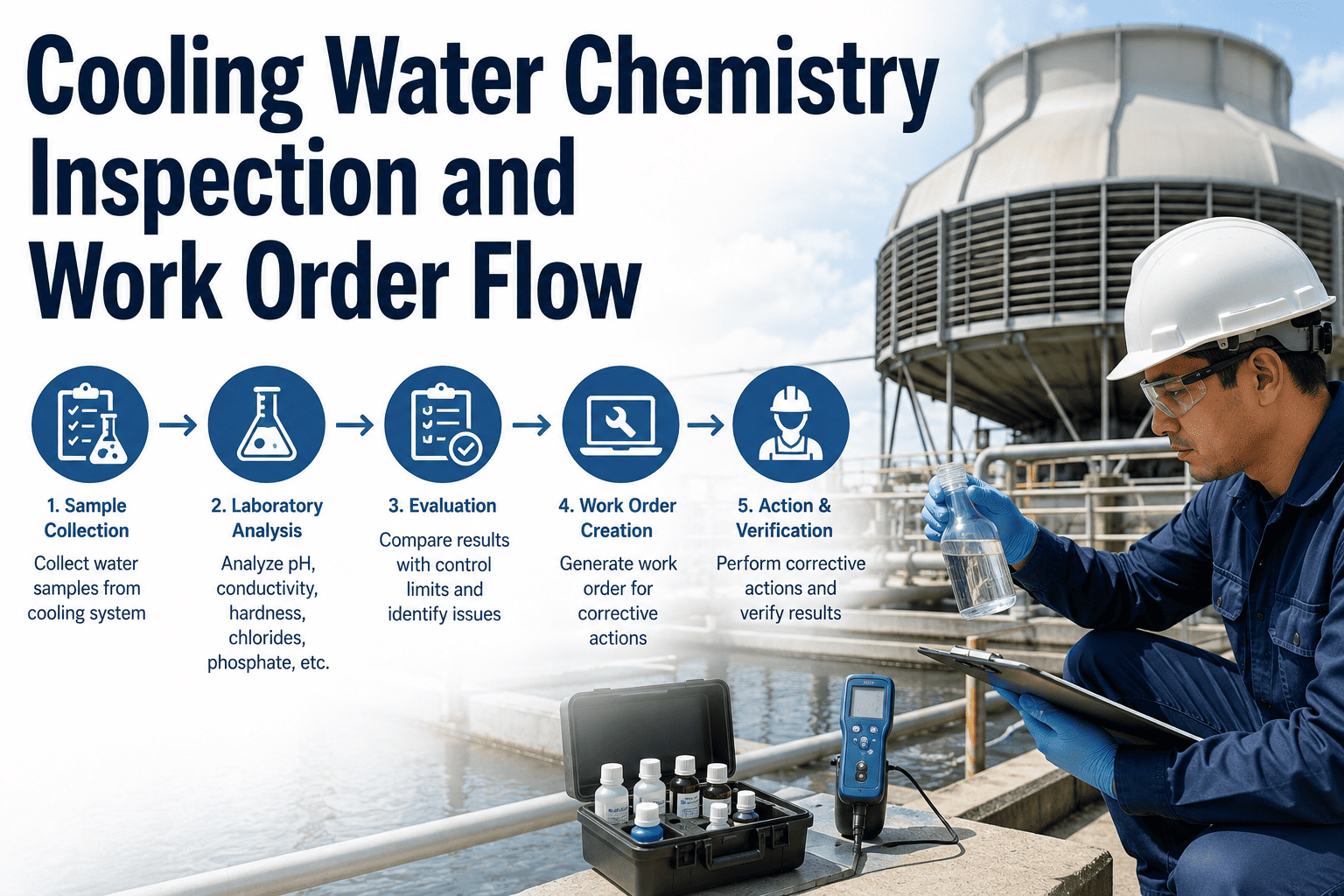
Chemistry Excursion Response Workflow
1
Out-of-Limit Reading Detected
Operator records reading in OxMaint digital chemistry log. Platform compares value against defined control limits for this parameter and sampling point. Any value outside the limit triggers automatic excursion flag.
2
Excursion Classified by Severity
Platform classifies the excursion as Advisory (within action limit), Actionable (between action and critical limit), or Critical (beyond critical limit). Classification drives the work order priority and notification routing.
3
Work Order Auto-Generated
OxMaint creates a corrective work order with the out-of-limit value, the parameter, the sampling point, and the recommended corrective action pre-populated from the response matrix. Critical excursions notify the shift supervisor immediately.
4
Corrective Action Taken and Verified
Technician completes the corrective action — dosing adjustment, blowdown increase, biocide shock dose, or make-up water quality correction. Action documented in the work order with before/after chemistry values.
5
Verification Sampling and Work Order Closure
Return-to-limit reading recorded and attached to the original work order. Work order closed with verified in-control status. Excursion record remains in the chemistry history for trend analysis and OEM / regulatory review.
From out-of-limit chemistry reading to closed work order — automated in OxMaint
OxMaint eliminates the gap between a chemistry excursion and corrective action. Every out-of-limit reading creates a tracked work order. Every corrective action is documented. Every chemistry trend is visible in one dashboard — by parameter, by system, or by week.
Chemistry Control Limits Quick Reference
| Parameter |
System |
Normal Range |
Action Limit |
Critical Limit |
Work Order Priority |
| pH |
Open recirculating |
7.0–9.0 |
<6.8 or >9.2 |
<6.5 or >9.5 |
Critical: Immediate |
| Conductivity |
Open recirculating |
Per CoC design limit |
>110% of design CoC |
>125% of design CoC |
Actionable: 24 hours |
| Free chlorine |
Open recirculating |
0.5–1.0 ppm |
<0.3 ppm |
<0.1 ppm |
Critical: Immediate biocide dose |
| Legionella (culture) |
Cooling tower water |
<100 cfu/L |
100–1,000 cfu/L |
>1,000 cfu/L |
Critical: Hyperchlorination + report |
| pH |
Closed CCW loop |
8.0–10.0 |
<7.8 or >10.2 |
<7.5 or >10.5 |
Actionable: 48 hours |
| Nitrite inhibitor |
Closed CCW loop |
800–1,200 ppm |
<600 ppm or >1,500 ppm |
<400 ppm |
Actionable: Dose within 24 hours |
| Cation conductivity |
Condensate / feedwater |
<0.2 µS/cm |
0.2–0.3 µS/cm |
>0.3 µS/cm |
Critical: Load reduction / source investigation |
| Dissolved oxygen |
Feedwater |
<7 ppb (with scavenger) |
7–20 ppb |
>20 ppb |
Critical: Deaerator and scavenger dose check |
Frequently Asked Questions
Why is daily chemistry sampling necessary for power plant cooling water systems?
Open recirculating cooling water chemistry changes continuously as the plant load varies, ambient temperature shifts, and evaporative losses concentrate dissolved solids. A chemistry excursion that develops over 12 hours can produce enough scale or biofouling growth to measurably reduce condenser heat transfer efficiency — which shows up as a backpressure rise and MW derate before the next scheduled weekly sampling would catch it. Legionella risk is a second critical driver: regulatory frameworks in most jurisdictions require evidence of daily biocide residual monitoring. Daily sampling also creates the trend data that enables the water treatment chemical supplier to optimise dosing programmes before problems develop, rather than responding to failures. OxMaint makes daily logging as fast as possible with mobile data entry and automatic comparison against control limits.
Configure your cooling water chemistry programme in OxMaint — free trial available.
What are cycles of concentration and how should they be controlled?
Cycles of concentration (CoC) measures how many times more concentrated the recirculating water is compared to make-up water, calculated as the conductivity ratio. Because cooling towers lose water to evaporation but retain dissolved solids, running at higher cycles reduces make-up water and chemical consumption — but concentrating calcium hardness, silica, and alkalinity beyond system limits causes calcium carbonate and silica scale on heat exchanger tubes. The design CoC limit is set based on the Langelier Saturation Index (LSI) for the system water chemistry: an LSI above +0.5 at operating temperature indicates scaling tendency. Most open recirculating cooling systems in power plants operate at 3–5 cycles. Blowdown rate is the primary control — automated blowdown conductivity controllers maintain CoC within limits continuously. OxMaint tracks daily conductivity measurements and flags when the calculated CoC exceeds the design limit.
How is Legionella risk managed in power plant cooling towers?
Legionella pneumophila proliferates in water between 20°C and 50°C with inadequate biocide treatment — conditions that describe most power plant cooling towers during normal operation. Risk management requires a documented water management programme (WMP) per ASHRAE 188 or local regulatory equivalent, covering: daily biocide residual monitoring, monthly microbiological sampling, quarterly Legionella culture testing, and periodic hyperchlorination. When Legionella culture results exceed 1,000 cfu/L, most jurisdictions require immediate hyperchlorination, retesting within 48 hours, and notification to the local public health authority. OxMaint tracks biocide residual readings daily, schedules quarterly Legionella sampling as a recurring work order, and maintains the WMP record required for regulatory inspection.
Book a demo to see Legionella risk management workflows in OxMaint.
What chemistry parameters should a closed cooling water (CCW) system monitor?
Closed cooling water systems for power plant auxiliary equipment — lube oil coolers, generator air coolers, exciter coolers — are filled once and recirculated indefinitely, so chemistry changes slowly but can reach damaging levels without detection if monitoring is infrequent. Key parameters are pH (target 8.0–10.0 to suppress corrosion of mixed metallurgy systems), corrosion inhibitor concentration (nitrite-based: 800–1,200 ppm; molybdate-based: 50–100 ppm), dissolved oxygen (should be minimal in a properly de-aerated and sealed system), and microbiological activity. Quarterly corrosion coupon retrieval provides the most direct evidence of actual corrosion rate — coupons installed in the system for 90 days are weighed and inspected to calculate mils per year corrosion. Any CCW system with a corrosion rate above 1 mpy (mild steel) requires programme review.
How does OxMaint handle chemistry excursions and work order generation?
When a chemistry reading entered in OxMaint falls outside the defined control limit for that parameter and sampling point, the platform automatically creates an excursion record and generates a corrective work order with the out-of-limit value, severity classification, recommended action, and target completion time pre-populated from the plant's response matrix. Advisory excursions generate a monitoring work order for follow-up sampling within 24 hours. Actionable excursions create a corrective dosing or blowdown work order with a 24-hour completion window. Critical excursions — such as low biocide residual or elevated Legionella — notify the shift supervisor and chemistry manager in real time and create an immediate-priority work order. All excursion records, corrective actions, and return-to-limit verifications are stored in a searchable chemistry log that satisfies OEM warranty requirements, environmental permit records, and insurance audit documentation.
Build a Chemistry-Driven Maintenance Programme for Your Power Plant Cooling Systems
OxMaint connects chemistry readings, control limits, excursion workflows, and corrective work orders in one platform — giving power plant water chemistry teams a complete digital record from daily sampling through equipment protection and regulatory compliance.