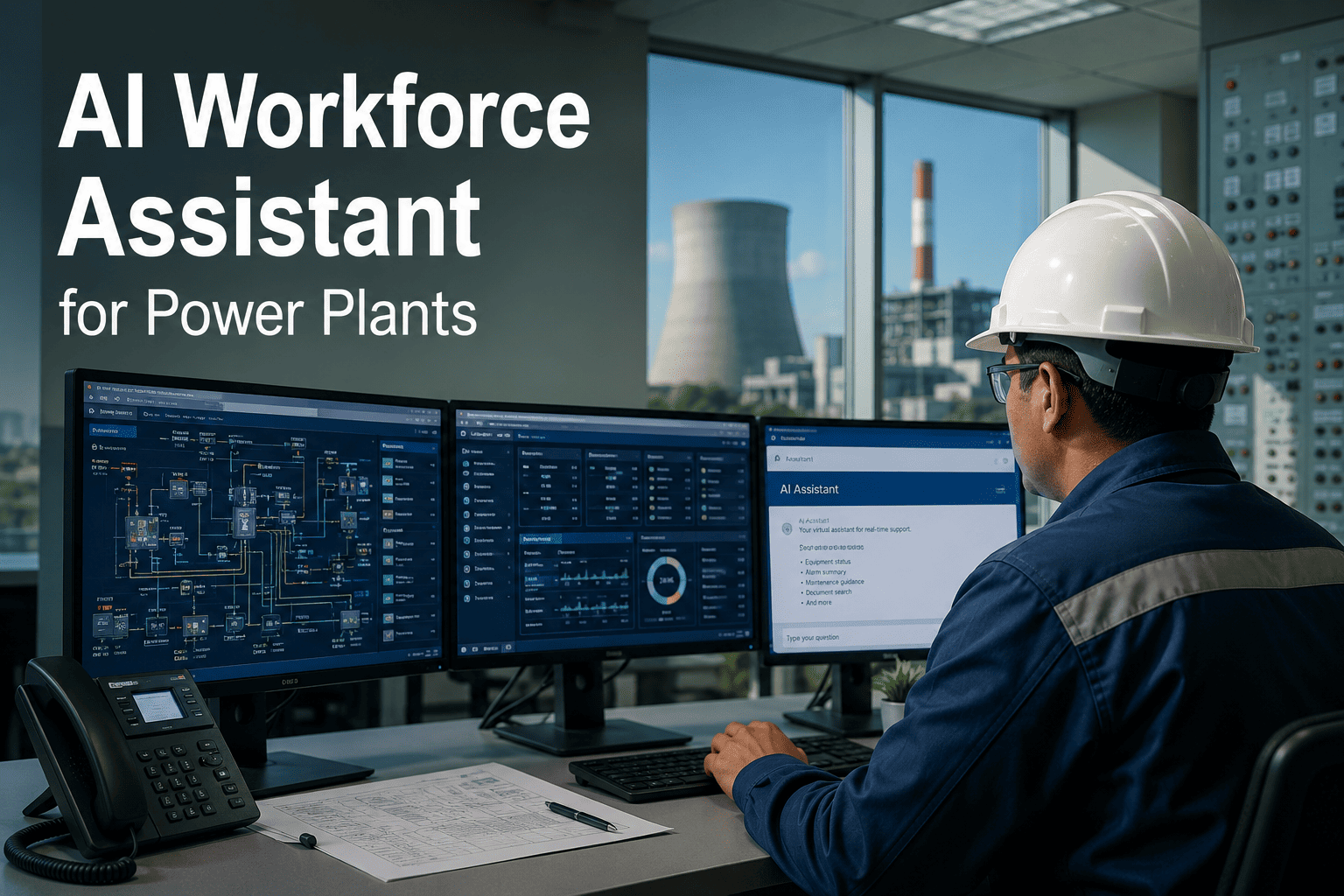
The average maintenance technician at a power plant spends a surprising share of every shift not turning wrenches but hunting — for the right procedure, the torque spec on a bolt pattern, the last inspection history on a transformer, or which spare part is actually in stock. That lost time compounds across a workforce that is shrinking as experienced staff retire faster than they can be replaced. An AI assistant embedded directly in the maintenance workflow closes that gap by surfacing answers the moment a technician needs them, instead of sending them back to a binder or a senior engineer's memory. OxMaint's AI workforce assistant puts that capability directly into the hands of every technician on the floor.
The Real Productivity Drain Nobody Tracks
Time and motion studies on maintenance crews consistently find that wrench time — the actual hands-on work fixing equipment — makes up a smaller share of the shift than most plant managers assume. The rest disappears into searching for documentation, walking back to find parts, and waiting on someone more experienced to confirm a procedure. None of that shows up on a work order, which is exactly why it never gets fixed.
35%
Typical wrench-time share of a maintenance technician's shift
20%
Of shift time lost searching for procedures and documentation
15%
Lost walking back and forth for parts and tools
What an AI Workforce Assistant Actually Does
Rather than being a generic chatbot bolted onto the CMMS, OxMaint's assistant is trained on the plant's own asset history, manuals, and past work orders, so the answers it gives are specific to the equipment in front of the technician — not a generic manufacturer FAQ.
A Typical Field Interaction
Technician
What's the torque spec for the coupling bolts on Pump 14, and when was it last serviced?
Assistant
Pump 14 coupling bolts: 85 Nm per the OEM manual. Last service was 47 days ago — bearing replacement, no anomalies noted. Open work order WO-2291 is currently linked to this asset.
Technician
Is there a spare seal kit on site?
Assistant
Two seal kits in stock at Warehouse B, bin 14-C. Reserved automatically against this work order — ready for pickup.
Where the Assistant Plugs Into the Maintenance Workflow
The assistant is most useful not as a standalone tool but woven into the moments where a technician would otherwise stop and search for something. OxMaint surfaces it at four specific points in the daily workflow.
1
Pre-Job Briefing
Pulls the relevant procedure, safety precautions, and asset history before the technician even walks to the equipment.
2
On-Asset Troubleshooting
Answers spec and history questions in real time using the mobile app, without needing to call a supervisor.
3
Parts & Inventory Lookup
Checks stock, reserves parts against the work order, and flags substitutes when the exact part is unavailable.
4
Closeout Documentation
Drafts the work order closeout notes from technician input, cutting paperwork time at the end of the job.
Give Every Technician a Senior Engineer in Their Pocket
New hires reach competency faster, experienced staff spend less time answering repeat questions, and institutional knowledge stops walking out the door at retirement.
Solving the Knowledge Transfer Problem
Power plants are losing institutional knowledge faster than they can replace it, as technicians with decades of equipment-specific experience retire without a structured way to pass that knowledge on. An AI assistant trained on historical work orders effectively captures that tribal knowledge before it disappears, then makes it available to every new hire from day one.
From Tribal Knowledge to Searchable Asset Memory
01
Historical Work Order Ingestion
Years of closed work orders, technician notes, and inspection findings are indexed against each specific asset.
02
Pattern Recognition Across Repairs
Recurring failure patterns and the fixes that worked are surfaced automatically when a similar symptom appears again.
03
Conversational Access for Any Technician
Any technician, regardless of tenure, asks a question in plain language and gets an answer grounded in the plant's own repair history.
What Plants Report After Deploying an AI Assistant
The clearest early wins show up in onboarding speed and reduced supervisor interruptions, with measurable wrench-time gains following once technicians build trust in the tool.
40%
Faster ramp-up time for new technicians
25%
Reduction in supervisor interruptions for routine questions
12%
Increase in measured wrench-time per shift
Frequently Asked Questions
Does the assistant need months of historical data before it becomes useful?
No, it provides immediate value from OEM manuals and standard procedures on day one, then becomes progressively more specific to your plant as historical work orders are ingested. Most plants see the assistant giving asset-specific answers within the first few weeks of rollout, with accuracy improving steadily after that.
Can technicians trust the answers without double-checking everything?
The assistant always cites the source it pulled from, whether that is a specific manual page, a past work order, or an inspection record, so technicians can verify rather than blindly trust.
OxMaint is designed to support technician judgment, not replace it.
Does this work offline in areas of the plant with poor connectivity?
Core procedure and spec lookups are cached locally on the mobile app for offline access, while live inventory and work order updates sync once connectivity is restored. This is a common requirement in large industrial sites with metal structures that block signal in certain areas.
Will this replace the need for experienced senior technicians?
No, the goal is to reduce repetitive interruptions so senior staff can focus their expertise on the genuinely complex problems that need human judgment, not to replace that judgment. Plants typically see senior technicians spending more time mentoring and less time answering routine spec lookups.
How is this different from a standard search function in our existing CMMS?
Standard search returns a list of documents that match keywords, while the assistant understands the question in context and returns a direct answer pulled from the relevant source, often combining information from multiple records.
Book a demo to see the difference on your own asset data.
Equip Your Workforce Before the Knowledge Walks Out the Door
Every retiring technician takes years of plant-specific knowledge with them. Capture it now, and put it directly in the hands of the people doing the work every day.