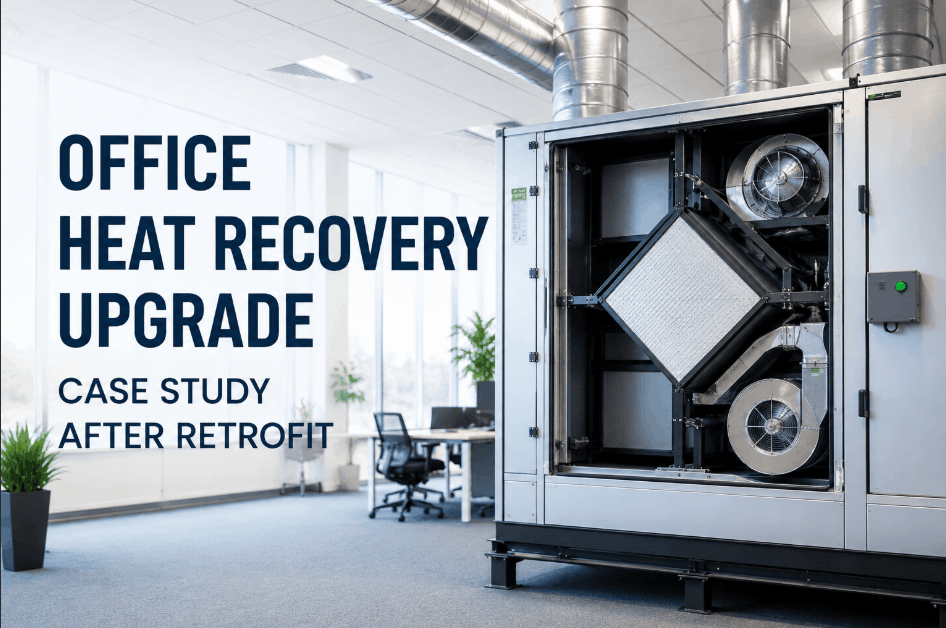
Heat recovery in commercial office buildings is one of the highest-leverage energy strategies available to facility engineers — but its value depends entirely on how well the recovered heat exchange equipment is maintained and tracked after installation. A multi-tenant office building completed a significant heat recovery ventilator upgrade targeting reduced utility spend and improved seasonal comfort, then discovered months later that the expected gains had not materialized. Without structured post-retrofit performance tracking, degraded heat exchanger efficiency, fouled media, and misaligned bypass dampers went undetected — and the investment failed to deliver its projected return. If your office building engineering team is managing heat recovery equipment without condition-based maintenance records and post-retrofit performance benchmarking, Sign Up Free to see how Oxmaint structures post-retrofit HVAC performance management for commercial buildings — or Book a Demo with a commercial facility efficiency specialist.
Heat Recovery · Retrofit Validation · Utility Spend · Comfort Stability
Stop Letting Heat Recovery Upgrades Underdeliver and Start Validating Post-Retrofit Performance With Condition-Based Maintenance Tracking
Post-retrofit performance benchmarking, heat exchanger condition logs, bypass damper inspection checklists, seasonal efficiency tracking, and utility spend monitoring — Oxmaint helps office building teams protect heat recovery investments and sustain energy gains through structured maintenance records.
Facility Profile
The Operation: Multi-Tenant Commercial Office Building With Heat Recovery Retrofit and No Post-Installation Performance Verification
Facility Overview
IndustryCommercial real estate — multi-tenant Class A office building with central air handling and rooftop heat recovery ventilators
Scope18-story office tower, 14 heat recovery ventilator units, 6 primary air handling units serving 32 tenant floors
Team6 building engineers, 2 HVAC technicians, 1 energy and sustainability manager
Prior SystemManufacturer commissioning report filed at installation, no ongoing performance tracking, paper service log by date
Oxmaint FeaturesAsset-Level HRV Tracking · Post-Retrofit Performance Benchmarking · Heat Exchanger Condition Logs · Bypass Damper Inspection Checklists · Seasonal Efficiency Records · Utility Spend Linking · PM Scheduling · Work Order Management
Baseline Performance Gaps
34%
Gap between projected post-retrofit energy savings and actual utility reduction measured 8 months after HRV installation — equipment underperforming against design spec
5 of 14
HRV units found with fouled heat exchange media or misaligned bypass dampers when first structured inspection was performed — conditions degrading recovery efficiency significantly
0
Seasonal efficiency trend records per HRV unit before Oxmaint — no baseline to compare against or detect performance degradation over time
Root Cause Analysis
Why the Heat Recovery Retrofit Failed to Deliver Projected Utility Savings — and Why Comfort Instability Persisted Season to Season
A technical review of post-retrofit utility data, BAS records, and physical HRV unit conditions across the building identified four connected failures that converted a sound capital investment into an underperforming asset. The engineering team had the skills and the equipment — the failure was in post-installation tracking discipline and the absence of a structured condition monitoring framework. Sign Up Free to bring structured post-retrofit performance tracking to your office building engineering team — or Book a Demo to see how Oxmaint manages heat recovery asset performance across commercial office portfolios.
38%
No Post-Commissioning Performance Baseline Established — Retrofit Outcomes Never Benchmarked Per Unit
The manufacturer commissioning report captured startup conditions but was never translated into ongoing performance benchmarks per HRV unit. Without a per-unit efficiency baseline, there was no reference point to detect degradation — and no structured process to trigger maintenance when performance fell below design spec.
27%
Heat Exchanger Media Not Inspected on Condition-Based Schedule — Fouling Went Undetected
HRV heat exchange media was not included in any regular inspection protocol. Fouling from particulate accumulation degraded thermal transfer efficiency progressively but silently — with no inspection trigger to catch the condition before it materially reduced recovery performance across multiple units.
22%
Bypass Damper Position Not Verified at Seasonal Changeover — Incorrect Operation Persisted
Bypass dampers on several HRV units were not verified for correct position at seasonal transitions. Dampers left in incorrect positions during heating and cooling seasons were bypassing the heat exchange core entirely on affected units — eliminating recovery benefit while consuming the same fan energy.
13%
Utility Data Not Linked to HRV Performance Records — ROI Invisible to Energy Manager
Gas and electric utility data was tracked separately from maintenance records. Even when technicians serviced HRV units, there was no structured link to energy consumption trends — making it impossible for the energy manager to demonstrate savings, justify further investment, or identify which units were driving the gap between projected and actual utility reduction.
The Solution
How Oxmaint Helped the Office Building Recover Heat Recovery Performance and Sustain Utility Savings Through Structured Post-Retrofit Tracking
The building deployed Oxmaint to replace the single commissioning report with a living, asset-level performance management system for every HRV unit. Each of the 14 heat recovery ventilators was configured as a distinct asset in Oxmaint, with design recovery efficiency, commissioning baseline readings, and seasonal operating parameters recorded. Technicians began capturing heat exchanger condition ratings, bypass damper position verifications, and efficiency readings at every inspection using structured checklists. Utility consumption data was linked to HRV work orders to create a trackable connection between maintenance activity and energy performance. Seasonal changeover inspections were scheduled in Oxmaint as recurring PM tasks to ensure damper verification and media inspection occurred at every transition. Book a Demo to see how post-retrofit heat recovery performance tracking works across commercial office buildings.
01
Asset-Level HRV Performance Records With Commissioning Baseline and Ongoing Efficiency Trend
Each HRV unit was structured as a separate asset in Oxmaint with design recovery efficiency, commissioning readings, and operating parameters recorded. Inspection work orders were tied directly to each unit record, building a seasonal efficiency trend that allowed the team to detect degradation against the baseline and trigger corrective maintenance before efficiency losses compounded across multiple units.
02
Condition-Based Heat Exchanger Media Inspection on Structured Recurring Schedule
Heat exchanger media inspection was added to recurring PM work orders in Oxmaint, with technicians logging fouling condition rating and cleaning or replacement actions at each visit. The PM interval was calibrated by unit location and outdoor air intake conditions — lobby-level units with higher particulate exposure received more frequent inspection cycles than upper-floor units with cleaner intake profiles.
03
Seasonal Changeover Checklists With Bypass Damper Position Verification Per Unit
Seasonal changeover work orders were created in Oxmaint for every HRV unit, requiring technicians to verify bypass damper position, test actuator response, and record airflow measurements before and after transition. This eliminated the pattern of dampers operating in incorrect positions for entire heating or cooling seasons without detection — the single highest-impact source of performance gap on the building.
04
Utility Consumption Linking to HRV Work Orders for Energy ROI Visibility
Monthly gas and electric consumption readings were entered alongside HRV maintenance records in Oxmaint, creating a documented link between HRV condition and utility performance. The energy manager could now generate season-over-season comparisons and demonstrate the direct energy impact of maintenance interventions — providing clear ROI data for ownership reporting and capital planning submissions.
Results at 90 Days
Heat Recovery Performance, Utility Savings, and Comfort Stability Metrics Three Months After Deployment
89%
Of projected post-retrofit utility savings recovered — up from 66% of target before structured performance tracking
-74%
Reduction in HRV units operating below design recovery efficiency — from 5 of 14 degraded units to under 2 at any inspection cycle
100%
Of HRV units now tracked individually with seasonal efficiency trend and commissioning baseline — replacing a single filed report
0
Bypass dampers found in incorrect position at seasonal changeover after structured verification checklists were deployed
41%
Improvement in tenant comfort complaint frequency related to temperature instability — consistent recovery efficiency stabilized supply air conditions
2.4×
ROI on Oxmaint platform cost within 90 days from recovered utility savings and reduced comfort-related tenant service calls
| Metric |
Before Oxmaint |
90 Days After |
Change |
| Projected utility savings achieved |
66% of target — 34% gap |
89% of target recovered |
+23pts |
| HRV units below design efficiency |
5 of 14 — fouling and damper issues |
Under 2 at any inspection cycle |
-74% |
| Units with seasonal efficiency trend |
0 — commissioning report only |
100% tracked in Oxmaint |
+100% |
| Bypass dampers in incorrect position |
Unverified at seasonal changeover |
Zero at changeover — verified each cycle |
Eliminated |
| Tenant comfort complaints |
Reactive, unlinked to HRV condition |
41% reduction in temperature complaints |
-41% |
| Energy ROI visibility |
No link between maintenance and utility data |
Per-unit utility trend linked to work orders |
Achieved |
Key Business Impact
What Structured Post-Retrofit Heat Recovery Tracking Means for Commercial Office Building Operations
"Heat recovery upgrades fail to meet their energy projections far more often than engineers expect — not because the equipment doesn't work, but because nobody builds a maintenance protocol that protects the performance gains after the commissioning team leaves. A fouled heat exchanger running at 60% recovery efficiency looks identical from the BAS to one running at 90%. You only see the difference in your utility bill — months later, when the damage is already done. The moment you start tracking HRV condition per unit and linking it to energy consumption data, the gap between projected and actual savings becomes visible and fixable. Oxmaint gives building teams that structure without adding complexity to the technician's day."
Priya Navaratnam, Commercial Building Energy and HVAC Performance Specialist
17 years commercial real estate facilities engineering · Former chief engineer, Class A office portfolio, major urban market · Specialist in heat recovery system performance, post-retrofit validation, and energy ROI tracking for multi-tenant commercial buildings
Post-Retrofit Performance · Heat Recovery · Utility Savings · Comfort Stability
Protect Your Heat Recovery Investment With Structured Condition Monitoring Before Fouling and Damper Drift Erase the Utility Gains
Asset-level HRV tracking, commissioning baseline records, heat exchanger condition logs, bypass damper verification checklists, seasonal efficiency trending, and utility consumption linking — Oxmaint gives commercial office teams the post-retrofit tracking structure to sustain energy savings across every building season.
FAQs
Frequently Asked Questions
How does Oxmaint support post-retrofit heat recovery performance tracking in office buildings?
Each HRV unit is tracked as a separate asset in Oxmaint with commissioning baseline data recorded. Technicians log efficiency readings, heat exchanger condition, and damper positions at every inspection — building a seasonal performance trend that makes degradation visible and actionable before utility losses accumulate.
Can Oxmaint manage bypass damper verification at seasonal changeover across multiple HRV units?
Yes. Seasonal changeover work orders are created in Oxmaint as recurring PM tasks for each HRV unit, with structured checklists requiring damper position verification, actuator testing, and airflow measurement before the inspection can be closed.
How does Oxmaint link heat recovery maintenance records to utility spend data?
Utility consumption readings are entered alongside HRV work orders in Oxmaint, creating a documented connection between maintenance interventions and energy performance that supports ownership reporting and capital planning submissions.
Is Oxmaint suitable for buildings with mixed HRV unit types and different inspection intervals?
Yes. PM schedules in Oxmaint are configured per asset, allowing different inspection frequencies for lobby-level units with higher particulate exposure versus upper-floor units with cleaner intake conditions — all managed from a single platform.
How quickly can post-retrofit HRV tracking and seasonal inspection schedules be configured in Oxmaint?
Asset setup and PM configuration typically complete within the first week. Most building teams are capturing structured efficiency records and running seasonal changeover checklists within the first two to three weeks of deployment.
Every Inspection Is a Protected Energy Investment
Give Your Office Building the Heat Recovery Tracking Structure It Needs to Sustain Utility Savings Across Every Season After Retrofit
Oxmaint brings asset-level HRV performance records, heat exchanger condition logging, bypass damper verification, seasonal efficiency trending, and utility spend linking to commercial office facility teams — with no additional headcount required.