A building that passed commissioning on opening day is not the same building five years later. Sensors drift, dampers seize, BAS overrides accumulate, and occupancy patterns shift — quietly eroding the HVAC performance your design team once verified. LBNL research found that buildings completing retro-commissioning averaged 16% energy savings with a 1.1-year simple payback. For most facility managers, that means tens of thousands of dollars recovered annually from systems already installed and paid for. This guide covers what commissioning and retro-commissioning actually involve, when each applies, and how digital CMMS documentation locks in the gains permanently. Start documenting your commissioning findings in OxMaint — free.
16%
Average energy savings from retro-commissioning (LBNL, 100+ projects)
$0.27
Average cost per sq ft — with 15% energy savings and 0.7-yr payback (EPA ENERGY STAR)
46%
EUI reduction at Rockville District Courthouse after BAS retro-commissioning (2018–2024)
3–5 yrs
Recommended retro-commissioning cycle per Building Commissioning Association
Cx vs RCx
Commissioning vs Retro-Commissioning: Key Differences
Both processes verify that HVAC systems perform as intended — but they apply at different stages of a building's life and address different root causes of underperformance.
New Building Commissioning (Cx)
WhenDuring construction and at handover
GoalVerify systems are installed and operating per design intent
ScopeEquipment installation, controls programming, TAB, BAS sequences
OutputCommissioning report, O&M manuals, verified setpoints, training records
TriggerMandatory for LEED, ASHRAE 90.1, most green certifications
Retro-Commissioning (RCx)
WhenExisting buildings — typically 3 to 5 years after last commissioning
GoalRestore systems to design performance degraded by age, drift, or changes
ScopeBAS trend analysis, sensor calibration, control sequence audit, airflow testing
OutputFindings report, prioritised measure list with savings estimates, CMMS work orders
TriggerRising energy bills, comfort complaints, equipment over-cycling, failed audits
When RCx Is Needed
Signs Your Building Needs Retro-Commissioning Now
01
Energy bills rising steadily with no change in occupancy or equipment — systems are operating inefficiently against their own setpoints
02
Recurring occupant comfort complaints — too hot, too cold, stuffy — that maintenance teams resolve with setpoint overrides rather than root cause fixes
03
BAS showing multiple manual overrides that have never been cleared — a telltale sign of accumulated quick fixes layered over broken sequences
04
HVAC equipment cycling more frequently than expected — often caused by simultaneous heating and cooling or control hunting from drifted sensors
05
Building has not been formally tested since initial commissioning — typical performance degradation of 5–20% is statistically expected beyond year 3
06
Occupancy or use has changed since original commissioning — the BAS control strategy is now serving a building it was not configured for
The RCx Process
How a Retro-Commissioning Project Runs: Phase by Phase
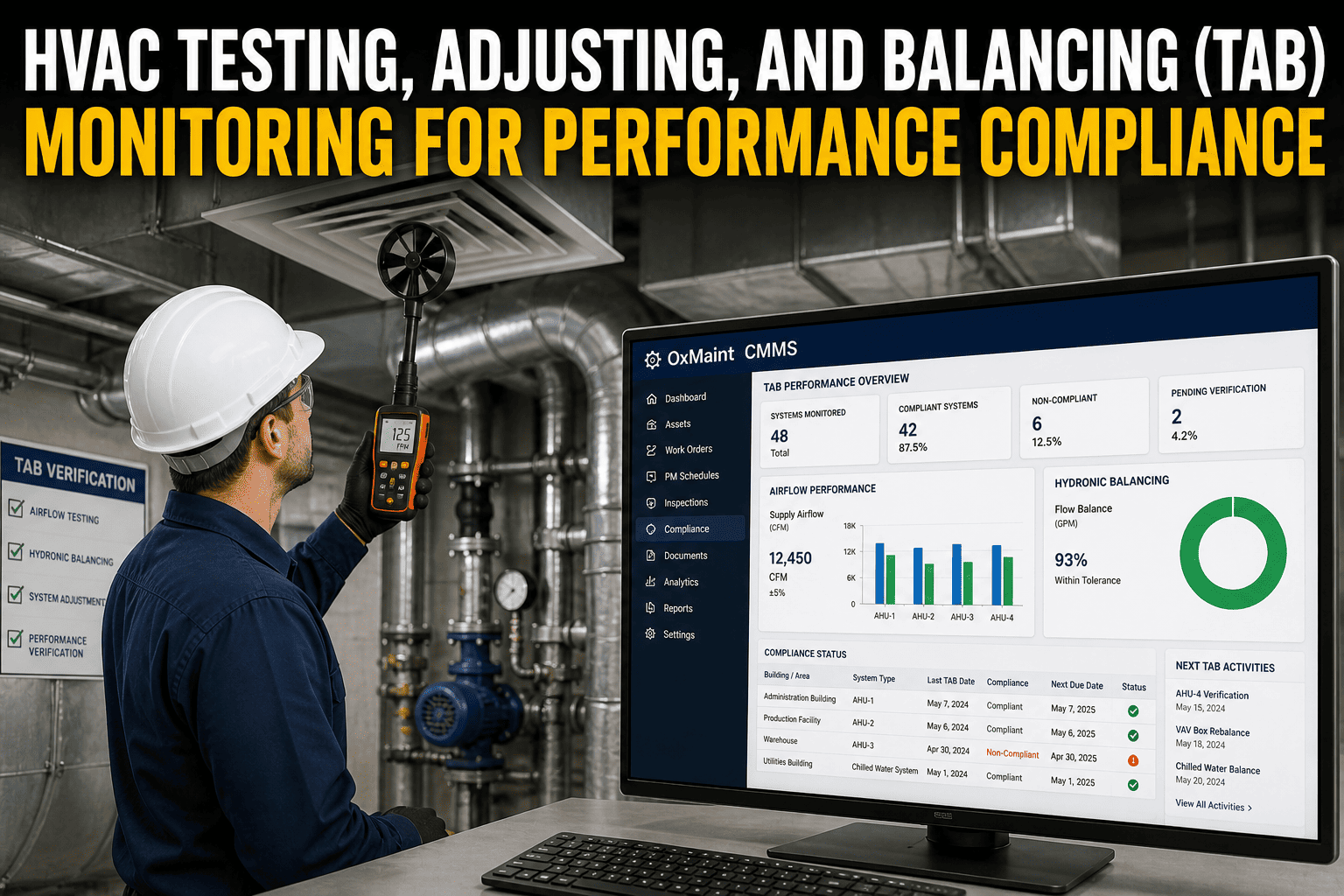
Retro-commissioning follows a structured investigation-to-implementation workflow. Each phase produces documented outputs that feed directly into your CMMS — converting findings into tracked work orders rather than PDF reports that are never actioned.
Phase 1
Planning & Data Collection
Gather as-built drawings, original commissioning reports, BAS trend logs, and utility data for 12–24 months. Map all HVAC assets, control points, and current setpoints against design-intent documentation. Identify high-energy-use systems as priority investigation targets.
Phase 2
Investigation & Functional Testing
Conduct site-level functional tests across AHUs, chillers, boilers, VAV boxes, and control sequences. Test economiser operation, verify sensor calibration with reference instruments, measure supply and return airflows, and audit BAS sequences for simultaneous heating and cooling, after-hours operation, and override accumulation.
Phase 3
Findings & Measure Development
Document all identified deficiencies with estimated energy impact and implementation cost. Rank measures by savings-to-cost ratio. Differentiate no-cost control fixes (setpoint adjustments, schedule corrections, override clearance) from low-cost repairs (sensor replacement, actuator repair) and capital measures (equipment upgrade).
Phase 4
Implementation & CMMS Documentation
Implement approved measures and verify performance through post-implementation BAS trending. Log every measure as a completed work order in OxMaint — with before/after setpoints, verified outcomes, and scheduled re-verification dates. This creates the audit trail required for ENERGY STAR, LEED O+M, and local energy benchmarking compliance.
Functional Testing
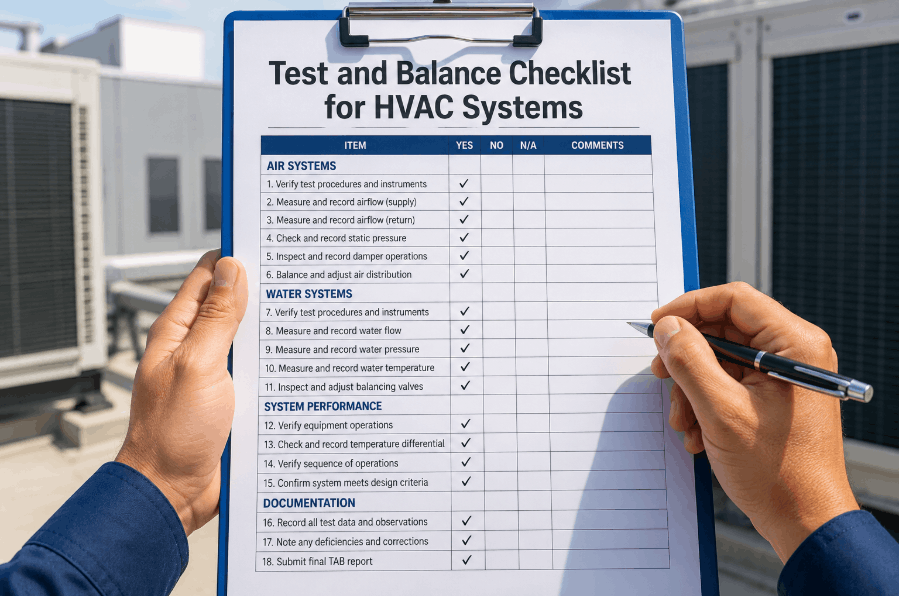
Core Functional Tests in Every Commissioning Scope
| Test |
System |
What is Verified |
Common Finding |
| Supply Air Temperature Reset |
AHU |
SAT varies correctly with load; reset schedule matches design |
Fixed SAT — no reset programmed or disabled |
| Economiser Sequence Test |
AHU, RTU |
Damper opens on enthalpy/temperature signal; lockout operates correctly |
Damper stuck or logic disabled after maintenance event |
| VAV Box Minimum Airflow |
VAV System |
Min. airflow setpoints meet ventilation code; reheat sequences correct |
Minimums set too high — over-ventilating unoccupied zones |
| Chilled Water Reset |
Chiller Plant |
CHWS temp floats upward at low load; not fixed at design day setpoint |
Fixed setpoint — chiller running 2–4°C colder than load requires |
| Sensor Calibration Verification |
All Systems |
Temperature, pressure, CO₂ sensors checked against reference instruments |
Drift of 1–3°C common after 3 years — driving incorrect control decisions |
| Occupancy Scheduling Audit |
BAS |
HVAC operating hours match current occupancy patterns |
Systems running 2–4 hrs past occupancy — common after schedule changes |
Real Results
Retro-Commissioning in Practice: What Buildings Actually Save
Rockville District Courthouse
167,000 sq ft — Maryland, USA
46% EUI reduction
BAS operating in manual mode for years. After RCx and BAS upgrade, the building cut gas consumption from 98,815 Therms/year to design levels. Savings tracked from 2018 to 2024.
Salt Lake City Public Safety Building
Net-zero target building — Utah, USA
$68,000/yr saved
FDD identified simultaneous heating and cooling, over-ventilation, and after-hours AHU operation. Control optimisation cut electricity by 300,000 kWh and gas by 4,800 dekatherms annually.
Vista Peak Preparatory School
Aurora, Colorado — K-12 facility
20% EUI reduction
14-month recommissioning of HVAC systems projected to deliver $54,000 in annual energy cost savings through control optimisation — no equipment replacement required.
OxMaint tracks every commissioning finding, work order, and verified outcome — creating the audit trail your compliance team needs and the performance data your operations team uses.
Expert Perspective
What Commissioning Professionals See in the Field
"The most consistent finding in every retro-commissioning project I have led is the BAS override accumulation problem. Operators patch a comfort complaint with a setpoint override, never clear it, and within two years the BAS is running on 30% manual control. The automation the owner paid for has effectively been switched off, one override at a time."
Commissioning Project Manager, BCxP certified — 17 years in BAS and HVAC commissioning
"Retro-commissioning consistently uncovers three to five times more savings than the building owner expected. The reason is simple — nobody has looked at the BAS sequences rigorously since day one. Sensor drift alone, at 1 to 2 degrees on a chilled water supply sensor, can cost a 200,000 sq ft building $30,000 to $50,000 annually in unnecessary chiller energy."
Senior Energy Engineer, LEED AP BD+C — building performance optimisation, 14 years experience
CMMS Role
Why CMMS Documentation Defines Long-Term Commissioning Success
Most retro-commissioning savings erode within 18–24 months without a system to maintain them. Setpoints drift back, overrides re-accumulate, and replaced sensors go uncalibrated. OxMaint prevents regression by converting commissioning outputs into living maintenance records — not static PDFs.
01
Setpoint Register
Every verified setpoint logged against its asset with commissioning date, value, and next verification due — preventing undocumented changes from eroding system performance.
02
Calibration Schedules
Sensors flagged during RCx are registered with calibration frequency and tolerance limits. OxMaint auto-generates calibration work orders on schedule — before drift causes control errors.
03
Compliance Audit Trail
Every functional test result, finding, and corrective work order is time-stamped and linked to the specific asset — providing the documented evidence ENERGY STAR, LEED O+M, and local benchmarking laws require.
04
Re-Commissioning Triggers
OxMaint tracks time since last commissioning per asset and flags systems approaching the 3–5 year re-commissioning window — so the next RCx cycle is planned, not reactive.
FAQs
Frequently Asked Questions
What is the difference between retro-commissioning and recommissioning?
Retro-commissioning applies to buildings that have never been formally commissioned or whose original commissioning records are unavailable. Recommissioning applies to buildings that have been commissioned before — the process is faster because baseline documentation already exists. Both achieve the same goal: restoring HVAC systems to verified design performance.
OxMaint stores commissioning history to make every future cycle faster.
How long does a retro-commissioning project take?
For a typical commercial building of 50,000–200,000 sq ft, the investigation phase takes 4–8 weeks, followed by 2–4 weeks for measure development and owner review. Implementation of no-cost and low-cost measures usually completes within 3 months. Capital measures follow a separate project timeline. Total project duration from kick-off to verified savings is typically 3–6 months.
Book a demo to see how OxMaint tracks RCx progress in real time.
Does retro-commissioning require equipment replacement?
The majority of RCx measures are operational and controls-based — setpoint corrections, schedule optimisation, sensor recalibration, override clearance, and sequence fixes — requiring no capital expenditure. Equipment replacement may be identified as an opportunity but is separate from the RCx scope. This is why the payback period is so short: savings come from better operation of systems already installed.
OxMaint documents both low-cost fixes and capital recommendations in one system.
How does OxMaint support HVAC commissioning documentation?
OxMaint provides a CMMS framework that converts commissioning outputs — functional test results, verified setpoints, sensor calibration records, and corrective work orders — into structured, searchable asset records. Every finding is linked to a specific piece of equipment with a timestamped resolution record, creating the compliance documentation required for ENERGY STAR, LEED O+M, and local energy benchmarking ordinances. Scheduled re-verification tasks prevent savings from eroding between commissioning cycles.
Book a demo to see the commissioning workflow.
Restore Design Performance. Document Every Gain.
OxMaint turns retro-commissioning findings into work orders, compliance records, and scheduled re-verification tasks — so savings last beyond the report.