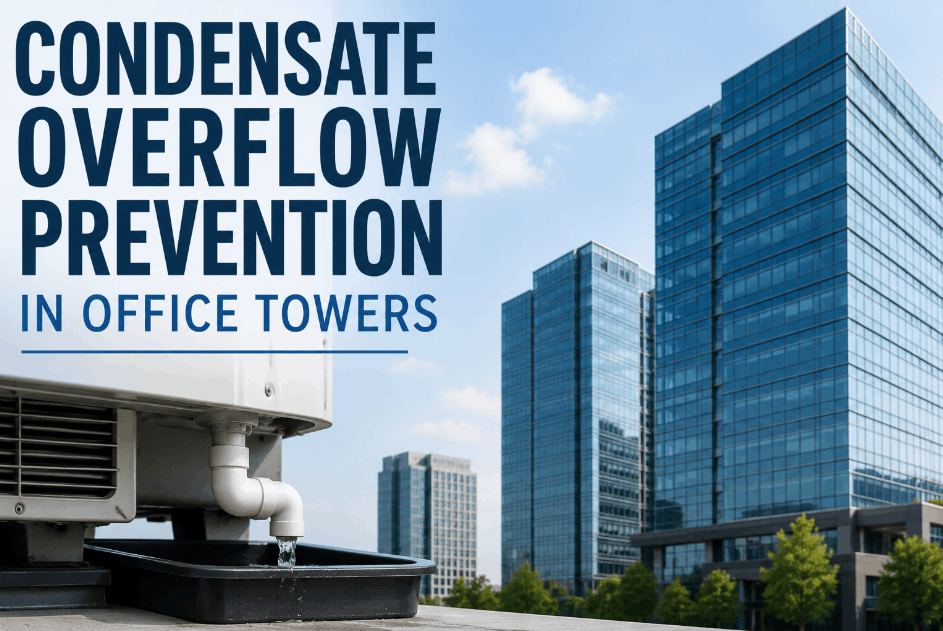
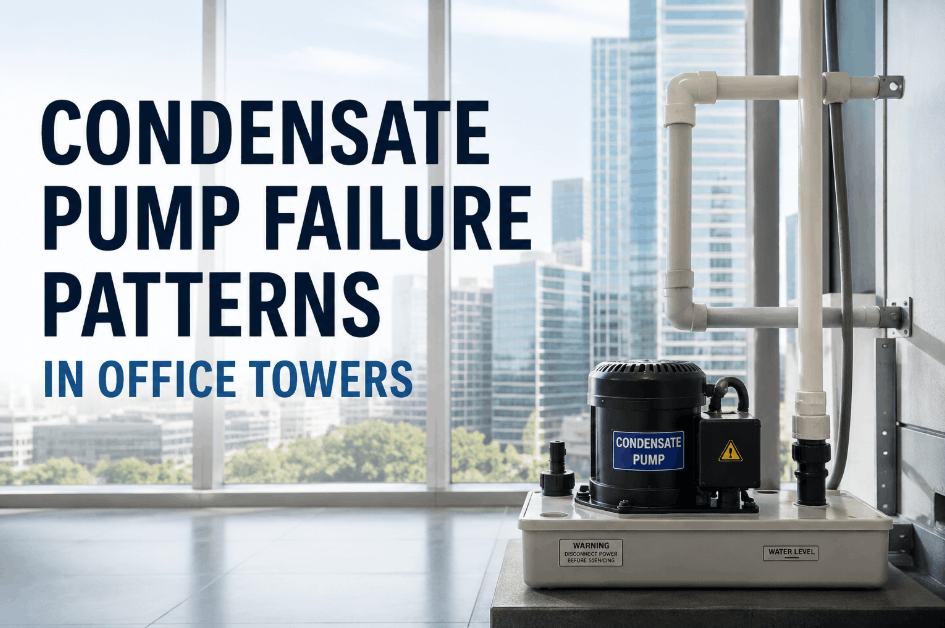
Condensate overflow in office towers is one of the most preventable sources of ceiling damage, mold risk, and tenant complaints in commercial HVAC operations. When drain pans fill faster than drain lines can clear — due to blocked traps, incorrect slope, or failed condensate pumps — water finds the path of least resistance through ceiling tiles, light fixtures, and structural cavities. Sign Up Free to start logging drain inspection findings, tracking pump performance, and linking condensate overflow events to maintenance records in OxMaint before water damage becomes a tenant escalation. Book a Demo to see how OxMaint structures condensate management for facility teams responsible for HVAC systems across multiple floors and zones in office buildings.
Facility Operations · HVAC Maintenance · 2026
Condensate Overflow Prevention in Office Towers
Check drains, traps, slopes, and pump operation before condensate leaks damage ceilings, disrupt tenants, and trigger costly remediation in office tower HVAC systems.
42%Of office tower water damage events originate from condensate drain failure
−31%Overflow incident reduction when drain inspection is structured and scheduled
5×Faster drain fault escalation with automated alerts vs. reactive tenant calls
94%Preventive maintenance compliance when condensate checks are CMMS-managed
Where Condensate Overflow Risk Builds in Office Tower HVAC
Condensate failure points are distributed across every floor of an office tower — in fan coil units, AHU drain pans, and condensate pump stations that each require independent inspection and maintenance. The six failure patterns below represent the most common diagnostic gaps in commercial building HVAC operations — and the points where OxMaint's inspection workflows and fault detection give facility teams a structured view before water reaches ceiling tiles. Sign Up Free to configure OxMaint's condensate management workflow for your office tower and start mapping drain inspection findings against floor-by-floor HVAC asset records.
01
Blocked Condensate Drain Lines
Risk Window: High-humidity cooling season
High RiskAlgae, debris, and sediment accumulate in drain lines over weeks of summer operation, restricting flow until drain pans overflow. Most blockages go undetected until water appears at ceiling level below.
02
Failed or Dry Condensate Traps
Risk Window: Post-shutdown restart
Transition RiskTraps that dry out during off-season shutdowns allow air into drain lines, breaking the siphon required for positive drainage. On restart, condensate backs up into the pan before proper flow is re-established.
03
Incorrect Drain Pan Slope
Risk Window: Standing water accumulation
Installation GapAHU and fan coil unit drain pans that are not pitched toward the drain outlet accumulate standing water even when lines are clear — creating a reservoir that overflows under peak condensate load without any blockage present.
04
Condensate Pump Failure
Risk Window: High-load periods
Largest VariableUnits positioned below drain elevation depend entirely on condensate pumps. A failed float switch, seized impeller, or broken discharge line produces a full pan overflow within hours of failure — often during peak summer cooling demand.
05
Drain Pan Corrosion and Cracking
Risk Window: Older unit inventory
Condition GapMetal drain pans in older fan coil units corrode through at weld seams and corners — producing slow leaks that saturate insulation and ceiling structure before any standing water is visible at the unit level.
06
Inspection Documentation Gap
Risk Window: Between PM cycles
Prevention InputDrain pan and trap checks performed during scheduled PM visits are often not logged with enough detail to identify trend deterioration — so progressive blockage goes undetected between inspection cycles.
Condensate Management — Without vs. With OxMaint
The difference between reactive condensate management and a structured CMMS-supported inspection workflow is measurable in leak incidents, ceiling damage costs, and tenant satisfaction. The comparison below shows what changes when OxMaint structures drain inspection logging, pump monitoring, and preventive maintenance scheduling for office tower HVAC operations. Book a Demo to walk through your office tower's current condensate management structure and identify the gaps OxMaint can close.
Condensate Overflow Prevention Maturity — Where Does Your Tower Score?
Condensate management maturity in office towers ranges from entirely reactive — maintenance teams respond to tenant complaints after ceilings are damaged — to fully structured preventive monitoring with scheduled inspections, pump testing, and mandatory root cause documentation. The maturity framework below maps where your building's current maintenance structure sits. Book a Demo to assess your condensate management maturity with an OxMaint solutions engineer.
Condensate Overflow Prevention Maturity
Score 5 = CMMS-structured preventive inspection · Score 1 = fully reactive response
5
Full Inspection Map · CMMS-Integrated · Automated Alerts
All drain pans, traps, slopes, and pumps on structured inspection schedule. Overflow alerts automated. Pan condition trends tracked per unit. Root cause documented at every incident close.
Profile: Condensate overflow is a prevented event, not a discovered one. Ceiling damage is systematically avoided through scheduled inspection and trend-based maintenance planning.
4
Structured Inspection · Partial Condition Capture
Drain pans and pumps on PM schedule. Blockage incidents documented. Pan condition logged inconsistently — slope verification and float switch testing not standard across all units.
Action: Standardize inspection checklists to include slope and pump testing on every visit. Condition consistency is where prevention is built.
3
Annual PM Inspection · Reactive Between Visits
Condensate systems checked at annual service only. Overflow incidents between visits escalated verbally. Findings not transferred to asset records or trend analysis.
Gap: Annual-only inspection misses seasonal blockage buildup. Quarterly drain flush and pump test schedule is the highest-impact next step.
2
Tenant-Complaint Driven Response
Condensate issues identified through tenant water damage reports. No structured inspection between annual service visits. Same units overflow repeatedly without increased maintenance frequency.
Risk: Overflow exposure accumulates invisibly. Ceiling damage and remediation costs are discovered after the fact — not prevented.
1
No Condensate Monitoring Structure
Drain pans and pumps not included in structured PM program. Overflow events undocumented. Maintenance intervals fixed by calendar regardless of unit age, load, or previous failure history.
Risk: Every cooling season adds untracked overflow exposure. Ceiling damage is a function of luck, not maintenance design.
Prevent Condensate Overflow Before It Becomes a Ceiling Repair.
OxMaint structures drain inspection scheduling, pump condition tracking, and overflow root cause documentation for office tower facility teams managing HVAC systems across every floor.
How OxMaint Structures Condensate Overflow Prevention
OxMaint connects drain inspection scheduling, pump monitoring, and maintenance planning into a single workflow for office tower facility teams. Every condensate-related fault becomes a documented maintenance record — with root cause captured, PM frequencies adjusted, and high-risk units flagged for increased attention before overflow damages ceilings and disrupts tenants. Sign Up Free to configure OxMaint's condensate management workflow for your office tower. Book a Demo to see how OxMaint adapts to your building's HVAC asset inventory, floor layout, and maintenance team structure.
Drain Inspection Scheduling
Per Unit · Per Floor
Structured drain pan and trap inspection on defined frequency
OxMaint schedules drain pan flush, trap check, and slope verification tasks per unit on quarterly or seasonal cycles — replacing the annual-only inspection that misses peak-season blockage buildup.
Pump Condition Monitoring
Float · Impeller · Discharge
Condensate pump operational check on structured schedule
OxMaint creates pump test tasks with float switch, impeller, and discharge line verification per unit — ensuring pump failure modes are caught on a maintenance visit, not when a pan overflows into the ceiling below.
Pan Condition Trending
Condition Rating Per Visit
Pan corrosion and crack progression tracked across inspection cycles
OxMaint logs pan condition ratings per asset each visit — surfacing progressive corrosion trends that allow pan replacement to be planned before failure, rather than discovered after a slow-leak ceiling event.
Root Cause Closure
Every Overflow Incident
Prevention trigger captured at incident close
CMMS closure requires root cause entry on every condensate overflow work order. Completion automatically increases PM frequency for affected units and flags high-overflow-risk floors for priority attention.
"
We had condensate overflow events on floors 14 through 18 every summer — always the same units, always the same blocked drain lines. The problem was that between annual PM visits, nothing was logged, so each event looked like an isolated incident. After configuring OxMaint's drain inspection workflow with quarterly flush tasks and pump tests, we caught three drain line restrictions and one failed pump float in the first three months. No ceiling events that summer for the first time in four years.
Chief Engineer — 32-Floor Commercial Office Tower, Kuala Lumpur, Malaysia
Frequently Asked Questions
What causes condensate overflow in office tower HVAC systems?
The most common causes are blocked drain lines, failed condensate pump float switches, dry or improperly installed drain traps, and drain pans not sloped toward the drain outlet. Each failure mode produces overflow at different rates but all result in water reaching ceiling structure and tiles below.
How often should condensate drains be inspected in office towers?
Quarterly inspection at minimum during cooling season, with drain line flush and pump test at each visit. High-load units on lower floors or units with previous overflow history should be inspected monthly during peak summer demand.
How does OxMaint help prevent condensate overflow before damage occurs?
OxMaint schedules structured drain and pump inspection tasks per unit, logs condition ratings at each visit, and routes fault alerts when overflow sensors trigger — replacing the reactive tenant-complaint detection model with a preventive maintenance workflow.
Can OxMaint track which floors and units have the highest overflow risk?
Yes. OxMaint maps overflow incident history per asset and floor — identifying high-frequency problem zones and automatically adjusting inspection frequency for units with repeat fault records.
Does OxMaint support multi-floor HVAC asset management in office buildings?
OxMaint manages HVAC assets across every floor of a building with per-unit work order tracking, floor-level PM scheduling, and building-wide fault reporting — deployable without hardware changes to existing BAS or building management systems.
Turn Every Drain Inspection Into a Structured Prevention Record — Not a Missed Overflow.
OxMaint schedules condensate drain inspections, tracks pump condition trends, and enforces root cause documentation — preventing ceiling damage at the HVAC units that need it most.