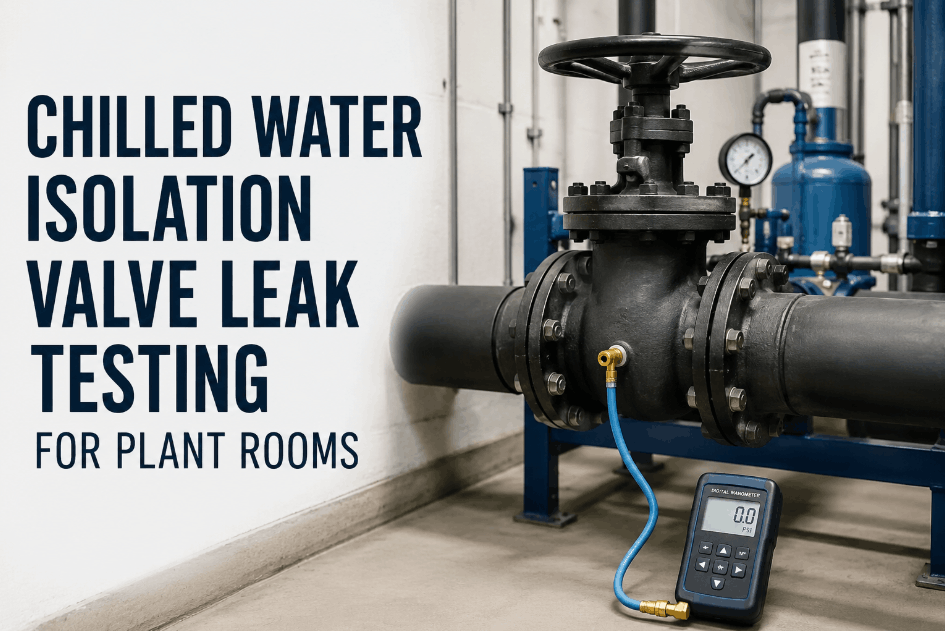
Chilled water isolation valve leak testing is one of the most underperformed inspections in commercial plant room maintenance — and one of the most consequential. A valve that fails to isolate completely allows bypass flow to persist through offline equipment, degrading delta-T, increasing pump energy, and creating conditions that are difficult to diagnose from system-level performance data alone. Identifying which isolation valves leak requires deliberate testing under pressure isolation conditions, not visual inspection during normal operation. OxMaint gives chilled water plant maintenance teams the work order infrastructure to Sign Up Free and schedule isolation valve leak testing as documented PM tasks with technician-verified results. If your plant room's isolation valves have never been formally tested, Book a Demo to see how OxMaint supports systematic valve inspection programs across your cooling plant.
OxMaint's asset register and PM scheduling tools let you track isolation valve condition, schedule leak tests, and log results — so your plant room doesn't carry hidden bypass flow you haven't found yet.
Why Isolation Valve Leakage Degrades Plant Room Performance
Bypass flow through a leaking isolation valve doesn't trip an alarm or generate a fault code — it silently undermines system efficiency. Four downstream consequences make isolation valve leak testing worth scheduling as a formal maintenance activity.
Bypass flow mixes chilled and return water in proportions that reduce the temperature differential across the chiller — degrading efficiency and increasing chiller runtime to meet the same cooling load.
Flow bypassing through leaking valves inflates pump energy consumption without delivering useful cooling. Variable frequency drives attempt to compensate by maintaining differential pressure, masking the underlying bypass loss.
Bypass flow causes chiller loading indicators to misrepresent actual cooling demand — leading to premature chiller staging decisions and unnecessary equipment runtime during partial-load operation.
When system performance is poor but no fault is visible, maintenance teams investigate chillers, pumps, and controls while leaking isolation valves — the actual cause — remain uninspected and uncorrected.
Isolation Valve Leak Testing Methodology
Leak testing isolation valves requires a structured procedure that differentiates true seat leakage from valve packing or actuator issues. Sign Up Free to build these procedures as OxMaint PM tasks with standardized checklists and pass/fail criteria for each valve in your plant room.
Close the valve under test and observe system pressure on both sides over a defined hold period — typically 15–30 minutes. Pressure equalization across a closed valve indicates seat leakage, with the rate of equalization proportional to leak severity.
Where flow instrumentation is available, verify that flow drops to zero on the isolated side when the valve is closed. Residual measured flow through an "isolated" section confirms bypass leakage and quantifies the volume loss.
Compare supply and return temperature on the isolated section. Temperature migration across a closed valve under steady-state conditions indicates conductive bypass through seat leakage — useful when flow instruments are unavailable.
Classify each valve as Pass, Monitor, or Replace based on measured leak rate against defined thresholds. Log results in OxMaint's asset register and generate remediation work orders for valves that exceed acceptable bypass limits.
Isolation Valve Condition Classification
How OxMaint Supports Plant Room Valve Inspection Programs
A valve testing program only delivers consistent results if tests are scheduled, completed, and documented in a system that tracks history across every asset. Book a Demo to see how OxMaint operationalizes chilled water isolation valve maintenance for plant rooms of any scale.
Create an asset record for each isolation valve in OxMaint — tagged by location, line size, valve type, and plant room section. Sign Up Free to start building your valve inventory today.
Schedule isolation valve leak tests as recurring PM tasks in OxMaint — with configurable frequency based on valve age, criticality tier, and prior test results. Critical valves get shorter intervals; confirmed-pass valves extend automatically.
Attach standardized leak test checklists to each PM task — ensuring technicians follow consistent pressure-hold, flow check, and classification steps regardless of shift or experience level.
When a valve fails the leak test threshold, OxMaint generates a remediation work order automatically — with valve details, test results, and location pre-populated for the repair team.
OxMaint stores every leak test result against the valve asset record — enabling condition trending over time and early identification of valves that are progressively worsening before they reach replacement threshold.
Generate plant room valve health reports showing test completion rates, pass/fail ratios by section, and open remediation work orders — giving plant engineers a clear view of isolation integrity across the system.
OxMaint gives plant room teams the asset tracking, PM scheduling, and inspection workflow tools to run systematic isolation valve leak testing programs — and document every result. Sign Up Free or Book a Demo to build your valve inspection program.
Frequently Asked Questions
OxMaint gives chilled water plant teams the asset register, PM scheduling, and inspection workflow tools to eliminate hidden bypass flow and protect cooling plant efficiency. Build your valve program today.