Hotel Water Conservation Guide for Engineering Teams
By Alex Jordan on June 16, 2026
A 280-room mid-scale hotel in Arizona was operating at $0.94 per occupied room per day in water costs—44% above the top-quartile target of $0.65. Their engineering team had no systematic approach to detecting leaks, monitoring consumption patterns, or optimizing guest-facing fixtures. After implementing a structured water conservation programme combining smart metering, predictive leak detection, and low-flow fixture upgrades coordinated through a CMMS, their water cost dropped to $0.52 per occupied room per day within 18 months. That's $124,600 in annual savings on a single 280-room property. The breakthrough wasn't technology alone—it was connecting water consumption data to maintenance schedules so that degraded pipes were identified and fixed before they became catastrophic failures. OxMaint integrates water monitoring systems with maintenance scheduling so you can detect leaks, schedule repairs, and track conservation impact across all your properties. Book a demo to see your water cost baseline.
Cut Water Costs 35–48%. Detect Leaks Before They Cascade.
Smart water metering, predictive leak detection, and conservation-focused maintenance. Average savings: $120,000–$280,000 annually per property.
Top-quartile water cost per occupied room per day (includes sewer, treatment, heating). Median hotel: $0.92.
8–12%
Of total hotel water waste is from undetected leaks in guest rooms, bathrooms, and common areas
42 gal
Average daily water consumption per guest in a hotel (vs 82 gal in a home). Top hotels hit 28–32 gal.
The Water Waste Picture — Where Hotels Lose Money
Hotel water consumption has five major drivers, and only three of them are visible to most engineering teams. Undetected leaks, inefficient fixtures, and loss of pressure in distribution systems account for 34–48% of water waste. The others—occupancy-based variation and seasonal demand—are inevitable. But preventive maintenance tied to water metering can cut the preventable waste by 70% within 18 months. This section breaks down where water actually goes and which maintenance actions save the most per dollar invested.
1
Undetected Leaks in Guest Rooms
8–14% of total water use
Dripping faucets, running toilets, shower pan leaks, and supply line pinhole leaks are invisible until water damage appears. A single running toilet wastes 6,000–8,000 gallons per month ($24–$32 per room per month). A 300-room hotel with just 4% of rooms having undetected leaks is wasting $1,152 annually per affected room. Smart leak detection systems flag water consumption anomalies within 2–3 days of onset.
2
Inefficient or Aging Fixtures
6–10% of total water use
Pre-1992 toilets consume 3.5–7 gallons per flush. Modern low-flow toilets use 1.28–1.6 gallons. Showerheads above 2.5 gpm waste water on guests expecting modern fixtures. Lavatory aerators that haven't been cleaned in 2+ years restrict flow and trigger guest complaints and longer shower times. Systematic fixture replacement on a 4–5 year cycle cuts guest room water use 22–28%.
3
Cooling Tower Losses (Commercial Properties)
18–28% of total water use
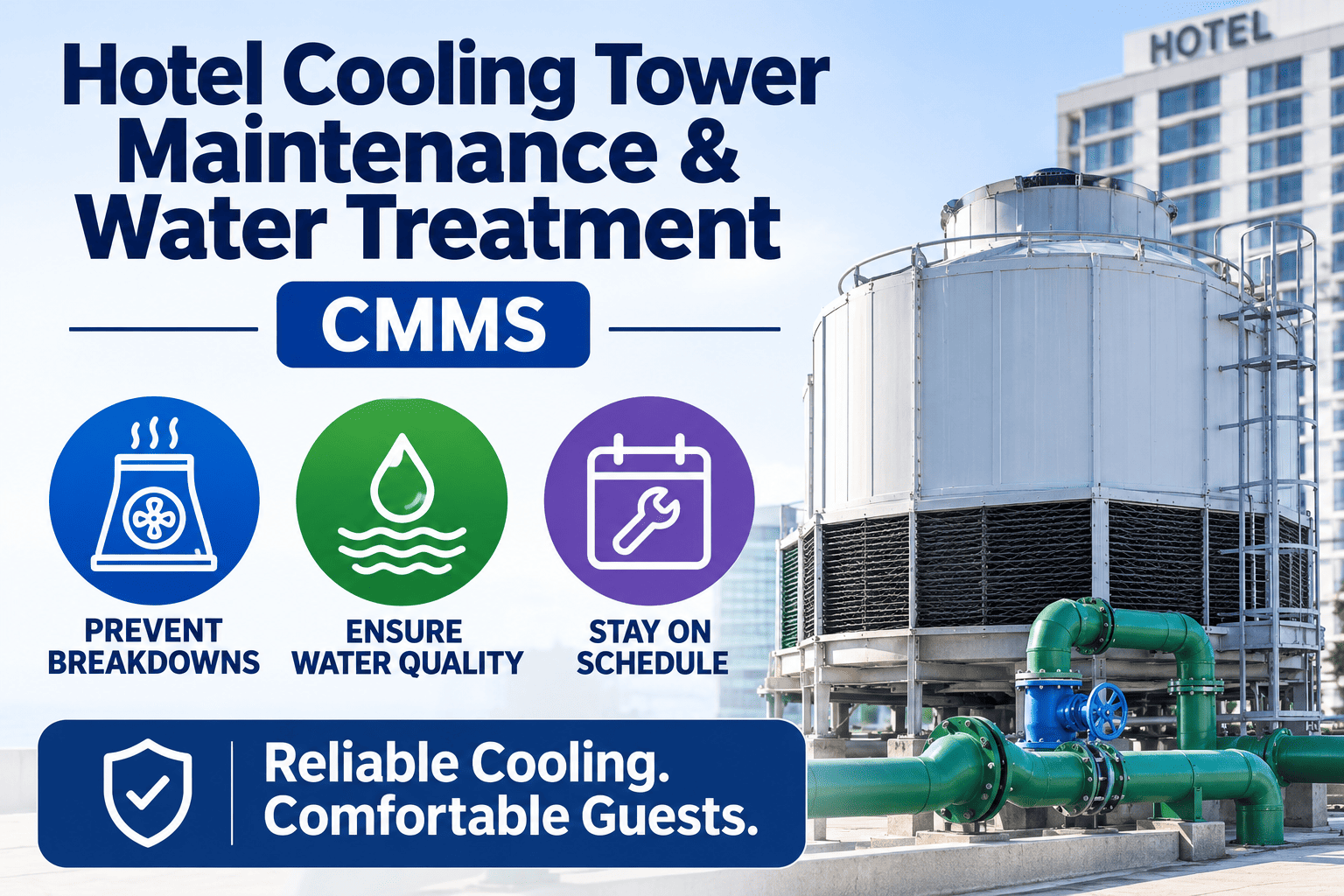
Cooling towers lose water through evaporation (60%), blowdown (20%), and drift (20%). Unmonitored towers often blowdown more than necessary (to maintain mineral concentration) or operate at excessive flow rates. Water treatment chemistry tied to tower PM—scaling, fouling, and biofouling prevention—can reduce total tower water use 24–32% without sacrificing cooling capacity.
4
Kitchen and Laundry Equipment
8–16% of total water use
Pre-rinse spray valves in kitchens can consume 3–5 gallons per minute. Low-flow models use 0.65 gpm. Industrial laundry extractors using "dump and refill" cycles waste water on each batch. Equipment age matters—a 12-year-old ice machine or dishwasher consumes 50–80% more water than current models. Strategic equipment replacement and flow monitoring reduces kitchen/laundry water 28–42%.
5
Distribution System Losses
4–8% of total water use
Old piping with scale, corrosion, or pinhole leaks loses water throughout the building. Pressure regulators failing silently can double water flow. Hot water distribution pipes without proper insulation waste energy and water waiting for hot water to reach fixtures. Systematic piping inspections tied to water consumption data identify problem zones. Once identified, replacements or repairs typically reduce distribution losses 40–60%.
Hotel Water Conservation Platform — OxMaint
Detect Leaks. Optimize Fixtures. Measure Savings. All Integrated.
Smart metering connected to maintenance scheduling means leaks are caught within days, not months. Water conservation is a maintenance problem, not just an environmental one.
Water cost varies dramatically by location (water rates, sewer charges), climate (cooling tower needs), and building age. The table below shows median and top-quartile water costs per occupied room per day across five hotel segments, plus the primary maintenance lever for closing the gap. Use this to benchmark your property.
Leak detection system + toilet/showerhead replacement
Limited Service / 2-Star
$0.68
$0.42
$0.26
Smart meter monitoring + preventive plumbing
Extended Stay / Residential
$0.74
$0.48
$0.26
Supply line inspection + aerator maintenance
Water Leak Detection and Prioritization — The Maintenance Schedule
Detecting leaks isn't just about technology—it's about correlating consumption data with physical inspection schedules. The most successful hotel programmes combine smart metering (24/7 monitoring) with systematic visual inspection (quarterly guest room walk-throughs). This section shows how to build a leak detection and response protocol.
Detection
Smart Meter Anomaly Flagging
Sub-metering on guest room water lines (or floor-level meters) identifies consumption spikes within 24–48 hours. A running toilet shows as +6.5 gallons/hour continuously. OxMaint automatically compares current consumption against 30-day rolling average for that zone and flags deviations >15%.
Prioritization
Cost-Impact Ranking
Not all leaks are equal. A guest room toilet leak costs $24–$32/month. A cooling tower circulation pump seal leak costs $180–$240/month. OxMaint multiplies detected consumption overage by local water/sewer rates and ranks by daily cost impact so the highest-return repairs get scheduled first.
Inspection
Physical Verification & Root Cause
Meter data tells you that there's a leak; visual inspection tells you where and why. Plumber checks for: running toilets, dripping faucets, supply line spray, water discoloration (corrosion indicator), and pressure anomalies. Root cause determines repair priority.
Repair & Verification
Fix & Confirm Savings
Once repair is complete, water consumption for that zone is re-baselined. OxMaint tracks the daily/monthly consumption for 30 days post-repair and calculates actual savings. This creates a feedback loop and quantifies each repair's ROI.
The Cost of Delayed Plumbing Maintenance — What Leaks Actually Cost
Every delayed water system maintenance task has a downstream cost much larger than the repair itself. The comparison below shows five common hotel water failures and their true cost-of-delay, including water waste, property damage, and guest impact.
Toilet Running (Guest Room)
Undetected for 60 days
Water waste cost (60 days)
$48–$64
PM cost (flapper replacement)
$18
Risk: sub-floor water damage
$1,200–$4,200
Prevention ROI
67–233×
Pinhole Leak (Supply Line)
Undetected for 90 days
Water waste cost (90 days)
$280–$420
PM cost (section replacement)
$240
Water damage to walls/fixtures
$2,000–$6,800
Total cost of delay
$2,480–$7,220
Cooling Tower Scale Buildup
Skipped quarterly descaling
Water waste cost (6 months)
$240–$360
Energy waste (reduced cooling)
$420–$640
Unplanned tower replacement
$12,000–$22,000
6-month delay cost
$12,660–$23,000
Before OxMaint, we had no idea where water was going. We'd get quarterly bills and assume waste was just part of the business. We had smart meters installed but they were just generating data—no one was looking at it. When we connected the metering to maintenance work order scheduling, we found 12 guest rooms with slow leaks we'd never noticed. One floor had a pinhole leak in the main supply line costing us $340/month in waste water. Once we coordinated leak detection with plumbing PM, we cut water spend from $0.96 to $0.58 per occupied room per day. That's $162,000 annually on our portfolio.
— Director of Engineering, 15-property Hotel Portfolio, Mountain West US, OxMaint Customer
Low-Flow Fixture Strategy and Installation Roadmap
Low-flow fixture upgrades are among the highest-ROI water conservation investments. A guest room toilet replacement pays for itself in 8–14 months. But success requires coordination between procurement, guest communication, and maintenance scheduling. This section breaks down the strategy.
Toilet Replacement ROI
Modern dual-flush toilets (1.28/0.8 gpm) vs older 3.5+ gpm models save 1,800–2,400 gallons per room per year. At $1.20/100 gal (sewer+water), that's $21–$29 annually per room. Cost: $180–$240 per toilet. Payback: 6–11 months.
Showerhead + Aerator Upgrade
Low-flow showerheads (2.0 gpm vs 2.5+) and cleaned aerators (0.5 gpm lavatory vs 1.2+) reduce per-guest shower water 18–24%. Cost: $6–$12 per fixture. Installation can be done during room turnovers. 6–month payback.
Pre-Rinse Spray Valve Retrofit
Commercial kitchens using low-flow spray valves (0.65 gpm vs 3–5 gpm) save 18,000–36,000 gallons per month per valve. Cost: $180–$280. ROI: 2–4 months. Reduces labour time on pre-rinsing (faster dishwashing).
Cooling Tower Water Treatment
Optimized tower water treatment chemistry + descaling every 6 months reduces tower water use 24–32% with zero cooling performance loss. Cost: $320–$480 per descaling. Saves: $180–$360/month in reduced blowdown.
Frequently Asked Questions
What's the difference between water cost and sewer cost for hotels?
Water is metered and charged by volume. Sewer is typically charged as a percentage of water use (70–100%) because all hot water and most guest water goes back into sewer. Some jurisdictions charge both. Total cost is usually 60% water supply, 40% sewer/treatment.
How quickly can we detect a leak with smart metering?
A continuous leak (running toilet, small spray) is detectable within 24–48 hours. An intermittent leak (dripping, occasional), within 5–7 days if the meter records every 15 minutes. Without metering, leaks often go undetected 30+ days.
Do low-flow fixtures affect guest satisfaction?
Modern low-flow fixtures (2.0 gpm showerheads, dual-flush toilets) are indistinguishable to guests from standard fixtures. Guest complaint rates do not increase with low-flow upgrades when installation is done properly and aerators are cleaned regularly.
What's the payback period for a cooling tower optimization programme?
Tower water treatment + descaling cycles typically pay back within 4–8 months through reduced water waste and reduced chemical blowdown. A 300-room hotel can save $18,000–$28,000 annually from optimized tower operation alone.
How does water conservation connect to sustainability reporting?
ESG reporting requires quantified water savings. OxMaint tracks baseline water consumption, conservation interventions, and post-intervention consumption, providing auditable data for sustainability disclosures and green certification (LEED, Green Key).
Can we replace all guest room fixtures at once or should we phase?
Phase replacement during normal room turnovers and renovations. Replacing 100 rooms annually (on a 300-room property) takes 3 years but spreads capital cost and eliminates guest disruption from mass construction.
What does a water conservation CMMS system cost to implement?
Integration of smart meters with CMMS scheduling typically costs $8,000–$18,000 upfront (hardware + software setup). For a 300-room hotel saving $120,000+ annually, payback is under 2 months. OxMaint includes integration at no extra cost.
Hotel Water Conservation Platform — OxMaint
Stop Losing Water to Leaks. Start Saving 35–48% Today.