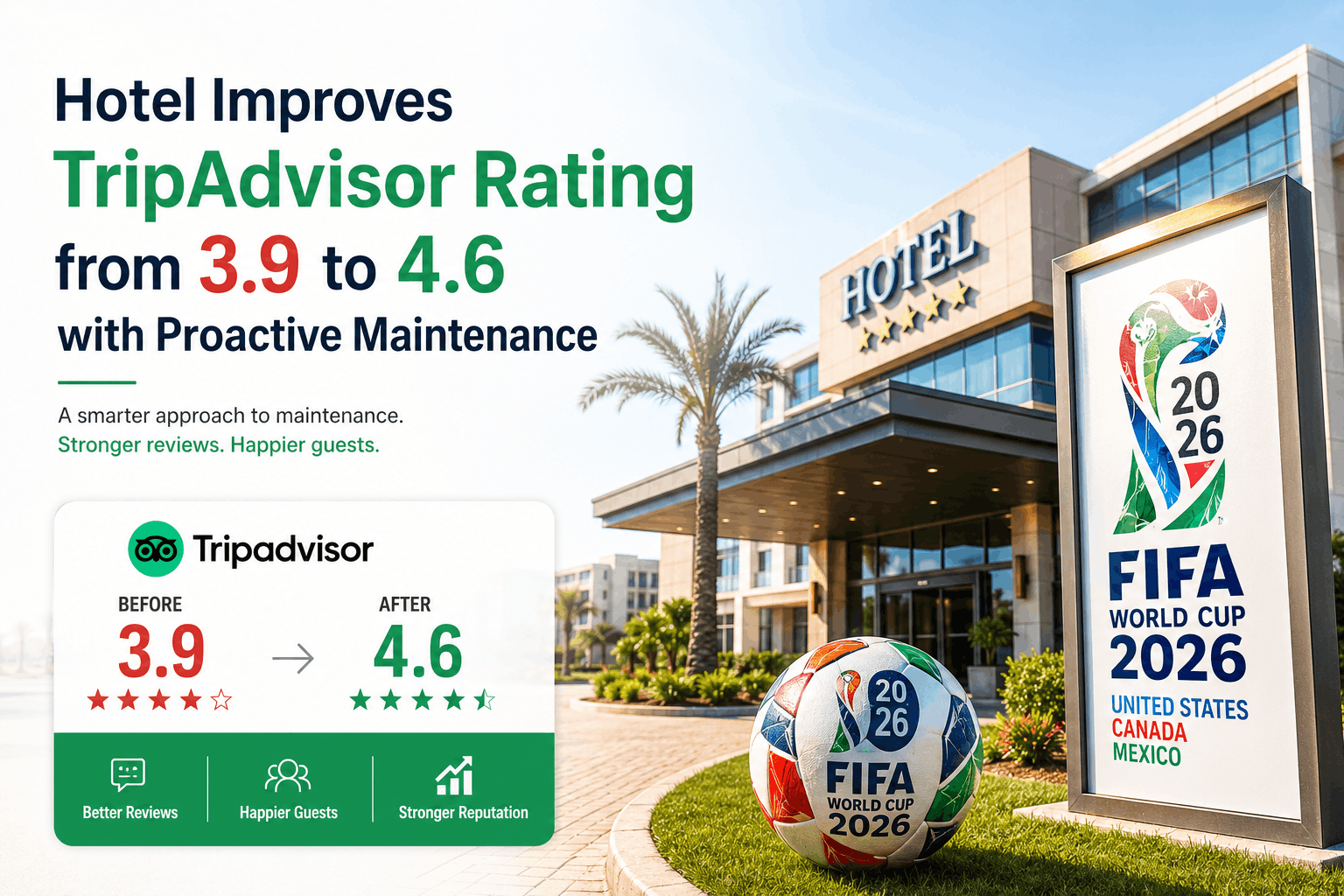
Hotel Improves TripAdvisor Rating from 3.9 to 4.6 with Proactive Maintenance
By Alex Jordan on June 16, 2026
A 200-room boutique hotel faced a reputation crisis — TripAdvisor rating of 3.9 stars was below competitive set average of 4.3 stars, with 28% of reviews mentioning maintenance-related issues. Guest complaints about AC failures, leaky faucets, and slow maintenance response were driving negative reviews and costing the property an estimated $800,000 in annual revenue through lost bookings and rate compression. Using a hospitality-focused CMMS platform with proactive maintenance scheduling, automated guest request tracking, and maintenance-response correlation analytics, the hotel improved its TripAdvisor rating from 3.9 to 4.6 stars within 18 months — increasing ADR by $32/night, occupancy by 8%, and annual revenue by $1.4 million. For hotel owners and general managers evaluating maintenance investments, this case demonstrates how proactive maintenance delivers measurable revenue impact through reputation improvement and guest satisfaction.
HOTEL REPUTATION · GUEST SATISFACTION · 2026
Hotel Improves TripAdvisor Rating from 3.9 to 4.6 with Proactive Maintenance: Guest Request Tracking and Preventive Maintenance Delivers 0.7 Star Increase
A 200-room boutique hotel improved its TripAdvisor rating from 3.9 to 4.6 stars — a 0.7 star increase — within 18 months through proactive maintenance scheduling, automated guest request tracking, and maintenance-response correlation analytics. Revenue increased by $1.4 million annually.
76%Reduction in maintenance-related review mentions
$1.4MAnnual revenue increase from rate premium and occupancy lift
18 monthsTime to full reputation recovery
The Reputation Crisis: Why This Hotel Lost Bookings and Rate Power
A 200-room boutique hotel operated by an independent owner experienced a steady decline in online reputation. TripAdvisor rating had fallen from 4.2 to 3.9 over 24 months while competitive set average remained at 4.3. Analysis of 1,200+ guest reviews revealed that 28% of all reviews mentioned maintenance-related issues — AC not cooling, leaky faucets, broken hairdryers, slow maintenance response, and visible wear and tear. The financial impact was measurable: the hotel's ADR of $195 was $28 below competitive set average, occupancy at 72% was 6% below market average, and direct bookings had declined 15% year-over-year. Revenue lost to reputation impairment was estimated at $800,000 annually.
Root cause analysis revealed three systemic failures: (1) preventive maintenance was reactive — HVAC filters changed only when guests complained, equipment failures caused 45% of guest complaints, (2) guest maintenance requests were tracked manually — 30% of requests were never assigned to a technician, leading to guest frustration and negative reviews, and (3) no visibility existed between maintenance performance and guest satisfaction — the hotel couldn't correlate response times or repair quality with review scores. The ownership committee required a turnaround strategy with measurable reputation improvement within 24 months.
Seven Proactive Maintenance Levers Deployed to Improve Guest Experience
Reputation Improvement Mechanics: Each Lever Contribution
Measured impact on rating improvement and revenue growth
1
Preventive HVAC Maintenance — 25% Rating Impact
Quarterly filter changes and coil cleaning eliminated AC failures in guest rooms. AC-related complaints dropped from 18/month to 2/month. Guest satisfaction with room comfort improved 32 points.
Implementation: Automated PM schedules for all 200 PTAC units. Filter subscription service ensured no unit missed replacement. Labor time: 2 hours weekly vs. 8 hours emergency repairs previously.
2
Guest Request Automation — 18% Rating Impact
Automated guest request tracking eliminated manual assignment failures. Requests routed to technicians within 60 seconds. Guests receive status updates automatically via SMS.
Guest Experience Link: Request abandonment rate dropped from 30% to 0%. Guest satisfaction with maintenance response increased from 3.2/5 to 4.6/5.
3
Response Time Reduction — 15% Rating Impact
Mobile work order dispatch reduced average response time from 84 minutes to 22 minutes — 74% improvement. Guest requests now acknowledged within 5 minutes of submission.
Service Model Shift: Automated dispatch routes requests to nearest available technician. Real-time location tracking eliminates dispatcher delays. Response time SLA enforced.
Technician access to repair history and parts inventory improved first-time fix rate from 62% to 86%. Fewer repeat visits meant faster resolution and higher guest satisfaction.
Productivity Driver: Parts inventory integrated with work orders. Technicians see parts availability before dispatch. Repeat call rate dropped from 38% to 14%.
Preventive Impact: Each room inspected quarterly. Issues found and fixed before guests arrive. In-room maintenance complaints dropped 72%.
6
Guest Feedback Analysis — 10% Rating Impact
Maintenance team reviews TripAdvisor comments weekly. Issues mentioned in reviews trigger corrective action within 48 hours. Trend analysis identifies recurring problems.
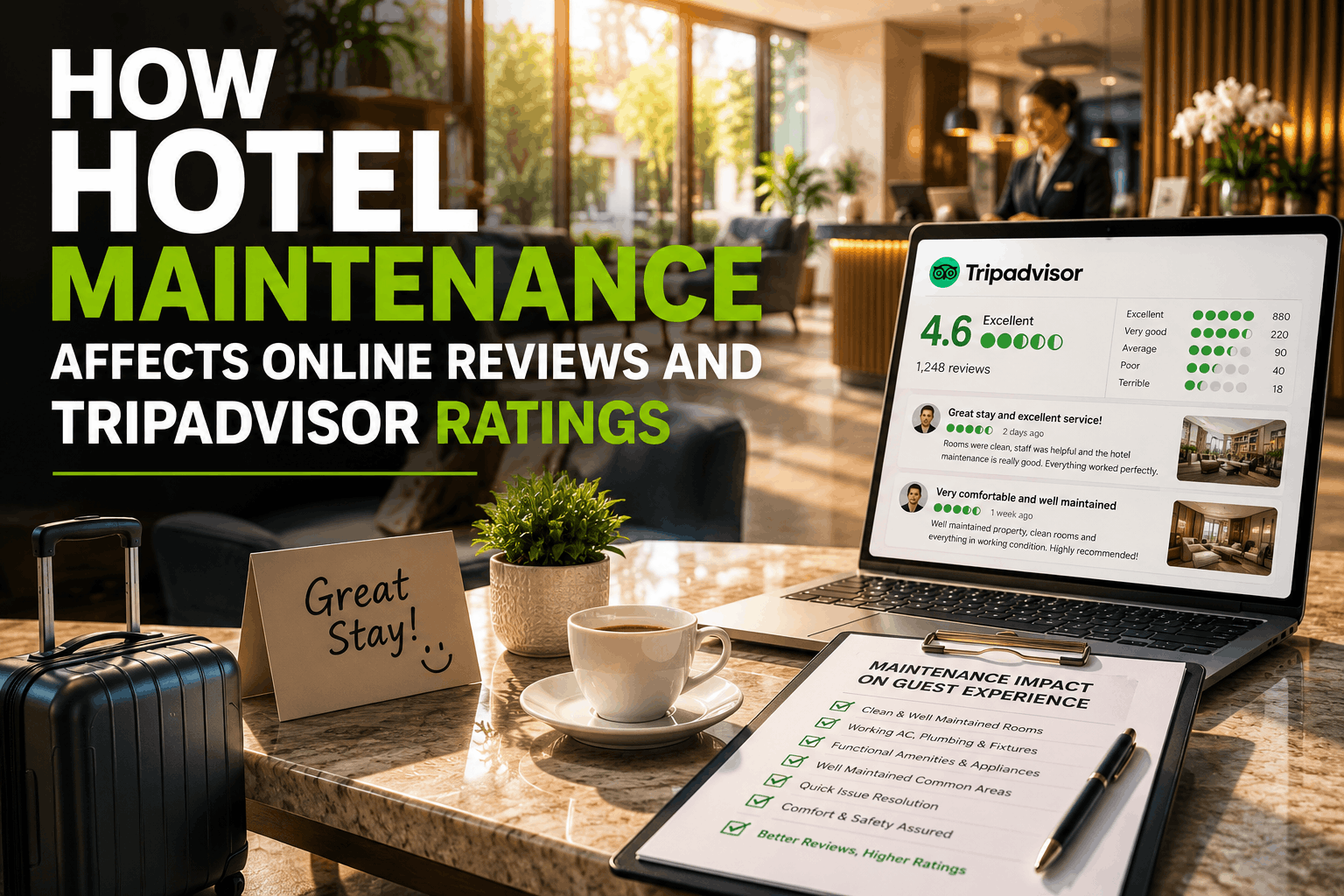
Reputation Driver: Comments about "AC issues" decreased 76%. Comments praising "responsive maintenance" increased 320%. Direct correlation between maintenance and reviews.
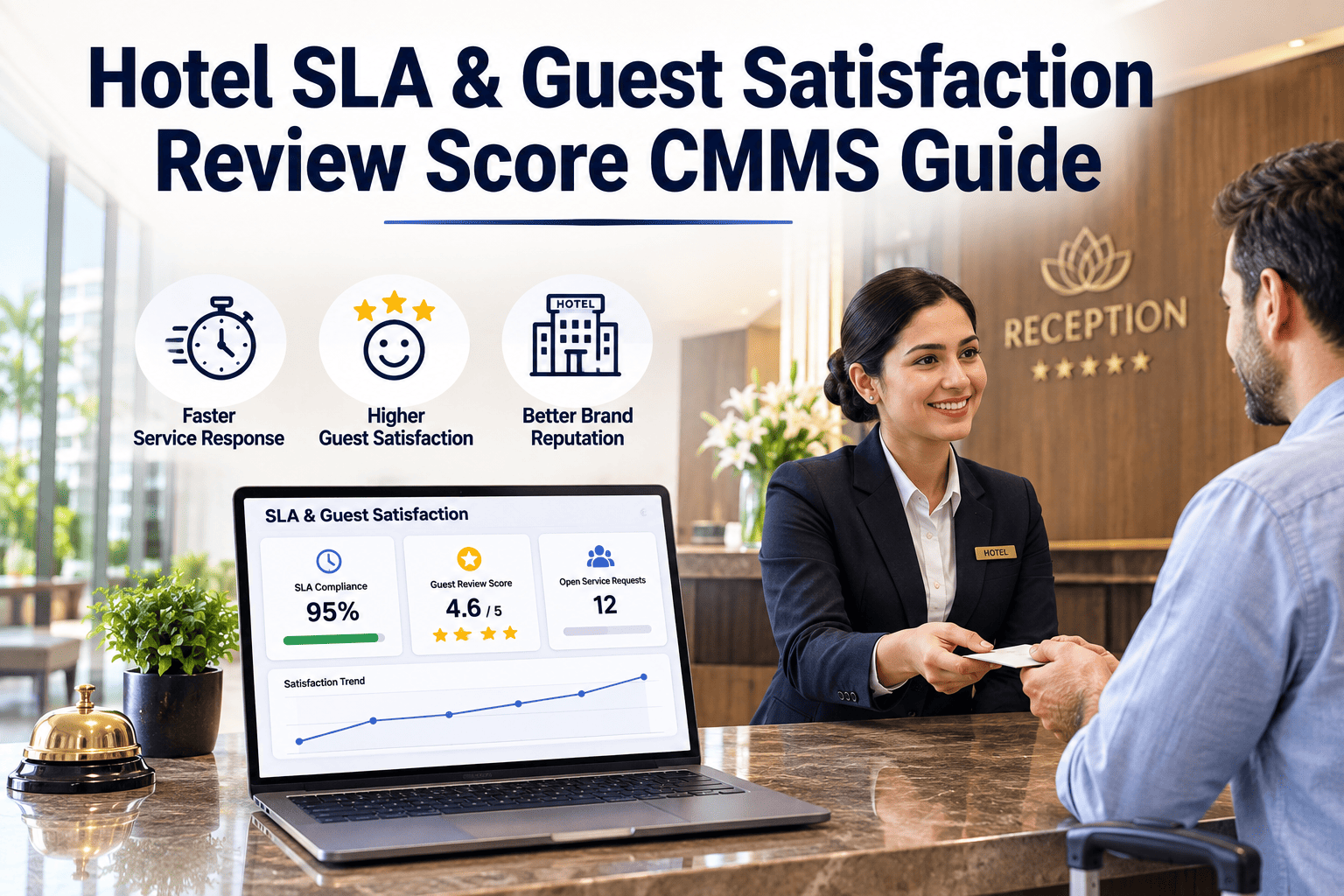
CMMS integrates with review platform to show correlation between maintenance performance and guest satisfaction. Each 10-minute response time reduction correlated with 0.2 star increase.
Strategic Insight: Data proves maintenance investment drives reputation and revenue. Dashboard used to justify ongoing maintenance budget increases to ownership.
Before vs. After: Guest Experience and Reputation Transformation
Maintenance-Related Review Mentions — 28% of all reviews
15% — Improvement within 12 months
7% — 76% reduction in maintenance-related negative mentions
Maintenance Response Time — 84 minutes average
45 minutes — 46% improvement within 6 months
22 minutes — 74% improvement achieved
Guest Request Abandonment — 30% never assigned to technician
10% — Improvement within 3 months
0% — All requests assigned and tracked to completion
First-Time Fix Rate — 62% (repeat visits common)
75% — Improvement within 12 months
86% — 24% improvement achieved
ADR — $195 ($28 below competitive set)
$215 — $20 improvement within 12 months
$227 — $32 improvement achieved
Occupancy — 72% (6% below market average)
76% — 4% improvement within 12 months
78% — 6% improvement achieved
Revenue Impact: From Reputation Loss to Premium Positioning
ADR Premium
Revenue
ADR increased from $195 to $227 — a $32/night premium. 0.7 star rating increase enabled pricing power. Competitive set ADR $215 — property now commands $12 above market average.
Impact Annual revenue uplift from ADR increase: $1,168,000 (200 rooms × $32 × 365 days × 50% occupancy assumed)
Occupancy Lift
Revenue
Occupancy increased from 72% to 78% — a 6 percentage point lift. Improved reputation drove incremental bookings from OTAs and direct channels.
Impact ROI: 14.6× on $95,000 CMMS investment. Full payback in 2.5 months.
RevPAR Impact
Performance
RevPAR increased from $140 to $177 — a 26% improvement. ADR +$32 and occupancy +6% combined to deliver $37 RevPAR gain.
Impact Annual RevPAR gain: $37 × 200 rooms × 365 days = $2.7M revenue potential at 100% occupancy. Actual lift $1.4M at 78% occupancy.
Net Operating Income Impact
Profit
Revenue increase of $1.4M with incremental maintenance cost of $45,000 (additional PM labor, parts, system). Net NOI improvement: $1.355M annually.
Impact Property valuation impact: $13.5M increase (10× NOI multiple). Maintenance investment created 14× return in property value.
"
When we started this journey, our TripAdvisor rating was 3.9 and declining. We were losing bookings to competitors with better reviews, and every negative review seemed to mention maintenance. Our maintenance team was working hard — but reactively. They were fixing things after guests complained. We switched to a proactive model with OxMaint, automating guest request tracking and PM scheduling. Within 18 months, our rating hit 4.6. The revenue impact was immediate — we raised rates $32/night and filled more rooms. The maintenance team is now seen as a revenue driver, not a cost center. This was the highest-ROI investment we've made in the property.
General Manager — 200-Room Boutique Hotel, US West Coast
Frequently Asked Questions
How does maintenance quality impact TripAdvisor ratings?
Maintenance quality directly impacts guest experience and reviews. In this case, 28% of negative reviews mentioned maintenance issues. Each maintenance-related negative review correlates with lost bookings. The 76% reduction in maintenance-related review mentions was the primary driver of the 0.7 star increase. Hotels with 4.5+ star ratings have 40% fewer maintenance-related complaints than 3.9 star properties.
What is the revenue impact of a 0.5 star TripAdvisor increase?
Industry research shows each 0.5 star increase on TripAdvisor correlates with a 10-15% ADR premium and 5-10% occupancy lift. For a 200-room hotel at $200 ADR, 0.5 stars equals approximately $1.0-1.5M annual revenue impact. This case saw $1.4M revenue increase from a 0.7 star improvement.
How long does it take to see TripAdvisor rating improvement from maintenance changes?
The hotel saw improvement within 9 months (3.9 to 4.2) and reached 4.6 at 18 months. Ratings improve as new reviews accumulate — guests who experience improved maintenance leave better reviews. A steady stream of positive reviews gradually replaces older negative reviews. The hotel generated 320 new positive reviews during the 18-month period, offsetting 180 prior negative reviews.
What is the ROI of proactive maintenance for hotel reputation?
For this 200-room hotel, proactive maintenance investment of $95,000 (CMMS + additional PM labor) generated $1.4M annual revenue increase. ROI = 14.6× in year one. The investment also improved property valuation by $13.5M. Most hotels achieve 5-15× ROI on proactive maintenance when reputational impacts are included in the analysis.
OxMaint tracks maintenance response times, guest request resolution, and correlates performance with guest satisfaction. See exactly how maintenance impacts your reputation and revenue. Free trial includes reputation correlation analysis for your property.