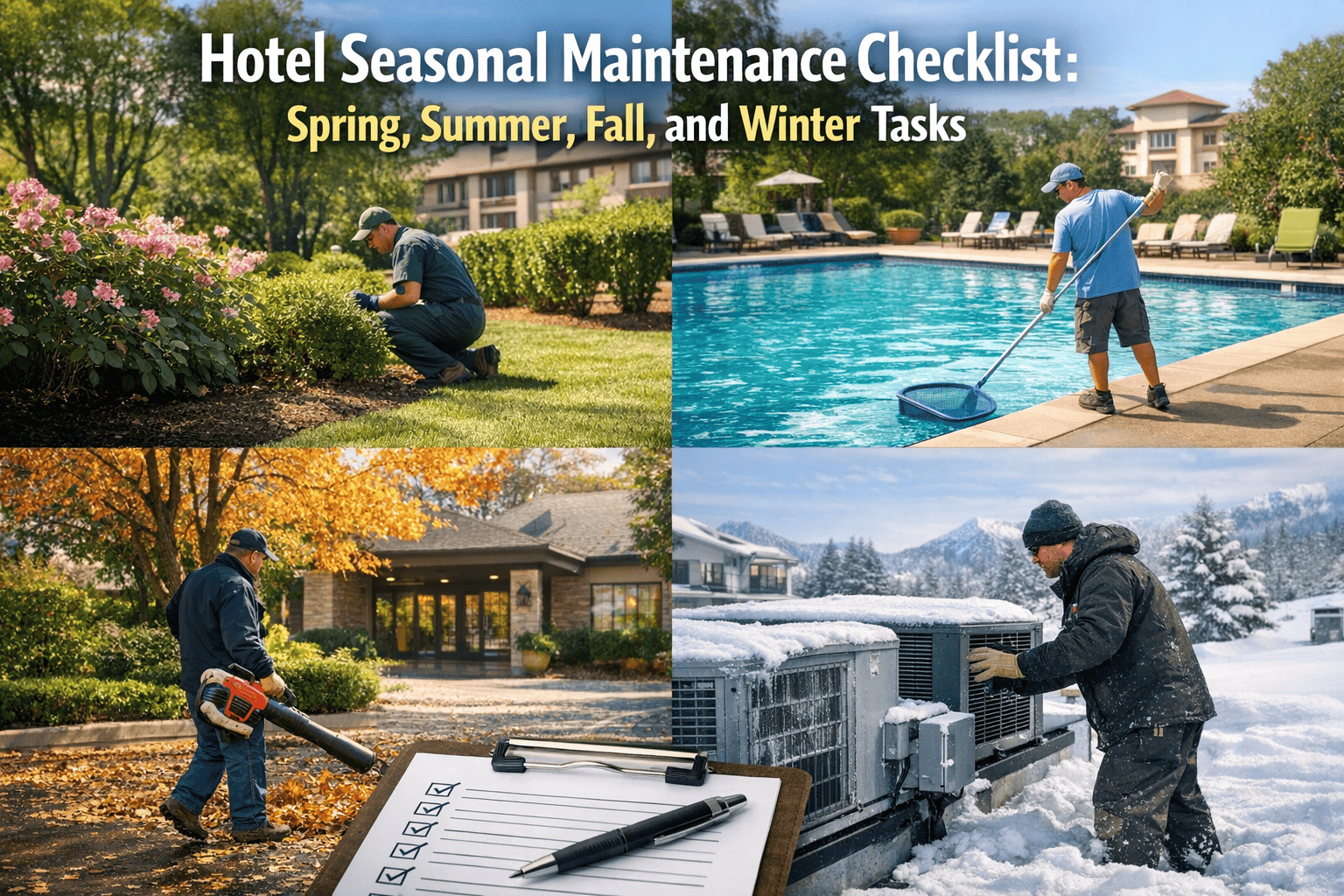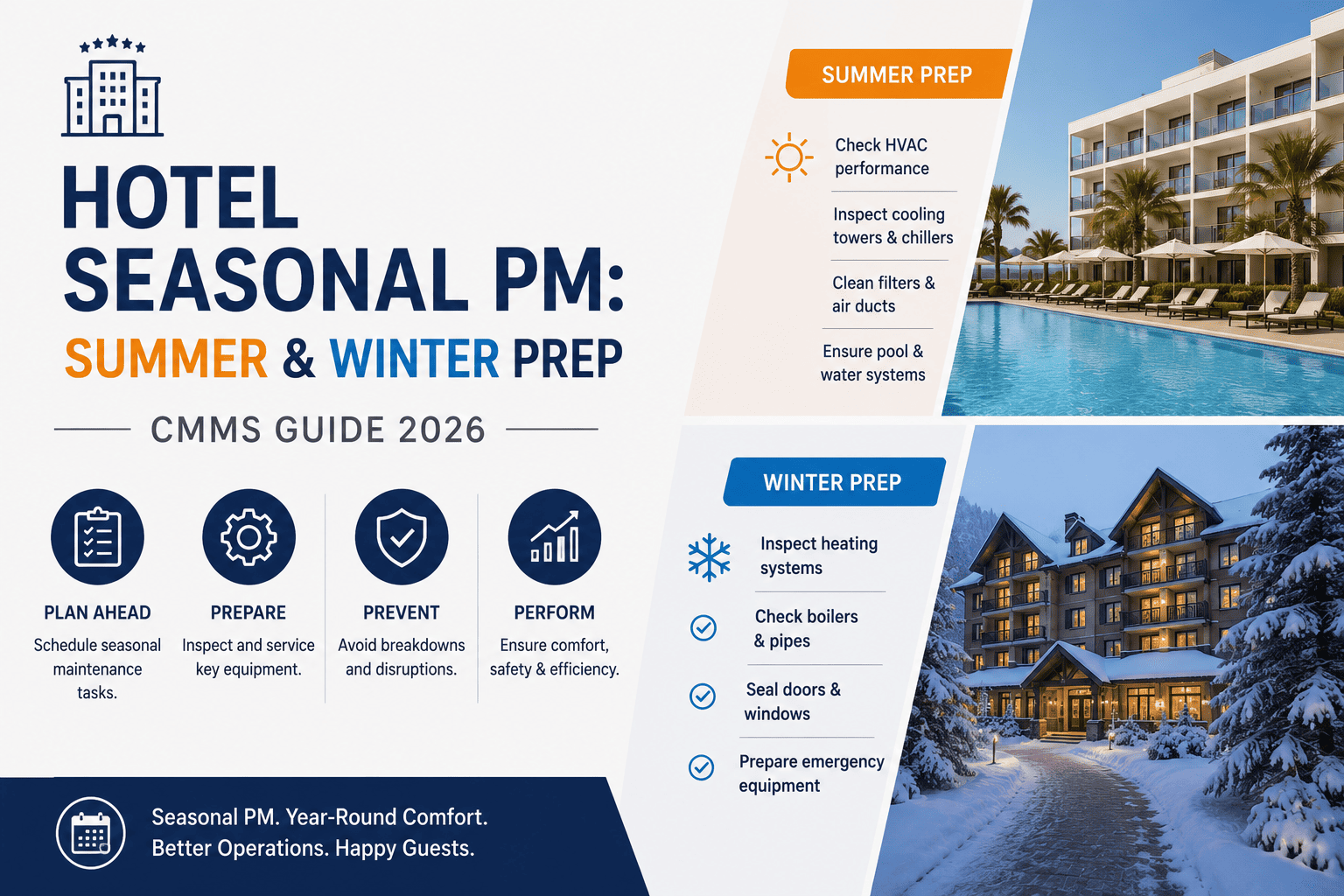
Hotel seasonal PM is the difference between sailing through peak occupancy and facing predictable equipment failures when every room is full. A CMMS for hotel seasonal maintenance puts summer HVAC peak-load preparation and winter pipe-freeze prevention into the calendar weeks before the season demands it — turning reactive scrambles into scheduled, documented work. This 2026 seasonal guide covers the pre-season inspection tasks, capacity testing, and control verification that keep guests comfortable and operations profitable year-round. Teams using OxMaint automate these seasonal work orders, cut unplanned downtime, and maintain full audit readiness. Start Free Trial to put your seasonal prep on autopilot.
Is your hotel ready for the next extreme season — or one failure away from a guest revolt?
Peak summer cooling demand and sudden winter freezes expose every PM shortcut. A CMMS-based seasonal maintenance plan schedules inspections, capacity tests, and freeze protection weeks ahead — so you never trade guest comfort for emergency repair costs.
When to schedule hotel seasonal PM: a month-by-month CMMS calendar
Hotels that complete seasonal readiness 6–8 weeks before peak demand experience 35% fewer emergency work orders during high-occupancy periods. Here is the optimal CMMS-driven timeline for 2026.
Summer Prep Phase 1: Audit & Plan
Generate asset registers for all cooling equipment. Schedule chiller inspections, cooling tower cleanings, and refrigerant level checks in the CMMS. Verify warranty status and parts availability for high-failure components.
Summer Prep Phase 2: Test & Verify
Run full-load capacity tests on HVAC systems. Calibrate thermostats and building automation sensors. Clean condenser coils and confirm economizer functionality. Lock all tasks to auto-generated work orders.
Winter Prep Phase 1: Insulate & Protect
Identify exposed piping and sprinkler lines. Schedule insulation repairs and heat-trace cable verification. Test boiler ignition sequences, bleed radiators, and verify freeze-protection alarms in the CMMS.
Winter Prep Phase 2: Peak Readiness
Confirm generator cold-weather kits. Verify snow-melt systems and ice-dam prevention protocols. Ensure all CMMS seasonal checklists are signed off and compliance documentation is locked for audit readiness.
Summer HVAC peak-load CMMS checklist for hotels
When outside temperatures exceed 90°F, a hotel's cooling load can spike 60% above baseline. This CMMS-based summer HVAC peak hotel checklist ensures every critical cooling asset is inspected, tested, and verified before the first heatwave.
- Inspect and clean condenser tubes; verify approach temperatures within 2°F of baseline
- Test cooling tower water treatment levels and drift eliminator integrity
- Confirm refrigerant charge and log pressure readings to the CMMS asset record
- Verify compressor oil levels and schedule vibration analysis
- Replace or clean all HVAC filters; log MERV rating and replacement date in CMMS
- Inspect and lubricate fan motors; verify belt tension and sheave alignment
- Test economizer dampers and enthalpy controls for free-cooling mode
- Calibrate zone thermostats and occupancy sensors in guest corridors
- Run full-load capacity test on primary chiller; document performance curve
- Verify building automation system (BAS) alarms and setpoint schedules
- Test backup cooling redundancy and automatic failover sequences
- Confirm load-shedding protocols and demand-response programming
| Asset Category | Inspection Frequency | CMMS Trigger Type | Estimated Downtime Risk if Skipped |
|---|---|---|---|
| Central Chillers | Pre-season + Monthly | Time-based + Meter reading | 8–24 hrs per failure event |
| Cooling Towers | Bi-weekly during summer | Time-based work order | Legionella risk + full shutdown |
| Guest Room PTAC / VTAC | Pre-season + On-demand | Inspection rounds | 1–2 hrs per unit, guest churn |
| BAS / Controls | Pre-season verification | Condition-based alert | System-wide inefficiency, 15% energy waste |
Winter pipe freeze prevention: hotel CMMS winter prep guide
A single burst pipe in a hotel wing can cost $50,000–$200,000 in water damage, room closures, and guest relocation. This winter pipe freeze hotel checklist — driven by CMMS seasonal work orders — protects vulnerable assets before the first hard freeze.
- Identify and tag all exposed piping in unheated spaces (attics, crawlspaces, exterior walls)
- Inspect pipe insulation; replace any sections with moisture damage or gaps
- Test heat-trace cable continuity and replace any open-circuit runs
- Verify freeze-protection valves and drip protocols for guest-room exterior plumbing
- Conduct pre-season boiler combustion analysis; tune burner for peak efficiency
- Inspect and clean heat exchanger surfaces; verify condensate drainage
- Test low-water cutoff, pressure relief valve, and flame safeguard controls
- Bleed radiators and verify circulation pump operation across all zones
- Inspect roof for ice-dam potential; clear gutters and verify heat cables
- Weatherstrip exterior doors and verify vestibule heater operation
- Test snow-melt systems for entrances, loading docks, and ADA ramps
- Verify emergency generator cold-weather kit: block heater, battery blankets, fuel treatment
The cost of skipping seasonal PM — and the payback of acting early
Consider a 220-room hotel running 1,400 assets on a reactive maintenance model. By shifting to CMMS-driven seasonal PM, the engineering team eliminated 80% of summer HVAC emergencies and reduced winter pipe-damage incidents to zero over two seasons.
A 220-room resort hotel in the mountains was spending $85,000 annually on emergency winter plumbing repairs and guest relocation. After implementing OxMaint CMMS seasonal PM — scheduling heat-trace inspections in October and pipe-insulation audits in November — the property spent $4,200 on preventive work and $0 on freeze-damage emergencies the following winter. Payback was achieved in less than one season.
How OxMaint CMMS streamlines hotel seasonal PM
OxMaint turns seasonal readiness from a spreadsheet-driven scramble into an automated, AI-powered workflow. These four capabilities directly map to the challenges of summer and winter hotel prep — with measurable outcomes.
Automated Seasonal Work Orders
Schedule entire summer and winter PM campaigns with date-based and meter-based triggers. OxMaint auto-generates work orders 6–8 weeks before peak season, assigns technicians, and attaches checklists — eliminating manual calendar management.
AI-Driven Predictive Maintenance
OxMaint analyzes vibration, temperature, and energy-consumption data from HVAC and boiler sensors to predict failures before the season hits. Get alerts when a chiller's performance curve deviates from baseline — weeks before a summer breakdown.
Spare-Parts Inventory Pre-Season
Never get caught without a critical filter, belt, or heat-trace cable. OxMaint links parts to seasonal PM templates and auto-creates purchase requisitions when stock falls below safety levels — verified against the pre-season audit.
Audit-Ready Compliance Documentation
Every seasonal inspection, capacity test, and freeze-protection check is timestamped, geo-tagged, and stored in the asset history. Generate compliance reports for insurers, franchisors, and health inspectors with one click.
See OxMaint on your assets — book a 30-min demo
Discover how OxMaint CMMS automates your entire hotel seasonal PM calendar, from summer HVAC capacity tests to winter pipe-freeze protection — and never miss a pre-season deadline again.
Hotel seasonal PM CMMS: frequently asked questions
What is hotel seasonal PM and why does it matter in 2026?
Hotel seasonal PM is the scheduled preventive maintenance performed before summer cooling and winter heating seasons to ensure HVAC, plumbing, and building systems handle peak demand without failure. In 2026, with extreme weather events increasing, seasonal readiness directly protects guest satisfaction, revenue, and compliance — a single day of summer HVAC failure during full occupancy can cost a 200-room hotel over $25,000 in lost revenue and compensation.
How does a CMMS improve hotel seasonal maintenance scheduling?
A CMMS like OxMaint automates seasonal work order generation based on calendar dates, meter readings, or weather triggers — ensuring every chiller inspection, pipe-freeze check, and boiler test is scheduled 6–8 weeks before peak season. This eliminates the spreadsheet errors and forgotten tasks that cause 35% of seasonal equipment failures. You can Start Free Trial to automate your 2026 seasonal calendar today.
When should hotels start summer HVAC peak-load preparation?
Hotels should begin summer HVAC prep in March–April, with all capacity testing, coil cleaning, filter replacement, and control verification completed by mid-May. This 6–8 week window allows time for parts ordering, contractor scheduling, and full-load testing before the first sustained heatwave drives occupancy and cooling demand to peak levels.
What are the most critical winter pipe freeze prevention tasks for hotels?
The highest-priority winter prep tasks are inspecting and repairing insulation on all exposed piping, testing heat-trace cable continuity, verifying freeze-protection alarms, and ensuring proper drainage in unheated spaces. Hotels should also bleed radiators, test boiler low-water cutoffs, and confirm that exterior plumbing in guest rooms has adequate freeze protection — all scheduled and documented in the CMMS by late October.
Can OxMaint CMMS handle both summer and winter seasonal PM for multiple hotel properties?
Yes. OxMaint supports multi-site asset hierarchies, allowing hotel groups to create standardized summer and winter PM templates and deploy them across all properties with location-specific adjustments. Book a 30-minute demo to see how multi-property seasonal scheduling, predictive analytics, and consolidated compliance reporting work across your portfolio.
Make next season your easiest yet
Join the hotel engineering teams using OxMaint to automate seasonal PM, predict failures, and keep every guest comfortable — no matter the weather outside.
Free 14-day trial · No credit card