Noise is the most common guest complaint in hotels — and the most difficult to resolve after the fact. A guest who checks into a noisy room has already had their experience damaged; the best you can do is apologize and move them. Engineering teams that systematically identify and mitigate noise sources before guests arrive prevent complaints before they start. HVAC vibration, plumbing noise, door seals, window glazing, and structural transmission each require different solutions — and each requires a systematic approach. OxMaint's noise management module helps engineering teams track noise complaints, identify root causes, schedule acoustic inspections, and document remedial actions — turning noise reduction from reactive guest relocation into proactive guest experience protection. This guide gives hotel engineers and property managers a practical framework to identify and mitigate noise sources — HVAC noise, plumbing noise, door seals, window glazing, vibration isolation, and structural sound transmission — so guests enjoy the quiet experience they expect.
HOTEL ENGINEERING · NOISE REDUCTION · 2026
Hotel Noise Reduction Guide for Engineering Teams: Identifying and Mitigating Noise Sources
HVAC noise, plumbing noise, door seal adjustment, window glazing, vibration isolation, soundproofing, and acoustic treatment — the complete guide to reducing guest noise complaints.
32%Of guest complaints in hotels are noise-related
0.5 starsAverage rating penalty for hotels with persistent noise complaints
8 dBTarget reduction to move from "noisy" to "quiet" perception
60%Noise complaints reduced with systematic mitigation program
Where Noise Comes From in Hotels — The 6 Primary Sources
Noise in hotels originates from six primary sources — each requiring different mitigation strategies. The six categories below represent the most common noise sources in hotel properties. OxMaint's noise source tracking module helps engineering teams identify and prioritize noise mitigation efforts based on complaint frequency and guest impact.
HVAC Noise
Airflow, vibration, equipment rumble
Most Common PTAC units, AHUs, and ductwork generate airflow noise, vibration, and equipment rumble. Dirty filters and unbalanced fans make it worse.
Plumbing Noise
Water hammer, pipe expansion, flow noise
Common Water hammer (sudden valve closure), pipe expansion/contraction (creaking), and flow noise from undersized pipes. Most noticeable at night when ambient noise is lower.
Structural Transmission
Footfall, impact, vibration
Difficult to Fix Noise transmitted through building structure — footsteps from above, moving furniture, doors closing, elevator machinery. Requires structural solutions.
Door & Window Seals
Gaps, worn seals, poor alignment
Quick Fix Air gaps around doors and windows transmit sound from corridors and exterior. Worn or missing seals are common and inexpensive to replace.
Equipment Building mechanical systems — elevators, pumps, generators, chillers — transmit noise through structure and ductwork. Requires isolation and acoustic treatment.
Noise Mitigation — The 6 Essential Strategies
Each noise source requires a specific mitigation strategy. The six strategies below represent the highest-ROI noise reduction measures for hotel properties. OxMaint's noise mitigation module schedules and tracks each strategy — ensuring no noise source goes unaddressed.
Noise Mitigation — 6 Essential Strategies
Measured impact on noise complaint reduction
1
HVAC Vibration Isolation
Install vibration isolators on PTAC units and AHUs. Balance fans and verify proper mounting. Reduces structural transmission of equipment rumble by 60–80%.
2
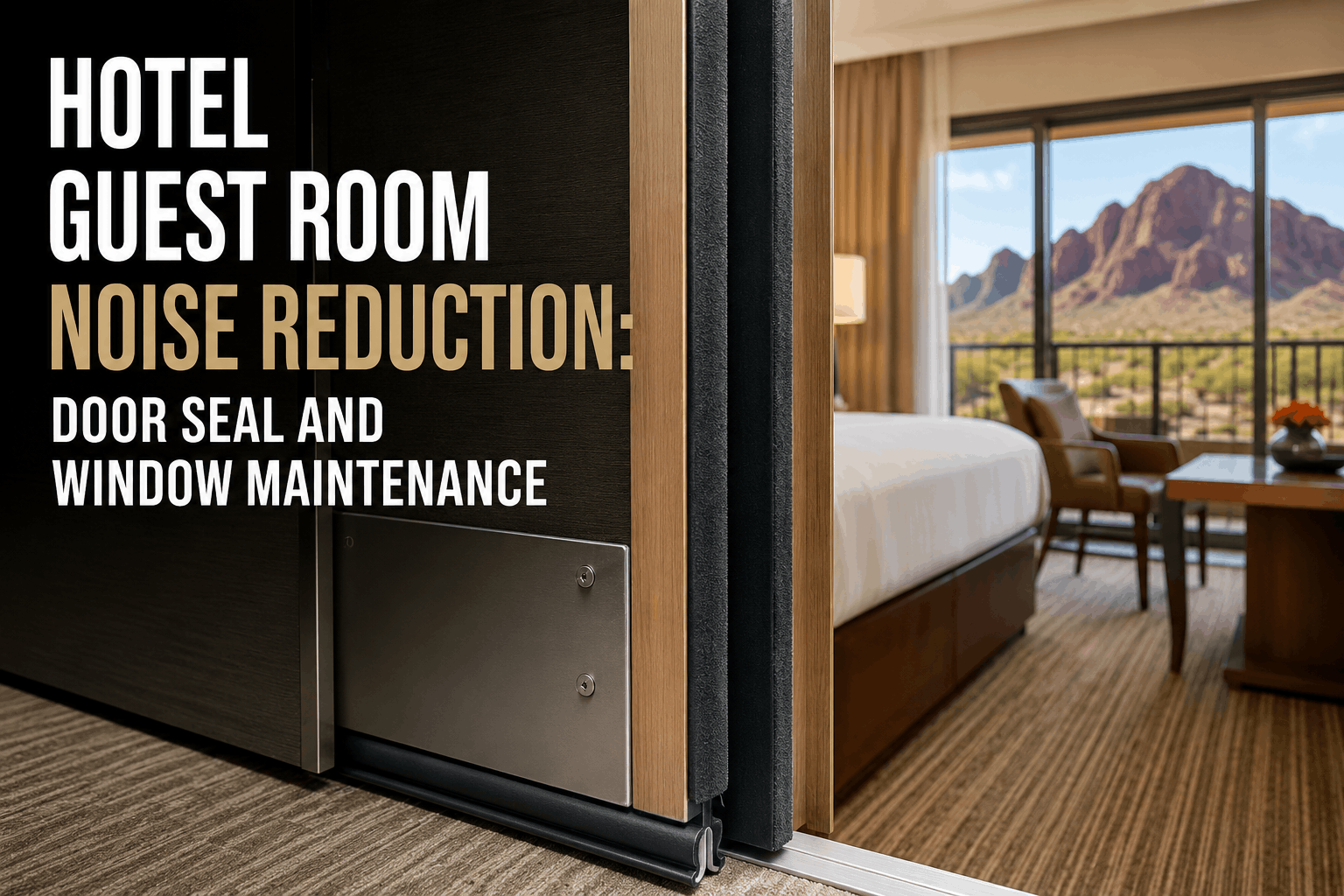
Door Seal Replacement
Replace worn door seals (sweeps, weatherstripping, acoustic seals) in all guest rooms. Address gaps under doors (max 1/4"). Reduces corridor noise transmission by 50–70%.
3
Window Glazing & Seals
Verify window seals are intact. Consider secondary glazing or acoustic glass for high-exterior-noise exposures. Reduces exterior noise penetration by 30–60%.
4
Plumbing Noise Mitigation
Install water hammer arrestors, pipe insulation (acoustic), and pressure-reducing valves. Secure loose pipes. Reduces plumbing noise complaints by 60–80%.
5
Acoustic Floor Treatments
Install carpet over acoustic underlay. Address creaking floors with structural screws. Reduces footfall transmission by 40–60%.
6
White Noise Systems
Install sound masking (white noise) systems in corridors and guest rooms. Reduces the perception of transmitted noise by 30–50%.
Before vs. After: Noise Management Transformation
Noise Management Metric
Before (Reactive)
After (Proactive)
Noise-related guest complaints
24–36 per year
8–12 per year — 60–70% reduction
HVAC noise complaints
12–18 per year
3–5 per year — 70–80% reduction
Plumbing noise complaints
6–10 per year
2–3 per year — 60–70% reduction
Door seal inspections
Reactive — only when complaint
Quarterly — 100% coverage
Guest relocation due to noise
40–60 per year
10–15 per year — 70% reduction
"
Noise complaints were our #1 guest issue — we were relocating 4–5 guests per week due to noisy rooms. We implemented a systematic noise reduction program: vibration isolators on PTACs, door seal replacements across all rooms, water hammer arrestors on plumbing. Within 12 months, noise complaints dropped from 32 per year to 9 per year. Guest relocation due to noise dropped by 70%. The program paid for itself in avoided guest compensation and improved reviews within the first year.
Director of Engineering — 350-room Full-Service Hotel, US Northeast
Frequently Asked Questions — Hotel Noise Reduction
What is the most common noise complaint in hotels?
HVAC noise is the most common noise complaint — airflow noise, equipment rumble, and vibration from PTAC units and AHUs. HVAC noise accounts for 35–40% of all noise complaints. Regular filter changes, coil cleaning, and vibration isolation can reduce HVAC noise complaints by 60–80%.
What is the easiest noise mitigation fix for hotels?
Door seal replacement is the easiest and highest-ROI noise mitigation fix. Worn door sweeps and weatherstripping allow corridor noise (talking, footsteps, luggage carts) to enter guest rooms. Replacement costs $20–50 per door and can reduce corridor noise transmission by 50–70%. Most hotels can replace all door seals in 2–4 weeks.
How does HVAC maintenance affect noise levels?
Dirty filters restrict airflow, causing the fan to work harder and generate more noise. Unbalanced fans vibrate and transmit noise through the structure. Clogged coils reduce efficiency and cause longer run times. Regular HVAC maintenance — filter changes, coil cleaning, fan balancing — reduces operational noise and extends equipment life. OxMaint's HVAC PM module schedules all maintenance tasks to prevent noise issues.
How does a CMMS help with noise reduction?
A CMMS like OxMaint provides three noise reduction advantages: (1) Complaint tracking — records noise complaints by room and source, identifying problem areas, (2) Preventive scheduling — schedules door seal inspections, HVAC maintenance, and plumbing checks, (3) Mitigation documentation — tracks which rooms have received noise treatments and their effectiveness. Without a CMMS, noise reduction is reactive and inconsistent.