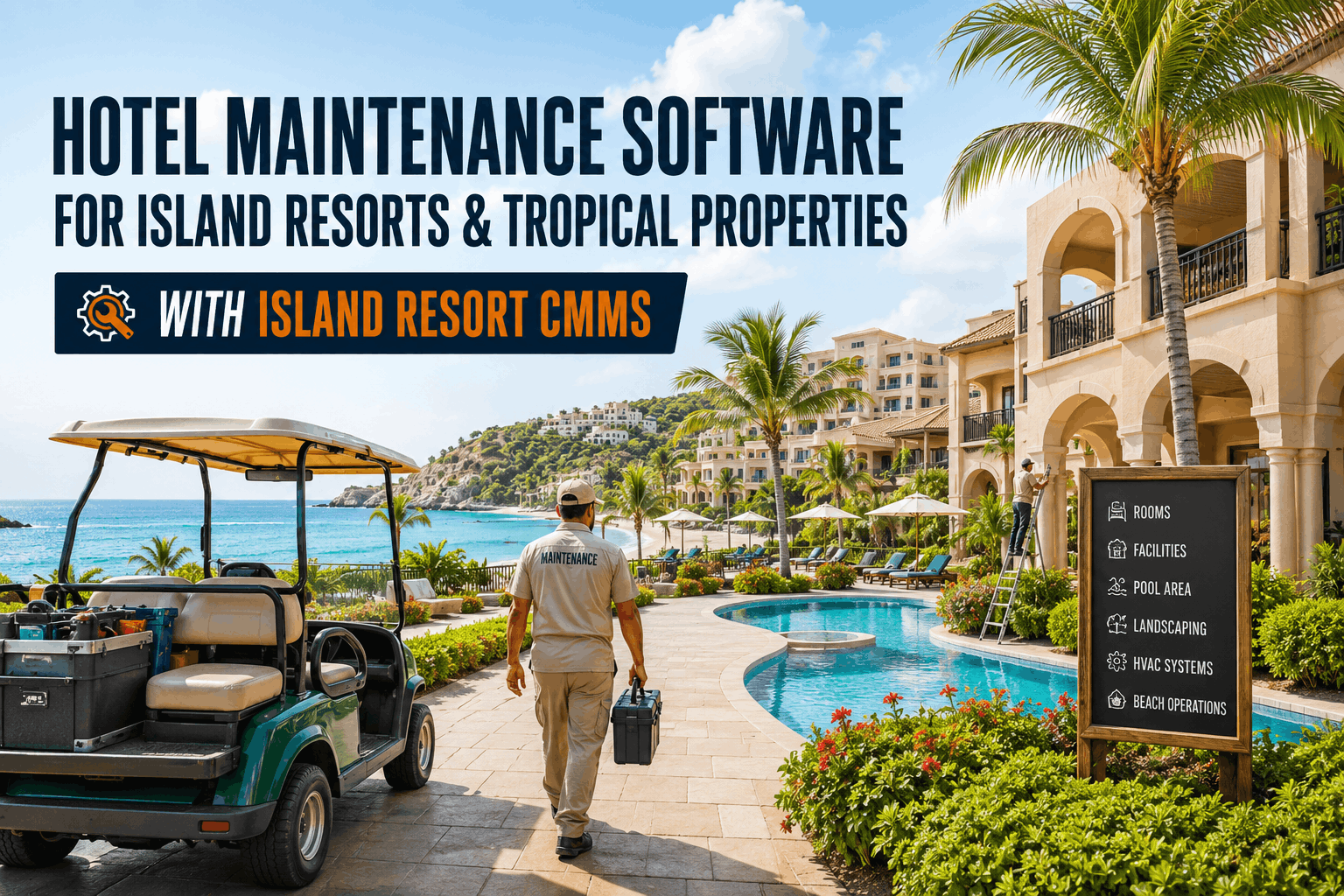
Island resorts and tropical properties deliver the ultimate escape for guests—but for the facility team, paradise is a relentless battle against salt-laden air, monsoon rains, tropical humidity, and the logistical complexity of maintaining a self-contained operation where the nearest hardware store is an ocean away. Every system on a tropical property faces accelerated degradation: salt spray corrodes electrical contacts and condenser coils within months instead of years, humidity feeds mold growth in HVAC ductwork and behind wall coverings, tropical storms test every waterproofing membrane and drainage system, and the constant cycle of wet-dry-wet creates expansion and contraction stresses that crack sealants and open water intrusion paths. An island resort CMMS is not optional in this environment—it is the operational foundation that prevents the tropical climate from winning. Without structured maintenance tracking, a corroded switch contact that could have been caught during a quarterly PM becomes a generator transfer failure during a storm; a dehumidifier drain pan that needed cleaning becomes a ceiling leak in a premium suite; and a boat transfer vessel that missed its scheduled engine service strands guests at the airport dock. Sign Up Free to see how OxMaint gives island resort facility teams the corrosion-adjusted PM scheduling, storm readiness tracking, and remote logistics management needed to maintain the paradise experience despite the environment's best efforts to reclaim it.
Keep Paradise Running—With Maintenance That Anticipates the Tropics
OxMaint gives island resort teams the corrosion-adjusted scheduling, storm readiness tracking, and remote logistics management to deliver flawless guest experiences when the nearest supply chain is a boat or plane away.
Why Island Resorts Need Environment-Specific Maintenance Management
Standard commercial maintenance schedules fail in tropical island environments for one fundamental reason: they assume supply chains are local and degradation rates are predictable. At an island resort, a failed chiller compressor doesn't mean a next-day replacement from a local distributor—it means chartering a part via air freight, managing customs clearance, and possibly closing rooms for a week. A corroded electrical panel on a beachfront restaurant doesn't mean calling a local electrician—it means flying in a specialized technician. These logistical realities demand that PM schedules be shortened to catch degradation before failure, that critical spare parts inventories be maintained at levels that account for resupply lead times measured in weeks rather than hours, and that seasonal storm readiness be treated as a structured, trackable program rather than a last-minute scramble. Properties that Book a Demo with OxMaint see how environment-adjusted PM intervals, spare parts inventory tracking with lead-time awareness, and structured seasonal readiness programs combine into an island-capable maintenance operation.
OxMaint schedules shortened inspection and cleaning intervals for all equipment exposed to salt-laden air—electrical contacts, condenser coils, structural connections, and outdoor fixtures—preventing the corrosion cascade that turns a cleanable contact into a replacement.
OxMaint manages the complete hurricane and tropical storm preparation program—generator testing, drainage clearing, outdoor equipment securing, and emergency supply verification—with pre-season milestones tracked to completion.
Tropical humidity demands aggressive dehumidification and mold prevention. OxMaint schedules dehumidifier PMs, HVAC drain pan inspections, and moisture intrusion checks at frequencies that prevent mold before it becomes a guest complaint or health issue.
When resupply takes weeks, stockout costs are measured in room nights lost. OxMaint tracks critical spare parts inventory with reorder points that account for island lead times—ensuring the part is on the shelf before the failure occurs.
Guest transfer vessels, dive boats, water sports equipment, and dock infrastructure are essential resort assets. OxMaint schedules vessel engine PMs, dock structural inspections, and safety equipment checks as trackable maintenance tasks.
Island resorts often operate their own water treatment, desalination, and wastewater systems with zero municipal backup. OxMaint schedules PMs and tracks reliability for every component of the self-contained utility infrastructure.
Essential Island Resort Maintenance Checklist by Environmental Challenge
Salt air corrosion is the single most aggressive asset destroyer in a tropical island environment—attacking every exposed metal surface, electrical connection, and mechanical component at rates that shock facility managers accustomed to inland properties. A structured corrosion prevention program classifies every asset by salt exposure level: direct beachfront (highest risk), ocean-view with prevailing wind exposure, inland/protected (moderate risk), and interior conditioned spaces (lowest risk). For high-exposure assets, PM intervals are shortened dramatically: condenser coil cleaning moves from quarterly to monthly, electrical panel inspections move from annual to quarterly with contact cleaning and anti-corrosion spray reapplication, outdoor lighting fixture gasket integrity is checked quarterly, and structural steel connections on beachfront structures are inspected semi-annually for coating integrity. OxMaint assigns each asset a salt exposure classification, schedules corrosion-adjusted PMs, and tracks coating and treatment application dates—ensuring that the shortened intervals the environment demands are actually executed. Facilities that Sign Up Free can configure salt-exposure-adjusted PM schedules from their first asset setup.
Tropical storm readiness at an island resort is not a checklist that can be completed in the 72 hours before a forecasted landfall—it is a seasonal program that must begin months before the first storm forms. The readiness program includes: emergency generator load bank testing with full fuel storage verification, transfer switch function testing under load, storm drain and swale clearing to handle monsoon volumes, outdoor equipment and furniture securing plan with assigned responsibilities and pre-positioned tie-down hardware, window and door shutter system function verification, backup water supply and treatment system testing, emergency communication system testing including satellite phone when cellular infrastructure fails, and guest evacuation logistics coordination documented and reviewed. OxMaint schedules every pre-season readiness task with completion deadlines, assigns responsibility, and tracks completion status—giving the general manager and director of engineering a real-time view of storm readiness that replaces clipboard checklists that are only found during the pre-storm scramble. Teams that Book a Demo can see how the storm readiness program is configured as a tracked seasonal project in OxMaint.
Tropical humidity creates mold conditions that damage building materials and trigger guest health complaints—and in a luxury resort environment, visible mold or musty odors are brand-destroying events. Humidity control maintenance includes: dehumidifier system PM with coil cleaning and drain pan inspection (mold starts in the drain pan before spreading to ductwork), HVAC condensate drain line cleaning and treatment to prevent the biofilm buildup that causes clogs and overflow, guest room moisture intrusion inspection during rainy season—checking window and door seals, ceiling stains indicating roof or plumbing leaks, and wall moisture readings in ground-floor units where rising damp is possible. Bathroom exhaust fan verification ensures guests can remove shower humidity. OxMaint schedules dehumidifier PMs at tropical-adjusted frequencies, logs moisture readings during room inspections, and tracks mold-related work orders by room number—identifying chronic moisture intrusion locations that need structural remediation rather than repeated surface treatment.
For island resorts, the guest experience often begins at the water—with a resort-operated transfer vessel, a dive boat for excursions, or a waterfront arrival dock. These marine assets require maintenance programs that integrate with the broader resort CMMS rather than being managed in a separate boatyard logbook. Vessel maintenance includes: engine service intervals tracked by operating hours (oil change, filter replacement, impeller inspection, fuel system water separation), hull inspection and cleaning to prevent marine growth that reduces speed and increases fuel consumption, safety equipment verification (life jackets, flares, radio, EPIRB battery date), and dock and pier structural inspection for corrosion, loose decking, and cleat/hardware integrity. OxMaint tracks engine hours, schedules services by hour interval, and logs all maintenance events per vessel—giving the marine operations manager the same structured maintenance visibility that the chief engineer has for land-side equipment.
Many island resorts operate their own water treatment or desalination plants, wastewater treatment facilities, and backup power generation because no municipal utility connection exists. A failure in any of these systems means the resort cannot operate—there is no grid to fall back on, no municipal water main to tap. Self-contained utility maintenance includes: desalination plant PM (membrane condition monitoring, high-pressure pump service, pre-filter replacement on shortened intervals due to tropical biofouling), wastewater treatment plant PM (aeration system, clarifier mechanism, effluent quality testing, pump service), and generator system PM beyond standard testing (fuel polishing to prevent diesel bug growth in humid storage, cooling system service, block heater verification). OxMaint schedules all utility system PMs at the frequencies required for continuous operation, tracks consumable inventory (membranes, filters, treatment chemicals), and generates work orders for any parameter trending outside specification before the system fails. Facilities can Sign Up Free and begin loading utility assets with tropical-adjusted PM schedules immediately.
When the nearest supplier is a flight or cargo boat away, the definition of a critical spare part changes—it's not the part that costs the most, it's the part whose absence forces a room closure, amenity shutdown, or guest service interruption for the duration of the resupply lead time. Critical spares for an island resort typically include: compressor contactors and capacitors for HVAC units, pool pump seals and impellers, generator fuel filters and belts, desalination pre-filters and dosing pump diaphragms, and specialized light bulbs or LED drivers unique to the property's lighting design. OxMaint tracks critical spare parts inventory by asset association, maintains reorder points calculated from historical consumption rate plus island resupply lead time, and generates reorder notifications before stockout occurs—preventing the situation where a $50 capacitor shortage closes a $1,000-per-night suite for a week waiting for air freight.
Island Resort Maintenance: Tropical Environment PM Schedule Reference
| Asset System | Tropical Adjustment Factor | Adjusted PM Interval | OxMaint Record | Failure Consequence |
|---|---|---|---|---|
| HVAC Condenser Coils | Salt air corrosion + humidity | Monthly beachfront; quarterly inland | Coil condition, cleaning date, fin treatment applied | Compressor failure; weeks for replacement delivery |
| Electrical Panels (Outdoor) | Salt air contact corrosion | Quarterly contact cleaning and anti-corrosion treatment | Panel ID, inspection date, treatment applied, thermal reading | Arc fault; equipment damage; fire risk |
| Emergency Generator | Storm season criticality + humidity | Weekly test run; monthly load test; quarterly full service | Run hours, test result, fuel level, service date | Resort-wide outage during or after storm |
| Dehumidification Systems | Continuous high humidity operation | Monthly coil and drain pan cleaning; quarterly full service | Unit ID, coil condition, drain flow verified, humidity reading | Mold growth; guest health complaint; room closure |
| Marine Vessel Engines | Salt water + continuous operation | Every 100 operating hours; pre-season full service | Vessel ID, engine hours, service items completed, next due | Guest transfer failure; stranded passengers |
| Desalination/Water Plant | Zero utility backup; biofouling | Daily parameter check; monthly membrane; quarterly pump | Flow rate, TDS reading, membrane pressure, chemical levels | Resort without water; mandatory evacuation |
How OxMaint Supports Island Resort Facility Management Programs
Island resort maintenance is a logistical and environmental challenge unlike any other hospitality operation—salt air corrodes, humidity breeds mold, storms threaten, and the supply chain is measured in weeks rather than hours. OxMaint connects corrosion-adjusted PM scheduling, storm season readiness tracking, marine asset management, self-contained utility PMs, and critical spare parts inventory into a single platform—giving the resort's leadership team the structured data to confirm that every system is being maintained for the environment it actually operates in, not the environment a standard hotel PM schedule assumes. When OxMaint shows pre-season storm readiness tasks completed on schedule, corrosion PMs executed at the shortened intervals the salt air demands, vessel services logged by engine hours, and critical spares stocked above reorder points, that is the evidence base that the resort is prepared for the environment—and that guest experience won't be interrupted by a predictable, preventable failure. Facilities can Sign Up Free and begin configuring tropical-adjusted maintenance programs from their first asset setup in OxMaint.
Building an Island Resort Maintenance Program: Implementation Steps
Classify Assets by Salt & Humidity Exposure
Assign every asset in OxMaint an environmental exposure classification: direct beachfront, ocean-view/prevailing wind, inland/protected, and interior conditioned. These classifications will drive PM interval adjustments across all equipment.
Configure Tropical-Adjusted PM Intervals
Set environment-adjusted PM frequencies in OxMaint: monthly coil cleaning for high-exposure HVAC, quarterly electrical panel contact cleaning, monthly dehumidifier service, weekly generator testing during storm season.
Build Storm Season Readiness Project Plan
Create the complete storm readiness program in OxMaint as a seasonal project with task deadlines 30 days before storm season begins—generator load test, drainage clearing, shutter verification, emergency supplies, fuel storage.
Establish Critical Spares Inventory with Lead Times
Identify every part whose absence forces guest-impacting downtime, load into OxMaint with island-adjusted reorder points (historical consumption rate × resupply lead time), and set reorder notifications.
Integrate Marine Assets into the CMMS
Load all vessels, docks, and waterfront equipment into OxMaint as tracked assets. Schedule engine services by operating hours, dock inspections quarterly, and safety equipment checks per regulatory requirements.
Review Environmental Impact Trends Quarterly
Review OxMaint dashboards quarterly—corrosion-related failure rate, storm readiness completion, spare parts stockout incidents, vessel downtime—and adjust PM intervals or inventory levels based on actual failure patterns in your specific microclimate. Book a Demo to see the full island resort maintenance workflow.
Frequently Asked Questions
How do island resort maintenance schedules differ from mainland hotel schedules?
Island resort maintenance schedules must account for salt air corrosion accelerating equipment wear, tropical humidity requiring aggressive mold prevention, storm season demanding structured readiness programs, and remote supply chains requiring larger critical spare parts inventories with lead-time-adjusted reorder points. PM intervals for exposed equipment are typically 50–100% more frequent, and the consequences of deferred maintenance are amplified by the weeks-long delay in obtaining replacement parts or specialized technician support.
What is the most critical pre-storm-season maintenance task?
Emergency generator system readiness—including load bank testing under full resort load, fuel storage verification and polishing to remove water and diesel bug contamination, and transfer switch function testing—is the single most critical pre-season task. A generator that fails during or after a tropical storm leaves the resort without power, water, communications, and guest services for potentially weeks until utility infrastructure is restored and equipment is repaired.
How does OxMaint help manage the salt air corrosion problem?
OxMaint assigns each asset a salt exposure classification, schedules PMs at shortened intervals appropriate for that classification, and tracks corrosion-prevention treatments—coil cleaning, contact cleaning and anti-corrosion spray application, coating renewal—to ensure the accelerated schedule the salt environment demands is actually being executed. The system also tracks corrosion-related failure events, identifying assets or locations where the current PM interval is still insufficient.
What spare parts should island resorts stock differently than mainland properties?
Island resorts should stock critical spares whose absence forces guest-impacting downtime for the duration of the resupply lead time—HVAC compressor contactors and capacitors, pool pump seals and impellers, generator fuel filters and belts, desalination pre-filters and dosing pump components, and any specialized lighting or control system parts unique to the property. The reorder point must be calculated as (daily consumption rate × resupply lead time in days) + safety stock, not just a standard minimum quantity.
How should marine assets be integrated into a resort CMMS?
Marine assets—transfer vessels, dive boats, water sports equipment, docks, and piers—should be loaded into OxMaint as tracked assets with their own PM schedules. Vessel engines are serviced by operating hours, so OxMaint tracks hour meter readings and generates service work orders when the interval is reached. Dock and pier inspections are scheduled on calendar intervals. Safety equipment (life jackets, flares, radios, EPIRBs) are tracked with expiration date alerts. This integration ensures waterfront maintenance has the same structured visibility as land-side building maintenance.
Keep Paradise Operating—No Matter What the Tropics Send Your Way
OxMaint gives island resort facility teams the corrosion-adjusted scheduling, storm readiness tracking, marine asset management, and remote logistics tools to deliver the flawless guest experience that makes your resort worth the journey.