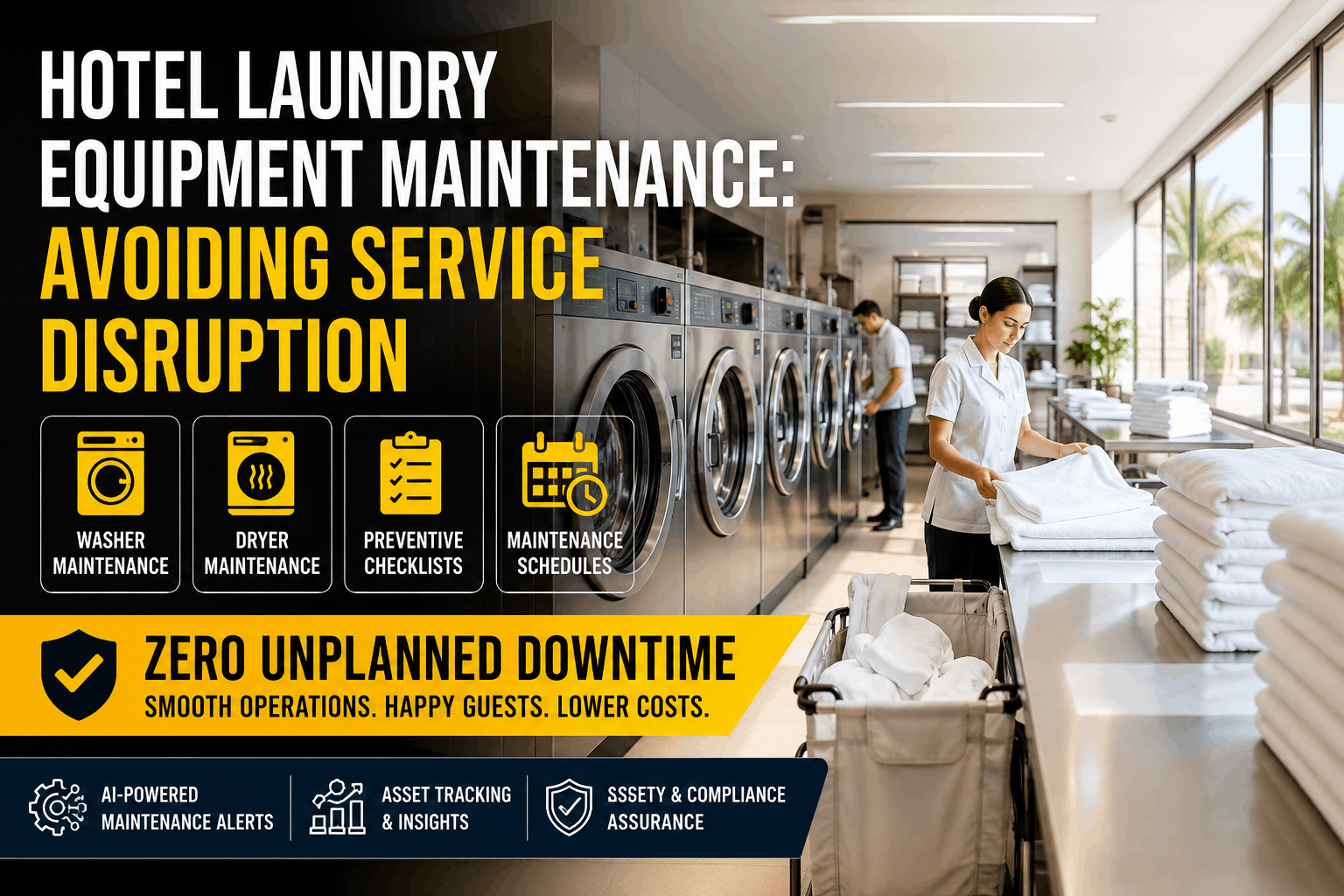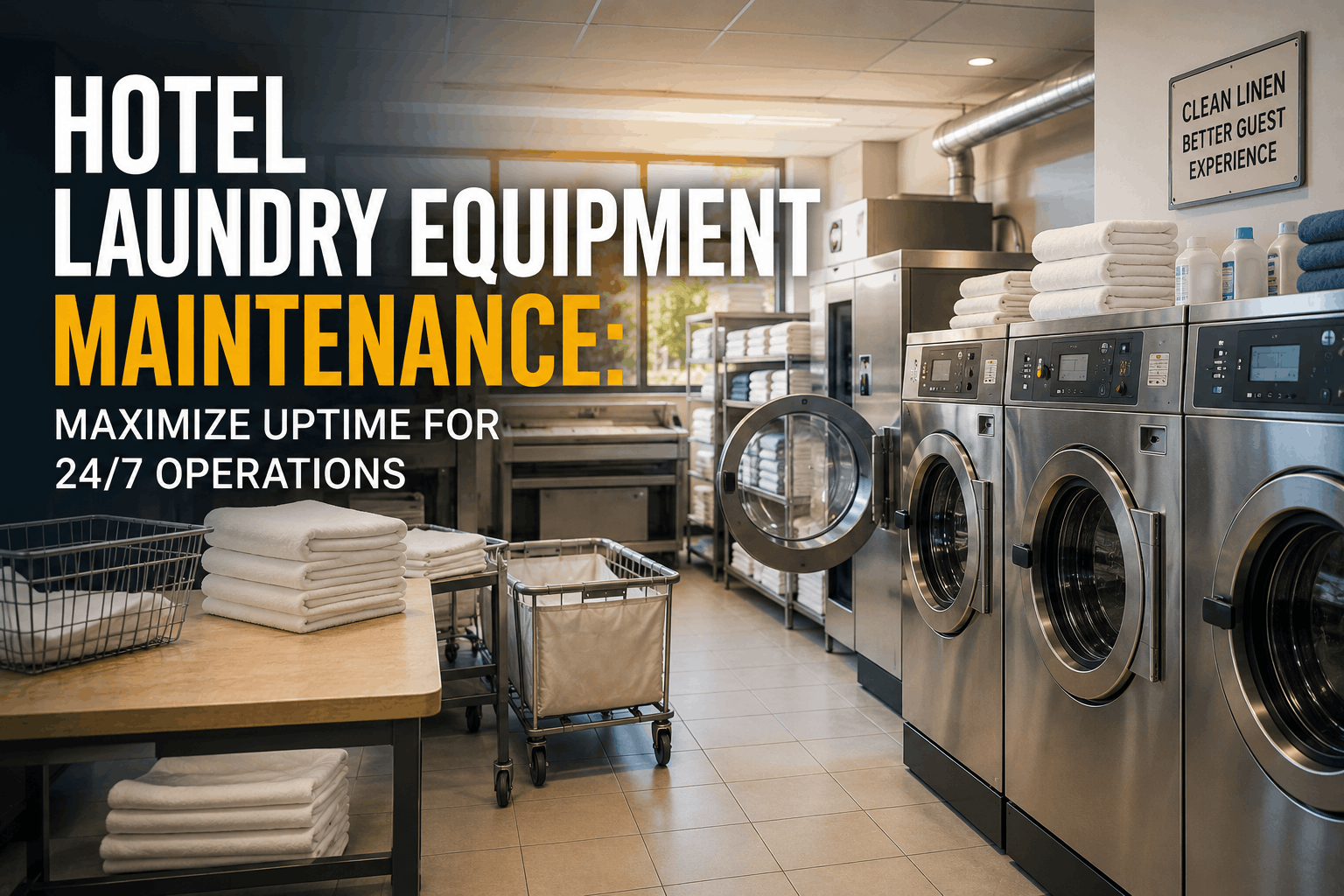
Hotel laundry equipment maintenance is the operational backbone of on-premise laundry — when a commercial washer or dryer fails, clean linen supply stops, room turnover stalls, and guest satisfaction drops within hours. A structured washer dryer CMMS for hotels eliminates reactive firefighting by automating preventive maintenance schedules, lint trap cleaning, belt and bearing inspections, drain and vent PM, and chemical injection servicing across every laundry asset. This 2026 guide covers the complete PM checklist, reliability benchmarks, and how a CMMS purpose-built for hotel laundry keeps throughput matched to occupancy. Ready to stop downtime before it starts? Start Free Trial or read on for the full framework.
What happens when your hotel laundry goes down at 9 PM on a sold-out night?
No clean sheets. No clean towels. Rooms not turned. Guests at the front desk. One failed commercial washer or clogged dryer vent can cascade into a housekeeping crisis that costs thousands per night in comped rooms, linen rentals, and damaged reputation. The fix isn't more staff — it's a CMMS that prevents the failure before it happens.
Hotel Laundry PM Checklist: Daily, Weekly, Monthly & Quarterly Tasks
A 200-room hotel runs 40–60 loads per day across 2–4 commercial washers and dryers. Without a tiered PM schedule, lint accumulation, bearing wear, and chemical scaling silently reduce capacity until a machine drops at peak occupancy. Below is the complete laundry PM 2026 checklist — every task mapped to frequency, asset type, and typical time-to-complete.
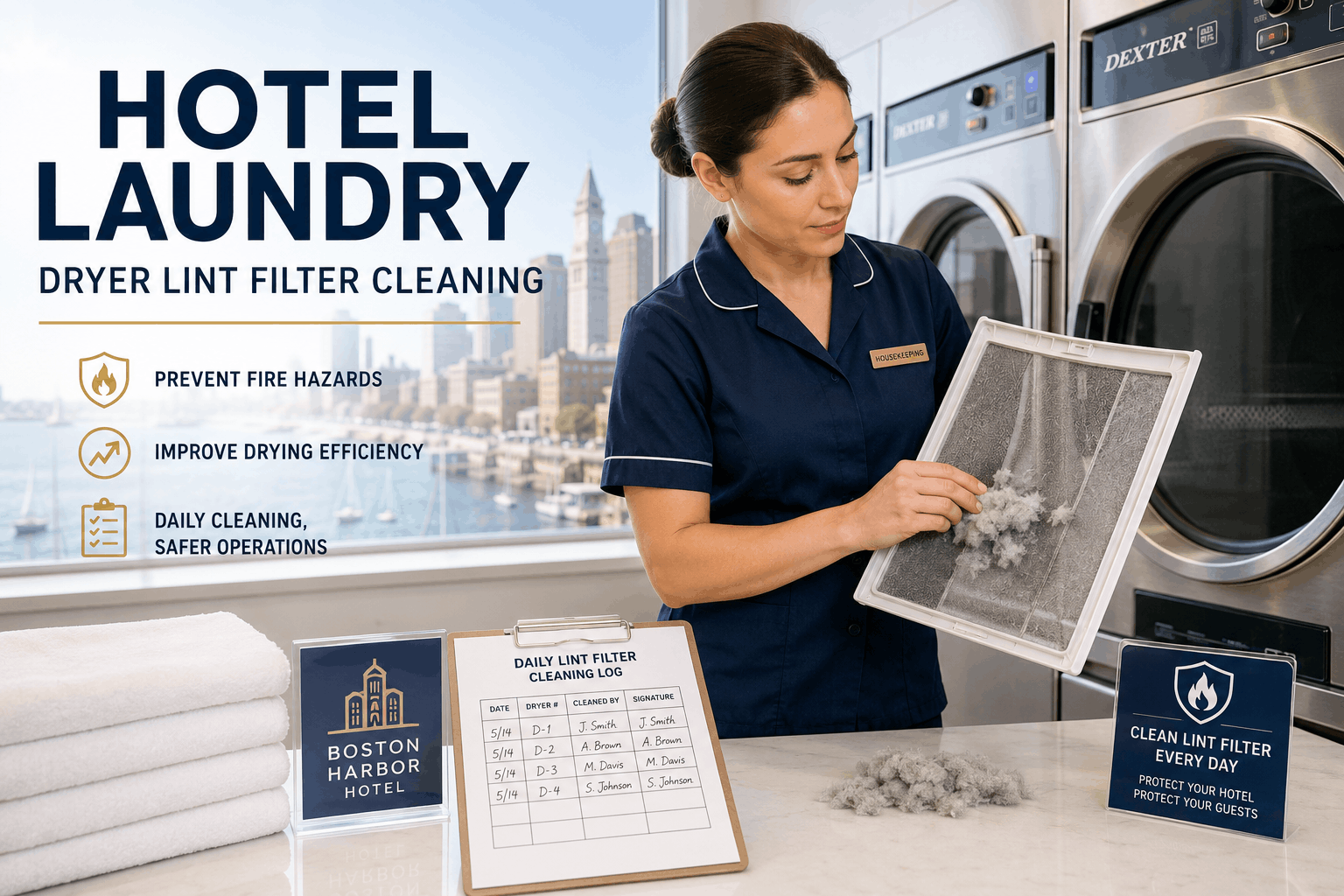
- Wipe dryer lint screen after every shift — clogged screens reduce airflow 30%+ and are the #1 fire hazard
- Inspect washer door seals and gaskets for tears, debris, chemical residue
- Verify chemical injection pumps are primed and dispensing correct volumes
- Check for water leaks around supply valves, drain connections, and door boots
- Confirm dryer exhaust temperature is within 150–180°F operating range
- Log cycle counts and any error codes per machine
- Deep-clean dryer lint trap and inspect exhaust ducting for blockage
- Lubricate washer and dryer bearings per OEM spec (typically lithium-based grease, NLGI #2)
- Inspect drive belts for tension, cracking, and alignment — replace at first sign of glazing
- Descale chemical injection lines and flush dispenser cups
- Test emergency stops, door interlocks, and thermal overload switches
- Inspect and clean dryer exhaust vent system from machine to roof/wall cap — NFPA 211 dryer vent cleaning
- Check washer drain pumps, inlet valve screens, and pressure transducers
- Verify motor amperage draw against OEM baseline — deviation >10% triggers work order
- Calibrate chemical dosing pumps against actual load weight and soil level
- Audit spare parts inventory: belts, bearings, seals, fuses, heating elements
- Full dryer vent system inspection and professional cleaning if airflow <400 CFM at termination
- Vibration analysis on washer/dryer motors and bearings — flag ISO 10816 velocity >4.5 mm/s
- Inspect shock absorbers, suspension rods, and trunnion supports for wear
- Thermal imaging scan of motor control panels, contactors, and heating elements
What Hotel Laundry Downtime Actually Costs You
Most hotels track laundry costs as a flat per-occupied-room figure ($4–$7) but never isolate the cost of equipment failure. When you do, the numbers are sobering — and they make the case for a CMMS dryer maintenance hotel program immediately.
A 250-room property with 8 laundry assets typically experiences 6–8 unplanned downtime events per year without a CMMS — costing roughly $51,000–$68,000 annually in comped rooms, linen rentals, and emergency repairs. Implementing OxMaint CMMS with automated PM scheduling, spare-parts tracking, and predictive analytics typically reduces unplanned laundry downtime by 35–50%, saving $18,000–$34,000 per year — with payback in under 4 months on a mid-tier CMMS subscription.
Commercial Washer & Dryer CMMS Maintenance: Component-Level Guide
A hotel laundry equipment CMMS guide isn't just a checklist — it's a component-level maintenance strategy mapped to failure modes, service intervals, and spare-parts readiness. Here's how each critical system breaks down.
| Component / System | Failure Mode | PM Interval | CMMS Trigger | Spare Part on Hand |
|---|---|---|---|---|
| Dryer lint trap & exhaust duct | Airflow restriction → fire, extended dry times | Daily wipe / Weekly deep clean / Quarterly full vent | Cycle count + calendar | Cleaning brushes, vent hood |
| Drive belts (washer & dryer) | Breakage → machine stop, motor overload | Weekly inspection / replace at 12–18 mo | Runtime hours + visual | 1 belt per machine + 1 spare |
| Bearings (trunnion, motor, drum) | Wear → vibration, noise, catastrophic seizure | Monthly lube / Quarterly vibration analysis | Vibration velocity >4.5 mm/s | Bearing kit per model |
| Door seals & gaskets | Tear → water leak, pressure loss, chemical spray | Daily visual / Monthly replacement audit | Leak report + age | 2 gaskets per machine model |
| Chemical injection pumps | Scale buildup → under-dosing, poor wash quality | Weekly flush / Monthly calibration | Cycle count + pH test | Diaphragm kit, tubing |
| Drain pump & inlet valves | Debris clog → flood, cycle abort, water damage | Monthly screen clean / Quarterly inspection | Drain cycle time deviation | Pump assembly, valve screen |
| Heating elements & gas burners | Scale/fatigue → thermal cutout, long dry times | Monthly temp verification / Quarterly thermal scan | Temp deviation >10°F from setpoint | Heating element, igniter, gas valve |
| Motor & control panel | Overheating, contactor pitting → control failure | Quarterly amperage + thermal imaging | Amp draw >10% above baseline | Contactor, capacitor, overload |
How to Launch a CMMS-Based Laundry Maintenance Program in 4 Months
Switching from clipboard-and-spreadsheet maintenance to a hotel laundry asset CMMS guide doesn't happen overnight — but it doesn't take a year either. Here's a realistic 4-month rollout that most properties follow.
Asset Registry & Baseline Data
Catalog every washer, dryer, folder, ironer, and chemical dispenser with make, model, serial, install date, and OEM PM manual. Upload to OxMaint. Photograph each machine, scan spec sheets, record current runtime hours and cycle counts as your reliability baseline.
PM Schedule Build & Spare-Parts Mapping
Build every PM task from the checklist above into OxMaint as a recurring work order — daily, weekly, monthly, quarterly — auto-assigned to the right technician. Map critical spare parts (belts, bearings, seals, fuses) to each asset with min/max reorder levels so you're never waiting 3 days for a belt.
Go Live: Mobile Work Orders & Compliance
Technicians receive PM work orders on mobile devices — complete with checklists, OEM specs, and photo capture. Lint trap cleaning, belt tension, bearing lube — every task logged with timestamp, parts used, and condition notes. NFPA-compliant dryer vent cleaning records are audit-ready instantly.
Analytics, Prediction & Optimization
OxMaint's analytics engine now has 90+ days of runtime, failure, and PM data. You can see MTBF per asset, PM compliance rate, mean time to repair, and cost per wash cycle. Predictive alerts flag machines trending toward failure — rising motor amperage, increasing drain cycle time, vibration drift — before they break.
How OxMaint CMMS Solves Hotel Laundry Equipment Maintenance
OxMaint is an AI-powered CMMS and EAM platform built for maintenance and reliability teams who can't afford unplanned downtime. Here's exactly how it maps to your on-premise laundry operation — and the measurable outcomes each capability delivers.
Automated PM Scheduling
Every daily, weekly, monthly, and quarterly PM task auto-generates as a mobile work order assigned to the right technician — with checklists, OEM specs, and photo capture. No more missed lint trap cleanings or skipped bearing lubes.
Predictive Maintenance Alerts
OxMaint's AI engine analyzes motor amperage trends, drain cycle times, vibration data, and temperature deviations — alerting you to developing failures weeks before they happen. Shift from "fix when broken" to "fix before failure."
Spare-Parts Inventory Tracking
Map belts, bearings, seals, fuses, and heating elements to each laundry asset with min/max reorder points. OxMaint auto-generates purchase requests when stock dips — so the belt you need is always on the shelf, not 3 days away.
Compliance & Audit-Ready Records
Every PM task, repair, and inspection is logged with timestamp, technician, parts used, and photo evidence — NFPA 211 dryer vent cleaning, OSHA safety checks, and brand-standard audits are instantly exportable. No more scrambling for paper records.
Laundry Maintenance KPIs Every Hotel Should Track in 2026
If you can't measure it, you can't improve it. These are the five metrics that separate a reactive hotel laundry from a reliability-driven one — and the benchmarks OxMaint helps you hit.
Percentage of scheduled PM tasks completed on time. Below 85% means you're accumulating reliability debt that will eventually surface as unplanned downtime.
Average runtime between unplanned laundry equipment failures. A well-maintained commercial washer should run 120+ days between breakdowns; dryers 100+.
From fault report to first clean load. Long MTTR usually means parts weren't on hand, the right technician wasn't available, or the problem wasn't diagnosed quickly.
How often a needed part is missing when a work order is opened. Every stockout adds 24–72 hours of downtime waiting for a rush shipment.
Total cost (labor + chemicals + utilities + maintenance + parts) divided by cycles run. A rising trend signals efficiency losses — scaling, under-dosing, or mechanical drag.
Unplanned downtime divided by scheduled laundry operating hours. Above 8% means your laundry room can't reliably support full occupancy — you're one busy weekend from a crisis.
See OxMaint on your laundry assets — book a 30-minute demo
We'll walk you through automated PM scheduling, predictive alerts, spare-parts tracking, and compliance reporting — configured for your hotel's washers, dryers, and occupancy patterns. No slides, just the product on real scenarios.
Hotel Laundry Equipment Maintenance: Your Questions Answered
How often should a hotel clean dryer lint traps and exhaust vents?
Dryer lint screens should be cleaned after every shift (daily), with a deep clean of the lint trap assembly weekly. The full exhaust vent system — from machine to roof or wall termination — should be professionally inspected and cleaned at least quarterly, and in high-volume properties monthly. NFPA 211 recommends dryer vent inspection at least annually, but hotel laundry volume (40–60 loads/day) demands quarterly minimum. Clogged vents are the leading cause of dryer fires and can reduce drying efficiency by 30%+, extending cycle times and driving up utility costs.
What does a CMMS do for hotel laundry maintenance?
A CMMS like OxMaint automates preventive maintenance scheduling, generates mobile work orders with checklists and photo capture, tracks spare-parts inventory with auto-reorder, logs every task for compliance, and uses analytics to predict equipment failures before they happen. For a hotel laundry, this means no missed PMs, no parts stockouts, audit-ready records, and 35–50% less unplanned downtime. You can Start Free Trial to see the full workflow in action.
What are the most common commercial washer and dryer failures in hotels?
The top five failure modes are: (1) drive belt breakage from wear and misalignment, (2) bearing failure from inadequate lubrication causing vibration and seizure, (3) drain pump clogs from debris causing floods and cycle aborts, (4) chemical injection scaling causing under-dosing and poor wash quality, and (5) heating element or gas burner failure from lint accumulation and thermal overload. Roughly 40% of these are preventable with a disciplined PM schedule — which is exactly what a CMMS automates.
How much does hotel laundry downtime cost per hour?
A typical 200-room hotel loses $350–$850 per hour of laundry downtime when you account for comped or downgraded rooms (guests can't check into clean rooms), emergency linen rental fees ($0.50–$1.25 per pound), overtime housekeeping labor, and expedited repair costs. A single 23-hour failure event averages $8,500. For a 250-room resort with 8 laundry assets experiencing 6–8 events per year, that's $51,000–$68,000 in annual downtime cost — most of it preventable with CMMS-driven PM.
How long does it take to implement a CMMS for hotel laundry?
Most hotels complete a full OxMaint CMMS rollout in 4 months: Month 1 is asset registry and baseline data, Month 2 is PM schedule and spare-parts mapping, Month 3 is go-live with mobile work orders, and Month 4 is analytics and predictive optimization. You can Book a Demo to see a tailored implementation plan for your property's size, equipment count, and occupancy patterns. Many properties see measurable downtime reduction within the first 60 days.
Stop fixing laundry equipment after it breaks. Start preventing failures today.
Join the hotels using OxMaint to automate PM, predict failures, track spare parts, and keep every washer and dryer running at full capacity — even on sold-out nights. Your housekeeping team and your guests will thank you.
Free 14-day trial · No credit card