Guest Room Maintenance Checklist: 147-Point Inspection for Five-Star Standards
By Peter Parker on February 26, 2026
A front desk associate at a 280-room upscale hotel received a guest complaint at 10:47 PM: the PTAC unit was not cooling, the shower drain was backing up, and the room-side USB outlets were dead. Three separate maintenance issues in one room, discovered simultaneously. The engineering log showed the room had not received a preventive inspection in 74 days. Each issue individually takes 15 minutes to fix during a scheduled inspection. Together, discovered by a guest at 11 PM, they generated a comp night, a negative review, and a chief engineer callback on a weekend. Sign up for Oxmaint and load this 147-point guest room inspection checklist into your CMMS today — before the next guest finds the problem your team missed.
Inspection Management · Guest Experience & Rooms
Guest Room Maintenance Checklist: 147-Point Inspection for Five-Star Standards
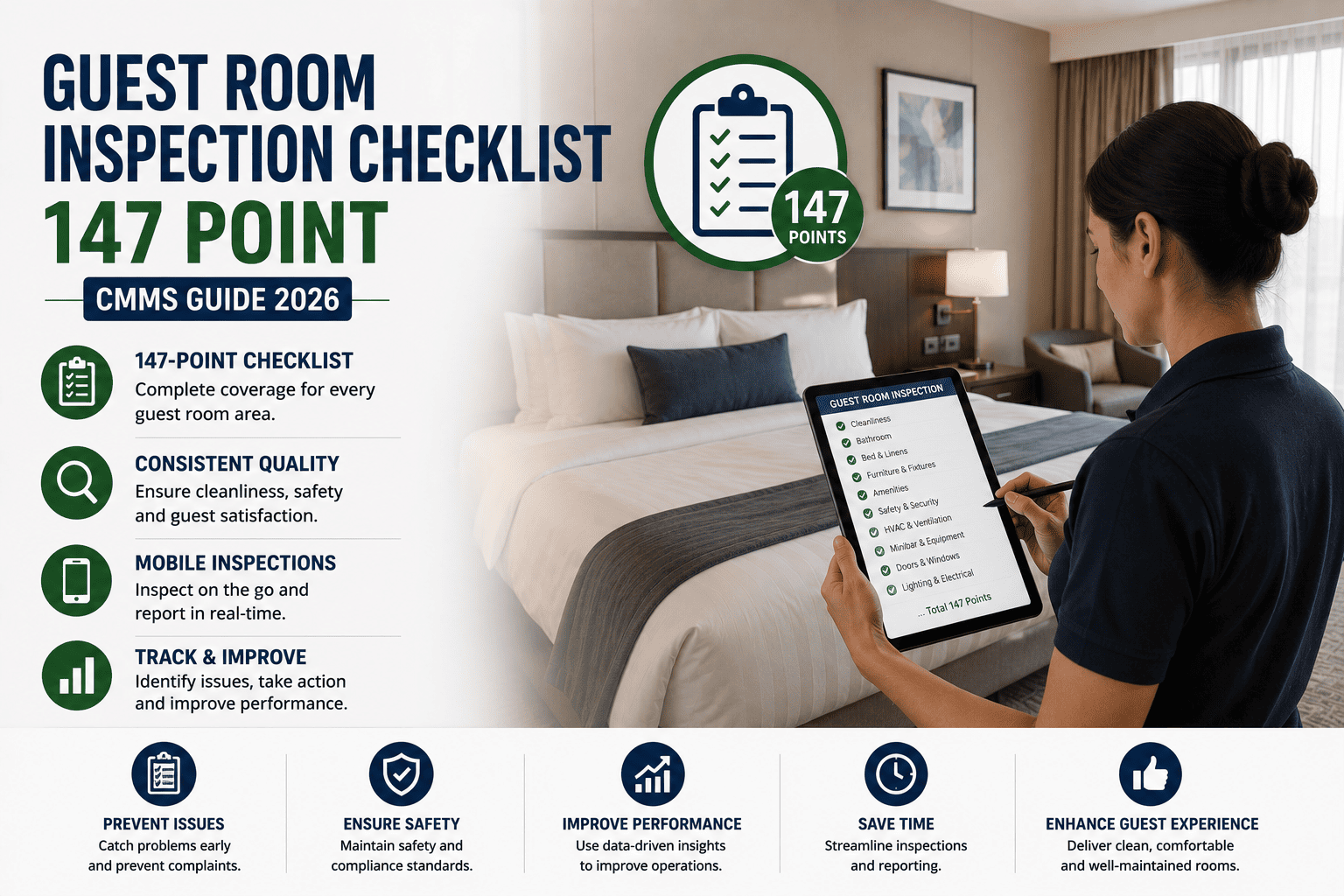
The most comprehensive hotel guest room inspection framework available — covering HVAC, plumbing, electrical, furniture, technology, security, and cosmetic standards across seven functional domains. Built for engineering teams, housekeeping supervisors, and QA programs.
147inspection points across 7 functional room domains
74%of guest maintenance complaints traceable to issues detectable during routine inspection
$340average comp night cost vs. $12 for the PM task that prevents it
30 daysmaximum inspection interval at full-service and luxury-tier properties
Why This Checklist Exists
Why Guest Room Maintenance Requires a Structured Inspection Framework
A guest room contains 40–60 individual mechanical, electrical, plumbing, and cosmetic components — each with its own failure mode and maintenance interval. Housekeeping cleans the room. Engineering maintains it. When the handoff between those two functions happens without a structured inspection protocol, maintenance issues accumulate silently between stays until a guest discovers them. Oxmaint digitizes this entire 147-point framework — assigning room-level checks to the right team member, logging completions with photos, and surfacing rooms that are overdue for inspection before the next arrival.
74%
of guest maintenance complaints involve issues that were present and detectable before the guest arrived — but were not caught because no structured pre-arrival inspection was completed. A 147-point inspection catches them. A visual turnover does not.
HVAC-related complaints are the most common in-room maintenance issue reported by hotel guests. Temperature failures, dirty filter odors, and fan noise are all detectable during a scheduled inspection. A PTAC found with a dirty filter and a loose blower wheel during inspection costs $25 to correct. Found by a guest at midnight costs $340 in comp plus a review mention.
DetectsBlocked PTAC filters, drifted thermostats, and drain pan overflows before guests experience them as temperature complaints or water damageBathroom exhaust failures that allow moisture accumulation in the bathroom cavity — the precursor to mold growth behind tile grout
Plumbing failures are the second most common in-room guest complaint and the most expensive when discovered late. A slow shower drain is a 20-minute snaking job when caught early — and a full bathroom pull when the blockage has been compounding for six weeks of missed inspections. Water pressure issues, running toilets, and dripping faucets are detectable in under three minutes.
DetectsSlow drain accumulation, running toilets, and supply line seeps before they become water damage events or mold remediation projectsCaulk joint separation allowing water infiltration behind tile — the most common hidden water damage cause in hotel bathrooms
Electrical issues create three distinct problem categories: life-safety failures (GFCI protection), comfort failures (lamp outages, dimmer malfunctions), and technology failures (USB charging dead). All three are detectable in under 10 minutes of systematic testing. Dead USB ports account for 8–12% of in-room technology complaints at full-service hotels — entirely preventable with a quarterly outlet sweep.
DetectsNon-functional GFCI outlets appearing operational during visual inspection while providing zero ground fault protectionDead USB charging ports — the most reported technology complaint at upscale properties, undetectable in any visual turnover check
All 147 inspection points live in Oxmaint.
Assign the full checklist to any room on any inspection schedule. Every completed item is timestamped, signed, and stored in the room asset record. Sign up free and load your first room inspection today.
22 inspection points · Quarterly — damage noted every turnover
22 pts
Furniture condition is the most directly visible indicator of property standards to an arriving guest. A chair with a torn seat edge, a drawer that will not close fully, or a headboard that wobbles on its wall mount creates a perception of neglect that overrides every other positive element of the room. These are deferred maintenance items that compound between inspections when no one is tracking condition systematically.
DetectsLoose headboard mounts, failing drawer slides, and seating structural failures before they become guest injury claims or review mentionsMirror and artwork mounting failures that create fall risk under door-slam vibration — only detectable by applying physical force
TCH
Technology & Entertainment
18 inspection points · Monthly — higher frequency at tech-forward properties
18 pts
Technology failures have a disproportionate impact on review scores relative to repair cost. A television that does not connect to the guest content system, an in-room tablet with a cracked screen, or a room phone with no dial tone generates review language about the property being "run-down" — feedback that no amount of operational excellence elsewhere can counterbalance at upscale and luxury tier properties.
DetectsContent system connectivity failures and dead TV inputs — the technology issue generating the most negative review language at upscale propertiesRoom phone failures creating life-safety gaps in fire and medical emergency scenarios where cellular is unavailable
DWS
Doors, Windows & Security
20 inspection points · Monthly — quarterly full hardware inspection
20 pts
Door and security failures create the intersection of operational, legal, and life-safety liability. A deadbolt that does not fully engage, a door that does not self-close against the latch, or a keycard reader that intermittently fails creates immediate guest security concerns and generates complaints that are far more damaging than any cosmetic deficiency.
DetectsDeadbolt misalignment, self-closer failures, and keycard reader issues creating unauthorized access risk and guest lockout complaintsBalcony railing movement only detectable by applying physical force — a life-safety failure mode that visual inspection cannot identify
COS
Cosmetic & Brand Standards
20 inspection points · Every turnover — condition logged to room asset record
20 pts
Cosmetic condition is the layer housekeeping sees every turnover but engineering sees only on inspection. Paint scuffs, carpet stains, worn baseboard caulk, and chipped grout accumulate incrementally between refurbishments — but the accumulation is only visible in aggregate when inspection logs condition against a baseline. Cosmetic tracking in Oxmaint creates the room-level data that drives targeted touch-up programs and informs refurbishment scheduling before review scores report them as a systemic issue.
DetectsPaint, carpet, and soft goods condition drift accumulating between refurbishments and surfacing as "worn" or "dated" room review complaintsMissing emergency egress maps and outdated collateral — zero-tolerance violations cited in flag company QA audits across all major brands
How Oxmaint Helps
How Oxmaint Manages Your Guest Room Inspection Program
01
Each Room as an Individual Digital Asset
Every guest room is a named asset in Oxmaint with its own inspection history, deficiency log, PTAC service record, and cosmetic condition baseline. When Room 412 has its third PTAC filter replacement in six months, that pattern is visible in the asset record — not buried in a shared work order log where it will never be noticed. Set up your first room asset records free.
Per-room historyDeficiency log
02
147-Point Checklist on Any Inspection Schedule
Configure the inspection schedule per room category — monthly for premium floors, quarterly for standard rooms, weekly for VIP suites. Oxmaint generates and assigns the inspection checklist automatically, sends mobile notifications before due dates, and escalates to supervisors if inspections are not completed on schedule. The full 147-point framework runs without manual coordination.
Auto-schedulingMobile assignment
03
Photo-Documented Deficiency Capture
Every deficiency is logged with a photo taken at the point of inspection. The photo, inspector name, timestamp, and description are stored against the room asset record. When ownership asks why a room is scheduled for early refurbishment, Oxmaint provides the photographic condition history that makes the capital decision defensible — not an opinion. See the photo-log demo.
Photo evidenceTimestamped records
04
QA Audit Reports and Brand Standard Compliance
When a flag company QA auditor requests inspection records, Oxmaint generates a room-by-room compliance report covering the last N inspection cycles in under five minutes — showing completion rates, open deficiencies by category, and trend data by floor and room type. Properties with documented inspection programs receive QA audit scores 15–22 points higher than properties with no digital records. Start your inspection program free today.
QA audit exportBrand compliance
"
Before Oxmaint, our room inspection program was a laminated sheet that housekeeping supervisors were supposed to fill out monthly. Nobody knew which rooms had been inspected and which hadn't. After three months on the platform, we had inspection data on every room in the building — and identified 14 rooms with recurring PTAC issues that nobody had ever connected because the work orders were logged separately. We addressed all 14 in two weeks. Our maintenance call volume from those rooms dropped 60% in the following quarter.
Director of Engineering · 320-Room Full-Service Hotel, Southeast Region
Frequently Asked Questions
Guest Room Inspection Checklist FAQs
How often should a hotel guest room receive a full preventive maintenance inspection?
At minimum: monthly for full-service and upscale properties, quarterly for select-service and limited-service properties. Luxury and independent hotels benchmarking against five-star standards should inspect every active room monthly and every out-of-rotation room before it is returned to inventory. The 147-point framework in this checklist is designed for the monthly full inspection. A shorter 40–50 point version covering the highest-failure items — PTAC filter, drain flow, GFCI, USB outlets, door lock — should be completed on every room turnover regardless of the full inspection schedule. Oxmaint runs both the monthly full inspection and the turnover quick check from the same platform.
Who should perform the 147-point inspection — housekeeping or engineering?
The domains split naturally by team: cosmetic condition, soft goods, and surface cleanliness are appropriate for a trained housekeeping supervisor. HVAC function testing, plumbing flow rates, electrical outlet testing, door hardware testing, and technology system verification require an engineering technician. The most effective programs use a shared workflow — housekeeping supervisor completes the cosmetic sections on each turnover, engineering technician completes the mechanical and electrical sections on the monthly cycle. Oxmaint assigns each section to the appropriate team member and aggregates both into a single room inspection record with a unified completion status.
What is the difference between a guest room PM inspection and a housekeeping turnover check?
A housekeeping turnover check verifies that the room is clean, amenities are stocked, and linens are fresh — a service delivery verification, not a maintenance verification. A preventive maintenance inspection tests the functional condition of each mechanical, electrical, and structural component in the room — verifying it operates within design parameters, not just that it appears visually acceptable. The gap between these two is where 74% of in-stay maintenance complaints originate: the room was clean when the guest checked in, but the PTAC filter was 90% blocked, the USB outlet was dead, and the shower drain was partially obstructed — none of which a turnover check detects. Book a demo to see how Oxmaint structures both workflows as separate but linked programs.
How does Oxmaint track guest room inspection compliance across a large property?
Oxmaint creates an individual asset record for each guest room and assigns inspection checklists — full monthly or quick-turn — automatically on the configured schedule. Managers see a real-time compliance dashboard showing which rooms are current, due, or overdue. Rooms overdue for inspection can be flagged so front desk does not assign them to arriving guests until the inspection is completed. Ownership and corporate QA teams receive auto-generated compliance reports on any schedule — weekly, monthly, or on-demand before an audit. Sign up free to configure your room inspection compliance dashboard.

.png)