Small hotel facilities maintenance costs 3–5× the repair invoice when all downstream effects are counted — blocked dirty guestrooms, negative online reviews, delayed room turnover, and high emergency contractor fees. For a boutique 80-room resort, the fully-loaded annual maintenance inefficiency cost typically runs $48,000–$72,000 against a direct repair bill of $12,000–$18,000. Critically, 68% of small hotel downtime is not mechanical — it is administrative, logistical, or parts-related and entirely preventable. Oxmaint's property CMMS categorizes every lost engineering hour and builds the data foundation to eliminate each cause systematically.
Best CMMS for Small & Independent Hotels: How to Choose in 2026
How boutique hoteliers deconstruct maintenance costs, simplify technician dispatching, and use a lightweight mobile CMMS — combined with automated PMS syncs, water safety loops, and bilingual frontline workflows — to systematically protect guest RevPAR.
The Complexity Surcharge: Why Enterprise Software Fails Boutique Properties
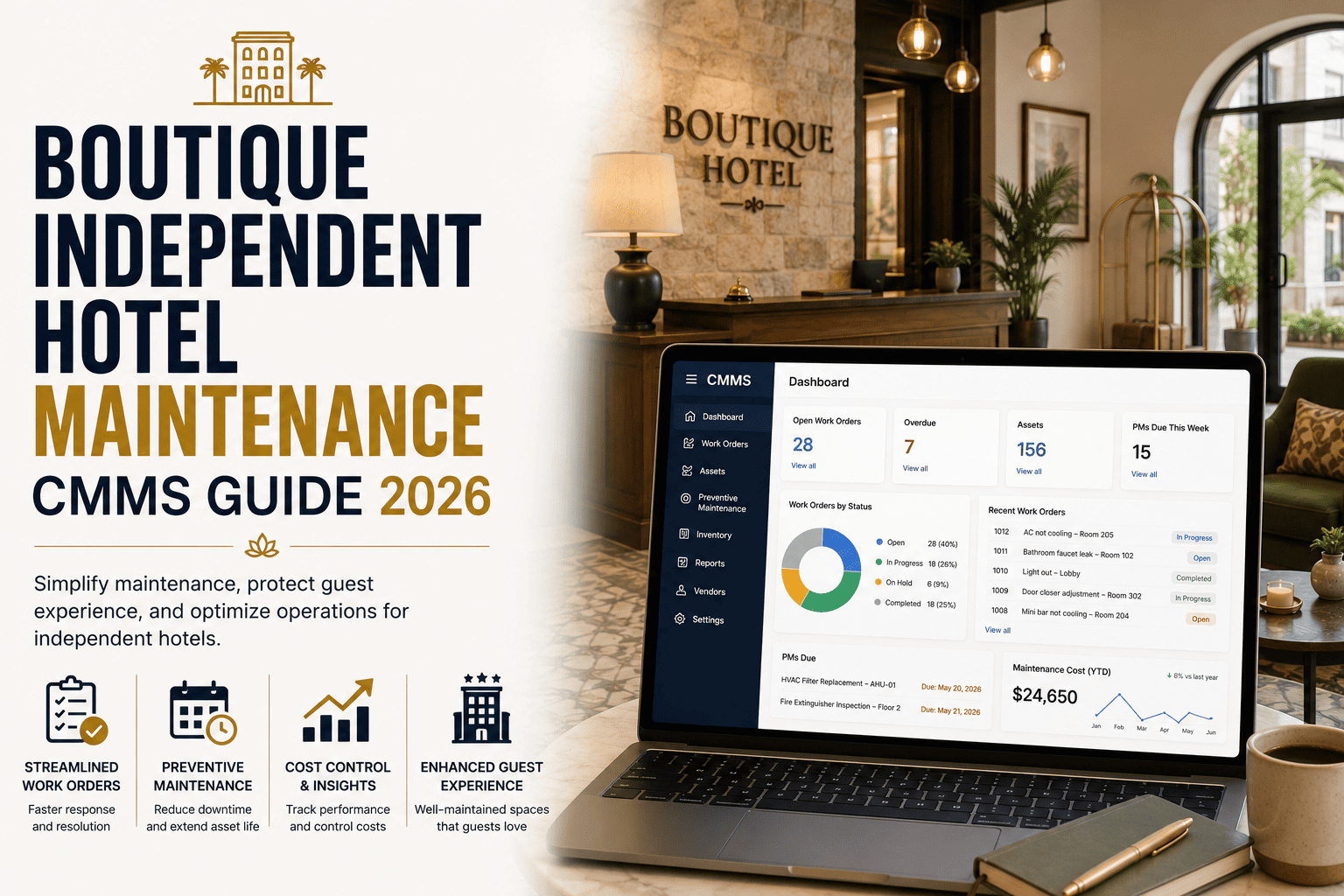
Independent boutique hotels face a distinct challenge when forced to adopt heavy, enterprise-grade facilities platforms designed for massive industrial factories or multi-national hospital groups. These systems are loaded with complex configurations and require long training cycles that frontline hospitality workers find impossible to navigate. When software takes months to configure and requires dedicated technical coordinators, busy building engineers abandon it entirely, returning to scrap paper and chaotic text messages. Boutique properties need a self-serve, lightweight mobile solution that connects housekeepers and floor technicians in under ten minutes. By choosing a system with pre-loaded hotel asset libraries and intuitive mobile interfaces, small properties can achieve complete operational visibility without paying massive technical consulting fees.
The 4 Room Downtime Categories — and Why Most Hoteliers Only Track One
Most hotel operations teams track core mechanical downtime — a guestroom PTAC breaks, a work order is logged, the technician repairs it, and the room returns to inventory. However, the three other room downtime categories are almost universally untracked by independent properties: parts wait delays, housekeeping transition gaps, and regulatory compliance holds. In a typical commercial hotel, pure mechanical failure accounts for less than 40% of total guestroom downtime hours. The remaining 60% is caused by administrative coordination bottlenecks and parts logjams. Treating all room downtime as a mechanical issue misidentifies the root problem, causing operations directors to allocate critical capital resources to the wrong solutions.
Deconstructing the Hidden Revenue Drag of Manual PMS Gaps
The primary source of revenue loss in independent hotel operations is the communication lag between back-of-house building technicians and front-desk coordinators. Under traditional paper workflows, when an engineer repairs a guestroom HVAC unit or fixes a door handle, the task details remain trapped on a clipboard or supervisor's desk. The front desk staff has no real-time visibility, keeping the room status blocked as out-of-service in the property management system for hours or even days. This communication gap directly diminishes resort RevPAR and forces front-desk teams to relocate check-in arrivals. Connecting the CMMS directly with property management engines solves this bottleneck natively, automatically releasing rooms back to inventory the instant verified photos are logged.
Calculating True Guestroom Downtime Cost: Beyond the Repair Invoice
Evaluating the financial return of building maintenance software requires looking beyond direct repair invoices. When a guestroom goes out-of-service, hoteliers face several downstream expenses. These include immediate room rate revenue losses, front-desk administrative overhead from guest reassignments, complimentary discount compensations, and long-term brand equity damage from negative TripAdvisor reviews. When all five cost dimensions are mapped out, independent property owners discover that a single delayed room breakdown costs up to 5× the direct contractor bill. Adopting a proactive maintenance framework is the only way to safeguard resort operating margins.
Leveraging Simple Telemetry Sensors to Extend Guestroom Asset Lifetimes
For boutique hoteliers, physical building systems represent the single largest capital investment on the balance sheet. Equipment like commercial boilers, cooling towers, and guestroom PTAC units face heavy wear due to high-occupancy shifts. Traditional reactive models ignore early warning signs, resulting in premature asset failures and expensive emergency contractor rates. Implementing a modern mobile CMMS with lightweight telemetry integration changes this balance entirely. By placing wireless current sensors and vibration monitors on key motors, engineers can detect mechanical wear weeks before a failure occurs. This proactive strategy adds years to mechanical lifespans, safeguarding property asset value without requiring expensive technical oversight.
Lightweight Telemetry Probes: Early Warning of System Malfunctions
Modern predictive maintenance technology is no longer limited to massive industrial facilities. Wireless sub-GHz LoRaWAN sensors now offer independent hotels an affordable, easy-to-install early warning layer that bypasses heavy concrete slabs. By tracking electric draws, temperature shifts, and motor vibrations continuously, these sensors catch issues before they turn into expensive guest complaints.
Protecting Boutique Properties: Balancing Local Water Codes and Energy Costs
Independent boutique hotels face an increasingly complex regulatory landscape, especially regarding municipal health codes and environmental goals. Local authorities require strict, daily logging of hot water loop temperatures to prevent Legionella reproduction, placing a heavy burden on small operations teams. Manually checking secondary lines is time-consuming and error-prone, leaving hotels vulnerable to compliance violations. Integrating simple wireless sensors into the building's central loops automates this process entirely. Hoteliers can gather unalterable compliance records while tracking energy trends, allowing engineering teams to descale boilers and desoot heaters exactly when performance drops to maintain efficiency.
Connecting BOH Operations to Front-of-House Systems
A modern boutique CMMS must serve as an active bridge between frontline employees, technical coordinators, and guest management systems. Oxmaint achieves this natively—translating housekeeper defect reports instantly, routing tasks automatically, and coordinating with property systems to protect guest room availability.
We thought our boutique resort's primary challenge was high contractor invoices. Oxmaint's downtime analysis proved that over 60% of our room downtime was housekeeping lags and parts delay. We corrected the PMS sync in two days and cut average room turnaround times by 44% without any complex setup.
Parts Wait Downtime: The Hidden Cost in Boutique Hotels
Independent hotels without a CMMS often resort to emergency parts sourcing at high price premiums. Oxmaint's preventive program lets properties order key spares weeks in advance, ensuring parts are on the shelf before the technician begins work, which reduces repair lags to zero.
Portfolio Expansion: Scaling Small Property Operations Natively
For growing independent hospitality groups, standardizing facilities management across multiple properties represents a significant operational milestone. When scaling from a single boutique inn to a portfolio of hotels, regional directors must establish consistent safety protocols, preventive schedules, and parts inventories across all locations. Legacy platforms complicate this transition by requiring separate system instances and charging additional multi-site licensing fees. A centralized B2B property dashboard simplifies scaling, giving operations directors a single hub to track asset health, trace regulatory water loops, and dispatch engineering resources across properties natively.
See Every Room Minute Categorized — Build Boutique Efficiency
Oxmaint tracks downtime by category — mechanical, parts wait, compliance, and scheduling — so you eliminate the right causes. Free to start, no card required.
Building a Boutique Room Downtime Program: The 90-Day Framework
Boutique hotel facilities management requires a structured program that targets the highest-impact room downtime sources first. Most independent properties that follow this timeline achieve 35–45% total room downtime reductions in 90 days, successfully converting lost administrative hours into direct revenue gains.
Frequently Asked Questions — Boutique Hotel CMMS
This prevents guest double-bookings and allows the front-desk team to sell vacant-clean rooms with zero communication delays.
It triggers immediate alarms and descaling checklists when water temperatures fall below safe CDC-specified sanitary thresholds.
This translates housekeeping defect reports instantly, ensuring floor engineers receive clear, actionable work tickets.
This syncs spare parts warehouse inventories and auto-drafts purchase orders without requiring custom software development.
This enables engineering directors to schedule low-cost preventative cleaning sweeps during low-occupancy weekday hours.
This satisfies municipal accessibility regulations, protecting resort properties from legal liabilities and non-compliance fines.
After 4 weeks, you can identify the top room downtime categories and deploy targeted, data-backed operational adjustments.
ERP sync integrations are completely optional for boutique portfolios wanting to sync spare parts with general ledgers.
68% of Boutique Room Downtime Has a Root Cause You Are Not Tracking.
Oxmaint categorizes every lost room hour and gives your team the data to eliminate each downtime cause with a specific, measurable intervention. Free to start, no card required.