Water intrusion in a hospital is never just a facilities problem — it is an infection control emergency, a structural liability, and a regulatory citation risk compressed into a single event. From a leaking roof in a sterile procedure corridor to a burst pipe flooding an ICU anteroom, hospitals face an average of 3.7 water intrusion events per year, and the difference between a contained incident and a Joint Commission finding almost always comes down to response speed and documentation quality. OxMaint's hospital maintenance software gives your facilities team a structured water intrusion response plan that activates the moment moisture is detected: work orders are created and dispatched instantly, infection control is looped in automatically, affected assets are logged, and every remediation step is captured with timestamps and photos. Facilities teams using OxMaint's response tracking system reduce intrusion-to-dry time by 47% and generate the KPI reports surveyors ask for without manual data gathering. Whether your concern is mold prevention, drywall remediation, equipment protection, or TJC EC standards, a digitized response plan is the only defensible approach. Book a 30-minute demo and see how OxMaint activates a complete water intrusion workflow from a single mobile report.
Hospitals · Water Intrusion · Incident Response CMMS
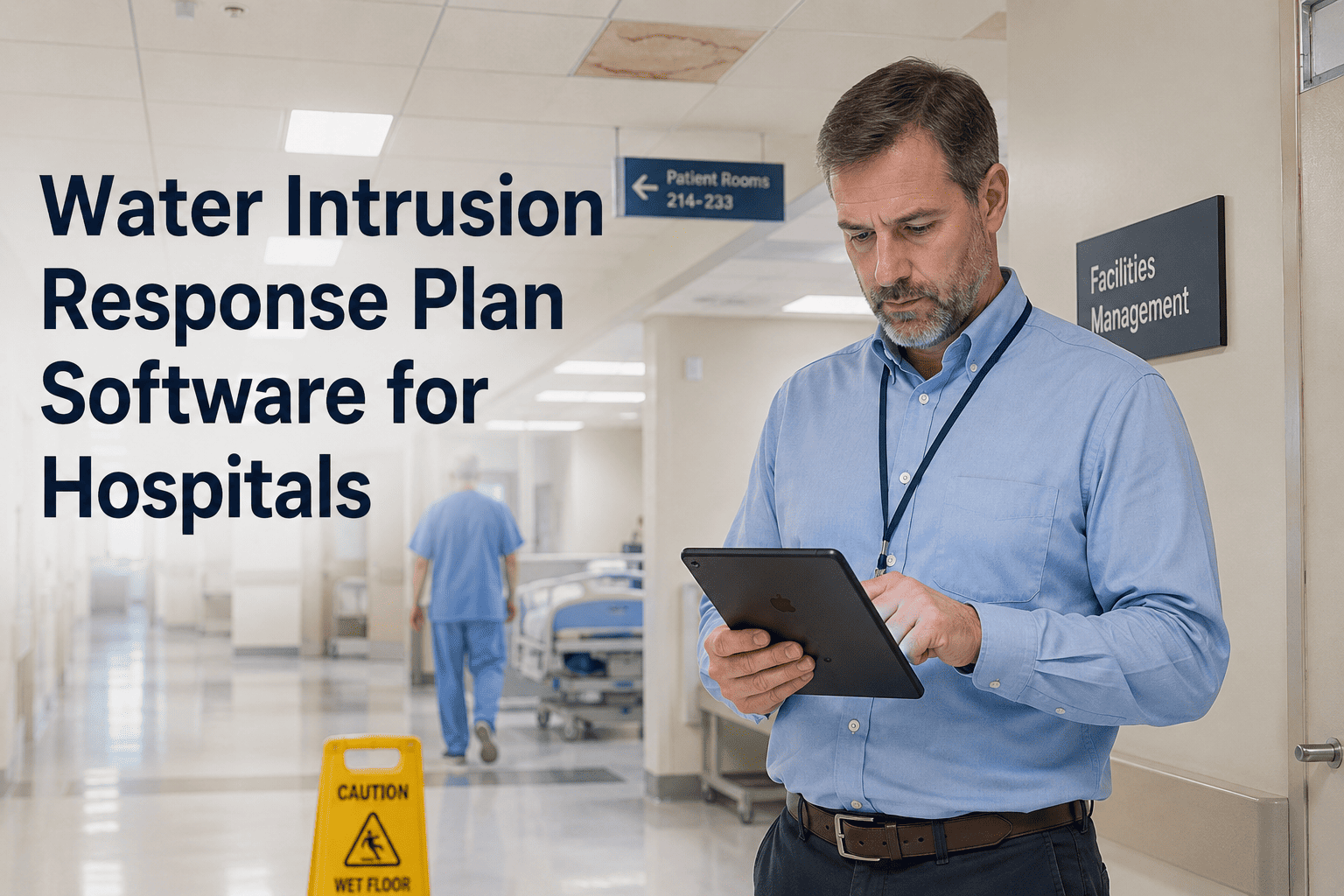
Water Intrusion Response Plan Software for Hospitals
Structured response. Instant dispatch. Infection control integration. Compliance evidence — from first report to verified dry-out.
Average Hospital Water Intrusion Risk
3.7 events per facility per year
$89K average remediation cost per major event
72 hrs — mold colonization window after moisture
61% of TJC water findings cite missing response docs
Infection control notification avg delay: 2.4 hours without CMMS
Response Framework
The 4-Phase Water Intrusion Response Plan in OxMaint
OxMaint structures your response into four trackable phases — each with assigned roles, time targets, and mandatory documentation checkpoints.
Phase 1
Detection & Report
Target: < 5 min
- Staff reports via mobile or QR code
- Location, severity, and affected area captured
- Photo evidence attached at submission
- Automatic work order created instantly
Phase 2
Triage & Dispatch
Target: < 15 min
- Severity classified: minor / major / critical
- Plumbing tech and supervisor notified
- Infection control team auto-alerted for patient areas
- Affected asset IDs linked to work order
Phase 3
Remediation Tracking
Target: Logged in real time
- Each remediation step logged with technician ID
- Drying equipment deployment recorded
- Moisture readings documented per location
- Contractor work orders linked if needed
Phase 4
Closure & Evidence
Target: Full audit package
- Final dry-out confirmation with moisture reading
- Before/after photos attached to work order
- Infection control clearance recorded
- Full incident report exportable as PDF
Does Your Current Plan Generate Audit-Ready Evidence?
Most hospital water response plans exist on paper — and fall apart under survey. OxMaint makes every phase digital, trackable, and exportable in 30 minutes of setup.
Response Time Benchmarks
OxMaint vs. Manual Response — Time & Compliance Impact
| Response Metric |
Manual / Paper Process |
OxMaint CMMS |
Risk Reduction |
| Detection to Work Order |
30–90 min (verbal chain) |
Under 2 minutes (mobile submit) |
Mold window protected |
| Infection Control Notification |
Avg 2.4 hrs (manual call) |
Automatic at work order creation |
Patient exposure reduced |
| Technician Dispatch |
15–45 min (supervisor routing) |
Auto-routed in under 5 min |
Faster containment |
| Escalation if Unresolved |
Depends on shift supervisor memory |
Automatic at SLA breach |
No event falls through |
| Compliance Documentation |
Reconstructed after the fact |
Generated in real time |
Survey-ready always |
| Incident Report Generation |
1–3 days manual compilation |
One-click export on closure |
Leadership visibility immediate |
Platform Features
What OxMaint Brings to Your Water Response Program
01
Scheduled PM for Plumbing Assets
Preventive maintenance schedules for pipe insulation, drain checks, roof drains, and mechanical rooms reduce the frequency of intrusion events before they occur.
02
Service History per Location
Every water event linked to a floor zone or room builds a location history — identifying repeat problem areas for capital planning and infrastructure review.
03
Multi-Team Notification Rules
Configure different notification chains for different areas: patient rooms trigger infection control, server rooms trigger IT, OR corridors trigger the OR charge nurse.
04
KPI Dashboard for Leadership
Real-time view of open water intrusion events, time in each phase, overdue responses, and monthly trend data — accessible to the Director of Facilities without waiting for a report.
05
Contractor Work Order Integration
When remediation requires external vendors, OxMaint issues contractor work orders with scope, location, and access requirements — keeping all remediation activity in one traceable record.
06
Audit Trail Export
Every water intrusion event generates a timestamped activity log exportable as PDF or CSV — structured to align with TJC EC.02.05.07 and CMS physical plant documentation standards.
Expert Review
The Hidden Compliance Risk in Water Intrusion Response
In my experience preparing hospitals for Joint Commission surveys, water intrusion documentation is one of the most consistently weak areas — not because facilities teams don't respond, but because they respond without generating a traceable record. Surveyors don't just want to know that the leak was fixed; they want to see when it was reported, who was notified, what infection control actions were taken, and when the area was cleared. That entire chain has to exist in writing. A CMMS-driven response plan doesn't just speed up the physical response — it converts every action into the documented evidence that makes the difference between a compliant finding and a corrective action plan.
Common Questions
Frequently Asked Questions
How does OxMaint integrate with our existing water management plan (WMP)?
OxMaint doesn't replace your written WMP — it operationalizes it. Your WMP defines response protocols, responsible parties, and notification chains; OxMaint makes those protocols executable in the field. Work order templates can mirror your WMP response steps exactly, and every completed action creates the audit evidence your WMP requires to be defensible during a Legionella or TJC water survey.
Book a demo to see how WMP steps map to OxMaint workflows.
Can OxMaint track moisture readings and drying progress over multiple days?
Yes. OxMaint supports multi-day work orders where technicians log moisture readings, equipment placement, and daily progress notes against the same incident record. Each entry is timestamped and associated with the technician who recorded it, building a day-by-day drying log that becomes part of the closure documentation. This is particularly important for events that require 3–7 days of active drying before mold risk is cleared.
Sign up and configure a multi-step drying checklist template.
How are infection control teams notified when a patient-area intrusion is reported?
OxMaint uses location-based notification rules: when a water intrusion work order is created in a designated patient care area, the infection control team receives an automatic push notification and email with the location, severity level, and photo. This happens at the moment the work order is submitted — not after triage, not after technician dispatch. The notification and the IC team's response are both logged to the work order record.
See notification configuration in a live demo.
What reports does OxMaint generate for TJC Environment of Care surveys?
For each water intrusion event, OxMaint can export a full incident report showing: initial report timestamp and reporter, severity classification, notification log (who was alerted and when), technician dispatch and acknowledgment times, all remediation steps with technician signatures, moisture readings timeline, infection control clearance record, and final closure with photos. This package directly addresses TJC EC.02.05.07 documentation expectations.
Start free and explore the compliance report builder.
Does OxMaint support preventive maintenance to reduce water intrusion events?
Absolutely. OxMaint's PM module supports scheduled inspections for roof drains, pipe insulation, expansion joints, mechanical room penetrations, and cooling tower overflow systems — the most common sources of hospital water intrusion. When a PM inspection identifies a vulnerability, a corrective work order is created instantly. Facilities using preventive water inspection schedules in OxMaint report 28% fewer reactive water intrusion events annually.
Talk to our team about building your preventive water inspection schedule.
Hospital Water Intrusion · Response Plan · Compliance Documentation
Give Your Facilities Team a Response Plan That Holds Up to Any Survey
OxMaint structures every water intrusion event from first report to verified closure — with automatic notifications, real-time tracking, and audit-ready documentation built in.
.png)

.jpg)
