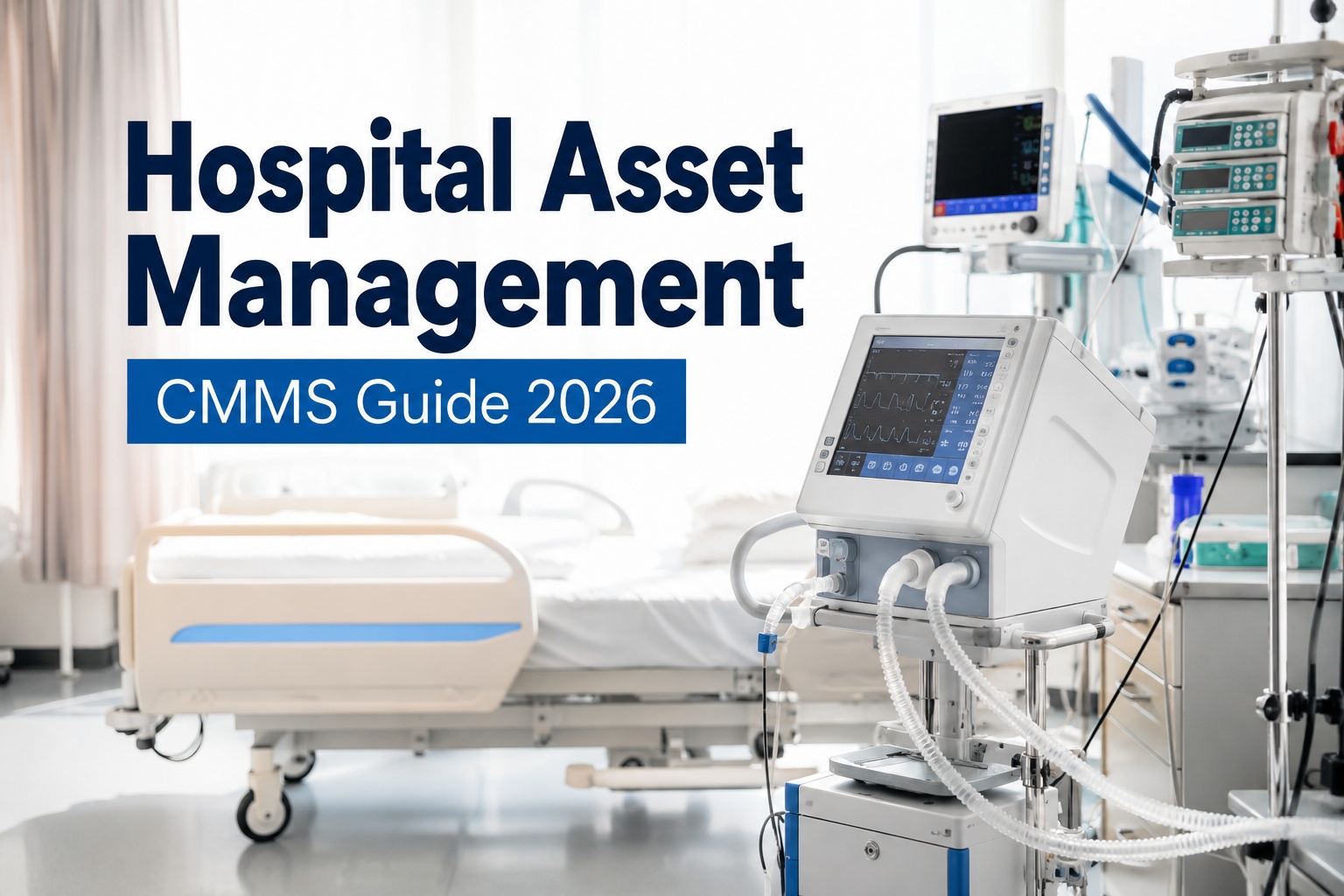
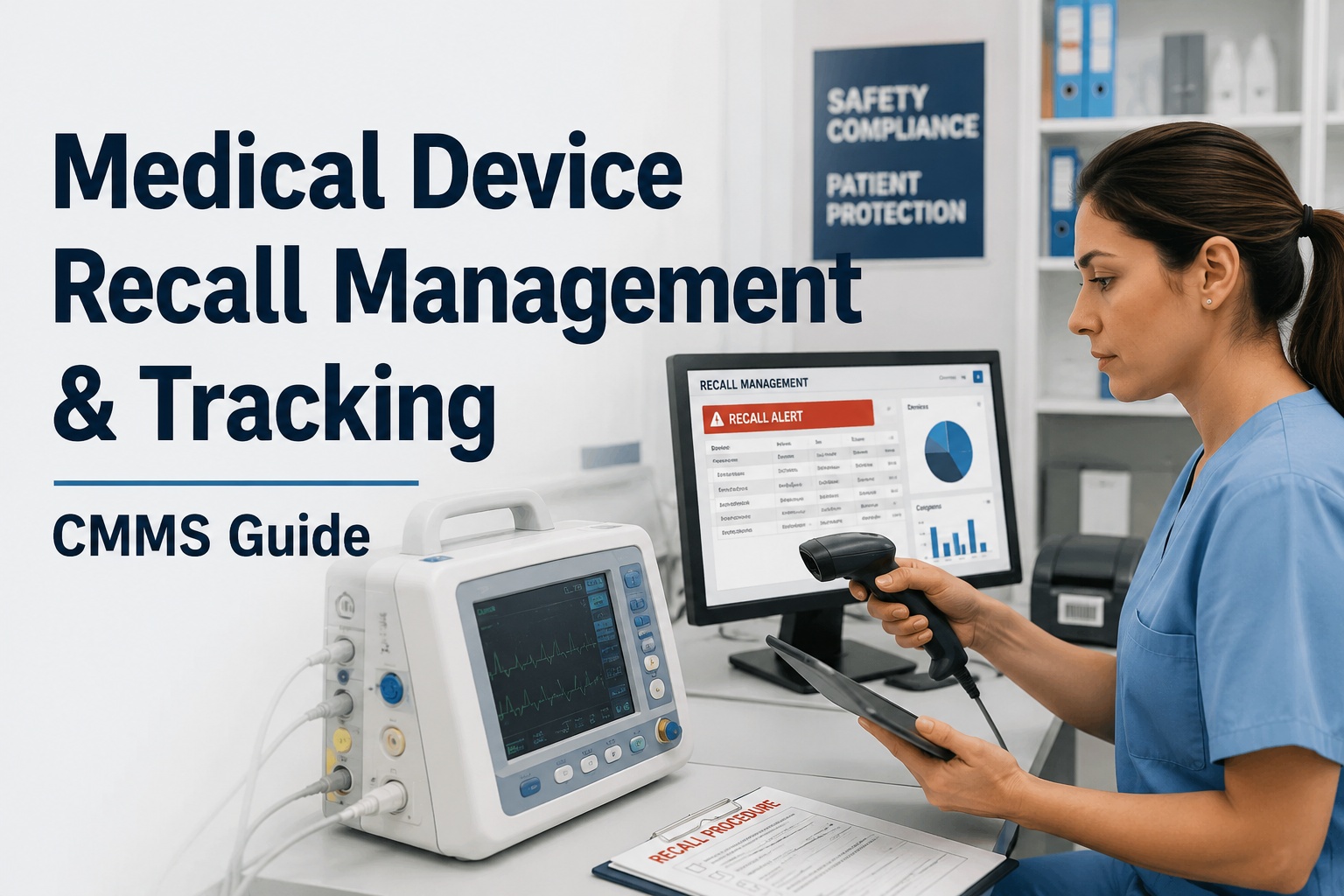
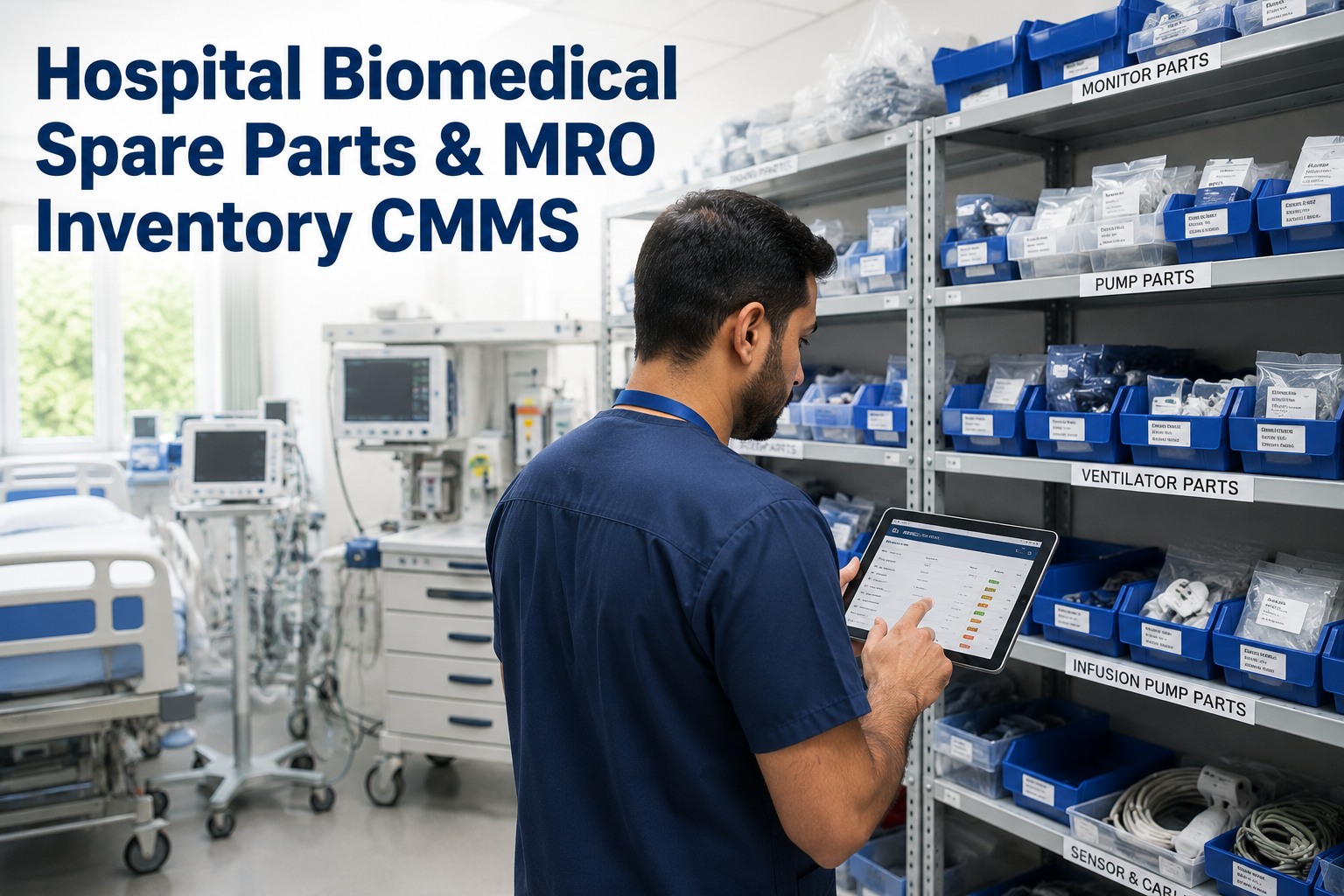
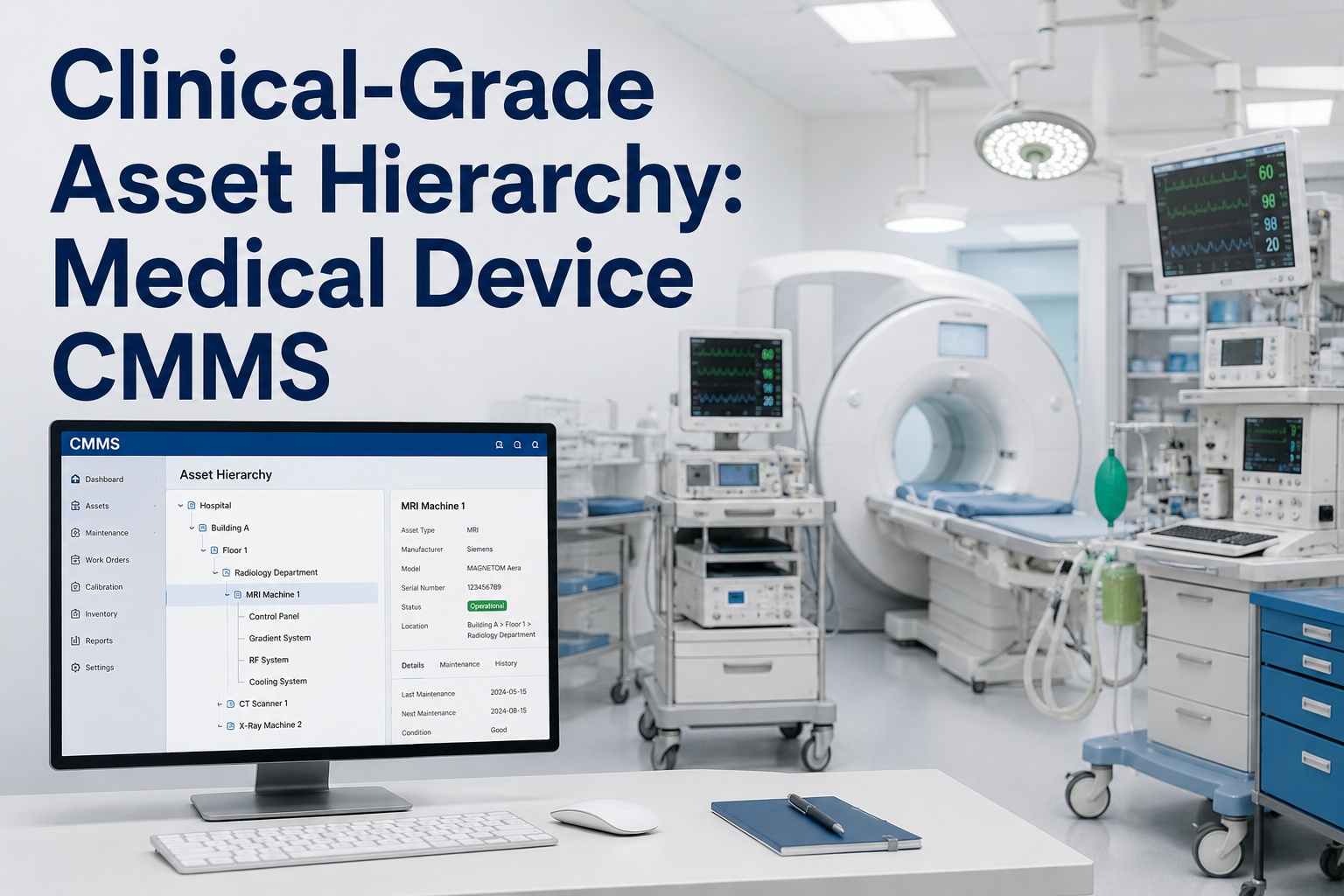
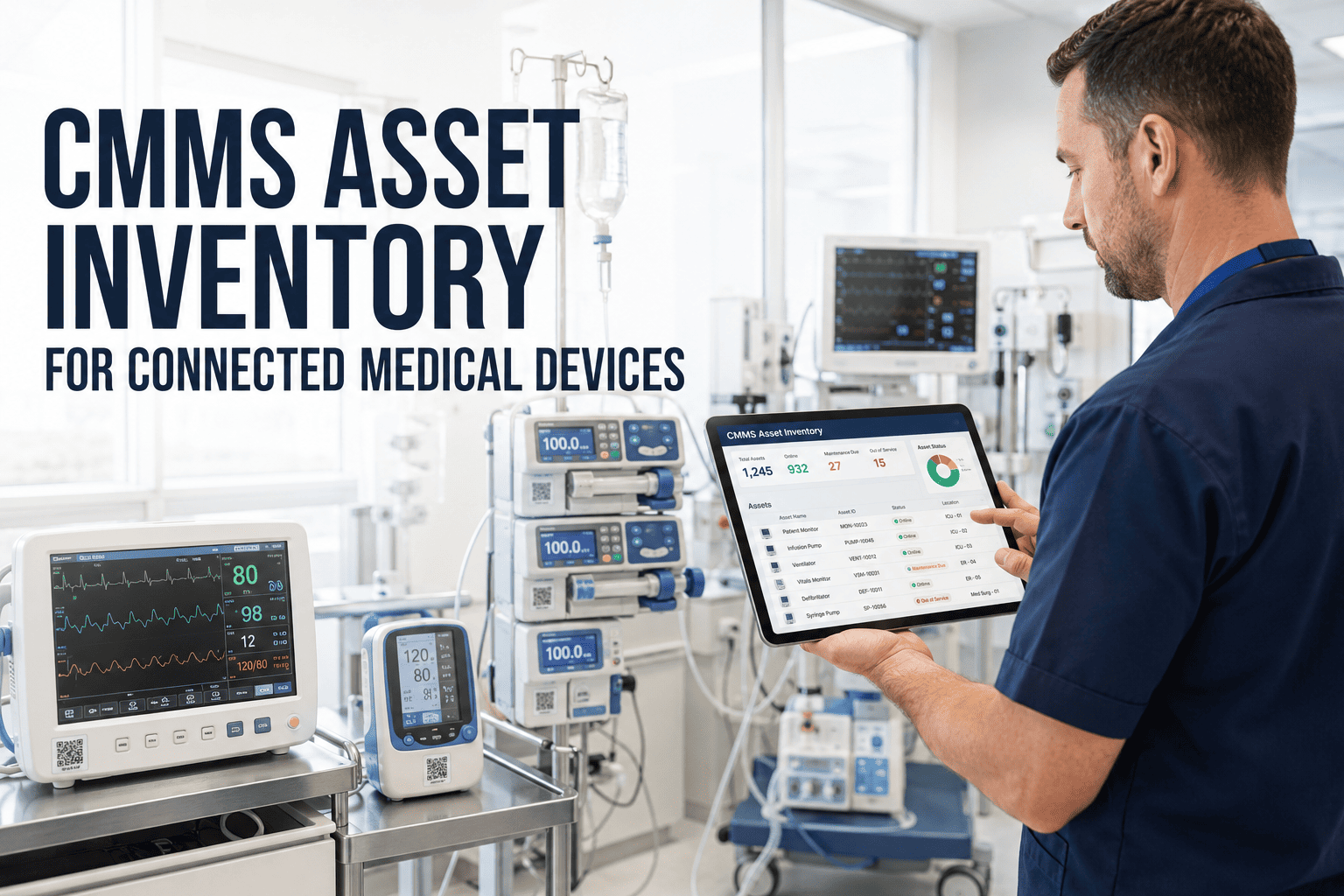
A mid-sized US hospital operates approximately 35,000 medical devices at any given moment — from a $3 million MRI in radiology to a $12 infusion pump on a nursing unit, with everything from ventilators and surgical robots to point-of-care glucose meters in between. Add facility assets (boilers, chillers, generators, HVAC), IT infrastructure (network switches, imaging servers), and furniture, and the total tracked asset population approaches 50,000 items across most acute-care hospitals. Somebody in the organization is expected to know where each of these assets physically is, what its current condition is, when it was last serviced, whether it is currently under recall, whether it is due for its next preventive maintenance, and whether it carries an active service contract. For most hospitals, that "somebody" is actually three or four separate departments — Biomedical Engineering, Facilities, IT, Materials Management — each operating on separate systems that do not talk to each other. The gaps between those systems are where ghost assets accumulate, PM deadlines slip past, recall notifications get missed, and Joint Commission surveyors find the citations that hospitals spend the following six months responding to. This 2026 guide walks through the asset hierarchy that a modern hospital CMMS must support, the actual device portfolio breakdown across the eight major clinical categories, the structure of a single unified asset record, the shift from siloed biomedical/facility/IT programs to a unified enterprise platform, and the FDA risk classification framework that drives maintenance priority. OxMaint gives hospital leadership the platform to hold the entire 35,000+ asset population as one operational reality. Book a free demo to see unified hospital asset management inside OxMaint.
Level 1
Enterprise Health System
1
Level 2
Hospitals & Care Sites
3-12
Level 5
Departments & Cost Centers
80-200
Level 6
Rooms & Locations
1,500-4,000
Level 7
Individual Assets
35,000-80,000
Every asset queryable at every level · leadership sees the enterprise · biomed sees the department · a nurse sees the room · OxMaint holds the full tree in one operational view
35,000+
medical devices in a typical mid-sized US hospital · 50,000+ when facility, IT, and furniture assets are included
3-4
separate departments typically manage the asset base today · biomed · facilities · IT · materials · with no shared record
1 Registry
the 2026 direction · a single unified asset registry serving every role from CFO to bedside clinician
The Asset Portfolio — Eight Categories Cover the 35,000
Hospital medical devices distribute across eight major clinical categories, each with its own regulatory backdrop, its own maintenance discipline, and its own consequence profile when equipment fails. The portfolio breakdown below reflects typical proportions across a mid-sized acute-care hospital. Understanding the distribution matters operationally because the highest-count categories (patient monitoring, therapeutic, point-of-care) drive PM workload while the highest-value categories (imaging, surgical) drive capital planning and downtime economics. OxMaint stores each device with both dimensions tagged at asset creation.
Medical Device Portfolio · Distribution Across Categories
Patient Monitoring · Bedside & Telemetry
Therapeutic · Infusion, Dialysis, Radiation
Point-of-Care · Glucose, Pulse Ox, Rapid Tests
Life Support · Ventilators, Defibrillators, ECMO
~4,500 units · high-consequence
Laboratory · Analyzers, Centrifuges
Surgical · OR Tables, Anesthesia, Robotic
~2,500 units · high-value
Sterilization & Reprocessing · Autoclaves, Washers
Diagnostic Imaging · MRI, CT, X-ray, US
~400 units · very high value
Volume drives PM workload · consequence drives criticality tier · both drive capital planning · OxMaint stores each device with both dimensions
The Single Asset Record — What's Actually in the CMMS
A hospital CMMS asset record is not a name and a location. It is a structured data object with roughly a dozen mandatory fields that support regulatory compliance, service execution, capital planning, and clinical decision-making. The record structure below reflects what a modern hospital asset registry captures per device inside OxMaint — and why the manual spreadsheets that most hospitals still partially rely on cannot support the operational rigor the FDA UDI rule, Joint Commission EC standards, and CMS Conditions of Participation collectively require.
Identity
UDI(01)00884838133478(11)240815(21)840101
ManufacturerMedtronic
ModelPuritan Bennett 980
Serial84-2201-337
Location & Ownership
SiteMain Campus
BuildingPatient Tower A
DepartmentMICU (Cost Ctr 7420)
Current RoomMICU-14 · Bed A
Classification & Financial
FDA ClassClass II
CriticalityLife Support · Tier 1
Purchase Date15 Aug 2024
Cost / Useful Life$42,800 / 10 yr
Service & Contracts
Last PM12 Mar 2026 · Passed
Next PM Due12 Sep 2026 (semi-annual)
Recall StatusNone active
Service ContractOEM · Full · Expires 15 Aug 2027
Every field regulated · every field queryable · every field auditable · this is the operational baseline every one of the 35,000 assets requires
The Silos Problem — Three Systems, Three Realities
Most US hospitals still manage their asset base across three or four separate systems: a biomedical engineering CMMS for medical devices, a facilities CMMS for plant equipment, an IT asset database for network and computing infrastructure, and often a materials management system for consumables. Each of these systems has its own asset numbering scheme, its own hierarchy, its own PM cadence, and its own reporting output. The Director of Biomedical does not see the HVAC condition that affects the operating rooms. The Facilities VP does not see which medical devices depend on the emergency power branch. The CFO does not see a unified capital plan. The transformation to a single unified platform is the defining hospital asset management trend of the 2026 planning cycle — and OxMaint's unified architecture is built specifically for this transition.
From Departmental Silos to Unified Enterprise Asset Platform
Today · Departmental Silos
Biomedical
Medical Devices
~35,000 assets
CMMS or spreadsheet
Facilities
Plant & Building
~8,000 assets
Separate CMMS
IT
Network & Compute
~5,000 assets
Asset database
Three data models · three reporting outputs · zero cross-department visibility
2026 Direction · Unified Platform
Enterprise Asset Platform
One hierarchy · one record structure · one CMMS
Biomedical view
Facilities view
IT view
CFO view
One data model · role-based views · full enterprise visibility for leadership
Unify the 35,000 Assets in One Registry
OxMaint holds biomedical, facility, IT, and consumable assets in a single hierarchy with role-based views for every department · Joint Commission-ready documentation as a byproduct of routine operation.
FDA Risk Classification Drives PM Priority
The Food and Drug Administration classifies medical devices into three risk tiers, and this classification is the single most important driver of preventive maintenance intensity. A modern hospital CMMS applies the correct PM cadence, redundancy requirement, and technician competency automatically based on FDA classification tagged at asset creation — so a Class III implantable defibrillator programmer receives an entirely different maintenance discipline than a Class I mercury thermometer, even though both are "medical devices" in the registry.
FDA Risk Classification · Driving PM Discipline
Class I
Low Risk
Bandages · exam gloves · manual stethoscopes · basic hand-held instruments
Minimal PM · general controls · visual inspection
Class II
Moderate Risk
Infusion pumps · patient monitors · surgical drapes · powered wheelchairs · CT scanners
Scheduled PM · special controls · performance verification
Class III
Highest Risk
Implantable pacemakers · defibrillator programmers · heart-lung machines · ventilators
Intensive PM · redundancy required · certified technicians · full audit trail
Classification tagged at asset creation · PM cadence, competency, and audit trail flow automatically · OxMaint enforces the discipline the registry describes
Executive Perspective · The Unified Asset Registry
For a decade the conversation about hospital asset management was about which biomedical CMMS to buy. That conversation is over. The question that matters in 2026 is whether the biomedical engineering department, the facilities engineering department, the IT infrastructure team, and the CFO are all looking at the same asset registry. When they are, the hospital operates as one system. When they are not, every capital planning cycle rediscovers the same integration problems — the medical devices depend on the utility feeds, the utility feeds depend on the electrical distribution, the electrical distribution depends on the emergency generator, and nobody has the enterprise view that would let leadership prioritize investment across all of them at once. The transition to a unified platform is not a technology decision. It is an operating model decision. And once the 35,000+ assets are in one registry, everything downstream — Joint Commission preparation, recall management, capital planning, service contract optimization, incident response — becomes dramatically simpler. That is the transformation modern hospital leadership is buying when they unify their asset management program.
One Hierarchy, Many Views
OxMaint holds every asset in one tree · biomedical, facilities, IT, and finance each see the role-relevant view of the same registry.
Classification Drives Discipline
FDA class tagged at creation · PM cadence, competency, and audit trail flow automatically from classification.
Compliance as Byproduct
Joint Commission and CMS documentation produced from routine operation · not reconstructed for surveys.
Move to a Unified Asset Registry in 2026
If your biomedical CMMS, facilities CMMS, and IT asset database still operate as separate systems with no shared record, you are carrying preventable integration risk into every capital cycle and every Joint Commission survey. See what OxMaint — a maintenance management platform built for unified hospital asset management — looks like against your 35,000+ assets.
Frequently Asked Questions
How many assets does a typical hospital manage?
A mid-sized US hospital typically manages approximately 35,000 medical devices, plus 8,000 facility and plant assets, plus 5,000 IT infrastructure assets, plus consumables and furniture — bringing the total tracked asset population to 50,000+ items across acute-care facilities. Large academic medical centers and multi-hospital health systems can multiply these figures several times. OxMaint holds the full population in a single hierarchy with role-based access per department.
What is the FDA UDI rule and why does it matter for hospital CMMS?
The Unique Device Identification (UDI) rule requires most medical devices to carry a globally unique identifier — a device identifier plus a production identifier — that supports traceability, recall management, adverse event reporting, and inventory control. A modern hospital CMMS captures UDI as a mandatory field per asset, enabling instant recall notification, service history tracking, and regulatory audit response. Hospitals that still rely on manual serial number tracking cannot satisfy the operational requirements the UDI rule enables.
What is the difference between biomedical CMMS and facilities CMMS?
Historically, biomedical CMMS managed medical devices under the Biomedical Engineering department, while facilities CMMS managed plant equipment, HVAC, and building systems under Facilities Engineering. The 2026 direction is toward unified platforms that hold both asset populations in a single registry with role-based views. This eliminates the integration gaps where cross-department dependencies (medical devices depending on utility feeds, for example) go unmanaged.
How does FDA risk classification affect maintenance requirements?
Class I devices (low risk — bandages, manual stethoscopes) require minimal PM under general controls. Class II devices (moderate risk — infusion pumps, patient monitors, CT scanners) require scheduled PM with performance verification and special controls. Class III devices (highest risk — implantable pacemakers, ventilators, heart-lung machines) require intensive PM, redundancy provisions, certified-technician service, and full audit trail. OxMaint applies the correct cadence automatically based on classification tagged at asset creation.
What data fields belong in a hospital asset record?
At minimum: UDI, manufacturer, model, serial number, current location down to room and bed, owning department and cost center, FDA classification, criticality tier, purchase date, cost, useful life, last PM date and result, next PM due date, active recall status, and service contract details. Every field is regulated, auditable, and operationally consequential. Manual spreadsheets cannot maintain this data structure at 35,000+ records without significant error rates.
How does a unified asset registry support Joint Commission surveys?
Joint Commission Environment of Care and Life Safety standards require documented evidence of medical equipment maintenance, inspection, testing, and performance. A unified CMMS produces this documentation as a byproduct of routine work order execution — every PM captured against the asset, every service completed with technician signature, every recall response documented. Hospitals with unified registries reduce Joint Commission survey preparation from weeks of manual reconstruction to a single report export.