AI vision cameras are no longer a pilot-program luxury reserved for large academic medical centers — they are an operational necessity reshaping how hospitals detect hazards, secure facilities, and prevent equipment failures before they become patient safety events. Computer vision technology, powered by trained neural networks and real-time analytics, can now identify a wet-floor hazard within 200 milliseconds, flag unauthorized access to a medication room, or detect vibration anomalies in critical HVAC equipment long before any alarm is triggered. Healthcare facility managers running on manual inspection rounds, spreadsheet-based incident logs, and reactive repair models are absorbing costs and risks that modern AI-integrated operations have systematically eliminated. The shift is not incremental — it is structural. If your facility is ready to modernize its safety and maintenance infrastructure, start a free 30-day trial today or book a demo with our healthcare operations team to see exactly what connected monitoring looks like in practice.
Is Your Hospital Still Running on Manual Rounds and Reactive Repairs?
Oxmaint connects AI vision camera data directly into your maintenance and safety workflows — automating hazard detection, work order creation, and compliance documentation across every department and site. Facility managers at hospitals across the US, UK, UAE, and Australia are already using it.
What Are AI Vision Cameras — And Why Do Hospitals Need Them Now?
AI vision cameras combine high-resolution hardware with machine learning models trained on millions of clinical and industrial scenarios. Unlike traditional CCTV systems that record passively and require human review, AI vision cameras analyze visual data in real time — classifying objects, detecting behavioral anomalies, measuring environmental conditions, and generating structured event data that feeds directly into safety management and maintenance systems. In a hospital context, the same camera infrastructure that monitors a corridor for patient fall risk can simultaneously flag a blocked emergency exit, detect an HVAC unit displaying abnormal vibration patterns in its motor housing, or identify unauthorized access to a sterile supply room — all within a single integrated platform. The convergence of these capabilities makes AI vision one of the highest-ROI technology investments available to healthcare facility managers today. To explore how this integrates with your existing operations, start a free trial and connect your AI camera feeds to Oxmaint's work order engine, or book a demo to see a live walkthrough of the integration.
The regulatory environment is accelerating adoption. CMS Conditions of Participation, Joint Commission Environment of Care standards, and OSHA 300 log requirements collectively create a documentation burden that manual systems cannot sustain at scale. AI vision cameras eliminate the documentation gap by creating timestamped, camera-verified records for every detected event — records that are immediately audit-ready and infinitely easier to produce under survey conditions than reconstructed paper trails.
6 High-Impact Applications of AI Vision Cameras in Hospitals
Each of the following applications represents a distinct operational improvement over legacy systems — and each generates data that flows directly into Oxmaint's CMMS for work order management, compliance reporting, and asset lifecycle tracking.
Computer vision models trained on clinical gait data detect pre-fall posture sequences and alert staff within seconds — reducing patient fall injury rates by up to 41% in published pilot programs.
Wet floors, spilled liquids, obstructed exits, and improperly stored materials are flagged automatically — triggering immediate housekeeping or maintenance work orders without waiting for manual rounds.
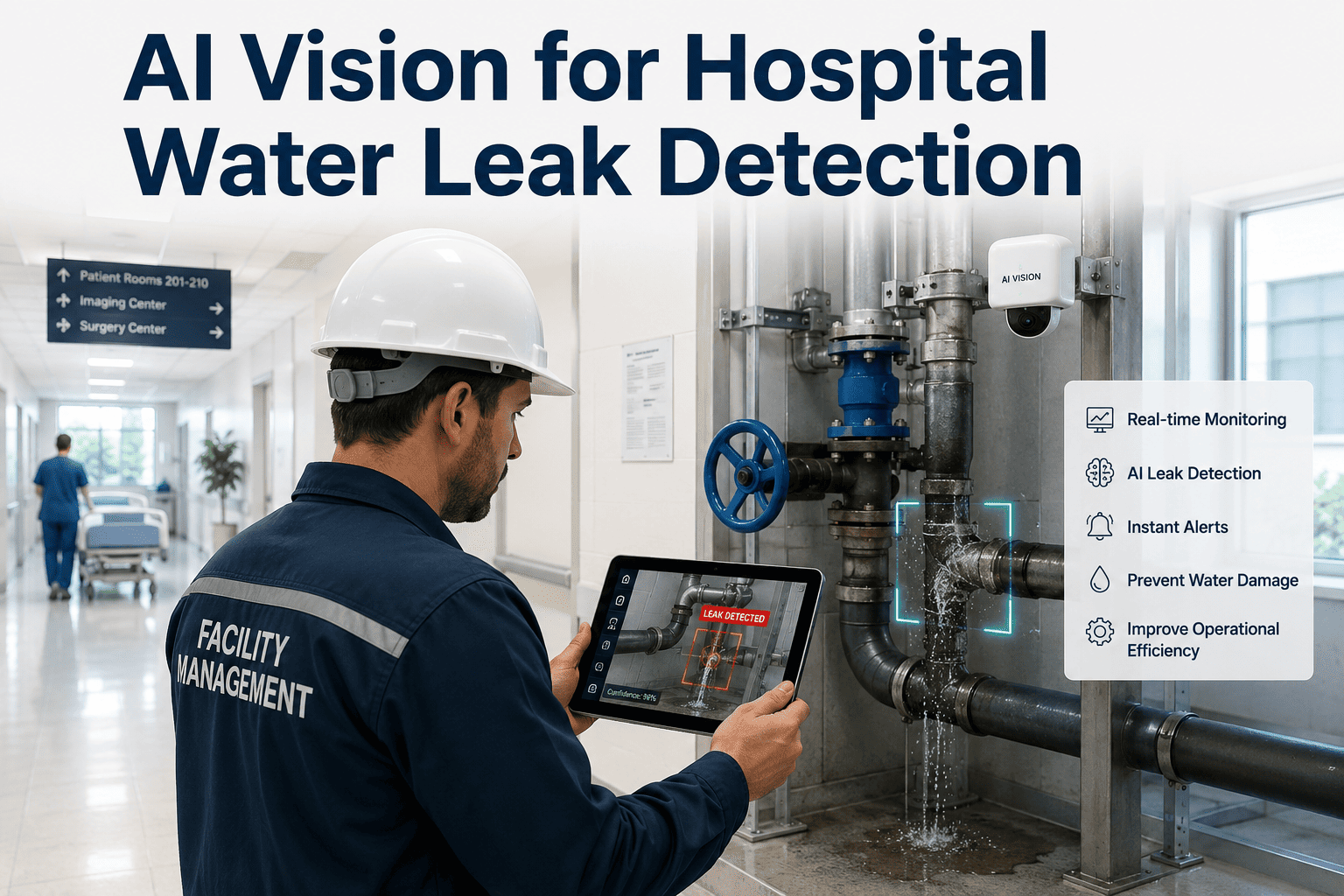
Thermal and visual AI cameras detect abnormal heat signatures, vibration patterns, and fluid leaks on critical hospital plant — HVAC, boilers, sterilizers, and elevators — before failure occurs.
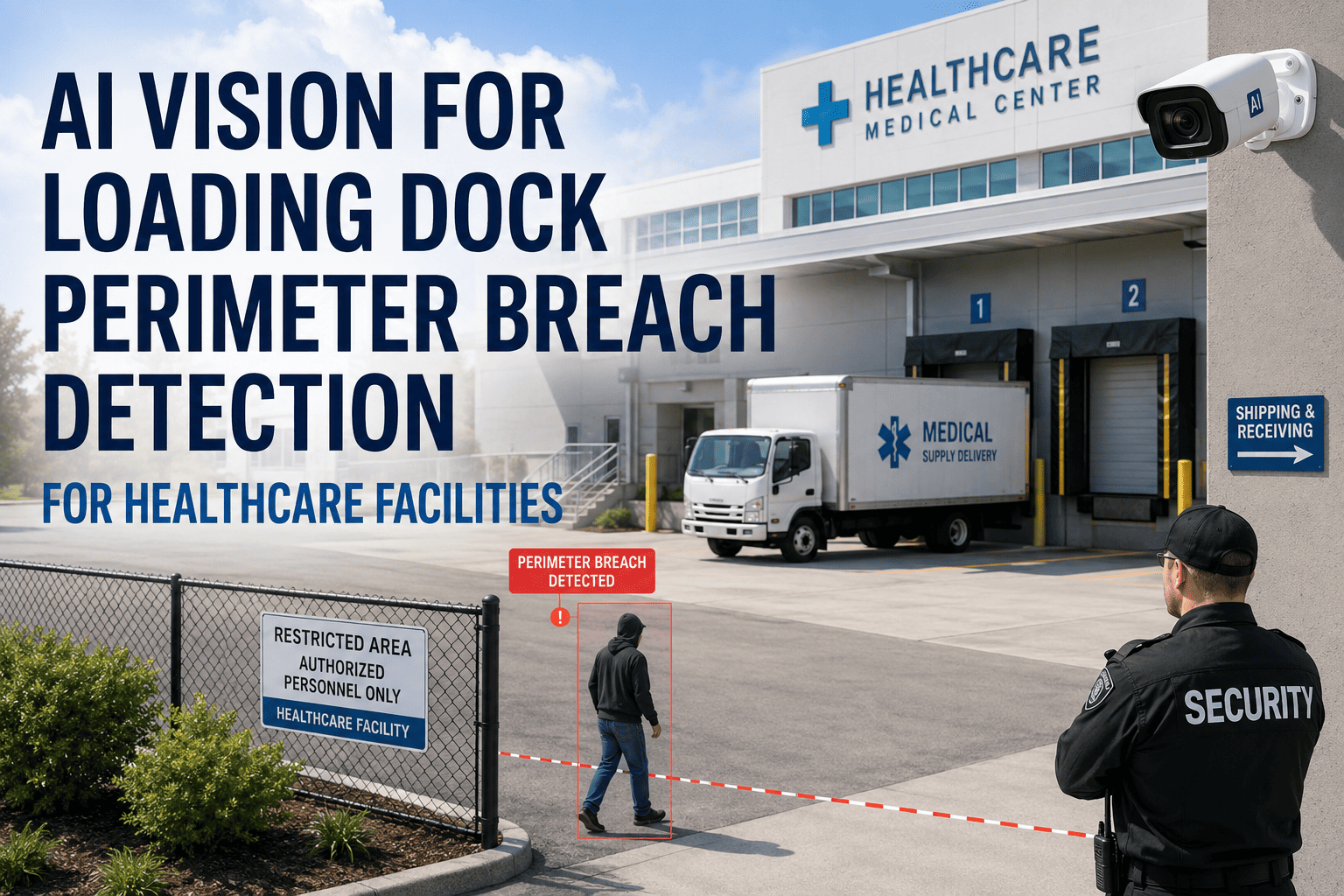
AI surveillance identifies tailgating at secured doors, unauthorized access to medication rooms, and restricted-area violations — generating security incident records with video timestamps automatically.
Vision systems verify that staff entering isolation rooms, sterile zones, and lab environments are wearing the required PPE — flagging compliance gaps before exposure events occur across any shift.
AI-detected anomalies feed directly into CMMS platforms as condition-based work order triggers — eliminating the gap between a detected equipment issue and a technician being dispatched to resolve it.
6 Critical Problems That AI Vision Cameras Solve for Healthcare Facilities
Manual workflows and legacy monitoring systems create compounding operational risk. These are the failure modes most commonly reported by healthcare facility managers before implementing AI vision infrastructure.
Manual patrols detect hazards an average of 38 minutes after they form. AI vision cameras flag the same hazards in under 30 seconds — a difference measured in patient safety outcomes.
Without condition-based monitoring, hospital engineering teams respond to failures rather than preventing them. Emergency repairs average 4.8x the cost of planned maintenance and create unplanned operational disruption.
Paper-based incident logs and spreadsheet maintenance records cannot produce the complete, timestamped audit trail that Joint Commission and CMS surveyors require — creating compliance exposure at every review cycle.
Traditional motion-based security systems generate false alarm rates above 90% in busy clinical environments. Staff desensitization to alerts is a documented safety hazard — AI vision reduces false alarm rates by 60% or more.
Safety, security, and maintenance data sitting in separate systems means no one has a complete operational picture. Incidents that required coordinated response are handled in silos, extending resolution times and increasing liability.
Healthcare portfolio managers overseeing multiple hospitals or clinics have no real-time visibility across properties without AI-integrated monitoring. Portfolio-level risk remains invisible until incidents escalate to reportable events.
How Oxmaint Turns AI Camera Data Into Operational Action
Oxmaint closes the loop between AI camera detection and operational response — automatically converting detected events into structured work orders, inspection records, and compliance documentation. No manual handoff. No information loss. Every camera-detected event becomes a tracked, documented, assignable action. Want to see this in your facility? You can start a free trial or book a demo and see a live integration demonstration.
When an AI camera detects an equipment anomaly or facility hazard, Oxmaint automatically creates a work order, assigns it to the correct technician based on asset type and location, and sets priority based on detected severity.
Every AI-detected condition event is logged against the specific asset in Oxmaint's registry — building a condition scoring history that feeds directly into predictive maintenance scheduling and CapEx forecasting models.
Technicians receive AI-triggered work orders on mobile devices with camera-captured event images, asset location, historical maintenance notes, and a digital checklist — resolving issues faster with full context at hand.
Every camera event, work order, inspection result, and resolution is timestamped with technician attribution and digital signatures — generating an audit-ready documentation chain for Joint Commission, CMS, and OSHA review.
Healthcare portfolio managers get a single real-time view across all properties — AI-detected events, open work orders, asset condition scores, and maintenance compliance rates — without switching between systems.
Condition data accumulated through AI camera monitoring feeds Oxmaint's rolling CapEx models — giving hospital leadership investor-grade equipment replacement forecasts based on real condition trends, not calendar assumptions.
Reactive Hospital Operations vs AI-Integrated Monitoring
The operational and financial difference between reactive hospital management and AI-integrated monitoring is not marginal — it is structural. The table below summarizes the most significant performance gaps across six critical operational dimensions.
| Operational Dimension | Reactive / Traditional | AI Vision + Oxmaint CMMS |
|---|---|---|
| Hazard Detection Speed | 38+ minute average detection via manual rounds | Under 30 seconds — real-time AI visual detection and alert |
| Work Order Creation | Manual report, verbal handoff, delayed entry into system | Automatic work order created from AI event — zero manual steps |
| Equipment Failure Mode | Run-to-failure with emergency repair at 4.8x planned cost | Condition-based triggers generate PM tasks before failure occurs |
| Compliance Documentation | Paper logs, spreadsheets, weeks of audit preparation | Timestamped digital records — audit-ready in seconds on demand |
| False Alarm Rate | 90%+ false positives from motion-based legacy systems | 60% lower false alarm rate with trained AI vision models |
| Multi-Site Visibility | Zero real-time cross-property view — siloed property data | Unified portfolio dashboard across unlimited sites in real time |
Documented Results: What AI Vision Integration Delivers
These are not projected outcomes — they reflect published benchmarks and operational data from healthcare facilities that have integrated AI camera monitoring with structured CMMS platforms. If you want to model the ROI impact for your specific facility, start a free 30-day trial and run your first asset condition assessment, or book a demo and our team will build a preliminary impact model using your facility's data.
Connect Your AI Camera Infrastructure to a CMMS That Actually Acts on It
Oxmaint is built for multi-site healthcare operations — full asset registry, condition-based maintenance scheduling, mobile technician dispatch, and investor-grade CapEx reporting. When your AI cameras detect a problem, Oxmaint ensures it gets resolved, documented, and reported without a single manual handoff.
Frequently Asked Questions
How do AI vision cameras integrate with a hospital CMMS like Oxmaint?
AI vision cameras communicate with CMMS platforms through API integrations, IoT middleware, or direct webhook connections. When a camera system detects a defined event — a hazard, an equipment anomaly, or a compliance violation — it sends a structured data payload to the CMMS, which automatically creates a work order, assigns it to the correct technician based on asset location and type, and logs the event against the relevant asset record. In Oxmaint, this integration connects directly to the asset hierarchy, meaning every camera-triggered event is traceable to a specific asset, system, and property. Start a free trial to configure your first AI-triggered work order workflow today, or book a demo and our integration team will walk through your specific camera vendor setup.
What hospital departments benefit most from AI vision camera deployment?
The highest-impact deployments are typically in facility management and engineering (equipment condition monitoring, hazard detection, and environmental compliance), security and access control (tailgating prevention, restricted-area monitoring, and incident documentation), and clinical operations (patient fall risk, PPE compliance verification, and hand hygiene monitoring). In terms of measurable ROI, engineering and facilities consistently report the fastest payback period due to maintenance cost avoidance from prevented equipment failures — typically achieving full ROI within 12 to 18 months when integrated with a condition-based CMMS platform.
How does AI vision monitoring support Joint Commission and CMS compliance?
AI vision cameras create timestamped, camera-verified records for every detected event — records that are immediately available for regulatory review without reconstruction from paper logs. When integrated with a CMMS like Oxmaint, every detected event, work order, inspection result, and resolution carries a complete audit trail with technician attribution, time stamps, and digital signatures. Joint Commission surveyors reviewing Environment of Care documentation and CMS reviewers examining equipment management programs will find complete, machine-generated records rather than manually assembled paper trails. This eliminates the weeks-long audit preparation process that facilities relying on paper-based systems must endure before every survey cycle.
What is the typical deployment timeline for AI vision cameras in a hospital facility?
Hardware installation timelines depend on facility size and camera density, but most single-facility deployments covering critical areas — main corridors, equipment rooms, secured access points, and high-risk patient areas — are completed within 4 to 8 weeks. Software integration with a CMMS platform like Oxmaint typically adds 2 to 4 weeks for configuration, model calibration, and workflow mapping. Most healthcare facility managers report their first measurable outcome data — reduced false alarm rates, first AI-triggered work orders, and initial compliance documentation — within 60 days of going live. The Oxmaint onboarding process is designed for rapid deployment with no heavy implementation fees or lengthy consulting engagements.
Every Camera Event. Every Work Order. Every Audit. One Platform.
Oxmaint gives healthcare facility managers the infrastructure to connect AI camera monitoring to maintenance operations — automated work order creation, full asset condition registry, mobile-first technician dispatch, and compliance reporting that is audit-ready on demand. Built for single hospitals and multi-site healthcare portfolios. No heavy implementation. No long onboarding. No spreadsheets.
Trusted by facility managers across the US, UK, UAE, and Australia.
No credit card required. 30-day free trial. Cancel anytime.