The state highway department's maintenance director received an urgent call at 6:42 a.m. on a Monday in February: a 340-metre section of pavement on the M-7 corridor had failed overnight — a combination of subsurface moisture intrusion and freeze-thaw cycling had produced a sudden, catastrophic surface fracture across two lanes. Emergency closures, contraflow operation, and accelerated repair contracts cost £1.3 million and caused 14 hours of network disruption affecting 28,000 commuters. The post-incident review found that IoT pavement sensors in that corridor had been recording anomalous subsurface moisture readings for 11 weeks. The data existed. The warning signal was present. But without a system to interpret sensor thresholds, correlate them against environmental conditions, and automatically generate a preventive work order, the insight never became action. That gap — between data that knows and humans who respond — is the defining failure mode of reactive highway maintenance management. OxMaint AI closes this gap permanently. The platform ingests IoT sensor streams, drone inspection findings, visual AI defect scores, and asset condition data continuously — then applies predictive algorithms to determine which assets are approaching failure thresholds, ranks intervention priority by traffic exposure and consequence of failure, and generates structured CMMS work orders automatically: pre-populated with asset ID, location, defect classification, required materials, and compliance documentation. Start your free OxMaint AI trial and activate predictive work order generation across your highway network today — or schedule a consultation to assess your current workflow automation readiness.
Highways Workflow Automation 2026
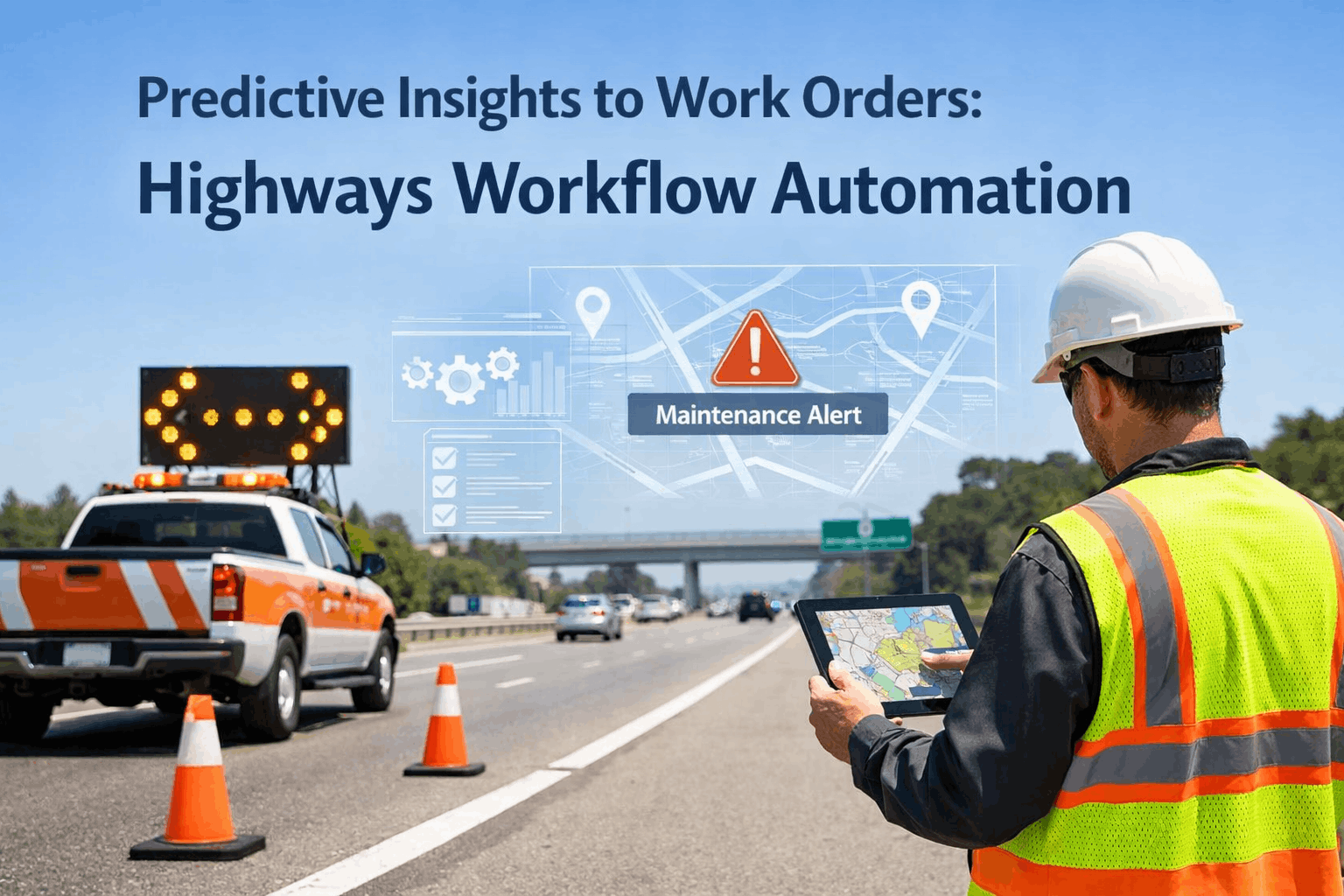
Predictive Insights to Work Orders: Highways Workflow Automation
Convert IoT sensor alerts, drone AI defect findings, and asset condition scores into structured CMMS work orders — automatically, instantly, and without a single manual handoff. OxMaint AI transforms highway maintenance from reactive firefighting into a predictive, data-driven operation where every intervention is scheduled before failure occurs.
73%of Highway Failures Preceded by Detectable Signals
<90sDetection to Work Order Creation
3.2×Reactive vs. Planned Repair Cost Ratio
41%Reduction in Emergency Callouts Year 1
The Highway Maintenance Automation Maturity Spectrum
Most highway maintenance teams still rely on visual inspections, resident complaints, and supervisor intuition to identify defects and dispatch crews. Advancing from this reactive baseline through data-informed scheduling to fully automated predictive work order generation is not a technology leap — it is a structured operational progression. The three maturity stages below represent where most authorities sit today, and where OxMaint AI delivers them within 12 months of deployment.
Reactive/Manual (Complaint-Driven)
67%
Data-Informed (Periodic Inspections)
24%
Fully Predictive (AI Auto Work Orders)
9%
Six Stages of the Predictive Work Order Pipeline
OxMaint AI does not simply alert maintenance teams to problems — it completes the entire journey from raw sensor signal or drone finding to a fully structured, scheduled, and assigned CMMS work order. Each stage in this pipeline eliminates a manual handoff, a decision delay, or a documentation gap that previously allowed small defects to become expensive failures on highway infrastructure.
Predictive Work Order Pipeline — Six Automation Stages
AI Powered
Stage 01
Multi-Source Data Ingestion
IoT pavement sensors, LoRaWAN structural monitors, drone AI vision findings, satellite imagery change detection, and manual inspection inputs all flow into OxMaint's unified data layer continuously. Every asset reading is timestamped, geotagged, and linked to the CMMS asset register in real time.
Foundation Layer
Stage 02
Threshold & Anomaly Detection
AI compares every incoming reading against established baselines, seasonal norms, and engineering thresholds. Deviations — whether a pavement deflection value approaching structural limit or a drainage flow sensor indicating 70% blockage — are classified by severity and asset criticality within seconds of occurrence.
AI Engine
Stage 03
Predictive Risk Scoring
Each flagged condition is scored 0–100 for intervention urgency, factoring in: rate of deterioration, traffic volume exposure, weather forecast impact, consequence-of-failure severity, and proximity to other open defects on the same asset. Scoring determines whether the resulting work order is Priority 1 emergency, scheduled, or routine.
Risk Intelligence
Stage 04
Automatic Work Order Generation
OxMaint creates a fully structured CMMS work order pre-populated with: asset ID, GPS location, defect type and severity, suggested repair method, required materials list, estimated labour hours, compliance documentation attachments, and scheduled completion deadline. Zero manual data entry required at any point.
Zero Manual Entry
Stage 05
Intelligent Crew Assignment & Dispatch
Work orders are matched to available crews based on skill, location, current workload, and equipment availability. Priority-1 orders trigger instant mobile notification to the nearest qualified crew. Routine orders are batched geographically to minimise travel and maximise crew productivity across the network.
Dispatch Intelligence
Stage 06
Verified Closure & Audit Record
Field technicians close work orders via mobile app with geo-stamped before/after photos, material quantities used, time on site, and digital sign-off. Completed data feeds back into the asset's condition profile, updates the predictive model, and auto-generates compliance documentation for FHWA, state DOT, or internal audit requirements.
Compliance Sealed
Predictive Risk Score — Highway Asset Decision Framework
OxMaint AI's predictive risk scoring engine converts raw sensor and inspection data into a standardised 0–100 score for every highway asset — removing subjectivity from maintenance prioritisation and ensuring that the most critical interventions are always scheduled first. This scoring framework aligns directly with highway asset management best practices and provides the defensible, data-backed prioritisation that transport executives and audit bodies require.
80–100
Critical
Failure imminent or occurring. Priority-1 work order raised instantly. Emergency crew dispatch. Network management team alerted. Closure risk assessment triggered automatically.
60–79
Urgent
Intervention required within 7 days. Scheduled work order created and assigned. Supervisor notified. Asset monitoring frequency increased to 15-minute intervals pending repair.
40–59
Elevated
Planned intervention within 30 days. Added to upcoming maintenance programme. Trend monitoring active — score automatically escalates if deterioration accelerates before scheduled repair.
20–39
Routine
Condition monitored. Added to next scheduled inspection cycle. No immediate action required. Asset included in forward maintenance programme and capital planning projections.
0–19
Healthy
Asset within all normal parameters. Continued monitoring at standard intervals. Condition data feeds long-range capital programme and life-cycle cost modelling with no current action required.
Activate Predictive Work Orders Across Your Highway Network
OxMaint AI converts sensor data, drone findings, and inspection scores into structured CMMS work orders automatically — eliminating the gap between detecting a problem and dispatching a crew. Start your free trial and generate your first predictive work order within 14 days.
Defect-to-Work-Order Profiles by Highway Asset Type
Different highway asset classes generate different predictive signals, trigger different work order types, and require different field response protocols. OxMaint AI is pre-configured with asset-specific detection models and work order templates for every major highway infrastructure component — so the right crew, the right materials, and the right compliance documentation are always attached to every work order from the moment it is created.
Highest Volume
Pavement Surface
IoT Deflection + Drone AI Vision
Falling Weight Deflectometer readings, pavement condition index scores, and drone AI crack mapping combine to predict remaining pavement life and trigger mill-and-overlay or patching work orders before structural failure occurs. Seasonal frost-thaw cycles modelled automatically.
CrackingRuttingDelaminationPotholing
Safety Critical
Bridges & Structures
Vibration Sensors + Drone Survey
Vibrating wire strain gauges, accelerometers, and drone photogrammetry identify structural anomalies weeks before visual detection. AI correlates loading cycles, material fatigue thresholds, and inspection findings to prioritise bridge deck, bearing, and substructure work orders with AASHTO-aligned documentation.
Deck CrackingBearing WearScour DepthSpalling
Network Critical
Drainage Systems
Flow Rate IoT + Camera Inspection
Culvert flow sensors detect blockage progression weeks before overflow risk. AI correlates flow reduction rates against seasonal rainfall forecasts to time cleaning and repair work orders for maximum impact — preventing the road damage events that blocked drainage consistently precedes.
Culvert BlockageCatch BasinSide DrainOutfall Erosion
Safety + Legal
Signs & Road Markings
Retroreflectivity + AI-OCR Survey
Mobile retroreflectometry readings and AI-OCR sign condition surveys trigger replacement work orders the moment a sign falls below MUTCD minimum RL values — before it becomes a liability event. Marking fade index triggers restriping orders automatically with lane-by-lane scheduling.
RetroreflectivitySign DamageMarking FadeVisibility
Impact Liability
Safety Barriers
Impact Detection + Drone Survey
IoT impact sensors on crash barriers trigger instant work orders when impact events occur — with GPS location, estimated severity, and photographic confirmation from the nearest drone asset. Deflection progression tracked between routine surveys to identify barriers approaching replacement threshold.
W-Beam DamagePost SpacingEnd TreatmentTensioner
Network Efficiency
Highway Lighting
Smart Lux Sensors + Remote Monitor
Smart lux monitoring detects individual luminaire failures and lumen depreciation below IES RP-8 minimums — generating replacement work orders with precise pole locations, luminaire specifications, and access requirements before a safety complaint or liability event occurs.
Lux LevelsLuminaire LifePole ConditionControl Gear
Workflow Automation Challenges by Agency Scale
A rural county highway department managing 400km of local roads faces fundamentally different workflow automation challenges than a national highways authority managing 4,000km of motorways — but both need the same core capability: turning data signals into dispatched crews before failures occur. Understanding your agency's profile shapes how OxMaint AI is deployed and configured for maximum impact from day one of implementation.
Large National / State (1,000+ km)
Thousands of IoT sensors generating millions of daily readings — without AI triage, alerts are noise
Multiple maintenance contractors requiring standardised work order formats and SLA tracking
Executive dashboards required for parliamentary, board, or Treasury accountability on spend efficiency
FHWA / DfT compliance documentation required for every capital and maintenance work order
Enterprise CMMS integration essential — OxMaint connects to SAP PM, Maximo, Confirm, and custom systems
Regional Authority (200–1,000 km)
Small inspection team responsible for full network — manual review of all sensor data is impossible
Contractor mix of in-house and external crews requires unified work order and dispatch system
Budget pressure demands defensible prioritisation — every work order must be justifiable by data
Mobile-first field operations required — crews receive, complete, and close work orders on site via app
Annual maintenance programme planning requires asset condition data aggregated by road class and age
Local / County (<200 km)
1–4 maintenance staff managing entire network — every automated work order saves 30–45 minutes of admin
No dedicated data analyst — AI must surface actionable alerts without requiring technical interpretation
Seasonal budget cycles make forward-planning data critical for annual funding submissions
Reactive complaint management currently consumes disproportionate time — digital tracking essential
CMMS must be immediately usable by non-technical staff with minimal training from day one
The True Cost of Reactive Highway Maintenance
The cost difference between a planned highway maintenance intervention and a reactive emergency repair is not marginal — it is transformational. Every deferred pothole repair, every ignored drainage sensor alert, every barrier impact that goes undetected for weeks represents not just a multiplied repair cost but a compounding safety liability, network disruption cost, and public trust erosion that proactive predictive maintenance workflows eliminate at their source.
£38K/yr
OxMaint AI Predictive Platform
IoT sensors and drone findings converted to work orders automatically. 85%+ of interventions planned 30–60 days ahead. Emergency callouts reduced to under 12% of total maintenance activity. Network reliability score: 94+.
Emergency Spend: <12%
£140K/yr
Manual Inspection Cycle Mode
Quarterly inspections catch obvious defects. IoT data collected but not actioned. Emergency callouts account for 28–38% of spend. Reactive repairs cost 3.2× more than planned interventions for equivalent defect severity.
Emergency Spend: 28–38%
£480K+
Full Reactive / Complaint-Driven
No predictive capability. Defects identified by public complaint or visual failure. Emergency contracts at 40–60% premium. Network closure events. Liability claims from unreported defects. Regulatory scrutiny on maintenance governance.
Emergency Spend: 45–60%
Stop Responding to Failures. Start Preventing Them.
OxMaint AI's predictive work order platform ensures every highway defect signal — from pavement sensors, drone surveys, or IoT monitors — becomes a structured maintenance intervention before failure occurs. Join highway agencies across three continents using automated work order generation to cut emergency spend and extend network asset life.
OxMaint AI Platform Features for Highway Workflow Automation
Generic CMMS platforms capture work orders after humans create them. OxMaint AI generates work orders before humans even know a problem exists — by continuously analysing every data source connected to your highway network and acting on predictive signals the moment they cross intervention thresholds. The six capabilities below form the complete highway maintenance automation platform.
A
Multi-Source Predictive Data Ingestion
Connect IoT pavement sensors, LoRaWAN structural monitors, drone AI inspection feeds, satellite change detection, SCRIM friction data, and manual inspection inputs into a single normalised data layer. Every reading linked to the CMMS asset register and updated in real time — no data silos, no manual imports.
B
AI Threshold & Anomaly Alert Engine
Pre-configured engineering thresholds for every highway asset class — pavement deflection, bridge strain, drainage flow, barrier impact, friction coefficient, lux levels — compared against incoming readings continuously. AI flags anomalies, classifies severity, and determines whether the condition warrants immediate, scheduled, or monitored response.
C
Automatic CMMS Work Order Creation
Every predictive alert above intervention threshold auto-generates a fully structured CMMS work order: asset ID, GPS coordinates, defect classification, severity score, recommended repair method, materials list, labour estimate, compliance documentation template, and deadline based on priority tier. Zero manual input at any stage of the process.
D
Intelligent Dispatch & Route Optimisation
Work orders are automatically batched and routed for maximum crew efficiency — geographic clustering reduces travel time, skill matching ensures the right trade for each task, and equipment availability is checked before assignment. Crews receive complete job packs on mobile devices before leaving the depot.
E
Executive Programme Dashboard
Real-time visibility across every active work order, asset risk score, maintenance programme status, budget vs. actual spend, and contractor SLA performance. Network-wide predictive risk maps updated continuously. Board-ready reporting generated automatically — no manual data compilation required for any governance submission.
F
Compliance Documentation & Audit Trail
Every work order carries a complete chain of evidence: sensor readings that triggered detection, AI classification rationale, risk score at time of dispatch, crew assignment records, field completion photos, materials used, and supervisor sign-off. FHWA, state DOT, and internal audit requirements satisfied automatically on every intervention.
Frequently Asked Questions
Q. How does OxMaint AI convert sensor data into work orders without human intervention?
OxMaint AI ingests continuous data streams from every connected source — IoT pavement sensors, LoRaWAN structural monitors, drone inspection feeds — and compares each reading against pre-configured engineering thresholds and AI-learned baselines. When a reading crosses an intervention threshold, the system instantly calculates a risk score using traffic volume, deterioration rate, consequence-of-failure weighting, and forecast environmental conditions. If the risk score exceeds the configured action level, a fully structured work order is created automatically in the CMMS — with asset location, defect classification, repair recommendation, materials list, and compliance documentation — and assigned to the appropriate crew or contractor. The entire process from sensor alert to created work order takes under 90 seconds. Human oversight is maintained through real-time dashboard visibility and configurable approval gates for high-value orders.
Start your free trial to see the pipeline in action on your own network data.
Q. Which IoT sensors and data sources does OxMaint AI support for highway predictive maintenance?
OxMaint AI supports all major highway monitoring data sources through open API integration and pre-built connectors: pavement deflection and condition sensors, LoRaWAN-connected bridge strain gauges and accelerometers, drainage flow rate monitors, road weather information system feeds, retroreflectometry survey data, drone AI inspection outputs (including integration with major drone platforms), SCRIM friction measurement data, barrier impact detection systems, and highway lighting lux monitors. Manual inspection inputs from field teams are also ingested via the OxMaint mobile app. New sensor types are integrated through the open REST API — typically within 5–10 business days for standard sensor protocols including Modbus, MQTT, OPC-UA, and DNP3. Data from existing SCADA systems and traffic management centres can also be ingested to enrich predictive models.
Q. How does the AI determine intervention priority when multiple assets need attention simultaneously?
OxMaint AI's predictive risk scoring engine calculates a composite 0–100 priority score for every flagged asset using five weighted factors: defect severity and rate of progression (35%), traffic volume and road classification exposure (25%), consequence-of-failure assessment including safety risk and network disruption potential (20%), environmental conditions and forecast impact on deterioration rate (12%), and proximity to other open defects that might indicate systemic failure patterns (8%). Assets scoring above 80 generate Priority-1 emergency work orders with immediate crew dispatch. Scores of 60–79 generate scheduled orders for action within seven days. The scoring model is calibrated to your network's specific asset mix and historical failure data during implementation and continues to improve accuracy as more operational data is ingested. Configuration is transparent — maintenance directors can review and adjust threshold weights at any time through the platform settings.
Q. Does OxMaint AI integrate with our existing CMMS and ERP systems?
Yes. OxMaint AI integrates with all major highway asset management and CMMS platforms via REST API and pre-built connectors. Supported systems include Confirm (Idox), SAP PM, IBM Maximo, Oracle eAM, Infor EAM, Brightly (Lucity), and custom systems through the open API. Work orders created by OxMaint AI can be pushed directly into your existing CMMS, maintaining your current workflows while adding predictive generation capability. Financial system integration — for automatic budget coding, purchase order creation, and cost centre allocation — is supported for SAP FI/CO, Oracle Financials, and Microsoft Dynamics. Implementation teams typically complete CMMS integration within 10–15 business days as part of the standard onboarding programme.
Book a technical scoping call to review your specific integration requirements before committing.
Q. How quickly does a highway agency see measurable results after deploying OxMaint AI?
Most highway agencies see measurable workflow improvements within the first 30 days of OxMaint AI deployment. Phase 1 (weeks 1–2) connects data sources and activates the predictive alert engine — agencies typically see their first automatically generated work orders within 72 hours of activation. Phase 2 (weeks 2–6) configures asset-specific thresholds, integrates with the existing CMMS, and deploys the mobile field app to maintenance crews. Phase 3 (weeks 6–12) activates the full executive dashboard, contractor SLA tracking, and compliance documentation modules. Measurable outcomes at the 90-day mark typically include: 28–35% reduction in emergency callout frequency, 15–22% improvement in crew productivity through better dispatch optimisation, and 40–60% reduction in work order creation time for maintenance coordinators. Full programme ROI — including emergency cost reduction and asset life extension — is typically evidenced at the 6-month review.
Book a scoping call for a deployment timeline tailored to your network size and current technology stack.