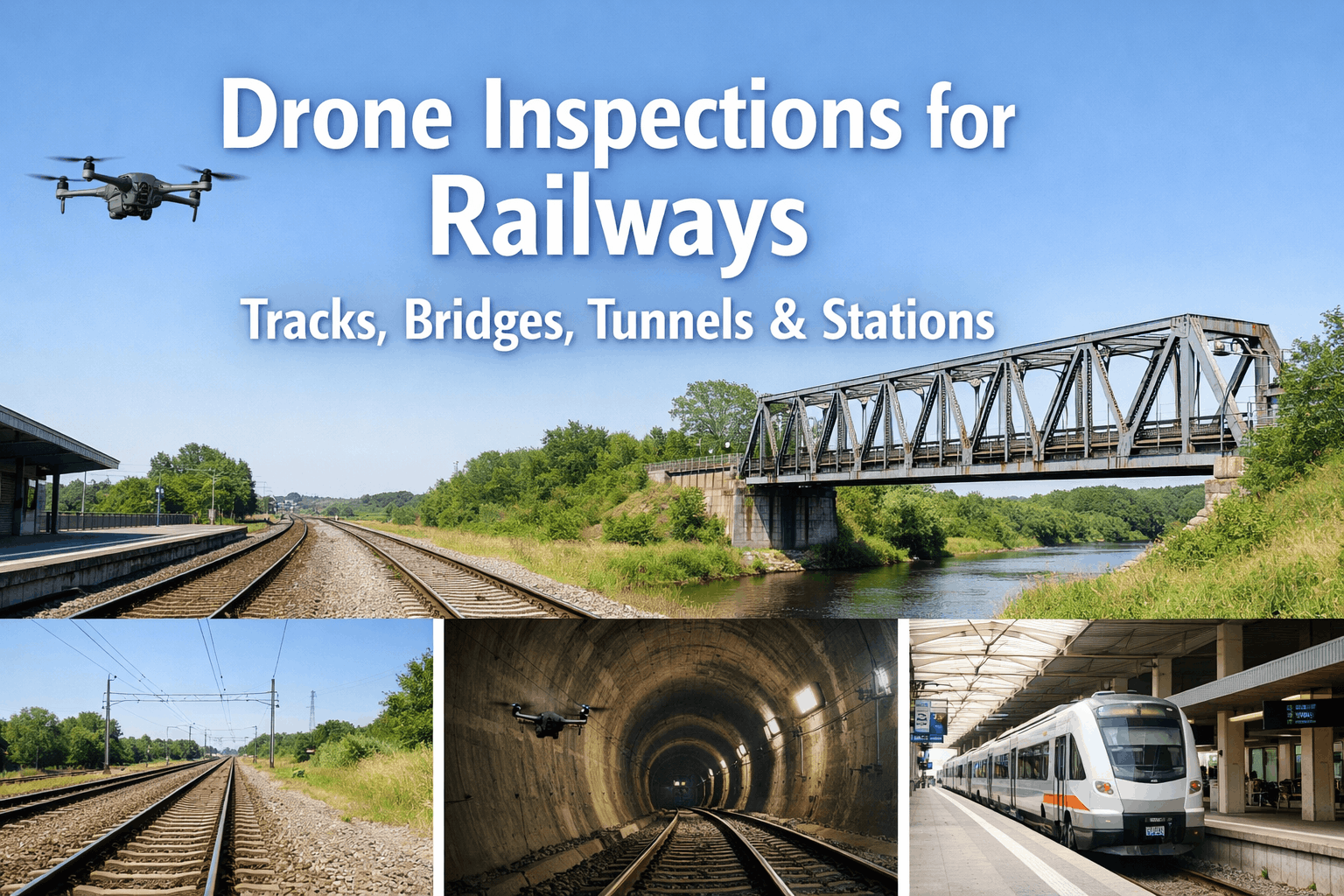
In November 2024, a commuter rail authority in the Northeast lost a critical steel-girder bridge to a fatigue fracture during morning rush hour. A loaded eight-car train crossed the span at 55 mph when a corroded bottom flange separated, sending the lead car off the rails and injuring 42 passengers. The corridor shut down for 14 days — costing $16.8 million in emergency repairs, replacement bus service, and liability payouts. The post-incident investigation revealed that the fracture originated from a fatigue crack growing for at least 22 months in a location invisible from the walkway where inspectors stood during their annual review. A drone with a high-resolution zoom camera could have captured millimetre-detail imagery of that flange from below in under 25 minutes, and AI defect classification would have flagged the crack as critical severity a full year before failure. Across the authority's network — 780 track-miles, 290 bridges, 9 tunnels, and 54 stations — manual inspection covered barely 40% of structural surfaces each cycle. The technology to inspect every square metre existed; the operational framework to deploy it did not. Schedule a consultation to build a CMMS-driven drone inspection programme for your railway infrastructure.
Why Drone + IoT + AI Is Transforming Railway Inspections
Railway infrastructure — tracks, bridges, tunnels, and stations — spans thousands of miles and includes structures that are dangerous, inaccessible, or prohibitively expensive to inspect manually. Drones equipped with LiDAR, thermal imaging, high-resolution cameras, and AI-powered defect classification can inspect a bridge in 30 minutes instead of 3 days, survey 50 track-miles per shift instead of 5, and access tunnel crowns and station rooftops without scaffolding or track closures. IoT sensors embedded in track and structures provide continuous data between flights. But drone and sensor data only drives maintenance action when it flows into a CMMS that auto-generates prioritised work orders. Oxmaint AI integrates drones, robots, sensors, and analytics to automate inspections, reduce downtime, and keep citizens safe.
The Railway Inspection Crisis in Numbers
62%
of railway bridge defects occur in locations inaccessible to manual inspectors without scaffolding or under-bridge inspection vehicles
3 Days
Average manual bridge inspection duration requiring track closures — a drone completes the same scope in under 30 minutes with zero service disruption
$16M+
Average cost of a single railway bridge failure — emergency repairs, replacement service, liability claims, and FRA investigation compliance
92%
Defect detection accuracy when AI vision processes drone imagery — versus 68% for manual visual inspection from walkways and platforms
How drone-ready is your railway inspection programme? Oxmaint provides transit agencies with drone mission scheduling, AI defect dashboards, and automated work order generation from aerial imagery.
From Flight to Fix: The Drone Inspection Data Pipeline
A railway drone inspection programme requires a seamless data pipeline — from mission planning and autonomous flight through AI-powered defect classification to CMMS-generated work orders and repair verification. Each stage feeds the next, creating a closed loop where every defect is discovered, classified, prioritised, repaired, and verified without manual data entry or paper forms.
CMMS generates drone inspection missions based on asset condition history, FRA inspection cycles, and risk priority. Flight paths are pre-programmed for each bridge, tunnel, track segment, and station — coordinated with revenue service schedules to minimise disruption.
02
Autonomous Flight & Multi-Sensor Capture
Drones execute pre-programmed flight paths capturing high-resolution imagery, LiDAR point clouds, thermal profiles, and video. IoT track sensors provide ground-level data on rail gauge, cant, temperature, and vibration patterns that complement aerial imagery.
03
AI Defect Classification & Severity Scoring
AI vision models classify defects by type (crack, corrosion, spall, fastener loss, vegetation encroachment, marking fade), severity (1-5 scale), and GPS location. Thermal analysis identifies moisture infiltration in bridge decks and delamination in tunnel linings.
04
CMMS Work Order Auto-Generation
Classified defects auto-generate prioritised CMMS work orders with defect imagery, GPS coordinates, severity scores, and recommended repair actions. High-severity findings trigger immediate safety alerts to maintenance-of-way supervisors and safety officers.
05
Repair Execution & Drone Verification
Maintenance crews execute repairs from CMMS-dispatched work orders. Post-repair verification drone flights capture before/after imagery. CMMS closes work orders with documented photographic evidence for FRA compliance records. Sign up for Oxmaint to close the loop between aerial defect detection and track-side repair.
Inspection Domains: What Drones + IoT Cover
Railway infrastructure spans six primary inspection domains — each with unique drone sensor requirements, IoT integration points, AI classification models, and CMMS work order templates. A unified CMMS manages all six domains so maintenance managers see one consolidated view of infrastructure health across the entire railway network.
Railway Drone + IoT Inspection Domains
Track & Right-of-Way (780+ miles)
Fixed-wing and multirotor drones survey rail gauge, tie condition, ballast profile, fastener integrity, and vegetation encroachment. IoT rail sensors provide continuous vibration, temperature, and strain data between drone flights for real-time anomaly detection.
Bridges & Elevated Structures (290+)
Multirotor drones with zoom cameras and LiDAR inspect steel girder fatigue cracks, concrete spalling, bearing pad displacement, scour damage, and paint system deterioration — accessing underside locations impossible for walkway-based inspectors.
Tunnels & Underground Structures (9+)
GPS-denied drones with SLAM navigation and thermal cameras inspect tunnel lining cracks, water infiltration, crown deformation, and ventilation equipment condition. LiDAR scanning detects clearance gauge encroachment at millimetre precision.
Stations & Platform Infrastructure (54+)
Drones inspect station rooftops, canopy structures, platform edges, drainage systems, and façade deterioration without scaffolding. Thermal imaging identifies moisture intrusion and insulation failures. IoT sensors monitor platform edge gaps and structural movement.
Signal & Power Distribution Systems
Drones inspect catenary wire sag, mast corrosion, signal head alignment, and cable tray condition across the entire corridor. Thermal imaging detects hot spots in electrical connections indicating resistance failures before outage occurs.
Geotechnical & Environmental Monitoring
Drones with multispectral cameras monitor embankment stability, slope erosion, drainage channel blockage, and vegetation encroachment. Change detection between survey flights identifies emerging geotechnical risks before they threaten track integrity.
Manage every inspection domain from one dashboard. Book a demo to see how Oxmaint orchestrates drone missions, IoT sensor feeds, and AI defect analytics across your entire railway network.
Railway drone inspections follow tiered protocols mapped to FRA regulatory requirements, asset criticality, and environmental exposure. Drones don't replace all manual inspections — they augment them by covering more assets more frequently and providing quantitative data that manual visual inspection cannot produce.
Drone Inspection Protocol Matrix by Asset Type
Asset Type
Drone Frequency
Key Deliverables
FRA Alignment
Track / Guideway
Monthly (arterial) / Quarterly (branch)
Rail profile, tie condition map, ballast assessment, gauge measurement
Catenary sag profile, mast corrosion map, hot spot detection, cable tray check
49 CFR 236 — Signal Systems
Geotechnical
Seasonal (4x/year) + post-storm
Slope stability index, erosion mapping, drainage clearance, vegetation index
FRA Emergency Order requirements
All drone inspection missions auto-generated as CMMS work orders. AI-classified defects flow directly into maintenance scheduling. FRA inspection documentation generated automatically from drone data.
Manual Inspection vs. Drone + AI + IoT + CMMS
The fundamental shift from manual to drone-based railway inspection isn't just about speed — it's about data quality, coverage completeness, worker safety, and the ability to predict failures before they endanger passengers. CMMS integration transforms drone imagery from files on a hard drive into actionable, prioritised maintenance work orders.
Manual Inspection vs. CMMS-Integrated Drone Programme
Manual Inspection
❌
3-day bridge inspections requiring track closures
Walkway-limited — cannot access underside of girders
Subjective condition ratings recorded on paper forms
Annual frequency for most assets across the network
Workers exposed to active rail, heights, confined spaces
68%defect detection rate from visual walkway inspection
Drone + AI + IoT + CMMS
✔️
30-minute bridge inspection — zero track closure needed
360° access including underside, crown, and confined areas
Quantitative AI-classified defects with GPS coordinates
Monthly to quarterly frequency across full network
Zero worker exposure to active rail environments
92%defect detection with AI-powered drone inspection
See Drone Railway Inspection in Action
Oxmaint CMMS provides railway agencies with drone mission scheduling, AI defect dashboards, IoT sensor fusion, automated work order generation, and FRA compliance documentation — turning aerial imagery into accountable infrastructure maintenance.
AI models trained on railway-specific imagery classify defects by type, severity, and repair urgency — enabling automated work order generation that prioritises safety-critical findings above cosmetic issues. Each asset domain has its own defect taxonomy mapped to FRA reporting categories and CMMS action triggers.
AI Defect Classification & CMMS Action Matrix
Asset Domain
Defect Types Detected
AI Severity Scale
CMMS Action
Track
Rail head wear, gauge widening, tie deterioration, fastener loss, ballast fouling
1-5 (Good → Immediate)
Auto work order + speed restriction alert at Level 4-5
All AI classifications include confidence scores. Low-confidence findings are flagged for human review. CMMS tracks AI accuracy metrics over time to improve model performance continuously.
ROI: Drone Inspection Programme Metrics
The return on investment for railway drone inspections is measured in reduced track closure hours, faster defect response, lower per-inspection costs, extended asset life through early intervention, and — most critically — prevented failures that endanger passengers and disrupt service.
Drone Inspection Programme ROI DashboardBased on commuter rail agency drone programme data and FRA compliance cost reports
90%
Reduction in track closure hours for bridge inspections
6x
Faster track survey coverage vs. manual windshield methods
60%
Lower per-bridge inspection cost vs. snooper trucks and scaffolding
100%
Elimination of worker exposure to active rail during aerial inspections
Calculate your inspection programme ROI. Create a free Oxmaint account to model how drone + AI + IoT + CMMS integration reduces costs and prevents infrastructure failures across your railway.
CMMS Capabilities for Drone-Powered Railway Maintenance
Managing a railway drone inspection programme requires CMMS capabilities beyond standard asset management. The system must handle aerial mission scheduling, AI data ingestion, IoT sensor fusion, multi-domain defect correlation, FRA compliance documentation, and integration with revenue service scheduling for minimal disruption.
CMMS Features for Railway Drone + IoT Programmes
Drone Mission Scheduler
Auto-generates inspection missions from asset maintenance calendars, FRA cycles, and risk priority. Coordinates flight schedules with revenue service timetables. Tracks mission completion status, coverage gaps, and drone fleet availability.
AI Defect Ingestion Engine
Receives AI-classified defect records with type, severity, GPS coordinates, and imagery. Auto-generates prioritised CMMS work orders. High-severity findings trigger instant alerts to maintenance-of-way supervisors and safety officers.
IoT Sensor Fusion Dashboard
Combines drone imagery with IoT track sensor data — vibration, temperature, strain — for a complete asset health picture. Correlates aerial defect observations with ground-level sensor anomalies to confirm and prioritise findings with higher confidence.
FRA Compliance Auto-Documentation
Auto-generates FRA-compliant inspection reports for bridges (49 CFR 237), track (49 CFR 213), tunnels, and signal systems. Drone imagery, AI classifications, and repair records populate required documentation fields without manual data entry.
We used to shut down the corridor for three days to inspect one bridge — a $45,000 operation counting crew costs, flagging, and lost revenue service. Now a drone inspects the same bridge in 30 minutes during a scheduled service gap, the AI classifies every defect with imagery, and Oxmaint generates the work orders before the drone has landed. We inspected all 290 bridges in our system in one season instead of the three years our manual cycle required. When FRA auditors reviewed our documentation, they said it was the most thorough they had ever seen — and every finding had geo-tagged photographic evidence attached.
Building a CMMS-integrated drone + IoT inspection programme for railway infrastructure follows a phased approach. The goal is a self-sustaining inspection cycle where drones fly on schedule, IoT sensors stream continuously, AI classifies findings, CMMS generates work orders, and repairs are verified — with FRA compliance documentation generated automatically at every stage.
120-Day Railway Drone Programme Launch
Phase 1
Asset Inventory & Prioritisation
Register all bridges, tunnels, stations, track segmentsAssign risk priority and inspection frequencyMap FRA compliance cycles per asset type
Phase 2
Drone Fleet & IoT Setup
Configure drone fleet as CMMS assetsBuild flight path library per assetDeploy IoT track sensors on priority corridors
Phase 3
AI Training & Pilot Programme
Train AI models on railway-specific defect imageryExecute pilot inspections on 20 priority assetsValidate AI accuracy against manual findings
Phase 4
Full Network Operations
Scale to complete network coverageActivate IoT sensor fusion dashboardsLaunch FRA compliance auto-reporting
Launch your railway drone programme in 120 days. Get a customised implementation plan for your agency's bridge, tunnel, track, and station inspection needs.
A railway drone CMMS doesn't operate in isolation. It connects to dispatch, GIS, asset management, IoT platforms, and regulatory reporting systems to create a complete infrastructure health ecosystem across the entire railway network.
Enterprise Integration Points
System
Integration Type
Data Exchange
GIS / Asset Registry
Two-way Sync
Drone defects geo-referenced to centreline network, bridge inventory, and station database
IoT Sensor Platform
Real-time API
Track vibration, temperature, and strain data correlated with drone imagery findings
Oxmaint CMMS gives railway agencies the drone + IoT inspection infrastructure that transforms aerial data and sensor feeds into actionable maintenance — automated work orders, AI defect dashboards, sensor fusion analytics, and FRA compliance documentation. Build your programme before the next bridge failure tests your manual process.
Can drones fully replace manual railway bridge inspections?
Drones augment rather than fully replace manual inspections. FRA requires hands-on bridge inspection elements (sounding, probing) that drones cannot perform. However, drones dramatically reduce the scope of manual work needed by pre-identifying defect locations, eliminating the need for under-bridge inspection vehicles for visual assessment, and providing quantitative condition data that manual inspection cannot match. Most railway agencies report reducing manual bridge inspection time by 60-70% when drones provide pre-inspection imagery. The CMMS coordinates both drone and manual inspection schedules to ensure complete FRA compliance. Sign up for Oxmaint to manage integrated drone and manual inspection programmes.
How do IoT sensors complement drone inspections between flights?
IoT track sensors provide continuous, real-time data between periodic drone flights. Rail-mounted vibration sensors detect gauge changes, joint deterioration, and broken rail events in real time. Temperature sensors monitor rail neutral temperature and expansion joint movement. Strain gauges on bridges measure live load response. When drone inspection imagery shows a defect, IoT sensor data from the same location provides temporal context — was this a sudden change or gradual degradation? The CMMS correlates both data sources to prioritise maintenance with higher confidence and fewer false positives. Schedule a demo to see IoT + drone sensor fusion in action.
What AI models classify railway defects from drone imagery?
Railway drone programmes use convolutional neural networks (CNNs) trained on domain-specific imagery — separate models for steel bridge defects (cracks, corrosion, section loss), concrete defects (spalling, delamination, rebar exposure), track defects (rail head wear, tie deterioration, fastener loss), and tunnel defects (lining cracks, water infiltration patterns). Models are trained on tens of thousands of labelled images from prior inspections and continuously refined as the CMMS tracks AI classification accuracy against human inspector validation. Thermal defect models use separate temperature-based architectures to identify moisture infiltration and electrical hot spots.
How are drone flights coordinated with revenue train service?
The CMMS integrates with the railway's revenue service scheduler to identify inspection windows — overnight non-revenue periods, midday service gaps, and weekend reduced-service windows. For track inspections, fixed-wing drones survey at altitudes above the track clearance envelope during revenue service without disruption. For bridge and tunnel inspections requiring close-proximity flight, the CMMS schedules missions during planned outages. Emergency inspections triggered by incidents or severe weather override normal scheduling with safety-priority dispatch. All flight coordination data is logged for FRA documentation and audit trails.
What is the ROI timeline for a railway drone inspection programme?
Most railway agencies see positive ROI within the first inspection cycle (6-12 months). Primary savings include: reduced track closure hours for bridge inspection (90% reduction translating to significant revenue service savings), lower per-asset inspection cost (60% reduction vs. manual methods with snooper trucks and scaffolding), early defect detection preventing costly emergency repairs ($16M+ per bridge failure avoided), and reduced FRA compliance preparation time through auto-generated documentation. A mid-size commuter rail agency with 250+ bridges typically saves $2-4 million annually against a drone programme investment of $400K-700K including equipment, AI software, IoT sensors, and CMMS integration.