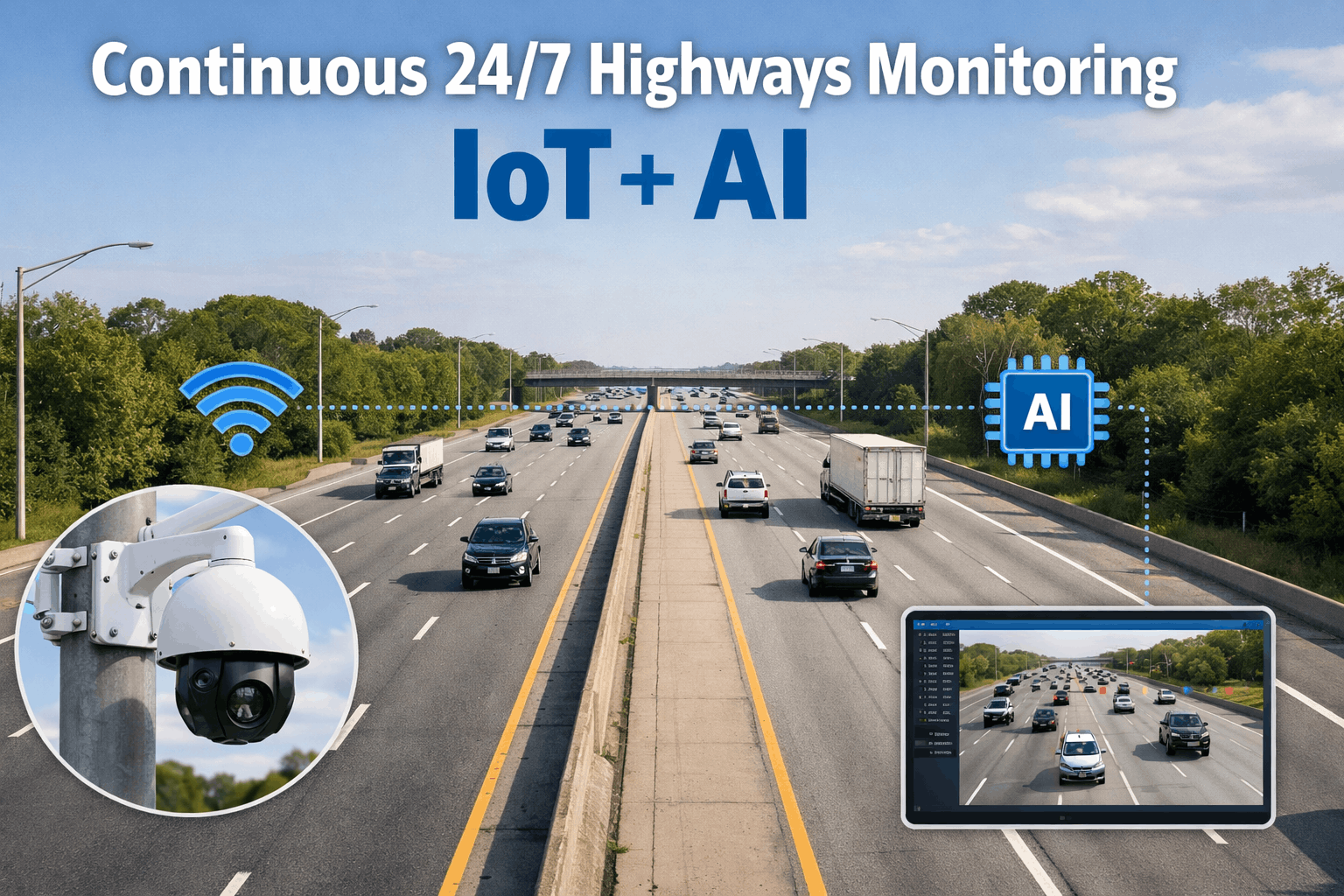
Government highway agencies are responsible for thousands of kilometres of pavement, bridges, tunnels, retaining walls, drainage systems, and traffic infrastructure that must perform safely and reliably around the clock. Traditional monitoring programs — annual condition surveys, periodic bridge inspections, reactive pothole repair — were designed for an era when the only available tools were human observation and physical measurement. That era is over. The convergence of low-cost IoT sensor networks, edge computing, satellite connectivity, and AI-powered anomaly detection has made continuous 24/7 highway monitoring not just technically feasible but economically superior to legacy inspection programs. Government highway networks that have deployed integrated IoT and AI monitoring are detecting pavement failures 6–8 weeks before they become safety hazards, identifying bridge structural anomalies between inspection cycles that would have gone undetected for years, and reducing emergency maintenance call-outs by 35–50% in the first year of operation. The question for government highway authorities is no longer whether to deploy continuous monitoring — it is how to prioritise the deployment to deliver the highest return on public infrastructure investment. Schedule a free highway monitoring capability assessment with our team and find out where IoT and AI monitoring can deliver the fastest returns on your network.
The 24/7 Monitoring Gap in Government Highway Programs
Between formal inspection cycles, highway infrastructure is unobserved. Pavement fails, bridges develop cracks, drainage systems block, and slope failures initiate — all without the highway authority knowing until a motorist reports it, a field crew happens to pass, or the defect reaches a size and severity that makes it unmissable. Understanding the cost of this observation gap is the foundation of the business case for continuous monitoring.
Annual Inspection
Condition recorded. No defects found.
Defects initiate and progress — invisible to the monitoring program
Failure Event
Emergency repair. 3–5× planned cost. Service disruption.
Next Inspection
Post-failure. Gap in condition history.
With Continuous IoT + AI Monitoring
Baseline established
Anomaly detected — 6–8 weeks early
Planned intervention. Failure prevented.
3–5×
Higher cost of emergency pavement repair versus planned maintenance on the same defect
47%
Of bridge structural defects in OECD networks found to have initiated between formal inspection cycles
£2.1M
Average cost of a major road closure event caused by undetected pavement failure — UK Highways England data
8 weeks
Average advance warning provided by IoT sensor networks before pavement failure threshold is reached
The IoT + AI Monitoring Architecture
A complete 24/7 highway monitoring system is not a single device — it is a layered architecture of sensors, communications, computing, and analytics that must work together reliably in the outdoor infrastructure environment. Understanding the architecture helps government highway authorities make informed procurement decisions and avoid the common mistake of deploying sensor hardware without the analytics and management platform that makes the data actionable.
Layer 1
Physical Sensor Network
Deployed on and within highway infrastructure
Pavement Strain & Stress Sensors
Embedded piezoelectric and fibre optic sensors measuring load-induced strain, temperature cycling stress, and subbase settlement
Bridge Structural Health Sensors
Accelerometers, strain gauges, displacement transducers, and tiltmeters on critical bridge elements — piers, girders, expansion joints
Slope and Retaining Wall Monitors
Inclinometers, piezometers, and GNSS-based displacement monitors detecting early-stage slope movement and groundwater pressure changes
Pavement Temperature & Moisture
Surface and sub-surface temperature sensors, moisture content probes for frost heave and drainage performance monitoring
Traffic Counting & Weigh-in-Motion
WIM sensors capturing vehicle counts, speeds, and individual axle loads — the input data for pavement damage modelling and overload detection
GNSS Deformation Monitors
Millimetre-precision satellite positioning on bridges, tunnels, and retaining structures providing continuous absolute displacement data
↓ Data transmission via LoRaWAN, 4G/5G cellular, or fibre ↓
Layer 2
Edge Computing and Connectivity
Local processing nodes at asset locations — reduces bandwidth, enables local alerting
Edge Processing Units
Local microcontrollers perform data aggregation, quality checks, and first-pass anomaly detection before transmission — reducing bandwidth requirements by 80–95% versus raw data streaming
Local Alert Logic
Critical threshold exceedances (seismic event, rapid bridge displacement, slope movement onset) generate immediate local alerts without waiting for cloud processing — sub-minute response for safety-critical events
Data Resilience Buffering
Local storage buffers sensor data during connectivity outages, ensuring no data is lost during network interruptions — critical for remote locations where cellular coverage is intermittent
↓ Aggregated data to cloud analytics platform ↓
Layer 3
AI Analytics and Decision Platform
Cloud-based machine learning, trend modelling, and maintenance management integration
Anomaly Detection Models
ML models trained on historical sensor baselines identify deviations that indicate developing defects — distinguishing genuine structural changes from seasonal variation and traffic effects
Deterioration Rate Modelling
Regression and physics-based models fit degradation curves to sensor trends, forecasting when assets will reach intervention thresholds with confidence intervals for planning purposes
Risk Prioritisation Engine
Combines structural condition trends with traffic exposure, consequence of failure, and remaining service life to rank maintenance priorities across the entire network in real time
Maintenance Management Integration
AI-generated maintenance recommendations flow directly into work order management systems — creating planned interventions with supporting sensor evidence, location data, and urgency classification
Connect Your Highway Sensor Data to the Platform That Turns It Into Action
Oxmaint integrates with IoT sensor networks, condition monitoring platforms, and inspection management systems to give highway authorities a single dashboard that connects real-time asset condition to planned maintenance workflows — closing the loop from detection to intervention.
The IoT sensor types, AI models, and alert protocols required differ significantly across highway asset classes. An effective 24/7 monitoring program matches sensing technology to the specific failure mechanisms of each asset type rather than deploying a one-size-fits-all sensor configuration.
Pavement Network
Motorways, A-roads, urban arterials
High Volume Asset
What Gets Monitored
Structural strain under traffic loading — fatigue damage accumulation tracking
Pavement temperature gradient — frost depth and thermal cracking risk
Sub-base moisture content — drainage failure and deformation risk
Axle load distribution — cumulative damage equivalent (AADT-ESALs)
AI Alert Triggers
CriticalSudden change in deflection bowl — subbase void or delamination onset
HighAccelerating fatigue damage rate — pavement life < 6 months at current rate
Deploying 24/7 IoT monitoring on public highway infrastructure requires navigating procurement frameworks, data governance requirements, and political accountability structures that are distinct from private sector technology adoption. Successful government highway monitoring programs address these requirements proactively.
01
Outcome-Based Procurement Specifications
Government procurement frameworks require technology-neutral specifications to enable genuine competitive tendering. Highway monitoring specifications should describe detection capabilities, alert response times, data format standards, and uptime requirements — not specific sensor brands or proprietary data formats. Open API requirements and data portability provisions protect against vendor lock-in that creates long-term budget dependency for public agencies.
Key Clause: Data ownership vested in the highway authority — not the technology provider
02
Data Governance and Cyber Security
Highway infrastructure monitoring systems are classified as Critical National Infrastructure in most developed nations, carrying cyber security obligations including ISO 27001 compliance, segregated operational technology networks, and penetration testing requirements. Data governance frameworks must specify retention periods, access controls, and the legal basis for data collection where any personally identifiable data is captured (e.g., vehicle identification through weigh-in-motion systems).
Key Clause: CNI-compliant cyber security certification required before system go-live
03
Integration with National Asset Management Systems
Real-time sensor data from IoT monitoring systems must flow into national highway asset management systems — including BIM models, GIS platforms, and maintenance management databases — to deliver network-level value. Isolated monitoring deployments that exist outside the asset management framework generate data without improving maintenance decisions. System integration specifications, data exchange standards (ISO 55000, BIM Level 2 and above), and API requirements must be included in procurement documentation.
Key Clause: Mandatory integration with existing HMIS and GIS platforms via open standard APIs
04
Public Accountability and Audit Trail
Government agencies must be able to demonstrate that monitoring data was acted upon appropriately — that alerts generated by AI systems were reviewed by qualified engineers, that maintenance interventions were triggered within required timeframes, and that budget allocations were directed to the highest-risk assets. Automated monitoring systems must generate audit-ready records that support parliamentary accountability, National Audit Office reviews, and public inquiries following adverse events.
Key Clause: Complete audit trail from sensor alert to maintenance intervention — retained for 10+ years
Performance Metrics for 24/7 Highway Monitoring Programs
Public investment in highway monitoring technology must be justified through measurable outcomes. These KPIs are aligned with the performance frameworks used by national highway authorities in the United Kingdom, Australia, the United States, and the European Union.
35–50%
Emergency Maintenance Reduction
Reduction in emergency call-outs in Year 1 of operation, measured against the three-year average baseline before monitoring deployment. The most immediate and auditable financial return on IoT monitoring investment.
6–8 wk
Average Early Warning Lead Time
Average time between IoT system alert generation and the defect reaching intervention threshold — the planning window that transforms reactive into planned maintenance. Target is minimum 4 weeks lead time for 85% of significant defect events.
> 95%
System Uptime and Data Completeness
Percentage of monitoring hours during which each sensor node is operational and transmitting valid data. Gaps in data continuity undermine anomaly detection model accuracy and create liability exposure during the gap periods.
Alert Confirmation Rate
> 80%
AI alerts confirmed by subsequent inspection as genuine defects — below 70% erodes engineer trust
Reactive-to-Planned Ratio
< 20% reactive
Share of maintenance work triggered by emergency versus planned work orders — programme maturity indicator
Asset Condition Score Trend
Improving
Network-level condition index trajectory — demonstrates that monitoring-led maintenance is reversing deterioration trends
Cost per Lane-Kilometre Maintained
Declining
Total maintenance cost normalised by network size and traffic loading — the value-for-money metric for Treasury reporting
From Sensor Data to Maintenance Action — The Platform Government Highway Teams Need
Oxmaint gives national highway agencies the maintenance management platform that makes 24/7 IoT monitoring programmes operationally effective — connecting sensor alerts to work orders, tracking interventions to closure, and generating the audit-ready reporting that public accountability requires.
Implementation Roadmap for Government Highway Authorities
Deploying 24/7 IoT monitoring across a national highway network requires a phased approach that delivers demonstrable value at each stage, satisfies government procurement requirements, and builds internal capability alongside the technology deployment.
Phase 1
Months 1–4
Network Risk Assessment and Pilot Site Selection
Rank the highway network by risk — combining asset age, traffic exposure, maintenance history, and consequence of failure scoring — to identify the 10–20 highest-priority assets for the initial monitoring deployment. Pilot sites must include a range of asset types (pavement section, bridge structure, slope) to validate multi-technology performance before network-wide rollout. Baseline condition surveys of pilot sites establish the comparison data against which monitoring effectiveness will be measured.
Risk-ranked asset registerPilot site specificationsBaseline condition survey
Phase 2
Months 4–10
Pilot Deployment and Model Calibration
Deploy IoT sensor networks at pilot sites, commission connectivity infrastructure, and integrate sensor data streams into the analytics platform. The first 6 months of operation establish the normal operating envelopes for each sensor at each site — the baselines against which anomalies will be detected. Alert threshold calibration during this period is critical: thresholds set too sensitive generate false positives that erode engineer trust; thresholds set too conservatively miss the early-stage events the system is designed to catch.
Live pilot monitoring networkCalibrated detection modelsFirst pilot performance report
Phase 3
Months 8–14
Maintenance Process Integration and Workflow Change
The technical platform delivers value only when its outputs are embedded in operational maintenance decision-making. This phase integrates monitoring alerts with the highway authority's work order management system, trains maintenance planners and asset managers on interpreting sensor-derived risk scores, and establishes the governance protocols for how AI-generated recommendations are reviewed, approved, and actioned. Performance tracking against the pre-deployment baseline begins, generating the evidence base for business case renewal and programme expansion.
Integrated maintenance workflowStaff training programme completeDemonstrated ROI from pilot
Phase 4
Year 2 onward
Network-Wide Rollout and Continuous Improvement
With pilot performance validated and business case evidenced, deploy monitoring across the full priority network using the technology configurations, data models, and operational procedures proven in the pilot. Network-wide deployment enables portfolio-level risk analytics — cross-network comparisons, aggregated condition trends, and capital investment prioritisation based on real-time condition data rather than periodic survey estimates. Annual model performance reviews improve detection accuracy as historical data accumulates.
Full network monitoring coverageNetwork-level risk dashboardCapital planning integration
Frequently Asked Questions
01
What does it cost to deploy 24/7 IoT monitoring on a highway bridge, and what is the return on investment?
A basic structural health monitoring system on a medium-span highway bridge (20–80m span) typically costs £15,000–£60,000 for hardware, installation, and first-year connectivity, depending on the number and type of sensors deployed. A comprehensive system including GNSS deformation monitoring, distributed fibre optic sensing, and real-time scour detection on a major structure may reach £150,000–£300,000. Against a typical bridge formal inspection cost of £8,000–£25,000 per cycle, the monitoring system represents a 2–5-year payback in inspection cost substitution alone — before accounting for emergency maintenance events prevented. The first avoided emergency repair or load-restriction event on a major crossing typically pays back the entire sensor investment within a single incident.
02
How do AI anomaly detection systems distinguish genuine structural changes from seasonal variation in sensor readings?
AI anomaly detection models used in highway monitoring are trained to understand the normal seasonal and traffic-induced variation patterns for each specific sensor at each specific location. A bridge strain gauge will naturally show higher readings in summer due to thermal expansion and different readings under heavy freight traffic versus light vehicle flow — these are not anomalies. The model learns these normal variation patterns over the first 6–12 months of operation and flags only deviations that fall outside the expected envelope for current conditions (season, traffic composition, recent weather). Advanced models also separate slow, long-term drift — which may indicate genuine gradual deterioration — from the rapid step-changes that indicate acute structural events, and respond to each type differently in terms of alert urgency and recommended response.
03
What are the legal and regulatory obligations for government highway authorities implementing continuous monitoring?
Government highway authorities implementing continuous monitoring face several overlapping regulatory considerations. Data protection legislation — GDPR in the UK and EU, equivalent frameworks elsewhere — applies when monitoring systems capture any personally identifiable data such as vehicle number plates or weigh-in-motion records that could identify individual vehicles. Critical National Infrastructure (CNI) designation of strategic road networks imposes cyber security obligations on connected monitoring systems. EU Directive 2004/54/EC mandates specific monitoring and surveillance requirements for road tunnels in the trans-European network. National rail and highway safety regulations may impose obligations to act on monitoring data within defined timeframes once alerts are generated — which creates a governance requirement to ensure that monitoring outputs are reviewed by qualified personnel and that response timelines are tracked and auditable.
04
How does a CMMS support 24/7 highway monitoring programmes for government operators?
A maintenance management system is the operational platform that makes continuous monitoring data actionable. It receives alert outputs from the IoT and AI analytics layer and converts them into structured work orders — automatically assigned to the relevant engineering team or contractor, with priority classification, supporting sensor evidence, and asset location data. It tracks the response to each alert from generation through engineer review, field inspection, remedial work authorisation, and confirmed closure — creating the audit trail that government accountability requires. It maintains the historical condition record for every monitored asset, enabling trend analysis that demonstrates programme effectiveness to treasury, audit bodies, and political oversight. And it integrates monitoring-derived maintenance planning with scheduled preventive maintenance programmes, ensuring that IoT-triggered interventions are incorporated into operational maintenance windows rather than generating uncoordinated separate call-outs that increase total programme cost.