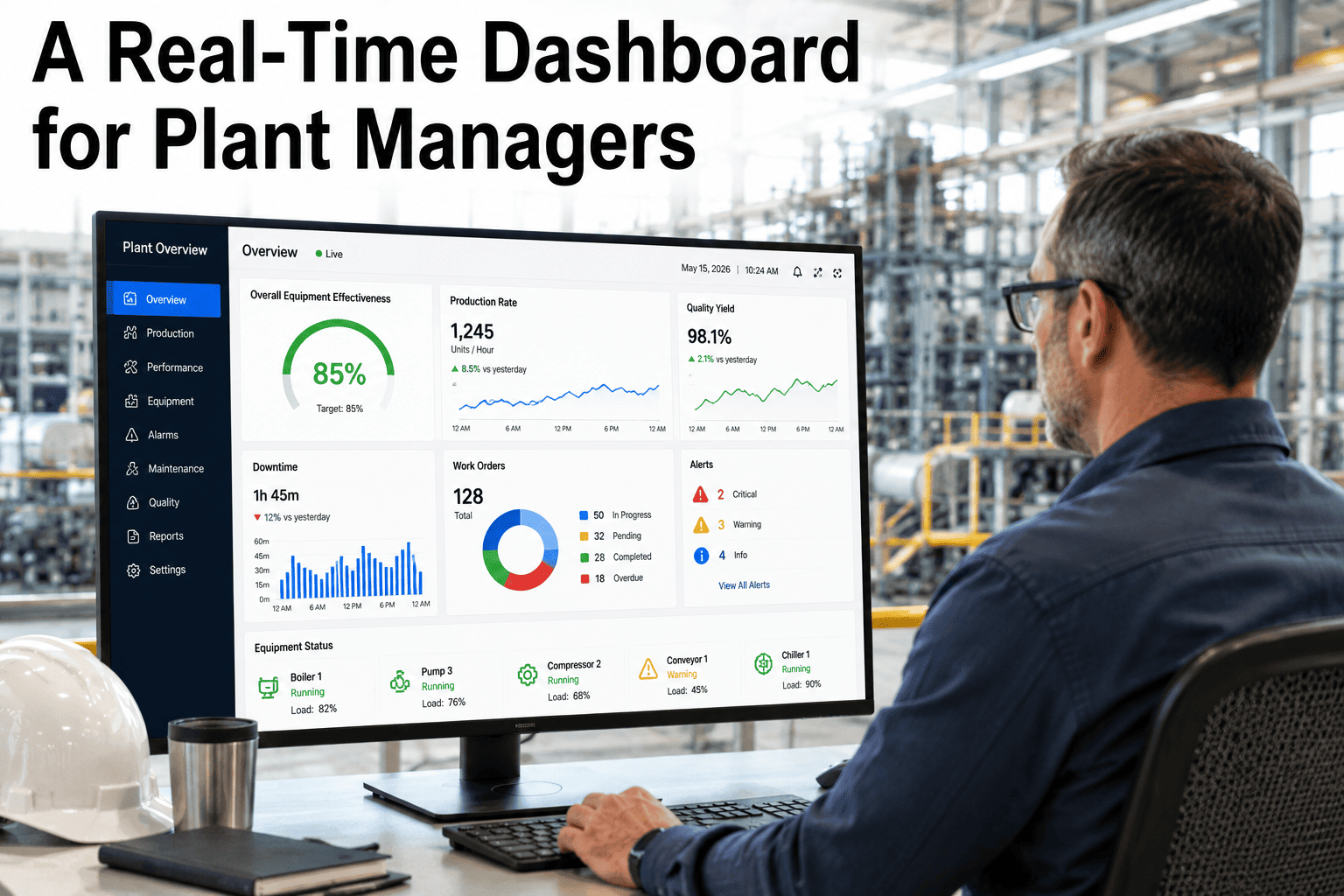
When a beverage manufacturer's production line went down for three hours because a critical pump failure wasn't detected until it completely seized, the facility lost 18,000 units of product and $47,000 in revenue. The equipment had been showing early warning signs—elevated vibration, rising temperature, declining flow rate—but without real-time monitoring systems, maintenance teams had no visibility into these deteriorating conditions until catastrophic failure occurred. Smart factory technologies are transforming how food and beverage manufacturers detect equipment issues, optimize production schedules, trace product batches, and manage maintenance operations through connected sensors, real-time data analytics, and automated decision-making systems. Sign up for Oxmaint to bring smart factory capabilities to your maintenance operations with real-time asset monitoring and predictive analytics.
Industry Trends
Smart Factory Concepts for Food and Beverage Production
12 min read
•
Updated February 2026
•
Industry 4.0
What Is a Smart Factory in Food and Beverage Manufacturing?
A smart factory integrates digital technologies with physical production processes to create an intelligent, self-optimizing manufacturing environment. In food and beverage operations, this means connecting machinery, sensors, control systems, and enterprise software into a unified network that collects real-time data, analyzes performance, predicts failures, and automatically adjusts production parameters to maximize efficiency, quality, and uptime.
Real-Time Visibility
Continuous monitoring of equipment status, production metrics, quality parameters, and energy consumption across all production lines and facilities
Data-Driven Decisions
Analytics transform sensor data into actionable insights that guide maintenance scheduling, quality adjustments, and capacity planning
Connected Systems
Machines, MES software, ERP platforms, and maintenance systems communicate seamlessly to coordinate production and operations
Predictive Capabilities
AI and machine learning analyze patterns to forecast equipment failures, quality deviations, and production bottlenecks before they occur
The Evolution: From Manual to Smart Manufacturing
Industry 1.0
Late 1700s - Early 1900s
Mechanization
Water and steam power enabled basic automation of food processing through mechanical equipment and assembly lines
Industry 2.0
Early 1900s - 1970s
Mass Production
Electrical power and conveyor systems enabled large-scale production with division of labor and standardized processes
Industry 3.0
1970s - 2010s
Automation
PLCs, computers, and robotics automated individual processes but systems operated in isolation without data sharing
Industry 4.0
2010s - Present
Smart Manufacturing
IoT sensors, cloud computing, AI, and interconnected systems create intelligent factories that self-optimize in real-time
Key Technologies Powering Smart Food Factories
Smart factory transformation relies on integrating multiple technologies that work together to create an intelligent production environment. Food and beverage manufacturers implementing Industry 4.0 typically deploy these foundational technologies first, then expand capabilities over time as systems mature.
IoT Sensors and Devices
Temperature, pressure, flow, vibration, and vision sensors monitor equipment and process parameters in real-time
Wireless Sensors
Smart Meters
RFID Tags
Vision Systems
Edge Computing and Gateways
Local processing units aggregate sensor data, perform initial analytics, and enable low-latency control decisions at the equipment level
Edge Devices
Industrial PCs
Protocol Converters
OT/IT Bridges
Cloud Platforms and Data Storage
Centralized storage of production data with scalable computing power for advanced analytics, machine learning, and enterprise-wide reporting
Cloud Storage
Data Lakes
Time-Series DBs
API Integration
Analytics and AI/ML
Machine learning algorithms identify patterns, predict equipment failures, optimize recipes, and recommend process improvements automatically
Predictive Maintenance
Quality Analytics
Anomaly Detection
Optimization Models
Enterprise Applications
MES, CMMS, ERP, and quality management systems coordinate production, maintenance, inventory, and compliance across the enterprise
MES Software
CMMS Platform
ERP Integration
QMS Systems
Smart Factory Impact on Food Manufacturing
20%
Production Output Increase
World Economic Forum
30%
Productivity Improvement
Industry Research
25%
Downtime Reduction
Manufacturing Studies
15%
Quality Improvement
Food Industry Data
Smart Factory Applications in Food and Beverage Operations
Challenge: Unexpected equipment failures cause production downtime, product loss, and emergency repair costs
Smart Solution: Vibration sensors, thermal cameras, and motor current analysis detect bearing wear, belt degradation, and component failures weeks before breakdown. Maintenance teams receive automated alerts prioritizing interventions by criticality.
Reduce unplanned downtime by 50-70%
Extend equipment lifespan by 20-30%
Lower maintenance costs by 25-40%
Challenge: Quality issues discovered after production create rework, waste, and potential recalls
Smart Solution: Vision systems inspect products at line speed, NIR sensors verify composition, and inline sensors monitor critical parameters. AI algorithms detect deviations instantly and automatically adjust process controls to maintain specifications.
Achieve 99%+ quality compliance rates
Reduce product waste by 15-25%
Eliminate manual inspection labor
Challenge: Food safety regulations require complete ingredient and process tracking, but manual logs are error-prone
Smart Solution: RFID tags track raw materials from receiving through production. Each batch is linked to specific equipment, operators, process parameters, and quality tests. Blockchain technology creates immutable audit trails meeting FSMA requirements.
Complete supply chain visibility
Instant recall scope identification
Automated compliance documentation
Challenge: Energy represents 10-30% of food manufacturing costs, but consumption patterns are invisible
Smart Solution: Smart meters track energy use by production line, equipment, and time period. AI identifies inefficiencies, schedules energy-intensive processes during off-peak hours, and automatically adjusts HVAC and refrigeration based on production schedules.
Reduce energy costs by 15-30%
Lower carbon footprint significantly
Meet sustainability targets
Challenge: Production schedules don't adapt to real-time conditions, creating bottlenecks and inefficiencies
Smart Solution: MES software receives real-time data on equipment availability, material inventory, and order priorities. AI-powered scheduling dynamically adjusts production sequences, batch sizes, and changeover timing to maximize throughput and minimize waste.
Increase OEE by 10-20 percentage points
Reduce changeover time by 30-50%
Improve on-time delivery to 95%+
Challenge: Manual work instructions and paper-based task tracking create errors and inefficiencies
Smart Solution: Operators receive digital work instructions on tablets with step-by-step guidance, photos, and videos. Task completion is automatically logged with timestamps and operator IDs. AR headsets provide remote expert assistance during complex procedures or troubleshooting.
Reduce training time by 40-60%
Eliminate manual documentation errors
Enable remote technical support
Real-Time Asset Monitoring with Oxmaint
Oxmaint brings smart factory capabilities to your maintenance operations through real-time equipment monitoring, predictive failure alerts, and automated maintenance scheduling. Connect your assets, analyze performance trends, and prevent downtime before it happens.
Implementation Roadmap: 4 Phases to Smart Factory
Most food and beverage manufacturers follow a phased approach to smart factory implementation, starting with high-impact, low-complexity projects and progressively expanding capabilities as the organization matures. This minimizes risk while building internal expertise and demonstrating ROI to secure ongoing investment.
Phase 1
Foundation: Digitize and Connect
Months 1-6
Key Objectives:
Deploy IoT sensors on critical assets for real-time monitoring
Implement CMMS or MES software for digital work management
Establish network infrastructure and data collection
Create baseline performance metrics and KPI dashboards
Focus: Critical equipment monitoring and digital maintenance tracking
Phase 2
Integration: Connect Systems
Months 7-12
Key Objectives:
Integrate CMMS, MES, and ERP systems for data flow
Expand sensor coverage to all production lines
Implement automated alerts and exception reporting
Build cross-functional analytics dashboards
Focus: Breaking down data silos and enabling cross-system visibility
Phase 3
Intelligence: Predictive Analytics
Months 13-18
Key Objectives:
Deploy machine learning models for predictive maintenance
Implement quality prediction and process optimization algorithms
Enable automated scheduling and production optimization
Create digital twins of critical processes
Focus: Moving from reactive to predictive and prescriptive operations
Phase 4
Optimization: Autonomous Operations
Months 19-24
Key Objectives:
Implement closed-loop control systems that auto-adjust processes
Deploy autonomous mobile robots for material handling
Enable AI-driven production scheduling and resource allocation
Expand to supply chain integration and demand forecasting
Focus: Self-optimizing systems with minimal human intervention
Overcoming Common Implementation Challenges
Legacy Equipment Integration
Older machinery lacks built-in connectivity and modern communication protocols, making data collection difficult without expensive equipment replacement.
→
Retrofit Solutions
Wireless sensors clamp onto existing equipment to monitor vibration, temperature, and performance without modification. Protocol converters bridge legacy PLCs to modern networks. Edge devices translate data formats for cloud platforms.
Cybersecurity Concerns
Connecting production systems to networks creates vulnerability to cyberattacks that could halt operations or compromise sensitive data.
→
Layered Security Architecture
Network segmentation isolates OT systems from IT networks. Industrial firewalls filter traffic. Regular security audits and patch management protect against threats. Zero-trust authentication controls access.
Skills Gap and Resistance
Existing workforce lacks expertise in digital technologies, and employees fear job displacement from automation initiatives.
→
Training and Change Management
Hands-on training programs upskill operators and technicians. Clear communication emphasizes that technology augments rather than replaces workers. Involve frontline staff in solution design to build ownership.
High Upfront Investment
Smart factory technologies require significant capital investment with uncertain ROI timelines, creating budget approval challenges.
→
Phased Deployment with Quick Wins
Start with pilot projects on critical equipment showing 6-12 month payback. Use early successes to fund expansion. Cloud-based solutions reduce upfront costs through subscription pricing.
Measuring Smart Factory Success
Overall Equipment Effectiveness (OEE)
Target: 85%+
Downtime Hours Per Month
Reduce 40-60%
Changeover Time
Reduce 30-50%
First Pass Yield
Target: 98%+
Product Waste Percentage
Reduce 15-25%
Customer Complaints
Reduce 50-70%
Planned vs Unplanned Maintenance Ratio
Target: 80/20
Mean Time Between Failures (MTBF)
Increase 30-50%
Maintenance Cost per Unit Produced
Reduce 20-35%
Energy Cost per Unit
Reduce 15-30%
Labor Productivity
Increase 20-40%
Time to Market for New Products
Reduce 30-50%
AI-Powered Recipe Optimization
Machine learning analyzes thousands of production runs to automatically recommend recipe adjustments that reduce costs, improve consistency, or enhance nutritional profiles while maintaining taste.
Autonomous Mobile Robots
Self-navigating robots transport materials between processing areas, reducing manual handling and enabling 24/7 operations without human supervision in warehouses and staging areas.
Digital Twin Simulation
Virtual replicas of production lines enable testing process changes, new product launches, and maintenance scenarios digitally before implementing in the physical environment.
Blockchain Traceability
Distributed ledger technology creates tamper-proof records of ingredient sourcing, production processes, and distribution—critical for food safety and consumer transparency.
5G Network Connectivity
Ultra-low latency 5G enables real-time control of robotics, AR/VR training applications, and massive sensor deployments without network congestion or performance degradation.
Edge AI Processing
Machine learning models run directly on edge devices at the equipment level, enabling instant decision-making without relying on cloud connectivity or creating data transmission bottlenecks.
Start Your Smart Factory Journey
Transform Maintenance Operations with Real-Time Monitoring
Oxmaint delivers smart factory capabilities specifically designed for food and beverage manufacturers—real-time equipment monitoring, predictive maintenance alerts, automated work orders, and comprehensive analytics. Deploy IoT sensors, track asset performance, and prevent failures before they impact production.
No credit card required
FSMA compliant
Setup in 24 hours