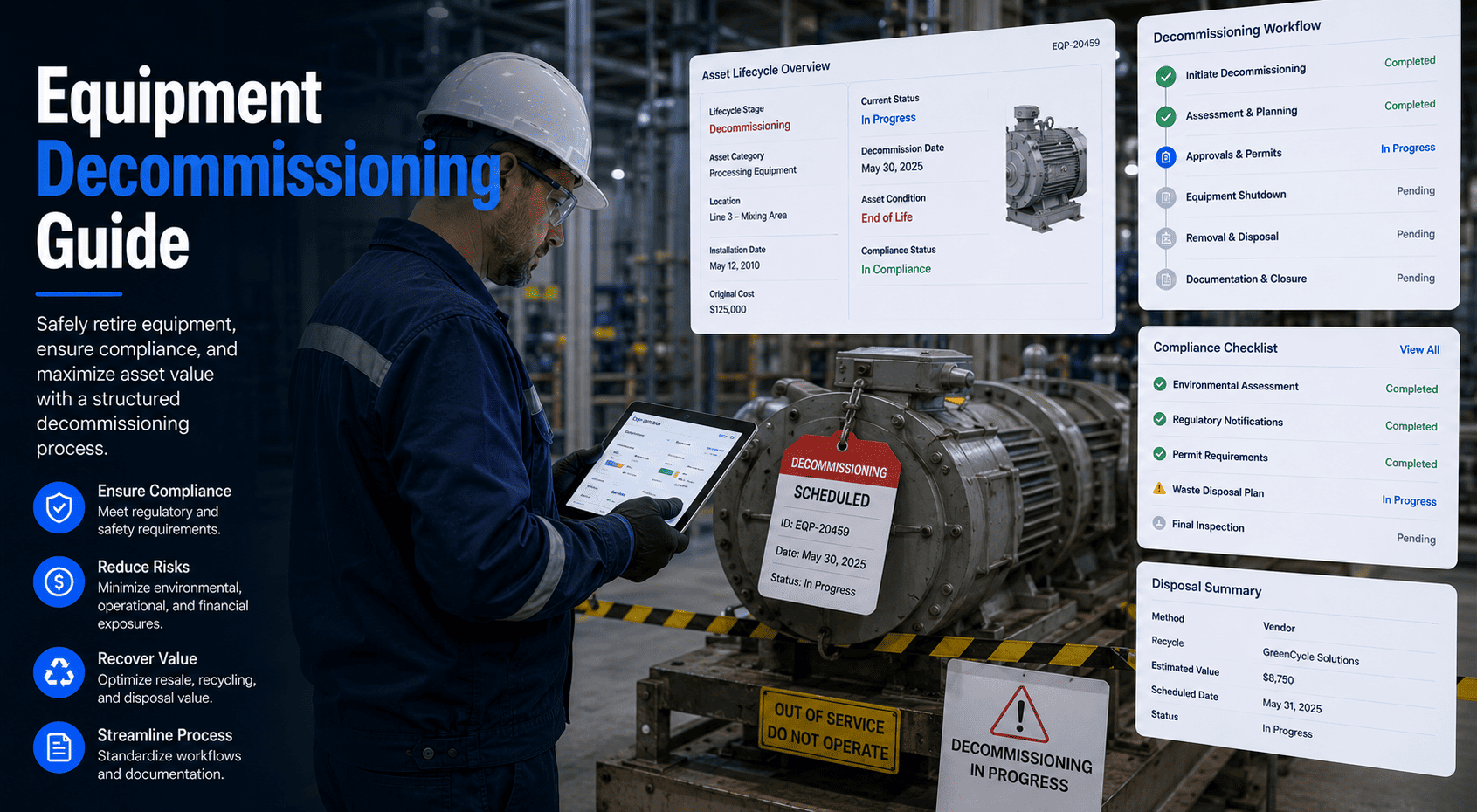
Food plant equipment decommissioning is one of the most compliance-heavy, liability-dense decisions a maintenance or operations manager makes — and most facilities still handle it with spreadsheets, paper logs, and gut feel. This guide covers every stage of the food plant asset retirement process: from lifecycle analysis and regulatory sign-off to CMMS record closure and physical disposal — so your team never faces an FDA auditor asking for decommissioning documentation you can't produce. Start a free trial to see how Oxmaint tracks asset retirement end-to-end, or book a demo and we'll walk through your current equipment lifecycle gaps.
Food Manufacturing Asset Management
Food Plant Equipment Decommissioning: The Complete Retirement Guide
Aging equipment in food plants isn't just a maintenance headache — it's a food safety liability. Running past-EOL assets through production carries contamination risk, compliance exposure, and escalating repair costs that compound every quarter.
40%
of food recalls linked to equipment failures or contamination from aging assets
3–5×
higher repair cost for equipment operating past designed service life
62%
less unplanned downtime when CMMS tracks full asset lifecycle from install to retirement
$250K+
average cost of a Class I food recall — often traced to equipment that should have been retired
Food plant equipment decommissioning is the structured process of safely retiring a production or facility asset from active service — covering lifecycle assessment, regulatory documentation, safe isolation, physical removal, data archiving, and compliant disposal or resale. Unlike simply pulling a machine off the line, proper decommissioning in food manufacturing requires GMP compliance, HACCP plan updates, FDA/USDA documentation, and a closed CMMS record that proves the asset is no longer in service.
Most plants underinvest here. An asset gets flagged as "end of life," someone pushes it to a corner of the facility, and six months later it reappears in an audit finding — still active in your CMMS, still generating PM work orders, potentially still touching the food contact zone. The risk isn't hypothetical: regulators treat improperly retired equipment as a food safety gap, not a paperwork issue.
A structured decommissioning workflow closes every one of these gaps — and Oxmaint's asset management module gives your team the lifecycle tracking tools to execute it without building a custom process from scratch.
The 8-Stage Food Plant Asset Retirement Framework
01
Lifecycle Assessment
Evaluate repair history, OEM service life, parts availability, and total cost of ownership. Use CMMS data to calculate break-even between continued repair and capital replacement.
02
Regulatory Review
Confirm decommissioning against FDA 21 CFR Part 110, USDA requirements, and any third-party food safety certification (SQF, BRC, FSSC 22000) that references this asset class.
03
HACCP Plan Update
Remove the asset from active HACCP flow diagrams. Update critical control point documentation and notify the food safety team of any process changes triggered by retirement.
04
Physical Isolation
Lock out / tag out per OSHA 29 CFR 1910.147. Drain fluid systems, isolate electrical feeds, remove food-contact surfaces, and place clear "DECOMMISSIONED" identification on the asset.
05
Spare Parts Audit
Inventory all associated spare parts. Determine which carry over to compatible active equipment, which should be returned to vendors, and which must be disposed of per hazardous materials rules.
06
CMMS Record Closure
Close or archive all active and future work orders tied to this asset. Update asset status to "Retired," attach decommissioning sign-off documents, and retain the full maintenance history for audit access.
07
Asset Disposal or Transfer
Choose the appropriate disposal path: resale, trade-in, scrap, donation, or destruction. Document chain of custody for any food-contact equipment. Comply with environmental regs for refrigerants, oils, and lubricants.
08
Post-Retirement Audit
30 days post-retirement, verify the asset is absent from active CMMS lists, PM schedules, KPI dashboards, and facility floor plans. Close any open regulatory notifications and update insurance records.
Most food plants have at least 3–5 assets operating past designed service life right now — generating false PM work orders and invisible food safety risk.
4 Decommissioning Pain Points Food Plants Face
Ghost Assets in CMMS
Retired or physically removed equipment remains "active" in the CMMS — generating PM reminders, tying up parts inventory, and distorting asset count metrics. During FDA inspections, ghost assets create immediate documentation credibility issues.
Missing Decommissioning Documentation
No sign-off trail means no audit trail. SQF, BRC, and FSSC 22000 auditors regularly cite lack of retirement documentation as a major non-conformance — requiring costly corrective action plans and reinspections.
HACCP Plan Gaps Post-Retirement
Removing equipment from the line changes process flow — sometimes creating unmonitored food contact points or altering CCP configurations. Plants that skip the HACCP review after decommissioning are vulnerable to food safety gaps that may go undetected until a recall event.
Environmental Compliance on Disposal
Food processing equipment contains refrigerants, hydraulic oils, food-grade lubricants, and cleaning chemical residues — all regulated under EPA and local environmental rules. Improper disposal triggers fines that routinely exceed the scrap value of the equipment.
If any of these sound familiar, your current asset tracking process has a gap — start a free trial to see how Oxmaint closes it, or book a demo and we'll map your decommissioning workflow.
How Oxmaint Manages Food Plant Asset Retirement
Complete Asset Lifecycle Records
Oxmaint's asset management maintains a full history from commissioning to retirement — install date, maintenance history, repair costs, and all attached documentation. One click retires the asset and archives everything for FDA/USDA audit access, indefinitely.
Automated Work Order Closure
When an asset is retired in Oxmaint, all linked open and future work orders and PM schedules are automatically flagged and closed — eliminating ghost asset maintenance and freeing your team's capacity for active equipment.
Compliance Document Attachments
Attach LOTO sign-offs, HACCP update confirmations, disposal certificates, and regulatory notifications directly to the asset record. Inspection and compliance workflows auto-generate the audit trail that food safety certifiers require.
Parts Inventory Reconciliation
Retiring an asset in Oxmaint triggers a parts inventory review — flagging associated spares for transfer, return, or disposal. AI-driven reorder logic adjusts automatically so you aren't stocking parts for equipment that no longer exists.
Multi-Site Visibility
For food manufacturers operating multiple facilities, Oxmaint provides cross-site asset retirement tracking — so a decommissioned filler line in Plant A doesn't generate false benchmark data for Plant B's OEE reports or capital planning forecasts.
Analytics-Driven EOL Decisions
Oxmaint's analytics surface repair cost trends, MTBF data, and total cost of ownership per asset — giving maintenance and operations leadership the data to make retire-vs-repair decisions on facts, not instinct.
Reactive vs. Structured Decommissioning: What Each Costs You
Decision Point
Ad-Hoc / Reactive Retirement
Structured CMMS-Driven Retirement
Asset identification
Discovered at breakdown or audit — often too late
CMMS flags EOL based on age, repair cost trends, and OEM life data
HACCP impact review
Skipped or done retroactively after removal
Triggered automatically as part of retirement workflow checklist
Work order cleanup
Ghost PM orders remain; technicians waste time chasing them
All open orders closed; future PMs cancelled on asset retirement
Documentation for auditors
Paper logs, emails, or nothing — fails FDA scrutiny
Digital sign-off chain attached to asset record; instantly retrievable
Parts inventory accuracy
Spare parts remain in stock for retired equipment, distorting inventory value
Parts reconciliation triggered; inventory data updated automatically
Disposal compliance
Environmental regs often missed; fines common
Disposal workflow includes EPA/local checklist with attached certificates
Capital planning accuracy
Retired assets inflate active fleet count; CapEx forecasts distorted
Asset register updated in real-time; replacement forecasting is accurate
FDA auditors cite "inadequate equipment retirement documentation" as a top-5 GMP violation in food processing facilities. A structured decommissioning workflow fixes this permanently.
Decommissioning Results: What Structured Asset Retirement Delivers
62%
Less unplanned downtime
When AI-driven CMMS manages full asset lifecycle including proactive retirement decisions — Oxmaint client average
94%
Predictive accuracy
Oxmaint AI accurately predicts equipment degradation that drives EOL decisions before failure, not after
100%
Audit-ready records
Every retirement event generates a complete, time-stamped document chain — no scrambling before FDA or SQF inspections
Days
Not months to go live
Oxmaint deploys and configures in days — 1,000+ clients across food manufacturing, facility management, and industrial sectors
Ready to build a decommissioning process your auditors will approve? Start a free trial or book a 30-minute demo to see Oxmaint's asset retirement workflow on your equipment types.
When should a food plant retire equipment vs. continuing to repair it?
The standard industry rule is to retire when annual repair costs exceed 50% of replacement value, or when the asset exceeds its OEM-designed service life and spare parts become unavailable. In food manufacturing, add a third trigger: any equipment that can no longer maintain food safety surface standards (corrosion, crazing, pitting on food-contact surfaces) should be decommissioned regardless of repair cost, because the contamination liability outweighs any repair economy.
What documentation does the FDA require when food processing equipment is retired?
FDA GMP regulations (21 CFR Part 110) require that equipment records be maintained and that HACCP plans reflect actual in-use equipment. When retiring food processing equipment, you need: a written retirement decision with sign-off, updated HACCP flow diagrams, LOTO completion records, sanitization records for food-contact surfaces, and chain-of-custody documentation for disposal. All records should be retained for a minimum of 2 years and be immediately available during inspections.
How does a CMMS help manage the food plant equipment decommissioning process?
A CMMS like Oxmaint centralizes the entire retirement workflow: it surfaces EOL candidates based on repair history and cost data, provides a structured decommissioning checklist, closes all linked work orders, archives the complete maintenance history, and stores all compliance documentation against the asset record. This creates the audit trail that FDA, USDA, and third-party food safety certifiers require — without relying on paper logs or disconnected spreadsheets.
What are the environmental compliance requirements for disposing of food plant equipment?
Food processing equipment commonly contains refrigerants regulated under EPA Section 608, hydraulic oils subject to state hazardous waste rules, and food-grade lubricant residues. Refrigerant recovery must be performed by a certified technician before any disposal or scrapping. Oil-containing components require proper waste oil disposal documentation. Any equipment with food contamination risk on contact surfaces must be decontaminated prior to resale or donation to prevent liability transfer.
Food Plant Asset Management
Stop Running Equipment Past Its Safe Service Life
Every food plant has assets that should have been decommissioned already — generating phantom work orders, creating audit exposure, and adding invisible food safety risk. Oxmaint gives you the lifecycle visibility to retire equipment on your schedule, not your auditor's.
Complete asset lifecycle tracking from commissioning to compliant retirement
Automated work order closure and PM schedule cleanup on retirement
Instant audit-ready documentation for FDA, USDA, and food safety certifications
Trusted by 1,000+ maintenance teams · Live in days, not months · Food manufacturing specialists