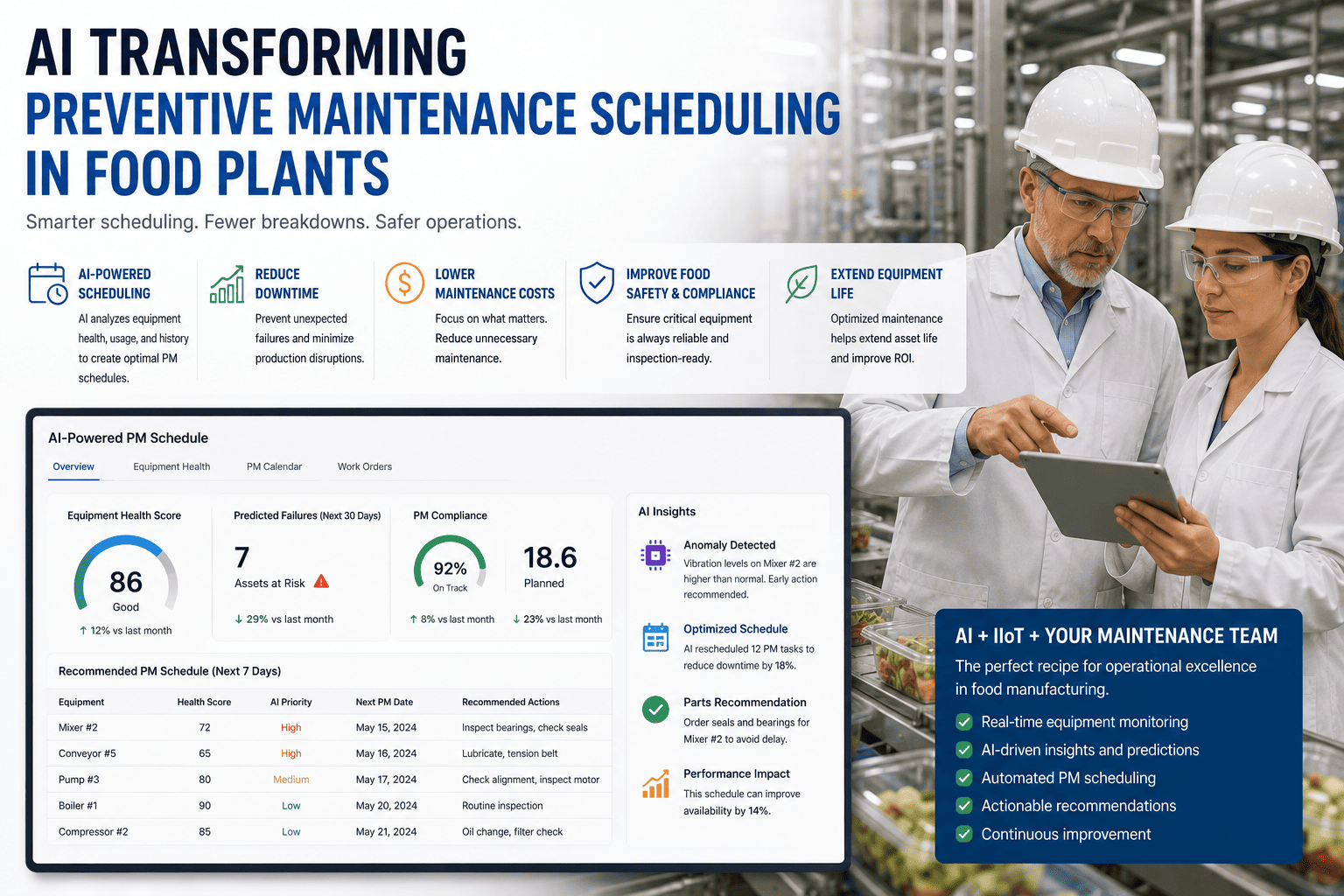
AI preventive maintenance scheduling in food plants is rapidly replacing the calendar-based PM programs that have governed food manufacturing equipment care for decades — and the performance gap between facilities that have made the switch and those still running time-based schedules is becoming impossible to ignore. When AI-powered predictive maintenance reduces unplanned downtime by up to 30% and cuts labor costs by 15% while giving teams 2–4 weeks of advance warning before failures materialize, the question for food plant managers isn't whether to adopt AI-driven scheduling, but how fast they can implement it without disrupting ongoing production. Start a free trial to see AI-optimized PM scheduling on your specific equipment, or book a demo to see the difference between your current calendar schedule and what AI would actually recommend.
See how AI rescheduling your current PM calendar could free up 25–35% of technician time while catching failures your current schedule would miss.
- AI-optimized PM intervals based on actual equipment condition data, not calendar assumptions
- Predictive failure alerts 2–4 weeks before breakdown — auto-generates work orders
- HACCP-integrated scheduling ensures CCP equipment never misses a compliance-critical PM
Trusted by food manufacturing teams managing 10,000+ assets · First AI alerts within 6–8 weeks of deployment.
What AI Preventive Maintenance Scheduling in Food Plants Actually Means
AI preventive maintenance scheduling in food plants replaces fixed time-based PM intervals with dynamic, condition-driven schedules generated from continuous equipment data. Instead of "lubricate bearings every 500 hours" regardless of actual bearing condition, AI monitors vibration signatures, temperature trends, motor current draw, and historical failure patterns to determine the optimal intervention point — which may be at 320 hours for one bearing and 740 hours for another, depending on operating load, environment, and wear pattern.
In food manufacturing, this isn't just about operational efficiency. It's about compliance precision. A calendar-based system generates PM work orders on a fixed schedule that may or may not align with actual equipment need. An AI-driven system generates work orders when sensor data indicates the equipment actually requires attention — and generates them early enough to be scheduled in the next sanitation window rather than handled as an emergency during production. The result is PM that satisfies FSMA's preventive controls requirements more reliably than a calendar schedule, because it's grounded in the actual condition of the asset being maintained.
The shift also addresses one of food manufacturing's most persistent labor problems: PM work performed on equipment that doesn't need it. Industry analysis consistently shows that 25–35% of scheduled PM tasks in food plants are executed on assets operating well within optimal parameters. That's technician time spent on unnecessary work while genuinely at-risk equipment continues running unmonitored. AI scheduling identifies both types simultaneously — over-maintained assets where interval extension is safe, and under-monitored assets where condition data is already showing early degradation signals. Explore how OxMaint's predictive maintenance engine integrates with your existing PLC and SCADA data, or see the complete AI and automation capabilities.
8 Ways AI Is Transforming PM Scheduling in Food Plants
AI replaces fixed time intervals with dynamic schedules driven by equipment condition data. A bearing running cool and smooth gets a longer interval; one showing early vibration anomalies gets accelerated attention — right-sizing labor to actual risk.
AI models trained on vibration, temperature, and runtime data flag developing failures weeks before they reach failure thresholds — converting emergency line stops into planned work order completions during scheduled sanitation windows.
When AI detects an anomaly or predicts an intervention point, it generates a fully populated work order — asset code, required parts, safety steps, technician assignment — without a manager touching a keyboard. Deloitte 2024 data shows AI-pilot sites cut backlog 32%.
AI scheduling integrates with your HACCP plan to ensure CCP-linked equipment — pasteurizers, metal detectors, continuous cook systems — always receives scheduled attention first. Compliance-critical assets carry elevated priority that the AI never over-rides in favor of efficiency.
AI maps predicted maintenance needs to your plant's planned downtime windows — sanitation shifts, changeovers, allergen flushes — scheduling interventions where production is already paused, eliminating the ongoing conflict between maintenance access and production uptime.
AI identifies assets where PM frequency can safely be reduced — freeing immediate technician capacity for genuinely at-risk equipment. First measurable results typically appear within 30–60 days of deployment, often from recovering labor wasted on unnecessarily frequent PMs.
AI tracks condition trends across your entire equipment fleet simultaneously — something no maintenance team can do manually. Patterns across similar assets (fillers, compressors, CIP pumps) refine individual machine predictions and identify systemic issues before they cascade.
AI-generated maintenance records carry timestamps, equipment condition data, and prediction confidence levels — giving FDA investigators not just proof that PM was performed, but evidence of the condition monitoring program that drove the intervention. Stronger than a calendar schedule alone under FSMA review.
Why Calendar-Based PM Scheduling Fails Food Plants — 4 Structural Problems
Calendar schedules apply identical intervals to assets with vastly different operating environments — a filler running two shifts gets the same PM cycle as one running three, and a compressor in a cold room gets the same lubrication interval as one in a high-humidity frying area. The mismatch creates both over-maintenance and under-maintenance simultaneously.
Fixed-interval PM tasks fire on the calendar regardless of whether production windows are available. When a PM date falls during a production run, it gets deferred. When deferred PMs accumulate, the backlog grows and genuine equipment risk compounds — until the failure that the PM was supposed to prevent actually occurs.
Calendar PM schedules can't detect a bearing that started degrading between scheduled intervals. The failure happens mid-production, generates an emergency work order, halts the line, and costs up to $50,000 per hour in food manufacturing — even though sensor data would have shown the developing fault weeks earlier if anyone had been reading it.
Under FSMA's preventive controls framework, a PM schedule demonstrates intent — but a completed calendar-based PM on a CCP instrument doesn't prove the instrument was actually in calibration. AI condition monitoring adds the evidence layer: timestamped sensor data showing the equipment was operating within parameters throughout the monitored period.
Solving these problems requires a system that reads equipment condition continuously — start a free trial to connect your first assets, or book a demo to see how OxMaint's AI scheduling compares to your current PM calendar on specific equipment types.
Calendar-Based PM vs. AI-Optimized Scheduling: Side by Side
| Scheduling Dimension | Calendar-Based PM (Current State) | AI-Optimized Scheduling (OxMaint) |
|---|---|---|
| Interval basis | Fixed time (e.g. every 500 hrs) regardless of condition | Dynamic — driven by vibration, temp, runtime, load data |
| Failure detection | Reactve — only detected after failure or at next scheduled PM | Predictive — flagged 2–4 weeks before failure threshold |
| Work order generation | Manual — planner creates based on calendar trigger | Automatic — AI generates fully populated work orders on alert |
| Labor efficiency | 25–35% of tasks executed on equipment that didn't need them | Labor directed only to assets where condition data shows need |
| Sanitation window use | PM dates fire on calendar — often conflict with production | AI maps predicted need to next available planned downtime window |
| CCP equipment priority | CCP and non-CCP assets share the same PM queue priority | HACCP-linked assets carry elevated AI priority — never deferred |
| Emergency work ratio | 60–80% reactive in most food plants | Target below 20% reactive — preventable failures caught early |
| ROI payback | No measurable ROI — maintenance cost is treated as fixed overhead | 6–12 month payback typical; first prevented failure often covers platform cost |
AI-Driven PM Scheduling: Outcomes Food Plants Can Expect
AI-powered predictive maintenance in food processing (Mordor Intelligence)
OxMaint food manufacturing customers after full AI-PM deployment
Food manufacturers report 35–50% reductions in unplanned downtime at full deployment
Eliminating unnecessary PMs and reducing emergency repair overtime (Mordor Intelligence)
Estimate your facility's ROI with the OxMaint ROI Calculator — plug in your current emergency work ratio and monthly downtime hours to see projected savings, or book a demo and we'll build the model together from your actual data.
How OxMaint Implements AI Preventive Maintenance Scheduling in Food Plants
OxMaint ingests vibration, temperature, pressure, runtime, and motor current data from existing PLC and SCADA systems — no new sensors required in most installations. Connect your first critical assets in days, not months. See the AI Vision Camera for equipment with visual inspection requirements.
AI models establish normal operating signatures for each monitored asset over 6–8 weeks of sensor data. Historical data from your existing historian can accelerate baseline training significantly. OxMaint uses this baseline to distinguish developing anomalies from normal process variation.
Once trained, the AI monitors every connected asset continuously — flagging developing anomalies, classifying failure modes, and estimating remaining useful life. Alerts carry confidence scores and recommend the type of intervention needed, so technicians arrive knowing what they're looking for.
AI schedules the triggered work order into the next appropriate planned downtime window — sanitation shift, changeover, or weekend block — based on urgency, available technicians, and required parts stock. Preventive maintenance scheduling and predictive alerts work from a single system.
Technicians receive the work order on mobile, scan the equipment QR code on arrival, and complete the task with guided steps, parts, and sign-off — creating a timestamped, attributed FSMA-compliant record. Completion data feeds back to improve AI model accuracy continuously.
Every maintenance action, component replacement, and operating change updates the AI model — improving prediction accuracy over time. OxMaint's OEE analytics track the performance impact of AI-scheduled PM vs. historical calendar-based programs, quantifying improvement in measurable terms.
AI Preventive Maintenance Scheduling: Frequently Asked Questions
How is AI preventive maintenance scheduling different from predictive maintenance?
How quickly does AI preventive maintenance scheduling start delivering results in a food plant?
Does AI maintenance scheduling in food plants replace or complement existing PM programs?
What sensors or data are needed to implement AI preventive maintenance scheduling?
OxMaint AI Preventive Maintenance — Food Manufacturing
Stop Running Last Year's PM Calendar on This Year's Equipment
Your food plant's equipment is generating condition data every hour — vibration, temperature, runtime, load. OxMaint's AI reads it continuously, optimizes your PM schedule against what equipment actually needs, and generates work orders that land in the right sanitation window before failures can halt your line. Most facilities see first savings within 60 days. Most eliminate their first emergency failure within 3 months.
- AI-optimized PM intervals driven by actual equipment condition data — not calendar assumptions
- Predictive failure alerts 2–4 weeks out — auto-generated work orders in the next planned window
- HACCP-integrated scheduling ensures CCP-critical equipment is never deferred
Trusted by 1,000+ maintenance teams across food manufacturing and industrial operations · 94% AI prediction accuracy · Live in days.


