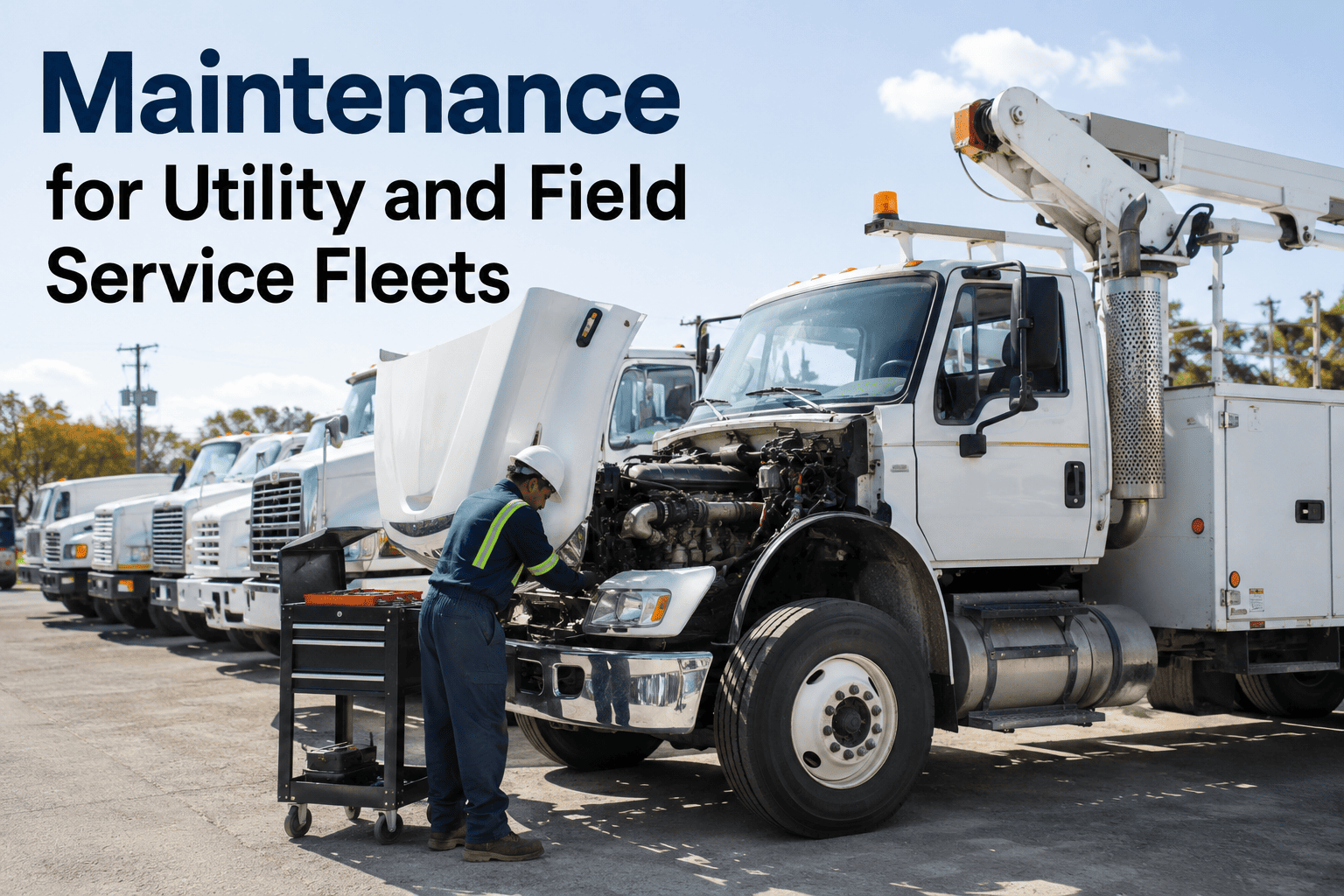
Utility and field service fleet maintenance demands a far more rigorous approach than standard commercial fleet upkeep, because bucket trucks, digger derricks, and specialized line equipment operate under high-stress conditions where a single mechanical failure can trigger catastrophic safety incidents and prolonged outages. A comprehensive utility fleet maintenance program integrates preventive scheduling, DOT and OSHA compliance tracking, and real-time asset visibility to keep emergency response readiness at peak levels. Field service fleet maintenance in 2026 will increasingly rely on AI-driven predictive analytics to forecast component failures before they ground critical vehicles during storm response. Teams managing hundreds of distributed assets can eliminate paper work orders and reactive scrambling by adopting a centralized CMMS platform like OxMaint—Start Free Trial to modernize your maintenance operation today.
Utility Field Service Guide 2026
Is a Grounded Bucket Truck Costing You $4,200 a Day in Outage Penalties?
When a utility fleet vehicle goes down during storm response, the financial impact extends far beyond repair costs. Specialized equipment like boom lifts, digger derricks, and line trucks requires proactive maintenance strategies that traditional fleet software cannot handle.
Utility Fleet Maintenance Guide
Why Utility Fleet Maintenance Is Different in 2026
Standard fleet maintenance software handles oil changes and tire rotations. Utility field service fleets operate in an entirely different risk category. A Class 7 bucket truck with a 60-foot insulated boom must pass ANSI A92.6 dielectric testing, OSHA 1910.269 mechanical inspections, and DOT annual checks simultaneously. Missing any of these creates immediate regulatory liability and endangers line workers at height. The utility field service guide for 2026 emphasizes that maintenance teams must track specialized equipment certifications alongside standard powertrain maintenance—something spreadsheet-based systems cannot scale.
A regional utility operating 240 line trucks and 80 bucket trucks typically spends between $1.8M and $2.4M annually on maintenance. Without a centralized CMMS tracking preventive maintenance schedules and parts inventory, 30–40% of that spend goes to emergency repairs that cost 3–5 times more than scheduled work.
Preventive Maintenance
Essential Utility Fleet Maintenance Checklist for Specialized Equipment
Use this tiered checklist to structure your preventive maintenance program for utility and field service fleets. Each category maps to specific regulatory requirements and failure modes that cause the most expensive downtime events.
Operator-Level Checks
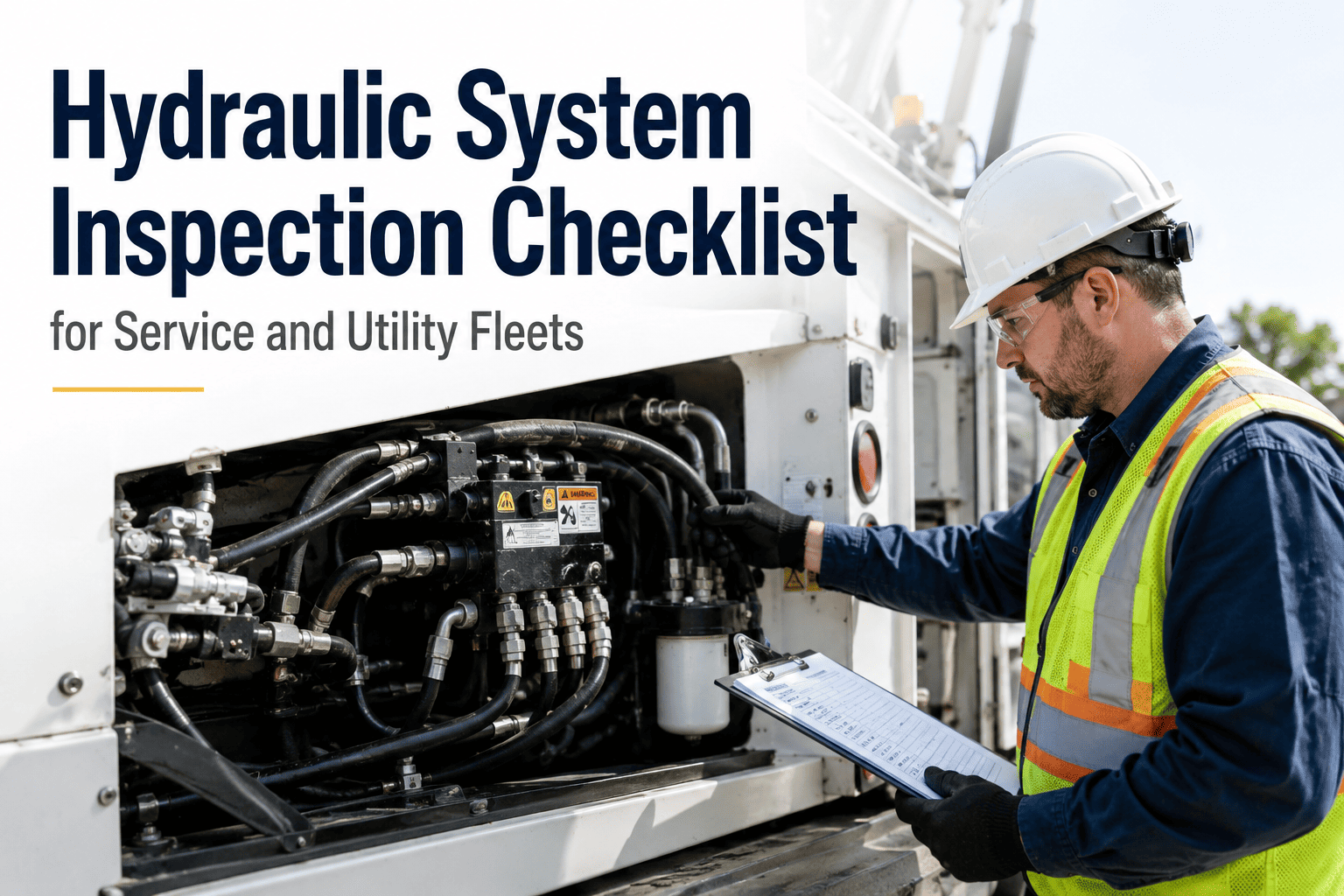
- Hydraulic fluid level and visible leak inspection on booms and outriggers
- Dielectric visual inspection of fiberglass boom sections for cracks or contamination
- Outrigger deployment test and load indicator function check
- Upper and lower control interlock verification on bucket trucks
- DOT pre-trip inspection: brakes, steering, tires, lights, and glass condition
Fleet Technician Checks
- Hydraulic system pressure testing against manufacturer specifications
- Boom pivot pin lubrication and wear measurement for bucket trucks
- Backup battery and inverter system load test for field service vehicles
- Tread depth measurement and tire rotation scheduling across the fleet
- Telematics data review for anomaly detection in engine and transmission codes
Certification & Compliance
- ANSI A92.6 dielectric testing and boom insulation certification for aerial devices
- DOT annual inspection (Form MCS-63) with brake and suspension teardown
- Crane operator certification renewal under OSHA 1926.1427 for digger derricks
- Spill prevention and hazmat containment equipment inspection
- Storm response equipment readiness audit for generators and mobile substations
| Equipment Type | Critical PM Interval | Top Failure Mode | Downtime Cost/Day |
|---|---|---|---|
| Bucket Truck (Class 6-7) | 90 days | Hydraulic seal failure | $3,800 |
| Digger Derrick | 60 days | Auger drive gearbox | $4,500 |
| Line Truck (Flatbed) | 120 days | PTO engagement failure | $2,100 |
| Storm Response Trailer | Pre-season | Generator fuel degradation | $1,900 |
Storm Readiness Timeline
Field Service Fleet Maintenance Timeline: Pre-Storm to Post-Deployment
Emergency response readiness is the single most critical performance metric for utility fleets. When a hurricane or ice storm triggers mutual assistance calls, your fleet must deploy within 24 hours. This timeline shows how a structured maintenance program ensures 95%+ fleet availability during peak demand.
Complete Fleet Condition Assessment
Run a full asset health report in OxMaint to flag every vehicle with overdue PM, open work orders, or expired certifications. Prioritize 100% compliance on bucket trucks and digger derricks before hurricane season begins. Verify spare parts stock for high-failure components like hydraulic pumps and boom cables.
Functional Testing and Parts Pre-Positioning
Deploy mobile maintenance teams to satellite yards for hands-on functional testing of all storm response vehicles. Use OxMaint to generate work orders for any deficiency found. Pre-position critical spare parts at strategic staging areas based on historical failure data from previous storm deployments.
Rapid Dispatch and Telematics Monitoring
Activate storm response mode in OxMaint to automatically generate deployment checklists for each vehicle. Monitor telematics feeds in real-time to catch emerging mechanical issues before they strand crews in the field. Track fuel consumption, engine hours, and hydraulic system alerts across all deployed assets.
Damage Assessment and PM Reset
Within 48 hours of demobilization, inspect every returned vehicle for storm-related damage. OxMaint auto-generates post-deployment work orders based on telematics fault codes and operator reports. Reset all PM clocks to reflect actual engine hours and mileage accumulated during storm operations, ensuring the next cycle starts from accurate baselines.
Stop Grounding Trucks During Storm Season
See how OxMaint's AI-powered CMMS predicts specialized equipment failures 7–14 days before they happen, keeping your utility fleet deployment-ready.
CMMS Platform Fit
How OxMaint Solves Utility Fleet Maintenance Challenges
OxMaint is purpose-built for maintenance and reliability teams managing complex, distributed assets. For utility and field service fleets, the platform replaces fragmented spreadsheets, paper inspection forms, and disconnected telematics dashboards with a single AI-powered system that drives measurable ROI.
Automated PM Scheduling by Engine Hours
Schedule preventive maintenance based on actual engine hours, PTO engagement time, and boom cycles rather than just odometer readings. OxMaint triggers work orders automatically when thresholds are reached, cutting missed PMs by up to 80% and extending specialized equipment life by 15–20%.
AI-Driven Predictive Failure Alerts
OxMaint's predictive analytics engine analyzes telematics streams, hydraulic pressure trends, and historical failure data to flag potential breakdowns 7–14 days before they occur. Utility fleets using predictive maintenance report 30–50% reductions in unplanned downtime during critical storm response periods.
Compliance and Audit Readiness
Track ANSI dielectric test dates, OSHA 1910.269 certifications, DOT annual inspections, and crane operator credentials in one dashboard. OxMaint generates audit-ready compliance reports in seconds, eliminating the 40+ hours per month teams typically spend compiling regulatory documentation manually.
Specialized Parts Inventory Tracking
Maintain real-time visibility into critical spare parts like hydraulic pumps, boom cables, and outrigger seals. OxMaint's inventory module auto-reorders when stock hits minimum thresholds, reducing parts-related downtime by 60% and freeing up to $85K in tied-up capital for a typical 300-vehicle utility fleet.
A 180-vehicle utility fleet spending $1.6M annually on maintenance typically recovers OxMaint's platform cost within 90 days through reduced emergency repair spending, improved parts availability, and eliminated compliance penalties.
ROI Analysis
Cost of Reactive vs. Proactive Utility Fleet Maintenance
The financial gap between reactive and proactive maintenance widens significantly for utility fleets because specialized equipment repair costs are 3–5x higher than standard commercial vehicles. This comparison shows the real dollar impact for a 300-vehicle utility and field service fleet over 12 months.
Frequently Asked Questions
Utility Fleet Maintenance FAQs
What is utility fleet maintenance and why is it different from standard fleet management?
Utility fleet maintenance encompasses the specialized upkeep of bucket trucks, digger derricks, line trucks, and storm response equipment that operate under high-voltage and high-load conditions. Unlike standard fleet management, it requires tracking ANSI dielectric certifications, OSHA 1910.269 compliance, hydraulic system integrity, and boom cycle counts alongside routine vehicle maintenance. A purpose-built CMMS like OxMaint centralizes all of these requirements into a single platform.
How often should bucket trucks undergo preventive maintenance?
Bucket trucks require preventive maintenance every 90 days or 250 engine hours, whichever comes first, with comprehensive annual inspections including ANSI A92.6 dielectric testing. Critical hydraulic systems should be inspected monthly, and operators must perform pre-trip checks daily. OxMaint automates these intervals based on actual usage data, ensuring no PM window is missed.
How can a CMMS improve emergency response readiness for utility fleets?
A CMMS improves emergency response readiness by maintaining 95%+ vehicle availability through predictive failure alerts, automated PM scheduling, and real-time parts inventory visibility. Before storm season, it generates fleet health reports flagging every vehicle with open issues. You can Book a Demo to see how OxMaint's storm readiness module works on your actual fleet data.
What are the main compliance requirements for utility field service fleets in 2026?
Utility field service fleets must comply with DOT annual inspections (FMCSA 396.17), OSHA 1910.269 for power generation and transmission, ANSI A92.6 for aerial lift devices, and OSHA 1926.1427 for crane operator certifications on digger derricks. Additional state-level utility commission requirements may apply. OxMaint tracks all certification expiration dates and generates compliance reports automatically.
How long does it take to switch from spreadsheet-based maintenance to OxMaint?
Most utility fleets complete the transition from spreadsheets to OxMaint within 2–4 weeks. The platform imports existing asset data, PM schedules, and parts lists directly, and the AI begins generating predictive insights within the first 30 days of telemetry data collection. A Start Free Trial lets your team experience the interface with a subset of assets before full deployment.
Modernize Your Utility Fleet Maintenance Today
Join the maintenance and reliability teams using OxMaint to cut unplanned downtime by 50%, achieve 96% storm readiness, and save $800K+ annually on specialized fleet maintenance costs.
Free 14-day trial · No credit card