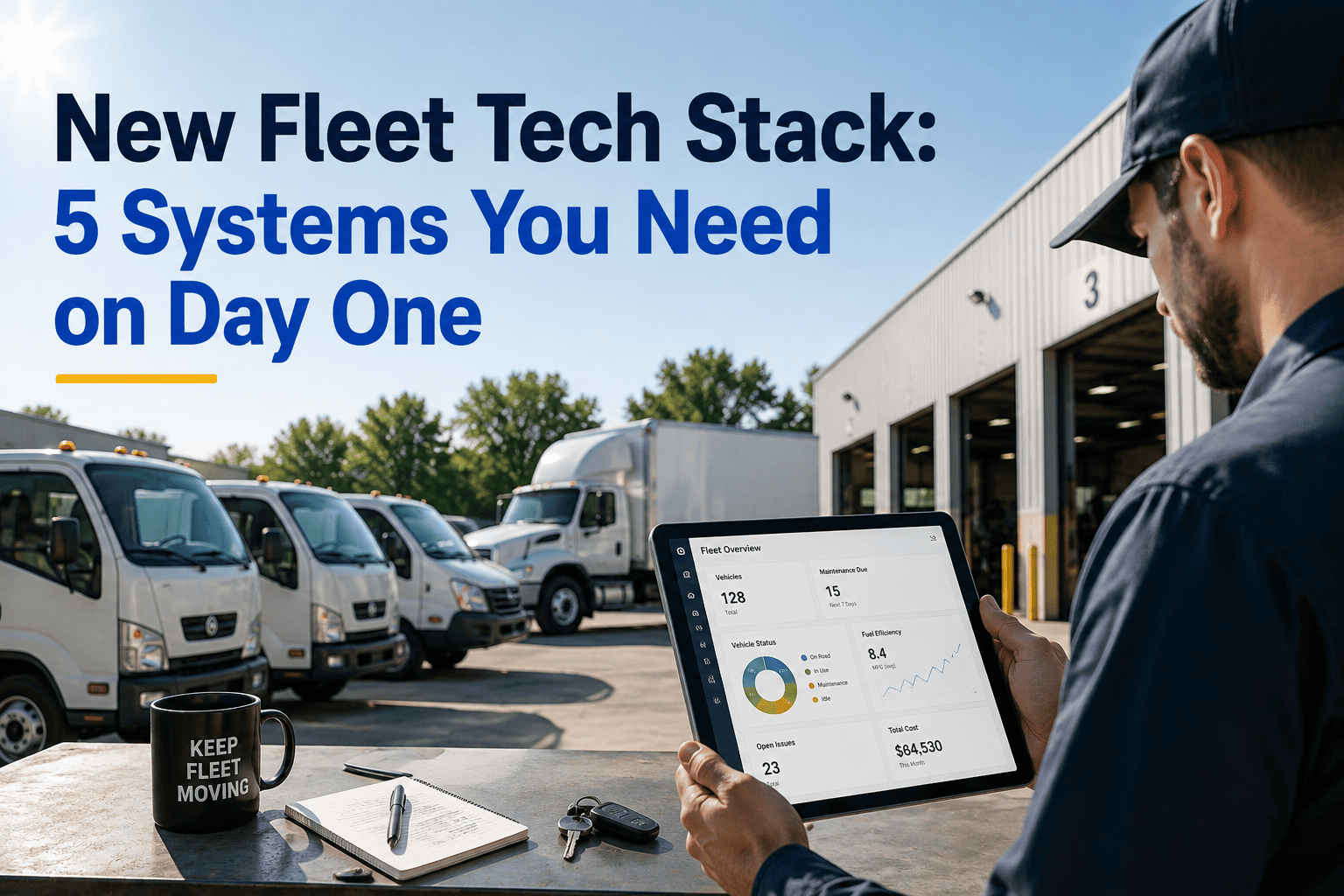
New Fleet Tech Stack: 5 Systems You Need on Day One

By Corin Hale on September 1, 2026

new-fleet-tech-stack-5-systems-day-one

New carriers hear the same advice from every trade forum: you need a TMS, an ELD, a maintenance system, a factoring partner, fuel cards, a safety platform, a driver app, an accounting tool, load boards, and a dozen more logins before you haul your first mile. Most of that list is noise. A new fleet running its first five to twenty-five trucks needs exactly five connected systems to stay compliant, get paid on time, and keep trucks moving — everything else can wait until the revenue justifies it. This page breaks down those five systems, what each one actually does for a new operation, and how they should talk to each other from day one. Skip the twelve-tool spreadsheet and see what a lean, working stack looks like at app.oxmaint.ai.

Fleet Startup Guide · 2026

New Fleet Tech Stack: 5 Systems You Need on Day One

Forget the 12-tool checklist. Here is the exact minimum software stack that covers compliance, dispatch, cash flow, maintenance, and books for a fleet running its first trucks in 2026.

5
Core systems that cover a new fleet's day-one operational needs
35-45
Average days brokers take to pay an invoice without factoring in place
3-5x
What an unplanned roadside breakdown costs versus a scheduled repair
Apr 2026
Deadline several decertified ELD providers gave carriers to switch devices

Why New Fleets Overbuy Software

Most fleet software listicles are written for carriers running 40, 100, or 500 trucks — operations with a dispatch team, a safety department, and a controller on staff. A new fleet at five to twenty-five trucks does not have those departments yet; the owner or a single ops person is wearing every hat. Buying enterprise-grade tooling at that stage means paying for modules nobody has time to configure, let alone use. The goal on day one is coverage, not sophistication: one system per critical function, chosen for fast setup and a mobile-first driver experience, wired together so data does not have to be typed twice.

The 12-Tool Trap
Separate apps for ELD, dispatch, maintenance, fuel, safety scoring, driver pay, factoring, accounting, IFTA, load boards, document storage, and messaging — each with its own login and no shared data.
The 5-System Stack
One system per function that actually changes daily operations — compliance, dispatch, cash flow, maintenance, and books — integrated so HOS, work orders, and invoices flow automatically between them.

The 5 Systems, in Priority Order

Set these up in roughly this sequence. The first two are non-negotiable before a truck leaves the yard; the last three prevent the cash and equipment problems that sink new carriers in year one.

01
ELD and Compliance
FMCSA-mandated hours-of-service logging is not optional, and enforcement has tightened — audits now cross-check ELD logs against dispatch records, fuel purchases, and payroll, so gaps between systems get flagged fast. Confirm your device is still on the FMCSA registry before you rely on it; several providers were decertified in 2026 and carriers had to switch or face out-of-service orders.
02
Dispatch and Load Management
A place to assign loads, track driver status, and confirm a driver has legal hours left before they accept a run. At a handful of trucks this can be simple, but it needs to pull HOS data from your ELD automatically — a dispatcher manually checking a separate compliance app before every assignment does not scale past a few trucks.
03
Freight Factoring
Brokers commonly pay on net-30 to net-60 terms, with 35 to 45 days a realistic real-world average even for established brokers. Factoring turns a delivered load's invoice into cash within a day or two instead of a month, which is often the only thing standing between a new carrier and missing a fuel or payroll payment in the first quarter of operation.
04
Maintenance Tracking (CMMS)
A single truck out of service for a preventable breakdown can wipe out a week of margin — an unplanned roadside failure typically costs three to five times what a scheduled repair would, once towing, missed loads, and customer trust are factored in. A CMMS that logs PM schedules, DVIRs, and repair history per truck from the first day keeps small issues from becoming roadside calls.
05
Accounting and Driver Pay
Invoicing, expense tracking, IFTA reporting, and driver settlements need one source of truth from the start — reconstructing a full year of trucking books from bank statements at tax time is a common and expensive mistake among first-year carriers. Pick a system that can pull mileage and fuel data in rather than requiring manual entry per load.
Maintenance Is Where New Fleets Fall Behind First

See How Oxmaint Covers System 4 of Your Stack

Oxmaint gives new fleets PM scheduling, digital DVIRs, and repair history per truck from the first vehicle you add — no spreadsheet, no whiteboard, no missed inspection. It is built to run alongside whatever ELD and dispatch tools you already picked, not replace them.

Day-One Stack vs. What Can Wait

Not every tool on a mature fleet's list belongs on a new fleet's list. Here is a simple way to sort what you set up before your first load against what you add once volume justifies it.

Function Day-One Priority Add When Skip Until Later
ELD / Compliance Required before first load
Dispatch / TMS Required before first load
Freight Factoring Set up in week one
Maintenance CMMS Set up before truck two
Accounting / Pay Set up in month one
Dedicated Safety Platform 10+ trucks
Multi-Terminal Coordination 25+ trucks, 2+ yards
Custom ERP Integrations Until back-office headcount grows
Dedicated BI / Analytics Tool Until reporting outgrows spreadsheets

How the 5 Systems Should Talk to Each Other

Buying five separate logins is not the goal — the value comes from the data moving between them without anyone re-typing it.

ELD logs hours
Dispatch checks HOS before assigning a load
Delivered load becomes an invoice
Factoring advances cash against it
Accounting books the settlement

Maintenance runs alongside this loop rather than inside it — every mile logged by the ELD and every DVIR filed by a driver should feed straight into the CMMS so PM intervals and repair flags update without a separate manual check.

Frequently Asked Questions

Do I really need five separate systems, or can one platform cover all of it?
Some all-in-one platforms bundle two or three of these functions, and that is fine if the integration is real rather than a shared login screen. What matters is that HOS, dispatch, and maintenance data flow automatically — not how many separate products it takes to get there.
Which of the five systems should a brand-new one-truck operation set up first?
ELD and dispatch come first because you cannot legally or practically run a load without them. Factoring is close behind — most new carriers feel the 30 to 45 day payment gap within their first month. Maintenance tracking should start no later than truck two, before repair history gets hard to reconstruct.
How do I know if my maintenance process is already behind?
If PM intervals live in a notebook, a whiteboard, or a driver's memory, you are already exposed to the roadside-breakdown cost multiplier. You can see what a structured CMMS looks like for a small fleet at app.oxmaint.ai before it becomes a problem.
Is freight factoring worth the fee for a new fleet with good customers?
Even reliable, creditworthy brokers commonly pay on 30 to 60 day terms. Factoring is not a signal of financial trouble — it is a scheduling tool that converts earned revenue into usable cash so payroll and fuel do not depend on a broker's payment calendar.
When should I upgrade past this five-system starter stack?
Once you are running a dedicated dispatch team, multiple yards, or enough trucks that spreadsheet-level reporting stops answering your questions — typically somewhere past twenty-five trucks — it is time to evaluate dedicated safety, BI, or multi-terminal tools on top of this base. Book a walkthrough at calendly.com/oxmaintapp/30min if you want help mapping that transition.
Built for Fleets Running Their First Trucks

Get the Maintenance Layer of Your Stack Right From Truck One

Oxmaint gives new carriers PM scheduling, digital DVIRs, and per-truck repair history without the setup overhead of enterprise fleet software. Start free and add trucks as your fleet grows, or talk to our team about what a lean, connected stack looks like for your specific lane and fleet size.
Share This Story, Choose Your Platform!