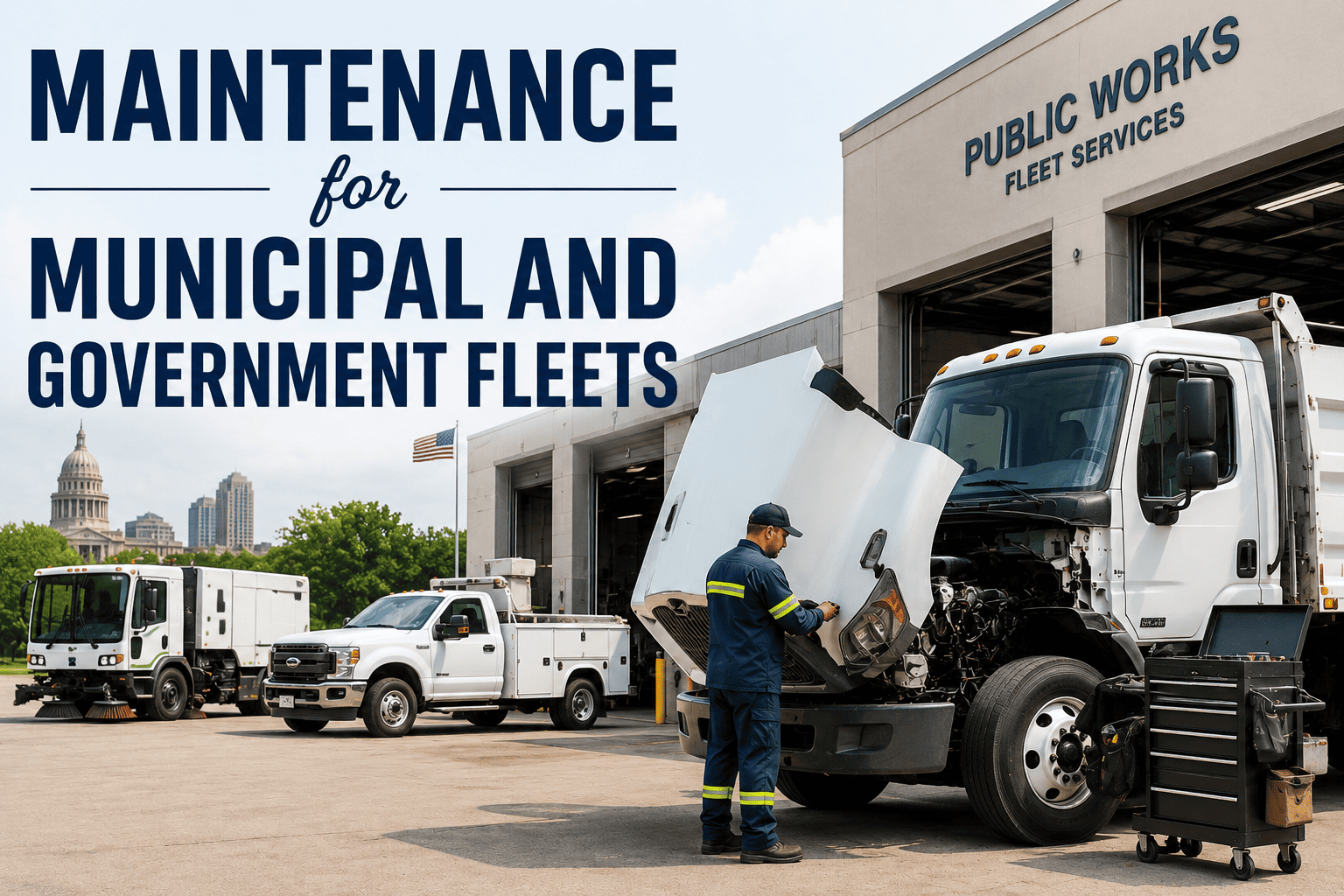
Municipal fleet maintenance is the structured process of keeping government-owned vehicles and equipment — from police sedans and refuse trucks to snowplows, street sweepers and transit buses — in safe, compliant and mission-ready condition. A municipal fleet guide for 2026 must address realities that private fleets do not face: public budget scrutiny, multi-class asset complexity, procurement rules and audited compliance with federal, state and local standards. Government fleet maintenance teams are being asked to extend asset life, reduce downtime and prove every dollar spent — all while often still relying on paper work orders or spreadsheets. OxMaint brings AI-powered CMMS and EAM capabilities purpose-built to solve this, and you can Start Free Trial to see the difference on your own assets.
Municipal Fleet Guide 2026
What does it cost your city when a snowplow or refuse truck is down in peak season?
Most municipal fleets lose 18–25% of annual productive hours to unplanned downtime, reactive repairs and parts stockouts — yet public works directors are asked to justify every line item in the next budget cycle. OxMaint replaces paper work orders and siloed spreadsheets with predictive maintenance built for mixed government fleets.
The 2026 Challenge
Why municipal fleet maintenance is getting harder — and more visible
Public works directors, fleet managers and city administrators operate under a level of scrutiny private fleets rarely see. Council meetings, FOIA requests and published audit reports put every repair invoice, parts purchase and fuel transaction in the public eye. At the same time, a typical municipal fleet is a mixed-asset environment — light sedans, Class 8 refuse trucks, street sweepers, snowplows, generators and even portable signage — each with different PM intervals, OEM specifications and compliance mandates. Without a unified system, maintenance teams default to reactive triage, and costs spiral.
Cost Breakdown
The true cost of reactive municipal fleet maintenance
When maintenance is reactive, the cost cascade is immediate and measurable. A single downed refuse truck can cost a city $2,800 per day in contracted route coverage, overtime for re-runs and missed-collection penalties. Multiply that across a 200-unit fleet averaging 12 unplanned breakdowns per month, and the annual exposure exceeds $400,000 — before parts and labor. The formula below illustrates how quickly avoidable costs compound.
Annual Reactive Maintenance Cost
Breakdowns / month × Days down per event × Daily cost (overtime + route coverage + tow) × 12 + Expedited parts premium
Example: 12 events × 3 days × $2,800 × 12 + $18,000 = $1,201,200 / year in avoidable exposure for a 200-asset municipal fleet.
Potential Annual Savings with Predictive PM
Reactive cost × Downtime reduction factor (30–50%) + Labor hours saved × Burdened rate + Extended asset life × Depreciation avoidance
Example: $1.2M × 0.40 + 1,800 hrs × $52 + 2.4 yrs × $14,000 = $589,600 / year in recoverable savings.
Compliance & Audit Readiness
How government fleet maintenance teams stay audit-ready
Unlike private operators, municipal fleets must produce complete, date-stamped maintenance histories on demand — for DOT inspections, internal audits, council oversight and federal grant compliance (including FEMA reimbursement after disaster deployments). A missing oil-change record on a fire apparatus can delay an entire inspection cycle. OxMaint automatically logs every work order, parts issue and technician signature into a tamper-evident audit trail, so your fleet is always inspection-ready.
| Compliance Area | Spreadsheets & Paper | OxMaint CMMS |
|---|---|---|
| FMCSA / DOT inspection records | Manual assembly, 4–8 hours per audit | One-click report, < 60 seconds |
| Preventive maintenance compliance rate | 55–70% (missed intervals common) | 95%+ with automated triggers |
| Parts & fuel reconciliation | Reconciled monthly, errors common | Real-time inventory tracking |
| FEMA / grant deployment documentation | Reconstructed after the fact | Auto-logged with GPS & timestamps |
| Council / public records requests | 2–5 business days to compile | Instant exportable reports |
Implementation Roadmap
How to modernize a municipal fleet in 90 days
Switching from spreadsheets or legacy systems does not require a multi-year capital project. A structured 90-day rollout gets your team live, trained and reporting measurable results within a single fiscal quarter — often before the next council budget review.
Asset & data onboarding
Import your full asset register — VINs, OEM specs, warranty data, current PM schedules — into OxMaint. Most municipal fleets complete this in under two weeks with our guided migration team.
PM automation & work-order go-live
Configure preventive maintenance triggers by mileage, engine hours, calendar intervals or condition data. Technicians begin receiving digital work orders on mobile devices — no more paper routes.
Parts inventory & predictive tuning
Link spare-parts stock to work orders with min/max reorder alerts. OxMaint's AI begins analyzing failure patterns to flag assets trending toward breakdown before they fail.
Analytics & council-ready reporting
Deploy dashboards showing downtime trends, PM compliance, cost-per-asset and labor utilization. Your first quarterly review with real data — not estimates — is ready.
How OxMaint Helps
OxMaint capabilities purpose-built for government fleets
OxMaint is an AI-powered CMMS and EAM platform designed for the realities of public-sector maintenance. Every capability maps directly to a measurable outcome that municipal fleet managers are accountable for — uptime, cost control, compliance and asset longevity.
Automated preventive maintenance scheduling
Configure PM triggers by mileage, engine hours, calendar date or condition sensor data. Eliminates missed intervals and raises PM compliance from 60% to 95%+ within the first quarter.
Outcome: Cut unplanned downtime 30–50%
AI-powered predictive failure alerts
OxMaint analyzes work-order history, part-failure patterns and usage data to predict which assets are trending toward breakdown — so you schedule repairs before routes are disrupted.
Outcome: Avoid $8K–$15K per prevented major failure
Real-time spare-parts inventory tracking
Link parts directly to work orders with automated min/max reorder points. No more stockouts on critical filters or brake kits — and no more over-ordering that ties up budget.
Outcome: Reduce parts inventory carrying cost 20–35%
Audit-ready compliance documentation
Every work order, parts issue and technician sign-off is automatically logged with timestamps into a tamper-evident record. Generate DOT, FMCSA, FEMA and council reports in one click.
Outcome: Cut audit prep from days to minutes
See OxMaint on your municipal fleet — book a 30-minute demo
Walk through a live environment configured for mixed government assets. See PM automation, predictive alerts and council-ready reporting in action.
Real-World Scenario
A 240-asset municipal fleet cuts downtime 38% in one fiscal year
BEFORE OXMAINT
A mid-sized city public works department managed 240 assets — sedans, refuse trucks, snowplows and sweepers — across two shops using spreadsheets and paper work orders. PM compliance was 58%. The fleet averaged 14 unplanned breakdowns per month, costing approximately $47,000 monthly in overtime, contracted route coverage and expedited parts. Audit preparation consumed 60+ staff hours per quarter.
AFTER OXMAINT (12 MONTHS)
After deploying OxMaint, the fleet achieved 94% PM compliance within the first quarter. AI-driven predictive alerts flagged 22 potential failures before they became roadside breakdowns. Unplanned downtime dropped 38%, saving an estimated $214,000 in the first year. Audit prep fell to under 4 hours per quarter, and the fleet manager presented a data-backed budget to council that secured a replacement-vehicle capital increase.
Frequently Asked Questions
Municipal fleet maintenance software: what government teams ask
What is municipal fleet maintenance software and how does it differ from private fleet tools?
Municipal fleet maintenance software is a CMMS or EAM platform designed to manage government-owned vehicles and equipment under public-sector constraints — budget transparency, procurement compliance, mixed asset classes and audit requirements. Unlike private fleet tools, it must support council-ready reporting, FEMA grant documentation and multi-department cost allocation. OxMaint is built to handle all of these out of the box — you can Book a Demo to see the public-sector configuration live.
How much does government fleet maintenance software cost?
Most municipal CMMS platforms price per asset per month, typically ranging from $3 to $12 depending on feature depth and asset count. A 200-asset fleet should budget $8,000–$24,000 annually. OxMaint's ROI typically pays for itself within 3–6 months through reduced downtime, parts optimization and eliminated overtime — often recovering more than 10x the subscription cost in year one.
Can OxMaint handle mixed asset classes like sedans, snowplows and generators in one system?
Yes. OxMaint supports unlimited asset classes with configurable PM schedules, custom fields and OEM specification tracking per class. A snowplow can have triggers based on plow-down hours while a police sedan tracks mileage and idle time — all in the same dashboard, with cost reporting segmented by department or asset type.
How long does it take to migrate from spreadsheets to a municipal CMMS?
Most municipal fleets complete a full migration — asset data, PM schedules, parts inventory and user training — in 30 to 90 days. OxMaint provides a guided onboarding team that handles data import and configuration, so your technicians are live on digital work orders within the first few weeks. A 240-asset fleet can be fully operational in under one fiscal quarter.
Does municipal fleet maintenance software help with FEMA and federal grant compliance?
Yes. OxMaint automatically logs every work order, parts issue, fuel transaction and deployment with timestamps and GPS data. When a disaster deployment requires FEMA reimbursement documentation, you can export a complete, auditable record in minutes rather than reconstructing records weeks after the event. This same capability supports federal grant reporting and state DOT audit requirements.
Ready to modernize your municipal fleet maintenance?
Join public works departments using OxMaint to cut downtime, prove compliance and stretch every taxpayer dollar further. Start your free trial or book a 30-minute demo tailored to your fleet.
Free 14-day trial · No credit card