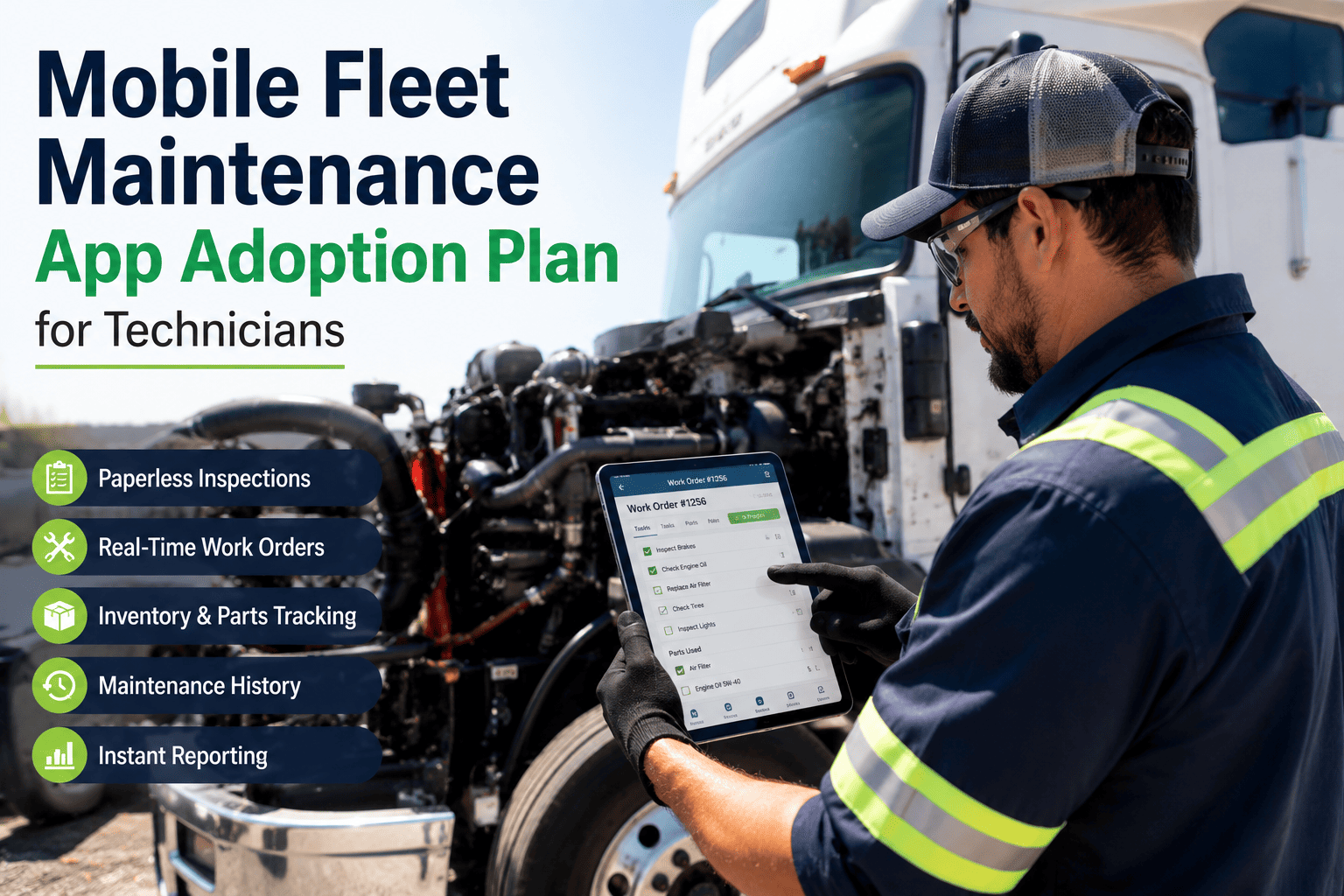
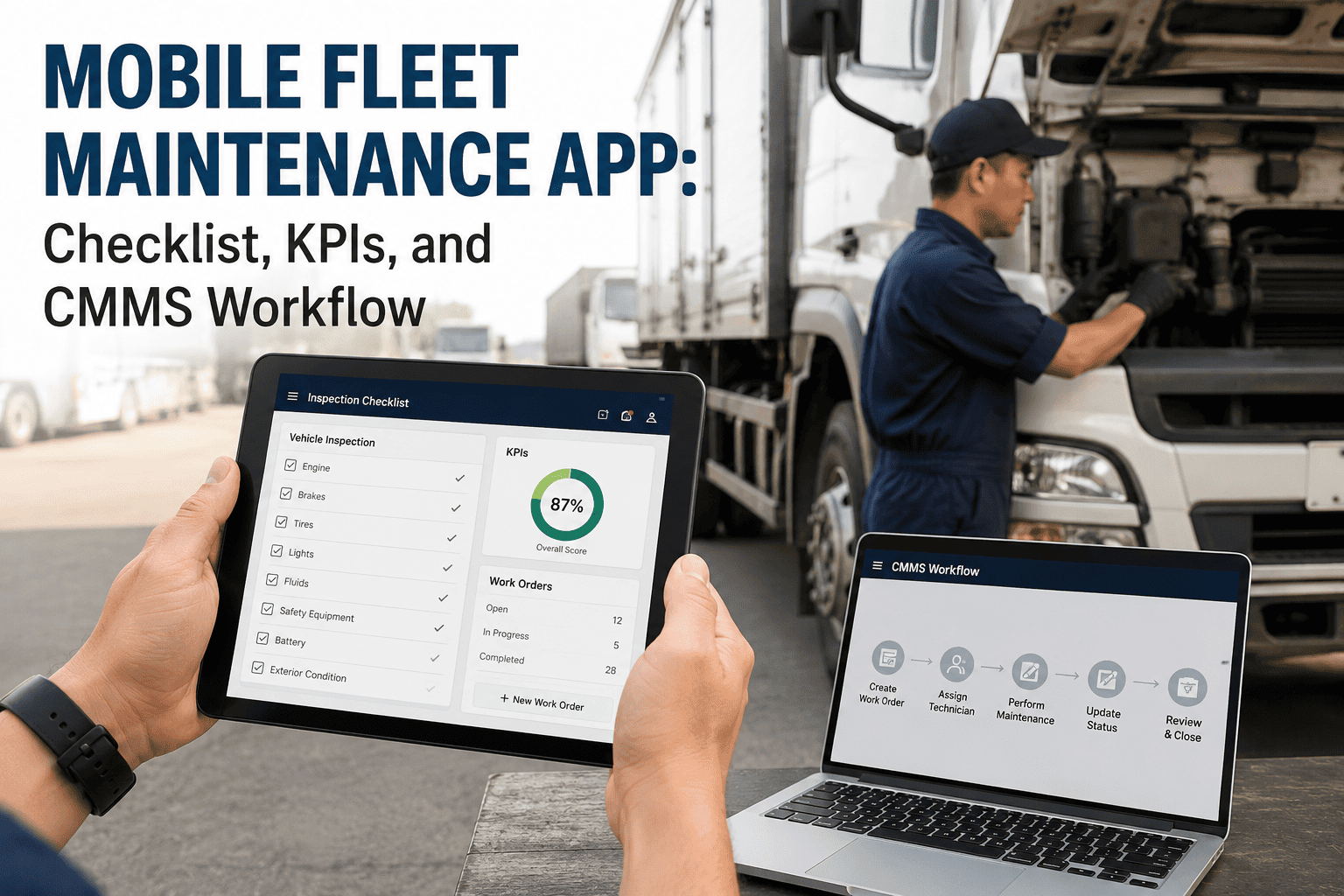
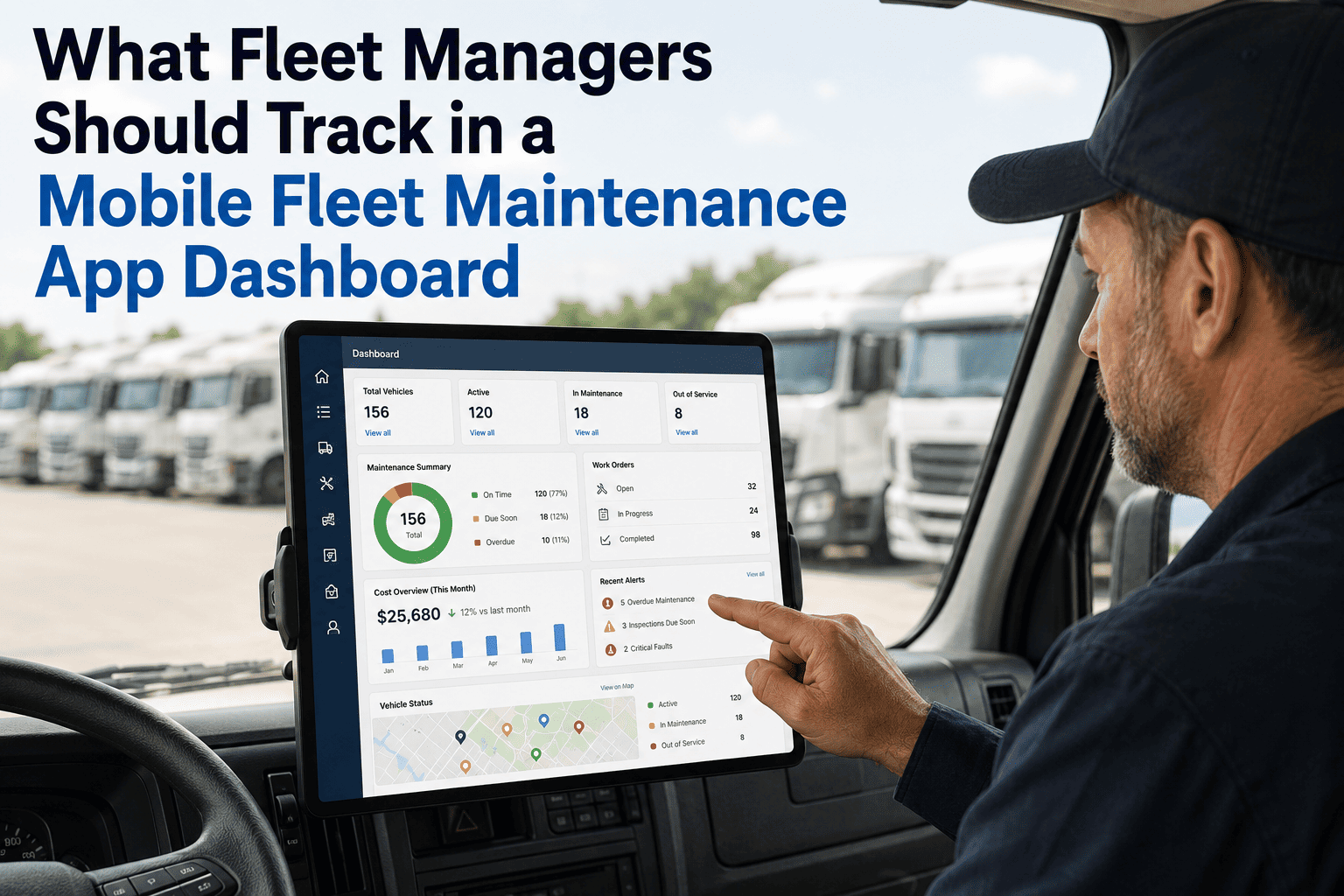
Mobile fleet maintenance app rollouts succeed or fail in the first 30 days — and the dividing line is almost never the software itself. The platforms with strong technician adoption share a deliberate rollout plan: pilot group, phased deployment, training cadence, paper-parallel period, and visible time-savings feedback to the field. Fleets that skip the plan and push the app on day one see adoption rates of 40–55% after a quarter. Fleets that follow a structured adoption plan hit 80% adoption inside two weeks and 91% within 30 days. This page lays out the exact four-phase adoption plan that gets technicians using the app voluntarily — because the time savings make their day measurably better. To get the rollout playbook configured for your fleet size, start a free trial or book a demo.
MOBILE CMMS · TECHNICIAN ADOPTION · ROLLOUT PLAN · CHANGE MANAGEMENT
Mobile Fleet Maintenance App Adoption Plan For Technicians
A four-phase rollout plan that hits 80% technician adoption in two weeks — built on what actually works in real fleet deployments, not on slideware change-management theory.
91%
Technician adoption by day 30
30min
Core workflow training time
3-5h
Daily time saved per tech
14d
To 80% adoption milestone
The Four-Phase Plan
The Adoption Roadmap That Works In Real Fleet Garages
Each phase has a defined goal, a clear duration, and a single decision gate before moving to the next phase. Skipping phases is the single most common reason adoption fails.
Pilot With Three To Five Volunteers
Goal: Validate workflows against real work — not against a configuration spec
Hand-pick three to five technicians who are curious, vocal, and respected on the floor. They run the app on actual work orders, raise every friction point, and shape the configuration before the rest of the team sees it. Their endorsement at end-of-phase is what gives the wider rollout social proof. Skip this and the deployment becomes a top-down mandate that technicians treat like every other top-down mandate.
Phase gate: Pilot group completes 25+ work orders on mobile, reports time-saved versus paper
Wider Rollout With Paper Parallel
Goal: Build adoption by demonstration, not by force
Roll out to all technicians. Run paper and mobile in parallel — no one is forced off paper yet. Pilot-group volunteers become floor coaches. Most technicians migrate to mobile within the parallel period because they watch peers finish work orders 3–5 hours faster. The remaining holdouts identify themselves naturally, which makes phase 3 surgical instead of broad.
Phase gate: 80% of work orders running on mobile, paper usage isolated to specific technicians
Targeted Coaching For The Final 20%
Goal: Surface and address the specific reasons each holdout has resisted
The remaining 20% usually fall into three buckets: device-comfort gap, eyesight or accessibility issue, or a workflow the app does not yet handle cleanly. Each requires a different response — extra one-on-one training, larger fonts and accessibility configuration, or a workflow tweak. None of these scale through generic training. Surface them individually and close them.
Phase gate: Documented resolution for every technician below adoption threshold
Retire Paper And Lock In The New Standard
Goal: Convert behavior change into permanent process
Once adoption holds at 90%+ for two consecutive weeks, paper work orders are retired. The desktop CMMS remains for planning, scheduling, and reporting — but technician work is mobile-only. New hires onboard directly to mobile. Adoption metrics shift from "did they use it" to "what value did they create with it" — first-time fix rate, work order cycle time, parts request accuracy.
Phase gate: 90% adoption stable for 14 days, paper formally retired
Training Cadence
The Training Curriculum Behind 91% Adoption — Not One Big Session
Single-session, all-day training is where most rollouts collapse. Adoption needs a cadence — short bursts that match how technicians actually learn new tools on the floor, with deliberate gaps so each lesson lands before the next one starts.
Day 1
30 min
Core Work Order Flow
Receive WO, accept, work, photograph, request parts, close. Nothing else. Anything past the core flow on day 1 is wasted bandwidth and pushes the brain past what it can absorb.
Day 3
15 min
Friction-Point Check-In
Floor coach walks the bay, captures one-off questions, removes the small frictions before they harden into reasons to give up on the app. Half of adoption failures die here.
Week 2
20 min
Advanced Features
Vehicle history, asset QR scanning, offline mode, voice notes, photo annotation. Only introduced once the core flow is muscle memory — never on day 1, no matter how excited a manager is to showcase them.
Monthly
10 min
Tune-Up & Tips
Toolbox-talk-length sessions on shortcuts technicians have discovered, new features shipped, and answers to questions raised in the field. Keeps the platform from drifting into background noise.
Technician Personas
Three Technician Personas Every Rollout Has To Plan For
Adoption succeeds when each persona is addressed by name — not when the rollout assumes everyone responds to the same change-management approach.
30% of typical fleet shop
Picks up the app in 10 minutes. Wants to see new features early. Becomes a floor coach if recognized. Risk: gets bored and disengaged if the pilot stretches too long without action.
Rollout move: Make them pilot volunteers, give them the first device.
55% of typical fleet shop
Will use it when convinced it makes the work easier — not before. Trusts peer endorsement over leadership announcements. Risk: stays on paper through Phase 2 unless the time-savings story is concrete.
Rollout move: Floor coaches show side-by-side time on real work orders.
15% of typical fleet shop
Genuine reasons — device-comfort, eyesight, prior bad software experience, or workflow the app does not handle. Risk: gets labeled resistant when the underlying issue is operational.
Rollout move: One-on-one in Phase 3, no group training, no public pressure.
A Structured Adoption Plan Beats Software Quality — Every Time
Oxmaint includes the full rollout playbook as part of the trial: pilot configuration, paper-parallel templates, coaching materials, and adoption-metric dashboards. To run the plan with your team.
Resistance Decoder
What Technicians Say vs. What They Actually Mean — And How To Respond
| What They Say | What It Usually Means | Right Response |
| "I don't need an app for this" |
Hasn't seen the time savings on real work yet |
Side-by-side timed demo on their actual work order |
| "My fingers are too big for the screen" |
Real ergonomic issue worth taking seriously |
Larger device, stylus, or voice-input configuration |
| "We tried this before, it didn't work" |
Past CMMS rollout left scars — fair pushback |
Acknowledge prior experience, show what is different |
| "The shop wi-fi is terrible back there" |
Genuine connectivity gap that paper has solved |
Demonstrate offline mode and sync behavior |
| "Paper is faster for me" |
It probably is — for a single work order on day one |
Show parts-lookup and history-retrieval time saved |
| "I'll use it when leadership stops watching" |
Trust issue — feels surveilled, not equipped |
Frame as "your tool" not "your tracker" |
Anti-Patterns To Avoid
Six Rollout Mistakes That Stall Adoption Below 60%
Every stalled mobile rollout has at least two of the below mistakes in play. Most have four. Audit your plan against this list before kickoff — and again at the 30-day mark when course corrections are still cheap.
M1
Mandatory Day-1 Cutover With No Pilot
Skipping the pilot phase turns the rollout into a top-down directive without floor evidence. Adoption stalls between 40–55% within the first month and rarely recovers without a full restart.
M2
No Paper-Parallel Period
Forcing technicians off paper before they have seen the time savings creates panic, errors, and resentment. The parallel period is a feature, not a delay — it is what builds voluntary migration.
M3
All-Day Training With No Floor Follow-Up
One 4-hour classroom session followed by silence is the most common training failure mode. Short cadence with floor presence beats a single deep dive every time, by every measurable metric.
M4
Personal Devices With No Stipend
Asking technicians to use their own phones for work without a stipend hits a moral ceiling around 60% adoption — half the staff will not install work apps on their personal devices, and they are right to refuse.
M5
No Visible Time-Saving Feedback
If technicians cannot see their own time saved, they treat the app like data entry. Show them the savings on a personal dashboard and the behavior locks in within two weeks — almost no exceptions.
M6
Treating Adoption As An IT Project
When IT owns adoption, technicians read it as enforcement and compliance. When the maintenance lead owns it, technicians read it as workflow improvement. Same software, different outcomes — by a wide margin.
Tracking The Rollout
The Adoption Metrics That Actually Tell You The Plan Is Working
Login frequency is a vanity metric — it tells you the app is open, not that it is doing work. Real adoption shows up in the work itself. These are the metrics fleet managers track week-over-week to know the rollout is on track and where to intervene early.
| Adoption Metric | Week 1 Target | Week 4 Target | Day 90 Standard |
| Work orders closed on mobile |
40% |
85% |
98%+ |
| Photo capture rate per work order |
1+ |
2+ |
3–4 average |
| Parts requests submitted in-app |
30% |
80% |
95%+ |
| WO assignment-to-acceptance time |
Under 2 hr |
Under 30 min |
Under 15 min |
| Daily active technician percentage |
50% |
85% |
95%+ |
| Average work order close time |
Down 10% |
Down 30% |
Down 40–50% |
| Voice-note or photo annotation use |
10% |
40% |
60%+ |
| Paper work orders submitted |
50% |
10% |
Zero |
Adoption FAQ
Mobile Fleet App Adoption Questions From Real Rollouts
Should technicians use personal phones or company-issued devices?+
Company-issued devices remove every excuse and signal investment. Cost recovers in the first two weeks of productivity gains. Personal-device rollouts hit 60–70% adoption ceilings because some technicians legitimately refuse to install work apps on personal phones. To plan device procurement,
start a free trial or
book a demo.
How long does the pilot phase need to be?+
Five to seven days is the sweet spot. Shorter pilots miss workflow edge cases. Longer pilots create momentum loss as pilot volunteers grow frustrated waiting for the wider rollout. The phase gate matters more than the calendar length.
What if a technician refuses to use the app even after phase 3 coaching?+
After targeted one-on-one in phase 3, persistent refusal is a performance-management conversation, not a software conversation. By that point the time-saving evidence is overwhelming and every reasonable accommodation has been offered.
Does adoption planning differ for fleets with mobile technicians versus shop-based ones?+
Mobile technicians often adopt faster — the app delivers value that desk-bound paper workflows cannot match for them. Shop-based technicians need more peer demonstration since paper is more workable in a fixed shop. To configure for your mix,
start a free trial.
How do we measure adoption beyond just login frequency?+
The real metrics are work orders closed on mobile versus paper, photo capture rate, parts requests submitted in-app, and time from work-order assignment to acceptance. These prove the app is doing the job, not just sitting on the home screen.
A Mobile App Is As Good As Its Adoption Plan. Use The Plan That Works.
Software quality matters. But the adoption plan matters more. Fleets that run the four-phase rollout above hit 91% technician adoption inside 30 days — and the time savings compound for the rest of the platform's operating life. Oxmaint includes the playbook, the templates, and the dashboards needed to execute it.