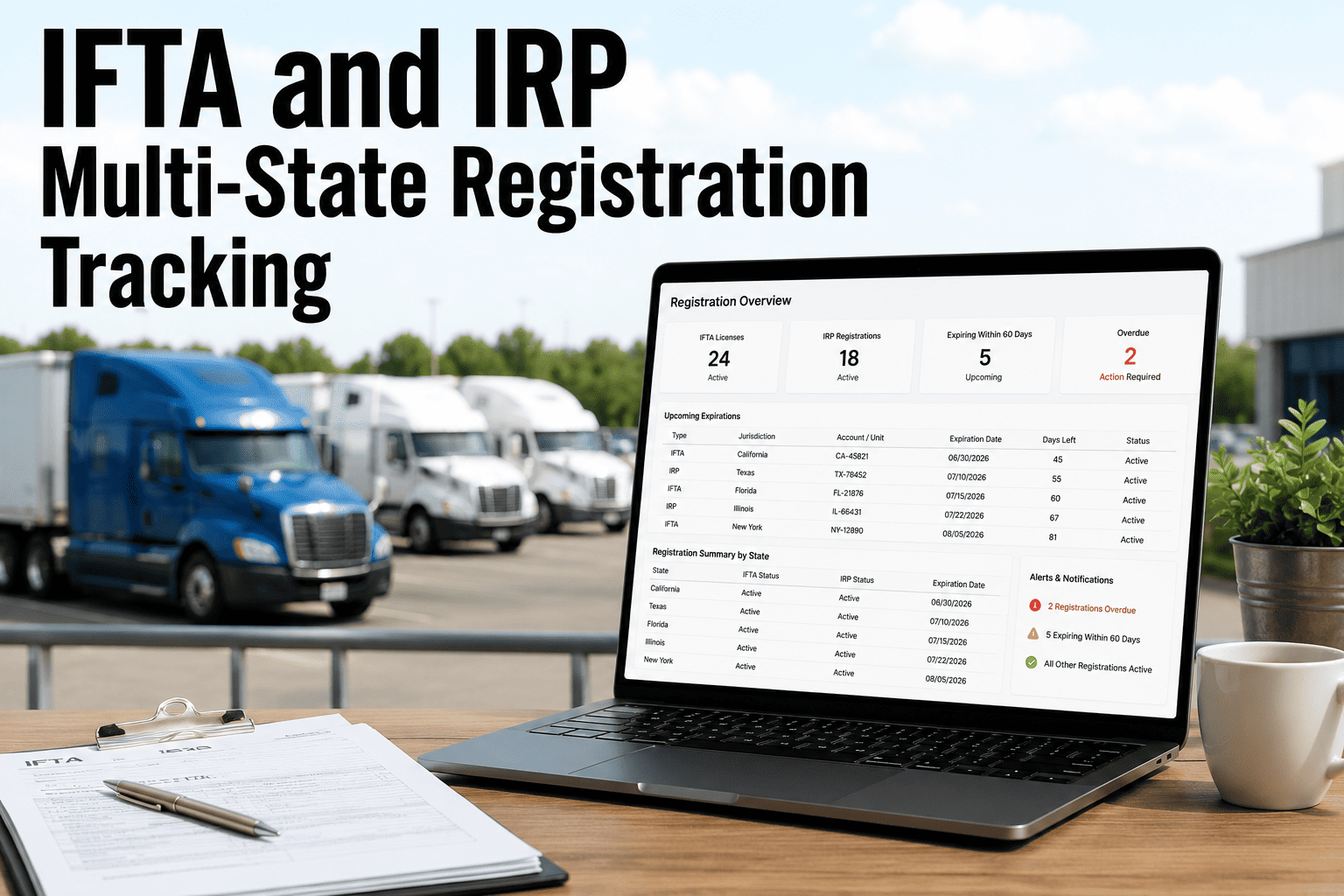
IFTA and IRP multi-state registration tracking is the backbone of compliance for any commercial fleet operating across U.S. states and Canadian provinces — without accurate mileage-by-jurisdiction data, carriers face compounded audit penalties, back taxes, and suspended base plates under a 3-year lookback. The International Fuel Tax Agreement (IFTA) governs quarterly fuel tax reporting, while the International Registration Plan (IRP) governs annual apportioned plate registration; both require every state-line crossing to be logged with a timestamp and odometer reading. Manual spreadsheet tracking turns this into a days-long, error-prone process every quarter. Automating IFTA IRP fleet reporting through GPS telematics and a CMMS like OxMaint cuts filing time from days to minutes — Start Free Trial to see how.
Multi-State Fleet Guide 2026
Is your fleet ready for IFTA & IRP multi-state registration in 2026?
Carriers filing manually spend 3–5 days per quarter reconciling jurisdictional mileage. A single Q3 error can trigger a 3-year audit lookback across every jurisdiction your trucks entered. OxMaint automates the entire pipeline — from GPS state-line detection to filing-ready IFTA and IRP reports.
What IFTA & IRP Actually Require
IFTA IRP fleet compliance: two registrations, one shared data requirement
Both IFTA and IRP operate on the same principle: rather than register and pay fuel tax in every jurisdiction, a carrier files with one "base state" that distributes fees proportional to miles driven in each jurisdiction. The catch — both demand accurate, per-vehicle, per-jurisdiction mileage records.
International Fuel Tax Agreement
Quarterly tax return filed with your base state. Each return reports miles driven per jurisdiction and gallons purchased per jurisdiction for every qualified vehicle. The base state distributes the tax to each jurisdiction proportionally.
International Registration Plan
Annual renewal that produces an "apportioned" base plate. You report total miles driven per jurisdiction from the prior year; the base state calculates registration fees owed to each jurisdiction proportional to those jurisdictional miles.
The Cost of Manual Tracking
Why spreadsheet-based multi-state tracking fails fleets
Without automation, IFTA and IRP reporting becomes a spreadsheet-intensive process that produces errors, missed state-line crossings, and audit findings — and those errors compound across a 3-year lookback window.
Real-World Scenario
A 180-truck regional fleet operating across 14 states was manually logging odometer readings at fuel stops. When Indiana flagged a 4,200-mile discrepancy in their Q3 2023 IFTA return, the audit expanded to all 14 jurisdictions across 3 years — resulting in $87,000 in back taxes, penalties, and accountant fees. Had the fleet used automated state-line crossing detection, every mile would have had a GPS-verified timestamp and odometer reading on record.
Step-by-Step Compliance Pipeline
How to automate IFTA & IRP reporting: the 4-step pipeline
Automation replaces spreadsheets with a closed-loop data pipeline — from the truck's GPS to a filing-ready report. Here is how the pieces connect for a compliant multi-state fleet in 2026.
GPS Telematics with State-Line Detection
Every border crossing is logged automatically with a timestamp and odometer reading. No driver input required — the telematics unit detects jurisdiction boundaries and records the exact mileage accumulated in each state or province.
CMMS Integration & Jurisdictional Mileage Storage
The telematics feed integrates into the CMMS, which stores a jurisdiction mileage record per vehicle, per quarter. Fuel card data feeds jurisdictional fuel purchases into the same record — closing the gap between miles driven and gallons bought.
IFTA & IRP Report Generation
One click produces filing-ready summaries: quarterly IFTA returns with miles and gallons per jurisdiction, and annual IRP renewals with full prior-year mileage breakdowns — formatted for each base state's requirements.
Audit-Ready Data on Demand
If a jurisdiction triggers an audit, the underlying GPS logs, odometer readings, and fuel card transactions are exportable instantly — no scrambling through 3 years of spreadsheets. Every mile is traceable to a source record.
Manual vs. Automated Filing
Manual spreadsheet tracking vs. automated IFTA IRP reporting
The difference between spreadsheet-based compliance and an integrated telematics + CMMS pipeline is measured in days saved, penalties avoided, and audit exposure eliminated.
| Compliance Dimension | Manual Spreadsheet Tracking | Automated (Telematics + OxMaint CMMS) |
|---|---|---|
| Quarterly IFTA filing time | 3–5 days per quarter for a 50-truck fleet | Under 30 minutes — report is pre-generated |
| State-line crossing accuracy | Driver-reported or estimated — 12–18% error rate | GPS-verified timestamp + odometer at every border |
| Annual IRP renewal data | Reconstructed from fuel receipts and logbooks | Full prior-year mileage-by-jurisdiction on demand |
| Audit response time | 1–2 weeks pulling and reconciling records | Instant export of all source data |
| Fuel purchase tracking | Manual entry from fuel card statements | Direct fuel card integration by jurisdiction |
| Audit exposure window | 3-year lookback with compounded errors | 3-year lookback with clean, verified records |
How OxMaint Helps
How OxMaint simplifies IFTA & IRP for multi-state fleets
OxMaint integrates IFTA and IRP data from telematics and fuel card sources, then generates filing-ready reports in the format each base state requires — turning a days-long quarterly ritual into a 30-minute review.
Telematics Integration with State-Line Detection
OxMaint ingests GPS data from your telematics provider and automatically logs every state-line crossing with timestamp and odometer reading — building a per-vehicle, per-jurisdiction mileage record with zero driver input.
Fuel Card Data Integration
Fuel card transactions feed directly into OxMaint, tagging every gallon purchase by jurisdiction. The system reconciles fuel bought vs. miles driven per state — flagging discrepancies before they become audit findings.
Filing-Ready IFTA & IRP Report Generation
Generate quarterly IFTA returns and annual IRP renewals in one click — formatted for each base state's filing requirements. Reports include miles per jurisdiction, gallons per jurisdiction, and calculated tax or fee apportionments.
Audit-Ready Data Vault
Every mile, gallon, and border crossing is stored with its source record for the full 3-year lookback period. If a jurisdiction triggers an audit, OxMaint exports the complete underlying dataset on demand — no reconstruction needed.
ROI of IFTA & IRP Automation
What a 50-truck fleet saves by switching to automated tracking
The payback math is straightforward: eliminated filing labor, avoided penalties, and reduced audit exposure. Here is a worked example for a mid-size regional fleet.
Annual Savings Formula
(Filing labor hours saved × hourly rate) + (penalties avoided) + (audit preparation hours saved × hourly rate) = Annual IFTA/IRP Automation Savings
| Savings Category | Manual Process (Annual) | With OxMaint (Annual) | Annual Savings |
|---|---|---|---|
| IFTA filing labor (4 quarters × 4 days) | $9,600 | $800 | $8,800 |
| IRP renewal preparation | $2,400 | $200 | $2,200 |
| Penalty exposure (avg. annualized) | $12,000 | $0 | $12,000 |
| Audit response preparation | $6,000 | $500 | $5,500 |
| Total Annual Cost | $30,000 | $1,500 | $28,500 |
"We went from spending four days every quarter on IFTA to under an hour. OxMaint pulls the GPS data, matches it against fuel card purchases, and the report is just... ready. When Illinois audited us last year, we exported three years of records in five minutes and the auditor closed the file."
— Director of Fleet Operations, 65-truck regional carrier
Stop spending days on IFTA & IRP every quarter
See how OxMaint automates jurisdictional mileage tracking, fuel card reconciliation, and filing-ready report generation for multi-state fleets.
Frequently Asked Questions
IFTA & IRP multi-state registration tracking: the questions fleets ask most
What is the difference between IFTA and IRP?
IFTA (International Fuel Tax Agreement) governs quarterly fuel tax reporting — you file miles driven and gallons purchased per jurisdiction every quarter. IRP (International Registration Plan) governs annual apportioned plate registration — you report prior-year mileage by jurisdiction to calculate registration fees owed to each state. Both require accurate per-jurisdiction mileage tracking, but IFTA is quarterly fuel tax and IRP is annual registration.
How long do I need to keep IFTA and IRP mileage records?
Both IFTA and IRP require records to be retained for a minimum of 3 years from the filing date, and jurisdictions can audit any quarter within that 3-year lookback window. This is why errors compound — a single quarter's mistake can trigger a full review of all prior quarters. OxMaint stores every GPS log, odometer reading, and fuel card transaction for the full lookback period so audit responses are instant. Book a demo to see the audit vault in action.
Does GPS telematics automatically detect state-line crossings?
Yes. Modern telematics units use geofencing and GPS positioning to detect when a vehicle crosses a state or provincial border, automatically logging the timestamp and odometer reading at that exact point. This eliminates driver-reported mileage and the 12–18% error rate typical of manual tracking. OxMaint ingests this telematics feed directly and builds the per-vehicle, per-jurisdiction mileage record without any manual entry.
Can OxMaint generate IFTA reports in the format my base state requires?
Yes. OxMaint's IFTA report generator produces filing-ready summaries formatted for each base state's requirements — including miles per jurisdiction, gallons purchased per jurisdiction, and the calculated tax apportionment. The same applies to annual IRP renewals, which include full prior-year mileage breakdowns by jurisdiction. You can Start Free Trial and generate a sample report for your base state in minutes.
How does fuel card integration help with IFTA reporting?
IFTA requires both miles driven and gallons purchased per jurisdiction. Fuel card integration feeds every fuel transaction into OxMaint with the jurisdiction tagged automatically, so gallons-per-state are tracked alongside miles-per-state. The system reconciles the two and flags discrepancies — for example, if fuel was purchased in a state where the GPS shows minimal mileage — before they become audit findings.
Make IFTA & IRP filing a 30-minute task, not a 5-day ordeal
OxMaint integrates telematics, fuel cards, and CMMS data into filing-ready IFTA and IRP reports — with full audit traceability for every mile and gallon across the 3-year lookback window.
Free 14-day trial · No credit card