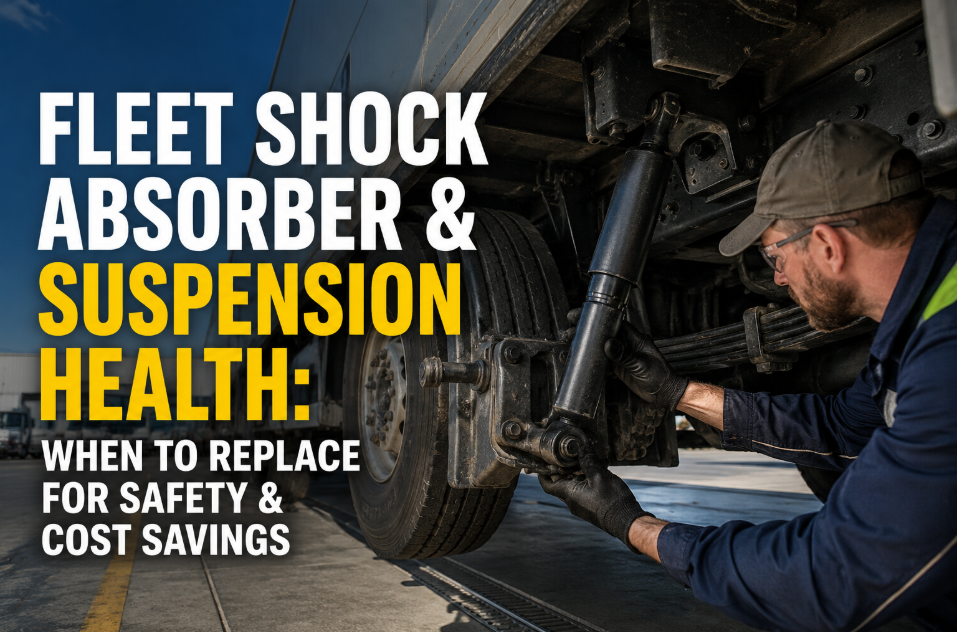
A worn king pin at highway speed, a broken leaf spring under a full load, or a seized tie rod end on a mountain descent — suspension and steering failures produce immediate loss of vehicle control with no recovery window. These components fail gradually and silently while drivers adapt, making structured measurement-based inspection the only programme that catches them before the road does. Oxmaint records king pin wear, alignment data, and spring condition per axle — flagging every out-of-spec finding before the vehicle is returned to service.
Manual vs. Oxmaint — Suspension Inspection Time Breakdown
A manual suspension inspection on a typical Class 8 vehicle takes 4–5 hours because technicians diagnose and document separately — measuring components, then writing paper findings, then raising a work order, then sourcing parts. Oxmaint compresses the same inspection to under 2 hours by capturing measurements, flagging OOS conditions, and generating work orders simultaneously. The time saving is not in the inspection itself — it is in eliminating every administrative step that surrounds it.
Technology Improving Fleet Suspension Management
Suspension degradation is gradual and invisible — bushing wear, spring sag, and king pin loosening develop over thousands of kilometres without visible symptoms until they reach the threshold of driver notice or roadside OOS citation. Four technologies make suspension maintenance data-driven rather than symptom-driven. Oxmaint integrates all four into one suspension PM workflow.
1. Leaf Springs, Air Suspension and Shock Absorbers Checklist
The primary suspension components carry the vehicle's load and absorb road input on every kilometre. Leaf spring fatigue, air bag deflation, and shock absorber failure develop gradually and silently — until the vehicle's ride height, cornering stability, or braking balance deteriorates to the point of an OOS finding or a tyre casualty. Record suspension measurements and findings per axle in Oxmaint.
Leaf springs — cracked, broken, or missing leaves
Inspect all leaf spring packs for cracks visible on the inner faces of each leaf and for missing leaves at any position. One broken leaf in a multi-leaf pack is an OOS condition — the remaining leaves are overloaded on every bump. OOS — cracked or broken leaf
Spring U-bolts — torque check at all axle positions
Loose U-bolts allow the axle to rotate under braking, shifting the brake application angle and causing pulling under braking. Torque-check at every PM — vibration works U-bolt nuts loose progressively without visible movement. Defect — loose U-bolts
Spring hangers — cracks at frame mounting points
Inspect hanger brackets at the frame for cracks radiating from the mounting bolt holes. Hanger cracks signal both a suspension failure and a frame failure simultaneously — each requiring separate repair action. OOS — cracked hanger
Air suspension bags — condition, pressure, and height control
Inspect air bags for cuts, bulging, or deflation. Check height control valve maintains ride height within 1" of specification at static loaded weight. A deflated bag resting on the jounce bumper is OOS. OOS — deflated bag
Shock absorbers — leaking, seized, or damaged body
Push down on each corner of the vehicle and release — more than 1.5 bounces indicates shock absorber failure. Any shock with oil streaking down the body is leaking and requires replacement before the next long-haul operation. Defect — leaking or excessive bounce
Torque rods and radius rods — bushing wear and alignment
Check all torque rod bushings for cracking or complete failure. A failed torque rod bushing allows axle rotation under braking — changing the brake application geometry and producing brake fade on repeated stops. Defect — cracked bushings
Equaliser beams and walking beams — wear and crack inspection
Inspect tandem axle equaliser beams for cracks at the centre pivot bore and end pad contact surfaces. A cracked equaliser beam on a tandem axle loads one axle significantly more than the other — causing premature tyre wear and brake imbalance. OOS — cracked beam
2. King Pins, Tie Rods and Steering Linkage Checklist
King pin and steering linkage wear is the most directly dangerous suspension defect category — because worn king pins reduce directional control precision on every steering input, and the driver does not notice the deterioration until it becomes gross. A king pin at the OOS wear limit reduces steering response by 30% at highway speed. Record king pin wear measurements per axle with Oxmaint's per-position recording.
King pin wear — dial gauge measurement at each steer axle position
Measure king pin lateral play with a dial gauge — OOS above 0.25" (6.35mm). Visual inspection alone cannot detect king pins approaching this limit — only dial gauge measurement gives accurate readings. OOS — above 0.25" play
King pin lubrication — grease nipple flow at all positions
Grease all king pin nipples and verify grease flows from the correct locations — a nipple that takes grease without flow indicates a blocked passage or cracked housing. A dry king pin wears exponentially faster than a lubricated one. Defect — blocked nipple
Tie rod ends — looseness and boot condition
Grasp each tie rod end and apply force in all directions — any perceptible looseness is OOS. Torn boots that have allowed water ingress require immediate replacement regardless of measured play. OOS — perceptible looseness
Drag link — both ends, clamp bolt torque, and alignment
Inspect drag link ends for wear and check clamp bolts for torque. A loose drag link clamp allows the drag link to rotate on the taper — progressively destroying the taper bore and requiring expensive drag link replacement. OOS — loose end or clamp
Steering gear — mounting bolts, backlash, and power steering
Check all steering gear box mounting bolts for torque. Measure output shaft backlash. Check power steering fluid level and inspect hoses for bulging under pressure — a bulging PS hose fails suddenly with complete loss of steering assistance. OOS — loose mounting
Steering wheel free play — measured with engine running
Measure free play before wheels respond. OOS: above ½" (12.7mm) for vehicles with power steering. Measure with the engine running and PS active — measuring with engine off overstates free play by 30–40%. OOS — above ½" free play
Steering column U-joints and intermediate shaft
Inspect all steering column U-joints for binding, roughness, and free play. A worn U-joint creates a dead spot in the steering that is felt as a momentary loss of control input response — most dangerous at parking speed. Defect — binding or play
AI Camera Vision tip: Oxmaint's drive-through tyre wear analysis identifies one-sided shoulder wear (camber fault), feathering (toe fault), and cupping (shock absorber fault) from camera images — directing suspension inspection to the correct component before the technician begins physical measurement. See Oxmaint's tyre wear pattern analysis for suspension diagnosis.
3. Wheel Alignment, Axle and Structural Checklist
Wheel alignment is the measurable output of every other suspension component's condition — when springs, king pins, tie rods, and bushings are all within specification, alignment holds. When any component wears, alignment drifts. Measuring alignment at every PM is both a verification of the preceding suspension work and the earliest possible detector of developing wear that has not yet reached the OOS threshold. Link alignment measurement results to vehicle asset records in Oxmaint.
Front axle alignment — toe, camber, and caster measurement
Measure toe, camber, and caster on the steer axle with a laser alignment system. Record all three values per wheel position — trend data across successive alignments reveals which suspension components are wearing first. Defect — outside OEM specification
Rear axle tracking — axle squareness to vehicle centreline
Measure rear axle tracking. A rear axle that is not square to the vehicle centreline causes dog-tracking — the vehicle moves diagonally, creating uneven tyre wear on every axle and increased rolling resistance. Defect — axle misaligned
Frame straightness — visual and measurement for crash damage
Inspect the frame for any diamond or twist distortion from prior impact. A twisted frame cannot be aligned — all suspension geometry measurements will appear asymmetric regardless of component condition. Document any frame deformation. OOS — frame distortion
Wheel bearing play — dial gauge at each steer axle wheel
Measure steer axle wheel bearing end play with the wheel lifted. OOS: above 0.030" on tapered roller bearings. Excessive bearing play creates steering wander and accelerates king pin wear by allowing wheel oscillation. OOS — above 0.030" end play
Cab mounting — front and rear cab mounts for wear and cracking
Inspect all cab mount rubber elements for compression set, cracking, and delamination. Collapsed cab mounts change the cab-to-axle geometry — affecting steering column alignment and creating driver fatigue from increased vibration transmission. Defect — collapsed or cracked mounts
Fifth wheel height and tractor-trailer alignment — combination vehicles
Measure fifth wheel height and verify it matches the trailer kingpin height within 2". A height mismatch places the combination in a permanent uneven load state, accelerating wear on all axle components on both units. Defect — above 2" height mismatch
Digital Twin tip: Oxmaint's vehicle digital twin accumulates alignment measurements across PM cycles and calculates the toe drift rate — predicting when the vehicle will need realignment 4–6 weeks before it reaches the tyre-damaging threshold, scheduling the alignment during a planned PM rather than in response to tyre damage. Book a demo to see predictive alignment scheduling in Oxmaint.
We were replacing 40–50 tyres per year on our tanker fleet purely from misalignment and worn king pins that our inspection programme wasn't catching. Since implementing Oxmaint's suspension inspection module with per-axle king pin dial gauge measurement and alignment tracking, tyre consumption dropped by 38% in the first year — saving more than the platform costs in tyre spend alone.
Frequently Asked Questions
The most common questions from suspension technicians and fleet managers about inspection intervals, OOS criteria, and measurement methods.
0.25" (6.35mm) of lateral play measured with a dial indicator — wheel lifted, engine off. Visual inspection cannot detect this limit. At or above this measurement the vehicle is OOS.
One-sided shoulder wear = camber fault. Feathering = toe misalignment. Cupping = shock absorber failure. Each pattern identifies a specific component — read the tyre before replacing it.
Every 50,000 km, or after any tyre replacement, king pin work, tie rod replacement, or front-end impact. Record all three steer axle values to build a wear trend over time.
½" (12.7mm) for power-assisted vehicles under §393.209. Measure with engine running and power steering active — any play beyond this limit is an OOS condition.
No. A single broken leaf is OOS under §393.207 — regardless of remaining leaves. The pack is overloaded on every road input and will fail rapidly if operated.
Oxmaint records king pin wear, alignment values, spring and shock findings per axle — building a trend that predicts OOS weeks in advance and auto-generates work orders.