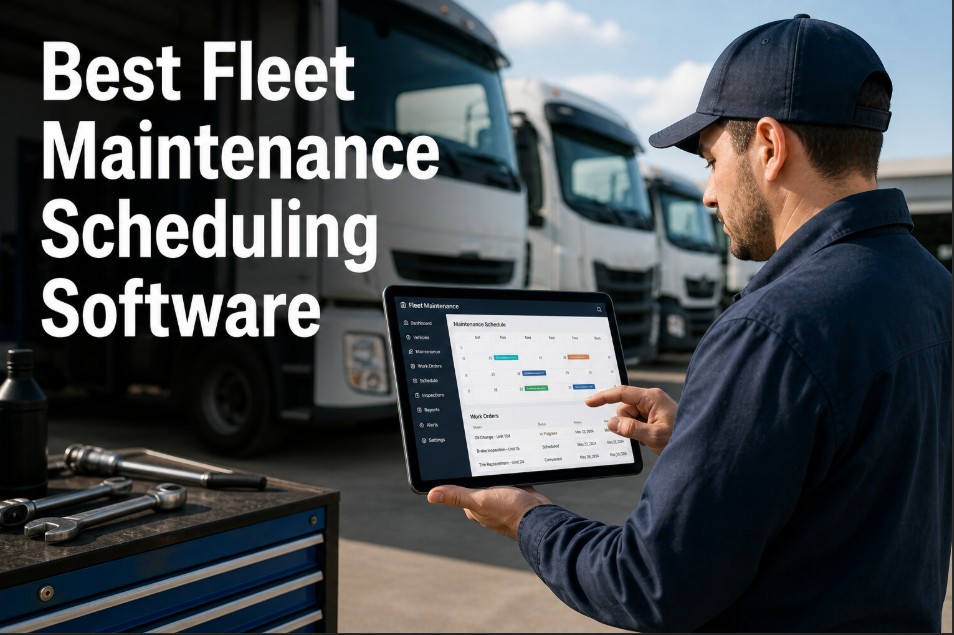
Fleet maintenance scheduling is no longer a calendar exercise. In 2026, it is a real-time, AI-driven operational function that determines whether your vehicles run profitably or bleed margin through preventable breakdowns. The global fleet maintenance management software market reached $847 million in 2025 and is projected to grow at 6.3% CAGR through 2034 — driven by fleet electrification, tightening emissions regulations, and the measurable gap between operators running automated schedules and those still managing PM intervals on spreadsheets. The stakes are direct: unplanned vehicle downtime now costs up to $2,000 per vehicle per day, emergency repairs cost 4–5x more than planned maintenance, and 65% of maintenance teams plan to deploy AI-driven scheduling by end of 2026 — yet only 27% have done it. That gap is where competitive advantage lives. This guide covers exactly what automated fleet maintenance scheduling delivers, why 2026 is the year to close the gap, and how Oxmaint's platform makes the transition measurable and fast. To explore how this applies to your fleet, sign up for Oxmaint or book a demo directly.
$847M
Fleet maintenance software market in 2025 — growing to $1.29B by 2034
$2,000
Cost per vehicle per day of unplanned downtime in 2026
65%
Of maintenance teams plan AI scheduling adoption by end of 2026
45%
Reduction in unplanned downtime achievable with AI-powered predictive maintenance
Stop Scheduling Maintenance on Spreadsheets. Start Automating It.
Oxmaint automates PM schedules, work orders, inspections, and compliance records across your entire fleet — from a single dashboard. Free to start. Live in days.
What It Is
What Fleet Maintenance Scheduling Software Actually Does
Fleet maintenance scheduling software is a digital platform that automates the creation, assignment, tracking, and closure of all preventive and corrective maintenance tasks across your vehicle fleet — replacing manual reminders, paper logs, and spreadsheet-based PM calendars with rule-based automation triggered by actual vehicle data.
Trigger-Based PM Scheduling
Maintenance tasks trigger automatically when a vehicle reaches a mileage threshold, engine hour count, calendar interval, or production cycle count — not when a manager remembers to check the spreadsheet. The system generates the work order, assigns the technician, and logs the service without manual intervention.
Automated Work Order Generation
When a PM trigger fires or an inspection flags a defect, the system automatically creates a work order, assigns it to the correct technician based on skill profile and availability, attaches the relevant service procedure, and notifies all stakeholders — eliminating the administrative gap where maintenance tasks exist as awareness but not as action.
Digital Inspection and Defect Management
Drivers complete pre-trip and post-trip inspections on mobile. Defects flagged during inspection immediately trigger maintenance work orders — closing the loop between field observation and workshop action without paper forms, delay, or manual re-entry. Inspection records are stored with timestamps and signatures for compliance.
Predictive Failure Analytics
AI-powered systems analyze telematics data, fault codes, historical repair patterns, and sensor readings to forecast component failures before they occur — scheduling proactive maintenance 7–30 days in advance of predicted failure windows. Predictive maintenance reduces unplanned downtime by up to 45% compared to calendar-only PM programs.
The Cost of Manual Scheduling
Eight Ways Manual Fleet Maintenance Scheduling Costs You Money
01
Missed PM Intervals
Manual calendar tracking misses PM windows when vehicles are deployed, managers are absent, or schedules shift. Missed oil changes, filter replacements, and brake checks compound into accelerated component wear and shortened vehicle lifespan.
02
Reactive Repair Culture
Without automated scheduling, teams default to fixing what breaks rather than preventing breaks. Emergency repairs cost 4–5x more than planned maintenance — every roadside breakdown is a PM failure that reached its natural conclusion without intervention.
03
Compliance Documentation Gaps
Manual systems produce fragmented inspection and service records — some in spreadsheets, some on paper, some in email threads. When a DOT audit, insurance claim, or safety incident requires complete service history, manual records routinely fail the documentation test.
04
Technician Productivity Loss
Technicians spending 20–30% of their shift searching for service history, finding the right parts, and manually logging repair details are not maintaining vehicles. Automated work order management with digital parts lookup and time logging recovers this productivity directly.
05
No Visibility Into Total Cost of Ownership
Manual tracking cannot produce cost-per-mile, cost-per-vehicle, or cost-per-repair-type breakdowns that inform replacement decisions. Without this data, vehicle replacement decisions are driven by age and intuition — not by total maintenance cost relative to residual value.
06
Parts and Inventory Waste
Without PM schedule visibility, parts ordering is reactive — purchasing what is needed right now at spot price rather than ordering anticipated parts at volume pricing weeks in advance. Automated scheduling creates a 30–60 day parts demand forecast that enables proactive procurement.
07
Fleet Downtime Exceeds Capacity
Uncoordinated PM scheduling produces clustering — multiple vehicles in the shop during the same week because PM intervals aligned without visibility. Automated scheduling staggers PM completions across the calendar to maintain available fleet capacity at all times.
08
Single-Person Dependency
Manual PM programs live in the maintenance manager's head and calendar. When they are absent or leave, the schedule breaks immediately. Automated systems codify all PM knowledge into rules that execute consistently regardless of who is managing the fleet on any given day.
Before vs. After
Fleet Maintenance Scheduling — Manual vs. Automated
Manual Scheduling
PM intervals tracked on spreadsheets — miss rate increases with fleet size
Work orders created manually — administrative burden grows with team size
Inspections on paper — defects reported hours or days after occurrence
Maintenance history in binders — unretievable during audits or incidents
Parts ordered reactively — emergency procurement at full spot price
No failure prediction — breakdowns arrive without warning
Vehicle replacement on intuition — no total cost of ownership data
Single-person dependency — program breaks when manager is absent
Automated Scheduling (Oxmaint)
Trigger-based PM auto-generation — mileage, hours, calendar, or cycles
Work orders created automatically — assigned, notified, tracked in real time
Mobile digital inspections — defects trigger work orders instantly
Complete searchable service history — retrievable in under 60 seconds
PM-driven parts demand forecast — 30–60 day advance procurement visibility
AI predictive analytics — failures forecast 7–30 days in advance
Cost-per-vehicle and cost-per-mile dashboards — data-driven replacement decisions
Rule-based automation — consistent execution regardless of who is on shift
Oxmaint Platform
How Oxmaint Automates Every Layer of Fleet Maintenance Scheduling
AI-Powered PM Scheduling
Set PM rules once — by mileage, engine hours, calendar intervals, or production cycles. Oxmaint auto-generates work orders, assigns technicians, and notifies stakeholders when triggers fire. No manual review cycle required.
Predictive Maintenance Analytics
Oxmaint analyzes telematics data, fault codes, and historical repair patterns to forecast component failures 7–30 days in advance. Predictive alerts auto-generate scheduled work orders — converting reactive breakdowns into planned repairs at 4–5x lower cost.
Digital DVIR and Mobile Inspections
Drivers complete pre-trip and post-trip inspection checklists on mobile. Defects are photo-documented and immediately trigger work orders. Inspection records are stored with timestamps, driver signatures, and GPS context — fully compliant with DOT and transport authority standards.
Work Order Management with Full History
Every work order captures technician ID, labor time, parts used, costs, photos, and resolution notes. Complete repair history per vehicle is searchable in seconds. Recurring failure patterns surface automatically — identifying vehicles that require corrective action before they become chronic cost drivers.
Total Cost of Ownership Dashboards
Cost-per-mile, cost-per-vehicle, cost-per-repair-type, and maintenance cost trend data are automatically calculated from work order history and parts usage. Replace intuition-based replacement decisions with data showing exactly when a vehicle crosses the economic replacement threshold.
Multi-Site Fleet Management
Manage maintenance schedules, inspection records, and work orders across every depot and location from a unified dashboard. Each site maintains its own schedules and technician assignments while sharing fleet-wide reporting for cross-site performance comparison and centralized CapEx planning.
Oxmaint Automates Your Fleet Maintenance Schedule From Day One. No IT Project. No Heavy Implementation.
Import your vehicle list, set your PM rules, and start generating automated work orders within hours. Free plan available. Full deployment in days — not months.
Measurable Results
What Automated Fleet Maintenance Scheduling Delivers — In Numbers
45%
Unplanned Downtime Reduction
AI-powered predictive maintenance reduces unplanned downtime by up to 45% vs. calendar-only PM programs. The shift from reactive to predictive is the single highest-ROI change in fleet maintenance operations.
4–5x
Planned vs. Emergency Repair Cost Ratio
Every emergency repair prevented by an automated PM schedule saves 4–5x the cost of the planned service that would have prevented it. For a 50-vehicle fleet, eliminating even 2 emergency repairs per month generates $8,000–$20,000 in annual savings.
30–90
Days to First Measurable ROI
Most fleets identify measurable savings within 30–90 days through reduced emergency repairs and lower admin hours. A typical 50-vehicle fleet saves $250+ per month from reduced downtime alone — breaking even in under 8 months on the platform cost.
65%
Maintenance Teams Adopting AI by End 2026
Only 27% have deployed predictive maintenance today while 65% plan to by end of 2026. The gap between early adopters and the majority is compounding — fleets that automate now capture competitive and compliance advantages that late movers cannot close quickly.
FAQ
Fleet Maintenance Scheduling Software — What Fleet Managers Ask First
What is fleet maintenance scheduling software and how is it different from a general fleet management platform?
Fleet maintenance scheduling software is specifically designed to automate the creation, assignment, and tracking of all maintenance tasks across a vehicle fleet — triggered by actual vehicle data (mileage, engine hours, fault codes, inspection results) rather than manual calendar reminders. A general fleet management platform typically prioritizes vehicle tracking, routing, and driver monitoring, with maintenance as a secondary module. Fleet maintenance scheduling software treats maintenance as the primary function — with PM rule configuration, work order management, technician assignment, parts tracking, and total cost of ownership analytics as core features rather than add-ons. Oxmaint is purpose-built for maintenance-first fleet operations.
Sign up free to explore the platform or
book a demo to see it running against your fleet's specific PM structure.
How does automated PM scheduling work — and what triggers does the software use to generate maintenance work orders?
Automated PM scheduling works by defining maintenance rules at the vehicle or vehicle-class level — specifying what service is required and what trigger should generate the work order. Oxmaint supports four trigger types that cover the full range of fleet PM requirements. Mileage triggers: a work order is generated when a vehicle's odometer reading reaches a defined service interval (e.g., every 5,000 miles for oil change). Engine hour triggers: critical for off-road equipment and vehicles where engine running time is a more accurate wear indicator than distance traveled. Calendar interval triggers: time-based PM that fires on a schedule regardless of utilization, used for fluid replacements, regulatory inspections, and certification renewals. Production cycle triggers: used for vehicles in manufacturing environments where component wear correlates to operational cycles rather than time or distance. Once configured, these rules run automatically — generating work orders, assigning them to technicians based on skill and availability, and notifying all stakeholders without requiring any manual review step.
Sign up free to configure PM rules for your fleet in minutes.
How quickly can a fleet deploy Oxmaint and start generating automated maintenance schedules?
Most fleets are generating automated PM work orders within their first week of Oxmaint deployment. The implementation process has three steps that each take hours, not weeks. Vehicle data import: upload your vehicle list with VINs, current odometer or engine hours, and vehicle type. Oxmaint automatically populates OEM service intervals for most vehicle models — eliminating manual PM schedule configuration for standard service types. PM rule configuration: review and adjust the auto-populated PM schedules for your specific operational requirements. Add any custom triggers or service types not covered by OEM defaults. Team onboarding: add technicians, configure their skill profiles and assignments, and complete the mobile app walkthrough. Drivers and technicians typically reach full productivity within 2–4 hours of first use. Because Oxmaint is cloud-based, there is no server installation, no IT infrastructure project, and no hardware procurement required.
Book a demo to see the deployment process step by step or
start your free account and import your fleet data directly.
Can Oxmaint integrate with our existing telematics hardware to receive odometer and engine hour data automatically?
Yes. Oxmaint connects with telematics data from any provider through open APIs and pre-built integrations — receiving odometer readings, engine hour counts, fault codes, and diagnostic data in real time. When telematics integration is active, PM triggers fire automatically based on live vehicle data without requiring manual odometer entry by drivers or dispatchers. This eliminates the administrative gap where PM schedules fall behind because vehicle usage data was never recorded. For fleets without existing telematics hardware, Oxmaint supports manual odometer and engine hour updates by drivers via the mobile app — which still enables trigger-based PM automation, just with manually-entered rather than automatically-received readings. IoT and SCADA integration for industrial and specialty vehicles is also supported for fleets managing equipment beyond conventional road vehicles.
Sign up free to explore integration options or
book a demo to discuss your specific telematics provider and data architecture.
What compliance documentation does Oxmaint generate automatically from fleet maintenance operations?
Oxmaint generates six categories of compliance-relevant documentation automatically from daily maintenance operations without any separate reporting step. Digital DVIR inspection records are stored with driver signature, timestamp, GPS context, and photo documentation for all flagged defects — meeting DOT pre-trip and post-trip inspection requirements. PM service records capture the work order, technician, parts used, labor time, and completion confirmation for every scheduled maintenance event — providing the continuous service history that vehicle compliance inspections require. Fault code and defect records document every OBD-II fault code, diagnostic finding, and inspection defect with the resolution work order linked — providing the corrective action chain that regulatory audits look for. Parts and cost records capture every part used, supplier, cost, and work order reference — enabling total cost of ownership reporting and supporting warranty claims. Technician certification records track which technician performed which work on which vehicle — creating the person-attributed audit trail that insurance and compliance inspections require. Regulatory inspection records capture DOT inspections, annual safety certifications, emissions testing, and any jurisdiction-specific compliance events with supporting documentation attached. All six categories are retrievable from Oxmaint's dashboard in under 60 seconds for any vehicle, any date range, any inspection type.
Book a demo to see the compliance documentation dashboard configured for your regulatory requirements.
What ROI should a fleet expect from automated maintenance scheduling — and how does Oxmaint calculate it?
The ROI of automated fleet maintenance scheduling comes from four independently measurable components. Emergency repair reduction: the most immediate ROI driver. Moving from reactive to scheduled maintenance eliminates 4–5x cost emergency repairs. A 50-vehicle fleet averaging two preventable emergency repairs per month at $1,500 average cost saves $36,000 annually from this component alone. Downtime cost recovery: unplanned downtime at $2,000 per vehicle per day means that preventing even 18 downtime days annually across a 50-vehicle fleet returns $36,000 — more than most annual platform costs. Administrative efficiency: automated work order generation, digital inspection processing, and automated compliance record generation typically recover 4–8 hours per week of fleet manager and administrative time currently spent on manual scheduling and documentation. At a loaded labor rate of $50–$80 per hour, this represents $10,000–$25,000 in annual efficiency value. Vehicle lifespan extension: consistent PM adherence through automated scheduling typically extends vehicle lifespan by 15–20% relative to reactive maintenance operations — delaying capital replacement costs by 1–2 years per vehicle in a fleet of any size. Most fleets break even on Oxmaint within 30–90 days.
Start your free account and begin capturing ROI immediately, or
book a demo for an ROI projection based on your fleet's specific vehicle count, repair history, and downtime frequency.
65% of Maintenance Teams Are Automating Fleet Scheduling by End of 2026. The Other 35% Will Pay the Reactive Maintenance Tax.
Oxmaint automates PM scheduling, work order management, digital inspections, predictive analytics, compliance records, and total cost of ownership reporting — in a single platform that deploys in days and starts delivering results in the first week. Free tier available. No IT project required.