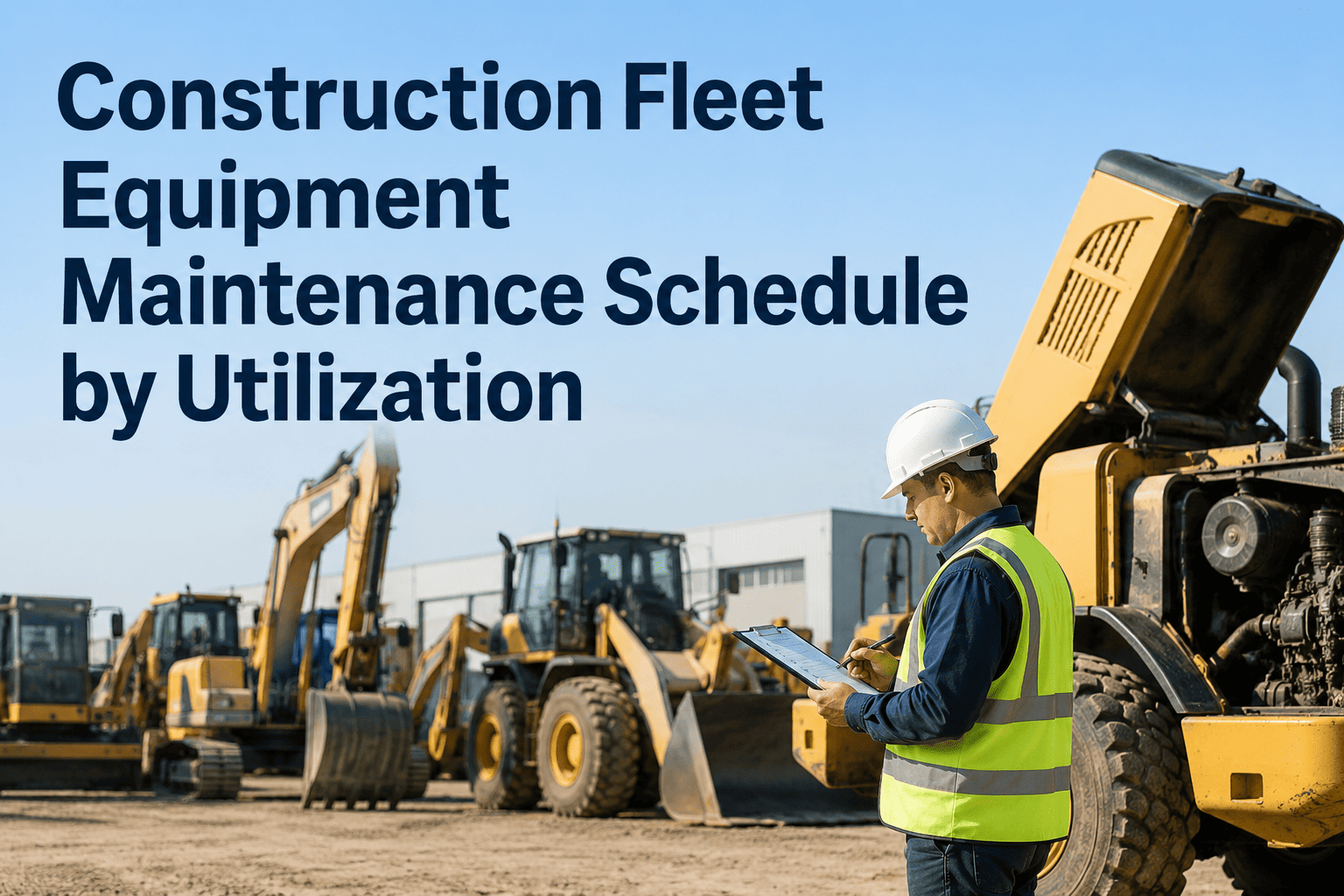
Managing a construction equipment fleet means tracking maintenance by hour-meters instead of odometers, coordinating PM schedules across constantly relocating job sites, and keeping mixed fleets — excavators, loaders, cranes, trucks — productive under harsh conditions. A modern construction fleet maintenance strategy combines preventive triggers on runtime hours, condition-based monitoring, and centralized work-order control to cut unplanned downtime 25–45% and extend asset life by thousands of operating hours. This 2026 construction equipment guide breaks down how maintenance and reliability teams are using AI-powered CMMS platforms like OxMaint to replace spreadsheets, automate PM scheduling, and protect multi-million-dollar assets — and you can Start Free Trial to see it on your own fleet today.
Construction Fleet Maintenance Guide 2026
Is hour-meter chaos quietly costing your fleet $1,200 per breakdown?
Mixed construction equipment fleets lose an average of 11 productive hours per unplanned failure. Between relocating job sites, tracking runtime across dozens of asset types, and chasing paper work orders, reactive maintenance drains margins fast. OxMaint replaces the chaos with automated, hour-based PM scheduling and real-time asset tracking.
Why Hour-Meter Maintenance Is Different
Construction equipment fleet maintenance runs on hours, not miles
Highway vehicles track wear via mileage; heavy machinery tracks it via engine hours — and that single difference breaks every generic fleet maintenance template.
Runtime-based wear curves
An excavator logging 2,000 hours/yr wears components 3–4× faster than the same machine at 600 hours. PM intervals must trigger on actual hour-meter readings — not calendar dates — or you risk catastrophic under-maintenance.
Job-site relocation gaps
When a loader moves from Site A to Site B, maintenance responsibility shifts too. Without centralized asset tracking, PMs get skipped, hours go unlogged, and warranties are voided. 38% of contractors admit losing track of PMs during moves.
Mixed OEM complexity
A single fleet may span Caterpillar, Komatsu, Volvo, and John Deere — each with different service intervals, parts catalogs, and telematics protocols. Managing that mix in spreadsheets is how PMs slip through the cracks.
The Real Cost of Reactive Maintenance
What unplanned downtime costs a 50-machine construction fleet
Reactive maintenance costs 3–5× more than planned work — and that is before you count schedule delay penalties, idle labor, and rental replacement costs.
Annual downtime cost formula
Unplanned Failures/Yr × Avg Repair Cost + Rental Replacement + Idle Labor Cost + Schedule Delay Penalty = Total Annual Downtime Exposure
| Cost Category | Reactive Fleet (Per Event) | Planned / OxMaint-Managed | Annual Savings (50 machines) |
|---|---|---|---|
| Avg repair cost (parts + labor) | $3,400 | $1,150 | $45,000 |
| Rental replacement (4 days @ $1,200/day) | $4,800 | $0 (scheduled during off-shift) | $72,000 |
| Idle crew labor (4 workers × 8 hrs) | $2,560 | $0 (reassigned to planned work) | $38,400 |
| Schedule delay penalty (contract clause) | $5,000 | $0 | $75,000 |
| Total per event / annual | $15,760 | $1,150 | $230,400 |
Worked example: A regional earthmoving contractor with 52 mixed assets tracked 31 unplanned failures in 2025 — averaging $15,760 per event in direct and indirect costs. After implementing hour-meter-based PM triggers and predictive alerts in OxMaint, projected unplanned events dropped to 11/year, saving an estimated $315,200 annually.
2026 Construction Fleet Guide
How to build a construction fleet maintenance plan for 2026
A defensible maintenance plan for mixed equipment fleets follows five sequential phases — from asset registration to predictive analytics. Skipping any phase leaves gaps that become six-figure breakdowns.
Register every asset with hour-meter baselines
Log make, model, serial number, current hour reading, OEM service intervals, and warranty end-date for each machine. OxMaint's asset registry stores this in one searchable record — eliminating the spreadsheet shuffle when equipment moves between sites.
Map PM triggers to hour-meter intervals
Set preventive maintenance triggers at 250, 500, 1,000, and 2,500-hour marks per OEM specs. OxMaint auto-generates work orders when telematics feeds or manual readings hit the threshold — no calendar guessing, no missed services.
Link spare-parts inventory to each PM template
Every PM work order should auto-pull required filters, fluids, and wear parts from inventory. When stock hits a reorder point, OxMaint flags procurement — preventing the "ready to service but no parts" stall that delays 22% of scheduled PMs.
Deploy mobile work orders for field technicians
Techs on remote job sites need mobile access to assignments, manuals, checklists, and parts catalogs. OxMaint's mobile app lets them close work orders, photo-document repairs, and log hour readings offline — syncing when connectivity returns.
Activate predictive alerts on critical failure modes
Once 60–90 days of work-order history accumulates, OxMaint's AI models identify patterns preceding failures — rising oil-consumption trends, recurring fault codes, shortening PM intervals — and issue predictive alerts before breakdowns happen.
Construction Maintenance Checklist
Essential PM checklist for mixed construction equipment
Use these tiered checklists as the baseline for every machine type in your fleet. OxMaint digitizes each item into a mobile-ready work order template.
Daily walkaround (operator)
- Fluid levels: engine oil, coolant, hydraulic, DEF
- Tire/track condition and pressure
- Walk-around for leaks, cracks, loose bolts
- Horn, lights, backup alarm, glass condition
- Seatbelt, ROPS/FOPS integrity, fire extinguisher
250-hour service (tech)
- Engine oil and filter change
- Fuel filter replacement
- Air filter inspection / restriction check
- Grease all zerk fittings per lubrication chart
- Battery, alternator, and charging-system test
1,000-hour service
- Hydraulic fluid and filter replacement
- Track tension / undercarriage inspection
- Brake system inspection and adjustment
- Coolant system flush and SCA test
- Diagnostic code scan and ECM health report
How OxMaint Helps
OxMaint turns hour-meter chaos into controlled, predictive maintenance
Spreadsheets and whiteboards cannot keep up with mixed fleets moving between job sites. OxMaint's AI-powered CMMS centralizes every asset, work order, and parts record — delivering measurable outcomes in the first 90 days.
Hour-meter-based PM automation
OxMaint reads telematics feeds and manual hour logs, then auto-generates work orders at exact OEM service intervals — eliminating calendar-based guessing and cutting missed PMs by up to 90%.
Outcome: 30–50% fewer unplanned breakdowns
Predictive failure alerts
AI models analyze work-order history, fault-code frequency, and fluid-analysis trends to flag assets likely to fail — giving you 5–15 days lead time to schedule repairs before they become breakdowns.
Outcome: 40% reduction in emergency repair spend
Mobile work orders for field crews
Technicians receive assignments, parts lists, and OEM manuals on their phones — even offline. Photo documentation and digital signatures replace paper, closing the loop in real time from any job site.
Outcome: 65% faster work-order turnaround
Parts inventory tied to PM templates
Every work order auto-reserves required parts. When stock drops below reorder points, OxMaint alerts procurement — so scheduled services never stall waiting on filters, fluids, or wear parts.
Outcome: 20% lower parts carrying cost
See OxMaint on your construction fleet — book a 30-minute demo
We'll import your asset list, map your PM intervals to hour-meter triggers, and show you exactly how much downtime and parts spend you can recover in year one.
FAQ — Construction Fleet Maintenance
Common questions about construction equipment fleet maintenance
How is construction equipment fleet maintenance different from vehicle fleet maintenance?
Construction equipment tracks wear via engine hour-meters rather than mileage, meaning PM intervals must trigger on runtime — not calendar dates. Job-site relocations, mixed OEM fleets, and harsh operating conditions add complexity that generic vehicle-fleet software cannot handle. OxMaint is built for hour-based scheduling, mixed-asset registries, and field-deployed mobile work orders.
What PM intervals should I use for heavy construction equipment?
Most OEMs specify service at 250, 500, 1,000, and 2,500-hour intervals — covering oil changes, filter replacements, hydraulic service, and major inspections. Always defer to the manufacturer's service manual for exact thresholds. OxMaint lets you configure custom interval templates per asset class and auto-generates work orders when hour readings hit the trigger.
How much can a CMMS save a construction fleet per year?
A 50-machine mixed fleet typically spends $230,000+ annually on unplanned downtime, rentals, and idle labor. By shifting to planned, hour-based PMs and predictive alerts, OxMaint customers cut unplanned events 30–50% and reduce emergency repair spend by roughly 40% — often recovering $100K–$300K in year one. Book a demo to see a modeled ROI on your fleet size.
Can OxMaint track equipment across multiple job sites?
Yes. Every asset record includes current location, assigned site, and transfer history. When equipment relocates, you update the site field — and all open PMs, warranties, and parts allocations follow the asset. Telematics integrations can auto-update hour-meter readings regardless of which job site the machine is operating from.
How long does it take to switch from spreadsheets to OxMaint?
Most construction fleets are fully operational in 2–4 weeks. You import your asset list via CSV, configure PM templates per equipment type, and invite technicians to the mobile app. OxMaint onboarding includes data migration support and hour-meter interval mapping — you can Start Free Trial today and begin registering assets immediately.
Stop losing hours to unplanned breakdowns — start your OxMaint trial today
Join the construction fleets using AI-powered maintenance to cut downtime, protect assets, and keep every job site on schedule.
Free 14-day trial · No credit card