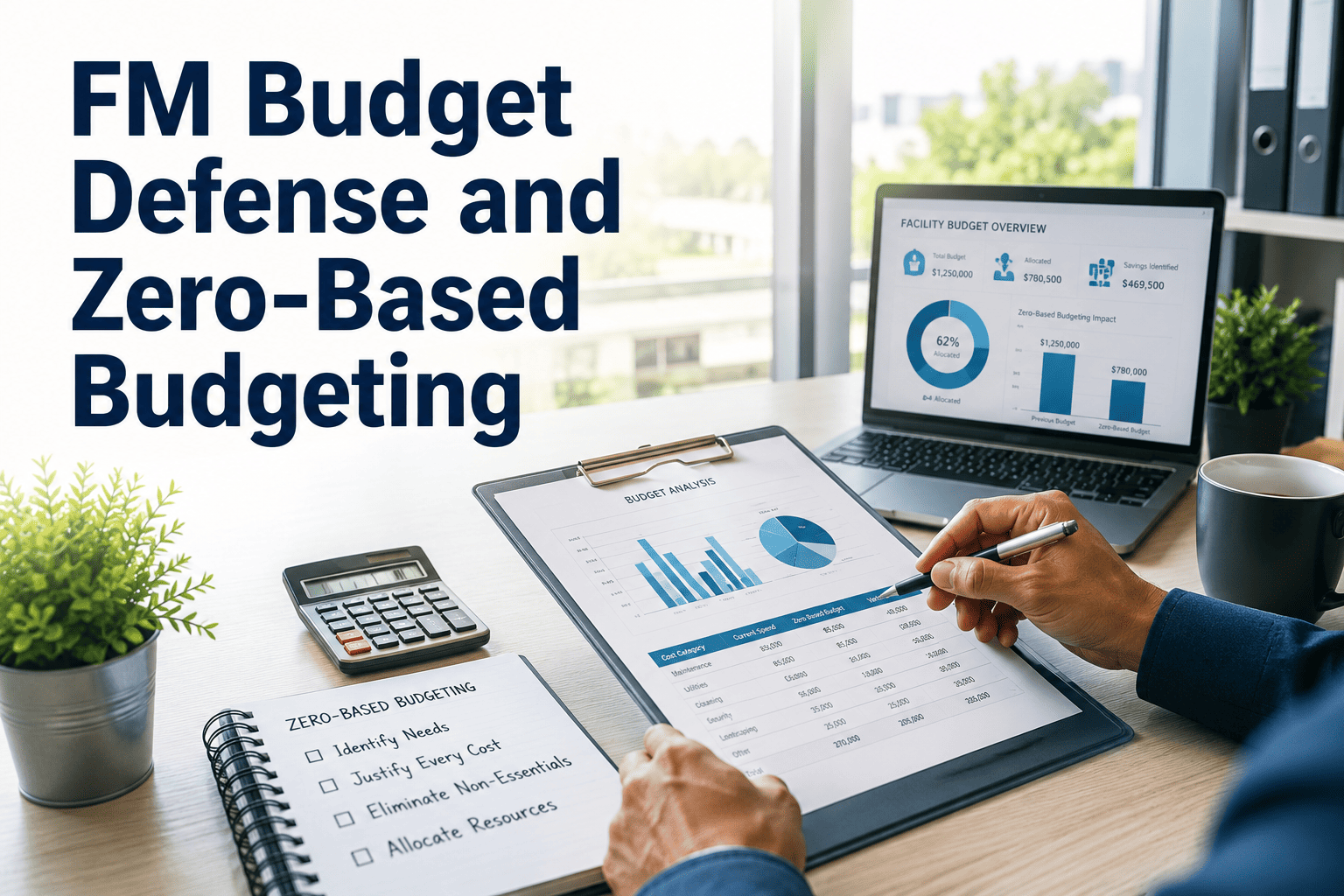
Facility budgets tend to be built by copying last year's number and adjusting for inflation. That keeps the process quick, but it also carries forward every habit, contract, and inefficiency that nobody has questioned. Zero-based budgeting asks a different question: what does each service cost to deliver, and what is it worth? Each activity must earn its funding from scratch. This guide explains how to apply the method to facility management, how to build and rank decision packages, a six-week rollout, and how Oxmaint maintenance software supplies the asset and cost data that makes the exercise credible.
FM Zero-Based Budgeting: Start From Scratch Every Year
Rebuild facility spend from zero, one service at a time, so every dollar has a reason. Find waste that last year's copy-and-paste budget hides.
Incremental budgeting versus zero-based budgeting
Both produce a budget. They differ in what they ask managers to defend.
Incremental approach
- Starts from last year's actual spend
- Defends only the increase
- Carries forward old contracts and routines
- Hides services that no longer add value
- Quick to prepare
- Rewards spending the whole budget to protect next year's number
Zero-based approach
- Starts from no authorized funds
- Defends every activity and its cost
- Questions contracts, frequencies, and standards
- Exposes services with weak justification
- Takes more time and management effort
- Rewards clear evidence and explicit trade-offs
Where facility spending hides
Not every cost line offers the same opportunity. Start with the categories where history, not need, usually sets the number.
| Cost layer | Typical question to ask from zero | Evidence to gather |
|---|---|---|
| Service contracts | Is each contract scope, frequency, and price still justified? | Contract terms, visit logs, and work performed against scope |
| Preventive maintenance | Which tasks protect safety, compliance, or critical equipment, and which are habit? | Task lists, failure history, manufacturer guidance, and regulatory requirements |
| Reactive repairs | What is the true cost of repeat failures, and what would prevent them? | Work order history by asset and failure cause |
| Utilities and energy | What load is needed, and what is wasted? | Meter data, schedules, and equipment runtime |
| Labor and overtime | Does staffing match the planned and reactive workload? | Hours by work type, overtime records, and backlog |
| Consumables and parts | What stock is needed, and what is obsolete or duplicated? | Usage history, stock levels, and reorder data |
| Capital replacement | Which assets should be replaced rather than repaired again? | Age, repair cost trend, and remaining life |
Decision units for facility management
A decision unit is the smallest piece for which a funding decision makes sense. Choose units that managers can explain and that match how work is actually done.
Building decision packages with three funding levels
Each decision package describes an activity and what different funding levels would buy. Presenting levels gives leaders a real choice instead of a single take-it-or-leave-it number.
What each package should contain
- Purpose: what the activity delivers and who depends on it.
- Scope: assets, buildings, and frequency covered.
- Cost: labor, parts, contractors, and overhead built up from unit costs.
- Alternatives: other ways to deliver the same result, such as a different frequency or provider.
- Consequence: what happens if the package is funded at a lower level.
- Measure: how you will know it delivered.
Ranking packages: criteria that keep it fair
Ranking forces trade-offs into the open. Agree the criteria before anyone sees the packages, so the scoring is about the framework and not the people.
| Criterion | Question | Example scoring cue |
|---|---|---|
| Safety and legal compliance | Is the activity required to keep people safe or meet legal obligations? | Required items rank above all others |
| Critical operations | Would failure stop a tenant, process, or revenue source? | Higher score for single points of failure |
| Asset condition and risk | Does the activity protect assets with high failure risk or cost? | Use condition scores and failure history |
| Cost-benefit | Does the benefit exceed the cost, including avoided failures and energy? | Use verified history where possible |
| Service level commitments | Does it support a contract or agreed service standard? | Check lease terms and service agreements |
| Deferral risk | Does postponing it create a larger cost later? | Flag items where deferral raises future cost |
Example decision package: HVAC preventive maintenance
The structure matters more than the figures. Fill the cost lines from your own records.
| Level | What it covers | Risk if chosen |
|---|---|---|
| Level 1: minimum | Inspections required by law or insurance, refrigerant and safety checks, and critical plant only | Higher failure rate on non-critical units and more reactive repairs |
| Level 2: current service | Today's task list at current frequencies across all units, each task confirmed as justified | Same exposure as today, with waste in low-value tasks removed |
| Level 3: enhanced | Level 2 plus condition monitoring on critical rotating equipment and seasonal tuning | Higher upfront cost, justified only if failure history and downtime costs support it |
Questions to challenge every line
- What would happen if we did this less often, or not at all?
- Is the frequency set by the manufacturer, a regulation, or habit?
- Could a different provider, method, or timing deliver the same result?
- Is this cost driven by repeat failures that a one-off fix would end?
- Who benefits from this activity, and have they confirmed its value?
- Does the activity overlap with another package or contract?
Contracts deserve their own pass
Service contracts often renew by default, so they hide more habit than almost any other line. Review them as separate decision packages.
- List every contract with its scope, price, term, renewal date, and the visits actually delivered.
- Compare contract scope against your asset register to find equipment that is covered but retired, or in use but not covered.
- Check whether visit frequency matches manufacturer guidance and regulation, not just the original template.
- Ask what in-house technicians could do at lower total cost, and what specialist providers do better.
- Set review dates before notice periods so you can renegotiate rather than renew automatically.
- Record performance, such as response times and repeat callbacks, to use in negotiation.
Build your budget from real asset and cost data
Pull work order history, asset records, and cost data into one place before you rebuild the budget.
A six-week zero-based budget rollout
This outline suits a portfolio that already has some work order history. Compress or extend it to fit your budget cycle.
Scope and baseline
- Agree the scope, cost categories, and the decision criteria.
- Extract last year's spend by category from financial and work order records.
- Name an owner for each cost layer.
Define decision units
- Choose the primary way to divide the portfolio.
- List every activity inside each unit, including contracts and routines.
- Confirm unit owners and brief them on the templates.
Write decision packages
- Owners build packages with three funding levels.
- Support each package with asset history and cost data.
- Collect alternatives, such as changed frequencies or providers.
Review and rank
- Hold review sessions to challenge assumptions and remove double counting.
- Score packages against the agreed criteria.
- Produce one ranked list across the portfolio.
Make funding decisions
- Fund from the top of the list until money runs out.
- Record the consequences of packages not funded.
- Agree what is deferred and when it will be reviewed.
Lock the budget and set tracking
- Convert approved packages into the operating budget.
- Set up monthly tracking against each package.
- Schedule a mid-year review of results.
Savings: what to expect, and what not to promise
Published estimates for zero-based programs vary widely, and most come from indirect costs and overhead rather than direct operations. Treat any percentage with care.
- One procurement-focused source suggests savings in the range of 10 to 25 percent are common, with indirect and overhead spend offering the most room.
- Facility management often sits inside indirect spend, so the method fits, but your result depends on how much habit is baked into your current budget.
- Savings come from specific decisions: contract scope, task frequency, duplicated services, and repeat failures that justify investment.
- Some packages will need more money, not less. Zero-based budgeting is about correct allocation as well as cuts.
Common zero-based budgeting traps in facilities
Most failures come from the process, not the idea.
- Managers pad packages to protect their budgetsRequire cost build-up from unit rates and test it in review.
- Cuts defer cost rather than remove itRecord the deferral risk for each package and review it mid-year.
- The effort overwhelms the teamStart with the highest-spend layers or use a modified version in year one.
- Nobody wants to propose a lower levelMake the minimum level a required part of every package.
- Data is thin, so numbers are guessesUse work order and asset history, and flag low-confidence figures.
- The result is forgotten after approvalTrack spend and outcomes by package every month.
How Oxmaint supplies the evidence
A zero-based budget is only as good as its evidence. Maintenance management software holds the cost and asset history that packages need.
Asset register
Know what you own, where it is, and what condition it is in before you budget to maintain it.Preventive maintenance schedules
List every recurring task and its frequency, so each can be justified or changed.Work order cost history
See labor, parts, and contractor cost by asset and failure type to show where repeat failures drain money.Planned versus reactive split
Measure how much work is planned, and use it to size packages and reserves.Inventory records
Identify slow-moving or duplicated stock and set reorder levels from real usage.Reports and dashboards
Track spend against each approved package through the year.Governance: who decides, and how it stays fair
A budget process fails quickly if people believe the ranking is political. Agree the rules in writing before work begins.
- Name a small review panel with facilities, finance, and operations, so no one owner ranks their own packages.
- Publish the criteria and weights before packages are written, and do not change them midway.
- Give every manager the same template, cost build-up rules, and deadline.
- Record why each package was funded, reduced, or declined, so the next cycle can learn from it.
- Allow an appeals step for packages where new evidence appears, with a clear cutoff date.
- Review actual results at mid-year and reallocate where packages are clearly over or under-used.
KPIs for tracking a zero-based budget
Measure both the money and the outcomes. A package that saves money and degrades service has not succeeded.
Spend versus package
Actual spend divided by approved funding, by package, each monthPlanned work share
Planned work orders divided by all work ordersRepeat failure cost
Cost of repeat repairs on the same asset and failure modeCompliance completion
Required inspections completed on time divided by inspections dueService level results
Response times and complaint volumes against agreed standardsDeferred items resolved
Deferred packages reviewed and decided on scheduleFM zero-based budgeting FAQs
How long does a zero-based FM budget take?
A six-week outline works for many portfolios, but data quality and portfolio size change it. Plan extra time the first year.
Does it mean cutting every budget?
No. Funding follows ranking, so some activities may receive more money and others less. The goal is to match spending to need.
What data do we need first?
Last year's spend by category, asset records, preventive maintenance task lists, and work order history. Book a demo to see how to pull these together.
Is it worth doing every year?
A full rebuild every year is heavy for many teams. Some do a full cycle periodically and a lighter review in between.
How does Oxmaint help?
It holds assets, schedules, work order costs, and inventory, so packages rest on records rather than memory. Create an account to begin.
Budget from evidence, not last year's number
Give your team one record of assets, schedules, and costs so every decision package can be defended.