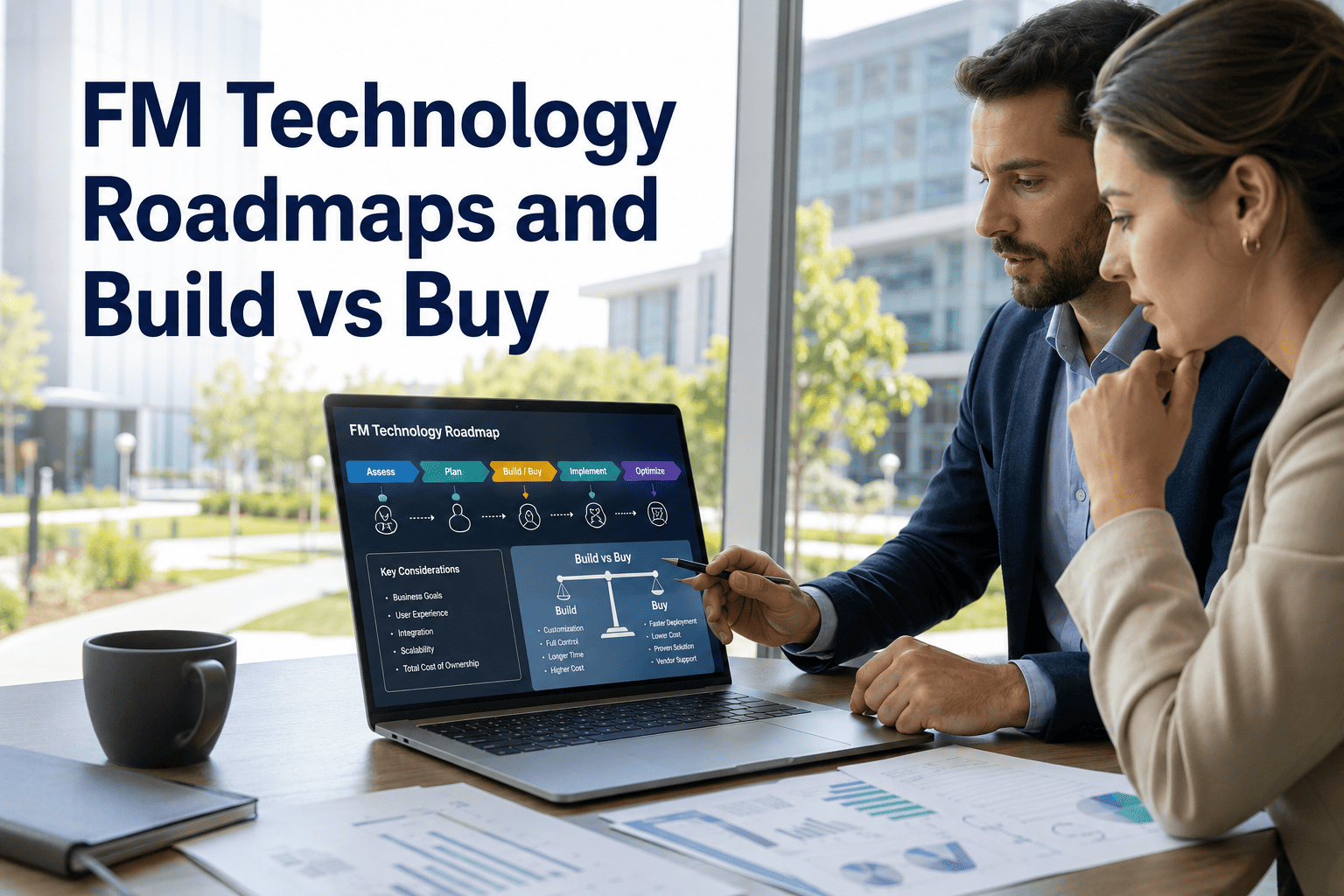
Every facility management team eventually faces the same crossroads in its FM technology roadmap: invest scarce engineering hours into building a bespoke maintenance platform, or buy a proven CMMS like OxMaint. The build-versus-buy decision for facility software hinges on total cost of ownership, speed to value, and whether your organization can sustain a custom software product long-term. Most teams that build their own system underestimate ongoing maintenance costs by 40 to 60 percent and spend 12 to 18 months before a single work order flows through the new tool. You can skip that risk entirely when you Start Free Trial and deploy a mature, AI-powered asset management platform in days, not quarters.
Is your FM technology roadmap building value — or building debt?
A custom FM system ties up 2–3 engineers for a year, costs $180K+ before launch, and still lacks predictive analytics. Buying a proven CMMS deploys in under 30 days and compounds ROI from week one.
Why the FM build-buy decision breaks internal teams
Roughly 70 percent of internally-built facility management tools are abandoned within three years — not because the code is bad, but because the original developer leaves and nobody can maintain it. The FM software decision to build almost always ignores the hidden cost curve of custom software ownership.
Consider a 180-asset manufacturing plant spending $42,000 annually on reactive repairs and spreadsheet-based scheduling. Their FM technology roadmap called for an internal build: two developers, a six-month timeline, and a $90,000 budget. Fourteen months later they had spent $165,000, the system handled work orders but not spare-parts inventory, and the lead developer had resigned. When they switched to OxMaint, deployment took 19 days, inventory tracking was live by week three, and unplanned downtime dropped 34 percent in the first quarter. The opportunity cost of those 14 months was roughly $51,000 in avoidable repairs — money the build-versus-buy analysis never captured.
The real cost of building facility software vs buying
A defensible FM build buy decision requires a 5-year total-cost-of-ownership model — not a 12-month build budget. Below is the framework reliability leaders use to compare the two paths side by side.
For a build, the risk multiplier averages 1.4× because scope creep, developer turnover, and integration gaps are near-certainties. For a proven SaaS CMMS, the multiplier is 1.0× — the price you see is the price you pay.
| Cost Category | Build In-House (5-Yr) | Buy OxMaint (5-Yr) | Difference |
|---|---|---|---|
| Initial development / onboarding | $150K – $250K | $0 (included) | Save $150K+ |
| Engineering FTE (2 devs) | $900K – $1.2M | $0 | Save $900K+ |
| Cloud infrastructure & security | $60K – $120K | $0 (included) | Save $60K+ |
| Feature gaps (predictive AI, mobile) | $200K+ to build | Included day one | Save $200K+ |
| Opportunity cost (delayed PM program) | $75K – $150K | $0 (live in 30 days) | Save $75K+ |
| 5-Year TCO Range | $1.38M – $1.97M | $54K – $96K | Save $1.3M+ |
How to build an FM technology roadmap that compounds value
A facility technology roadmap is not a shopping list — it is a sequenced plan that aligns maintenance capabilities with business outcomes. The most effective roadmaps follow five phases, each with a clear gate before the next begins.
Asset baseline & criticality ranking
Inventory every asset, assign criticality scores (A/B/C), and map failure modes. OxMaint's asset registry imports existing spreadsheets in minutes and auto-tags criticality by risk tier.
Digitize work orders & PM schedules
Replace paper and email with digital work orders. Build preventive maintenance triggers based on meter readings, calendar intervals, or condition data. OxMaint converts 1,000 paper work orders into structured digital records in under a day.
Spare-parts inventory & procurement
Link each asset to its bill of materials and min/max stock levels. OxMaint auto-generates replenishment alerts and ties parts consumption to work orders for real cost-per-asset visibility.
Analytics, KPIs & compliance reporting
Track MTBF, MTTR, OEE, and PM compliance on live dashboards. OxMaint's analytics module aligns with ISO 55000 asset management principles and exports audit-ready reports in one click.
Predictive maintenance & AI optimization
Feed IoT sensor data and historical work orders into OxMaint's AI engine to predict failures 7–21 days in advance, shifting from time-based PM to condition-based maintenance that cuts unnecessary PM labor by 20–30 percent.
Facility build vs buy: what teams get wrong
The build-versus-buy conversation is loaded with assumptions that do not survive contact with reality. Here are the four most dangerous myths — and what actually happens.
Building is cheaper because we already have developers on staff.
Developers spent on internal tooling are not shipping revenue features. The true cost is lost product velocity plus $900K+ in 5-year FTE spend — versus $54K for OxMaint.
Our requirements are too unique for off-the-shelf FM software.
90 percent of FM requirements — work orders, PM scheduling, asset hierarchies, parts tracking, mobile access, reporting — are universal. OxMaint configures to your workflows without custom code.
A custom system gives us full control over features and roadmap.
Control means you own every bug, every security patch, every OS update, and every integration. OxMaint ships continuous updates — predictive AI, mobile enhancements, new analytics — at no extra cost.
Switching from spreadsheets to any system will take months.
OxMaint onboarding averages 19 days. Asset imports, PM templates, and user provisioning are handled by our team. Your technicians are closing digital work orders in week one.
Why OxMaint is the clear buy decision for your FM tech strategy
OxMaint replaces the 18-month build cycle with a deployment measured in days. Here is how four core capabilities map directly to the gaps that derail in-house FM system roadmaps.
AI-Powered Work Orders
Auto-prioritize, auto-assign, and auto-close work orders based on asset criticality and technician availability. Eliminates the manual dispatch bottleneck that custom builds never solve.
Cuts work-order resolution time by 35–50%Predictive Maintenance Engine
Machine-learning models analyze vibration, temperature, and historical failure data to flag degrading assets 7–21 days before breakdown — a capability that costs $200K+ to build from scratch.
Reduces unplanned downtime 30–50%Spare-Parts Inventory Sync
Real-time stock levels tied to every work order. Auto-reorder at min/max thresholds. No more “part not in stock” delays that extend downtime by days.
Cuts parts stockouts by 60–80%Live Maintenance Analytics
Dashboards for MTBF, MTTR, OEE, PM compliance, and cost-per-asset — aligned to ISO 55000 and TPM standards. Audit-ready reports in one click, no SQL required.
Improves PM compliance to 95%+Stop building software. Start maintaining assets.
See OxMaint on your assets — book a 30-minute demo and walk through your FM technology roadmap with a reliability expert.
FM technology roadmap and build-vs-buy: your questions answered
When does it make sense to build rather than buy FM software?
Building only makes sense if you are a software company with a dedicated product team, your FM workflows are truly unique (under 10 percent overlap with standard CMMS features), and you can commit $1M+ over five years. For 95 percent of maintenance and reliability teams, buying OxMaint delivers the same capabilities in 19 days at a fraction of the cost. You can explore the platform yourself — Start Free Trial with no credit card.
How long does it take to deploy OxMaint vs building internally?
OxMaint deployments average 19 days from sign-up to your first live digital work order. Asset imports, PM templates, user provisioning, and mobile setup are handled by our onboarding team. A comparable internal build typically takes 12 to 18 months before reaching feature parity — and that assumes no developer turnover.
What is the typical ROI of switching from spreadsheets to a CMMS?
Teams switching from spreadsheets or reactive maintenance to OxMaint typically see a 25 to 40 percent reduction in unplanned downtime, a 20 to 30 percent cut in unnecessary PM labor, and 60 to 80 percent fewer parts stockouts in the first year. Most customers recover their annual subscription cost within 90 days through avoided repairs and recovered production time.
Can OxMaint integrate with our existing ERP, IoT sensors, and accounting tools?
Yes. OxMaint supports REST APIs, webhook events, and pre-built connectors for common ERP systems (SAP, Oracle, NetSuite), IoT platforms (vibration and temperature sensors), and accounting software. Integrations that would take 3 to 6 months to build internally are configured in days. Book a demo to see your specific integration scenario — Book a Demo.
How does OxMaint support ISO 55000 and compliance audit readiness?
OxMaint's asset hierarchy, criticality scoring, lifecycle tracking, and maintenance history modules align with ISO 55000 asset management principles. Every work order, PM completion, parts transaction, and inspection result is timestamped and audit-logged. Compliance reports for OSHA, FMCSA, and internal audits export in one click — eliminating the weeks of manual data compilation that spreadsheet-based teams endure.
Your FM technology roadmap starts here
Deploy OxMaint in under 30 days. Cut unplanned downtime 30–50%. Stop building software and start compounding maintenance ROI.
Free 14-day trial · No credit card