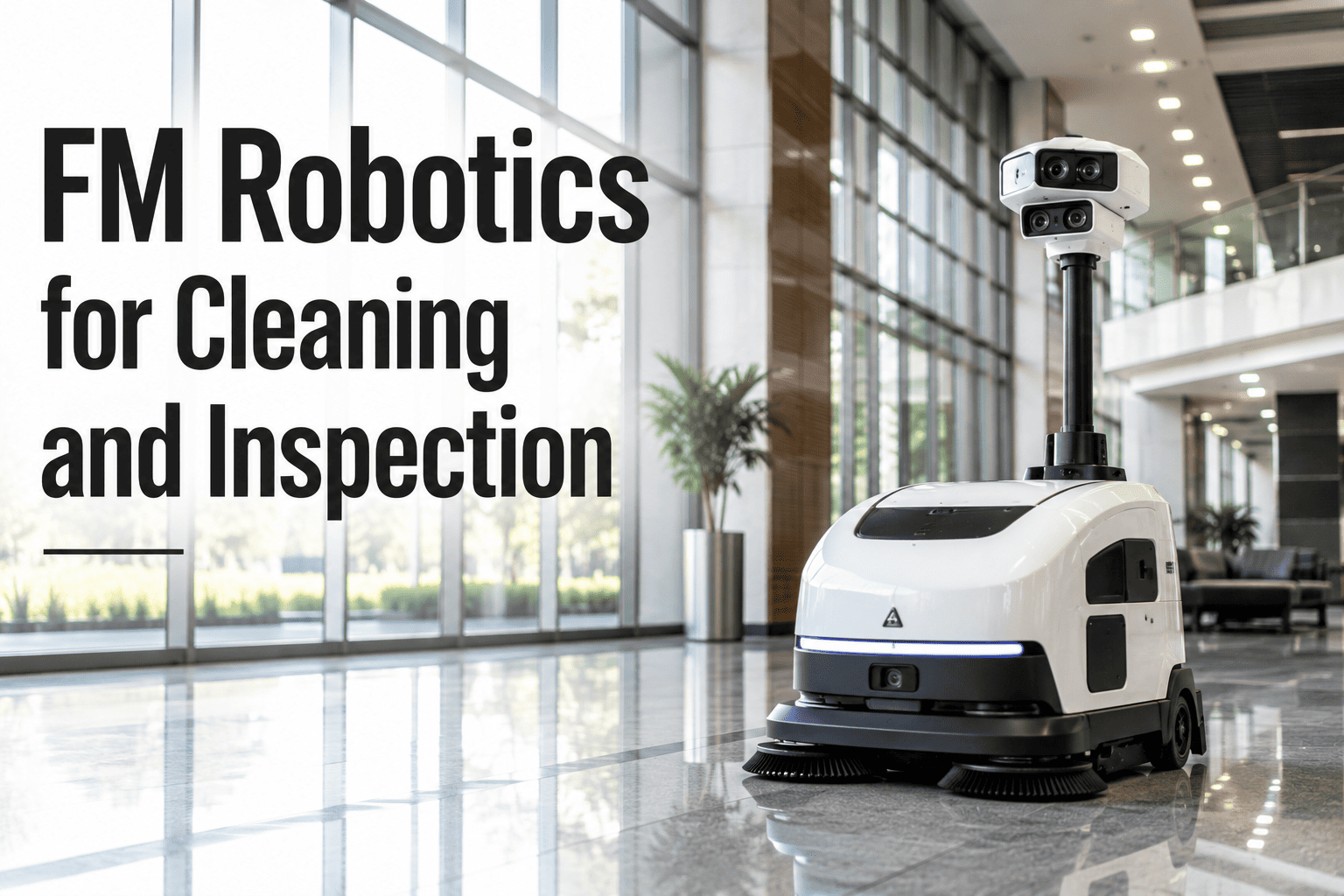
FM robotics for autonomous cleaning and inspection have shifted from conference demos to production floors, with over 35% of large facilities now operating at least one autonomous unit in daily service. Autonomous cleaning robots in facility environments tackle the repetitive, high-frequency tasks that drive labor turnover, while facility inspection robots capture continuous condition data that human rounds simply miss. The teams that win with robotics facility management are not those buying the most hardware — they are the ones integrating FM autonomous robots into a centralized maintenance platform. This guide breaks down use-case selection, deployment strategy, and how OxMaint connects facility automation robots into a single, audit-ready system. Ready to bring your robotic fleet under control? Start Free Trial.
Robotics Facility Management
Autonomous cleaning and inspection robots are now production-ready — is your CMMS ready to integrate them?
Strategic FM robotics adoption moves facility automation from novelty to scaled operational reality. OxMaint connects your autonomous facility robots to work orders, asset tracking, and predictive maintenance — so robot-generated data triggers real action, not just dashboards.
Where Autonomous Cleaning Robots Deliver Real ROI
Which FM cleaning robot use cases actually pay off?
Not every facility task belongs on a robot. The use cases that deliver measurable payback share three traits: high frequency, predictable pathing, and low exception-handling. A 250,000 sq ft logistics facility spending $148,000 annually on night-shift floor care can cut that line item by 45–60% with a fleet of two autonomous cleaning robots — but only if the FM software schedules, tracks, and documents every cycle automatically.
Large-Format Floor Care
45–60%
Reduction in cleaning labor cost
Autonomous scrubbers cover 20,000–40,000 sq ft per charge with consistent chemical dosing. OxMaint auto-generates preventive work orders based on runtime hours, so filter changes and squeegee replacements never slip.
Routine Visual Inspection
3×
Inspection frequency vs. manual rounds
Facility inspection robots with thermal and visual sensors detect steam leaks, hot spots, and anomalies during patrol. OxMaint ingests anomaly flags and instantly opens a prioritized corrective work order.
High-Ceiling & Confined Space
70%
Drop in rope-access inspection spend
Crawling and drone inspection units eliminate scaffolding for ductwork, tank exteriors, and roof assets. OxMaint attaches inspection media directly to the asset history record for full audit traceability.
Deployment Strategy
How to deploy FM autonomous robots without stalling
Most facility robotics adoption efforts fail at month four — not because the hardware underperforms, but because the robot operates in isolation from the maintenance ecosystem. A structured deployment timeline prevents the pilot-to-production gap that stalls 60% of robotics FM operations initiatives.
Map tasks to robotic suitability
Score every recurring FM task on frequency, path predictability, and exception rate. Select the top 2–3 tasks for the initial deployment. OxMaint's asset registry surfaces the highest-cost, highest-frequency tasks instantly from your work order history.
Evaluate robot platforms and integration
Shortlist platforms with open APIs that push telemetry, cycle counts, and anomaly alerts to your CMMS. Robots that only log to a proprietary silo deliver half the value. OxMaint's API accepts webhook alerts from any autonomous cleaning or inspection unit.
Run a controlled 30-day pilot
Deploy 1–2 units on a single use case. Baseline labor hours, chemical consumption, and inspection coverage before the pilot. OxMaint tracks baseline vs. pilot performance with side-by-side analytics dashboards.
Expand to full fleet integration
Scale the successful pilot across shifts and zones. OxMaint auto-schedules preventive maintenance for the robot fleet itself — battery cycles, brush replacements, sensor calibrations — so your autonomous facility robots stay online, not in the shop.
Robotics FM Operations Payback
What is the payback period for facility automation robots?
A single robotic cleaning unit in a facility environment typically costs $28,000–$55,000 depending on payload and navigation sophistication. Against a fully-loaded night-shift labor rate of $32/hr with benefits, the payback math is straightforward — and compelling when the robot runs 2.5 shifts per day instead of one.
Annual Payback Formula
(Labor Hours Saved × Loaded Rate) + (Inspection Coverage Gained × Avoided Downtime) − (Robot Lease + Maintenance)
Example: A 180,000 sq ft distribution center saves 4,200 labor hours/yr ($134,400), avoids $22,000 in undetected equipment failures, and spends $31,200 on robot lease + preventive maintenance. Net annual benefit: $125,200 — a 9–14 month payback on a $42K unit.
| Cost / Savings Line | Manual Operation | Robotic Operation | Annual Delta |
|---|---|---|---|
| Floor-care labor (3 shifts) | $148,000 | $59,000 | +$89,000 |
| Inspection rounds labor | $62,000 | $28,000 | +$34,000 |
| Chemical & consumables | $18,500 | $11,200 | +$7,300 |
| Robot lease & PM | $0 | −$31,200 | −$31,200 |
| Avoided unplanned downtime | $0 | $22,000 | +$22,000 |
| Net Annual Benefit | — | — | +$121,100 |
Cost of Inaction
What happens when you leave robot data in a silo?
The most expensive mistake in facility robotics adoption is buying the hardware but leaving it disconnected from your maintenance system. Robots generate thousands of telemetry points and anomaly alerts per shift — but if those signals die in a vendor portal, no corrective action follows. A facilities team running 4 autonomous units without CMMS integration typically loses 60–80% of the inspection value because anomalies are detected but never converted into work orders.
Siloed Robot Portal
- Anomaly alerts sit in a separate dashboard, checked manually
- No automatic work order creation from robot findings
- Robot maintenance tracked on a clipboard or spreadsheet
- No asset-level history linking inspections to equipment
- Audit trail fragmented across 3+ systems
OxMaint-Integrated Fleet
- Every robot anomaly auto-opens a prioritized corrective work order
- Inspection media attaches directly to the asset record
- Robot PM scheduled automatically by runtime hours and cycles
- Full asset history: human + robot inspections in one timeline
- Single audit-ready trail for ISO 55000 and internal compliance
How OxMaint Helps
How OxMaint connects FM robotics to real maintenance outcomes
OxMaint is the integration layer that turns autonomous facility robots from expensive sensors into actionable maintenance engines. When a cleaning robot detects a floor anomaly or an inspection unit flags a thermal hotspot, OxMaint converts that signal into a routed, prioritized, trackable work order — automatically. No swivel-chair data entry, no missed alerts.
Auto-Generated Work Orders
Robot telemetry and anomaly alerts trigger instant corrective work orders — routed to the right technician with priority, location, and context pre-filled. Eliminates the 24–48 hr lag between detection and action typical of siloed portals.
Asset-Level Inspection History
Every robot patrol, thermal scan, and visual inspection attaches to the specific asset's history record. Compliance auditors see one unified timeline — human rounds and robotic coverage side by side — cutting audit prep from days to hours.
Predictive Maintenance Engine
OxMaint's AI analyzes robot-collected condition data alongside work order history to predict equipment failures 2–6 weeks in advance. Teams shift from reactive firefighting to planned interventions — cutting unplanned downtime 30–50%.
Robot Fleet PM Scheduling
Autonomous units need maintenance too. OxMaint tracks battery cycles, brush hours, and sensor calibrations per robot — auto-scheduling preventive work orders so your fleet stays above 95% uptime instead of sitting idle in the shop.
We deployed 6 cleaning robots across a 400,000 sq ft fulfillment center, but the real ROI came when we connected them to OxMaint. Robot-detected anomalies now auto-generate work orders — our mean time to repair dropped from 52 hours to under 9. The robots became part of the maintenance team, not just janitorial equipment.
See how OxMaint turns your robot fleet into a maintenance engine
Book a 30-minute demo and we'll show you exactly how autonomous cleaning and inspection robots integrate with OxMaint work orders, asset tracking, and predictive analytics — on your assets, in your facility.
Facility Robotics Adoption FAQ
Common questions about FM robotics for cleaning and inspection
What tasks should we automate first with FM cleaning robots?
Start with large-format floor care in open, predictable paths — warehouses, distribution centers, hospital corridors, and retail aisles. These tasks are high-frequency, low-exception, and carry the heaviest labor cost. A robotic cleaning facility deployment typically targets 20,000+ sq ft zones with consistent obstacle layouts, delivering 45–60% labor reduction in the first 90 days. OxMaint's work order history instantly identifies your highest-cost, highest-frequency tasks.
How do autonomous facility robots connect to a CMMS?
Most commercial robot platforms expose a REST API or webhook that pushes telemetry, cycle completion, and anomaly alerts to external systems. OxMaint accepts these webhooks and converts them into work orders, asset history entries, and PM triggers automatically. Integration typically takes 2–5 days per robot platform. You can Book a Demo to see a live robot-to-work-order integration in action.
What is the typical payback period for facility inspection robots?
Facility inspection robots generally achieve payback in 9–18 months, depending on inspection frequency, asset criticality, and avoided downtime value. The fastest payback comes from replacing rope-access and scaffolding-based inspections of high-ceiling or confined-space assets, where a single inspection event can cost $8,000–$15,000. Continuous robotic inspection also catches developing failures 2–6 weeks earlier than monthly human rounds.
Do autonomous cleaning robots replace janitorial staff entirely?
No — they replace the repetitive 60–70% of floor-care labor, not the detail and exception-handling work. Most facilities redeploy 1–2 staff members per shift from driving scrubbers to managing the robot fleet, handling restrooms, spill response, and edge cleaning. The net effect is higher coverage per headcount, not headcount elimination. OxMaint tracks both human and robotic task completion in one dashboard.
How does OxMaint handle robot maintenance itself?
OxMaint treats each robot as a tracked asset with its own preventive maintenance schedule — battery cycle counts, brush/mop replacement intervals, filter changes, sensor calibration, and firmware updates. When a robot logs runtime hours via API, OxMaint auto-generates the next PM work order before the component fails, keeping fleet uptime above 95%. Spare parts for the robot fleet are managed in the same inventory module as your facility equipment.
Ready to make your robot fleet work for maintenance — not just cleaning?
Join the facilities teams using OxMaint to turn autonomous cleaning and inspection robots into a predictive, audit-ready maintenance engine. See it on your assets in 30 minutes.
Free 14-day trial · No credit card


