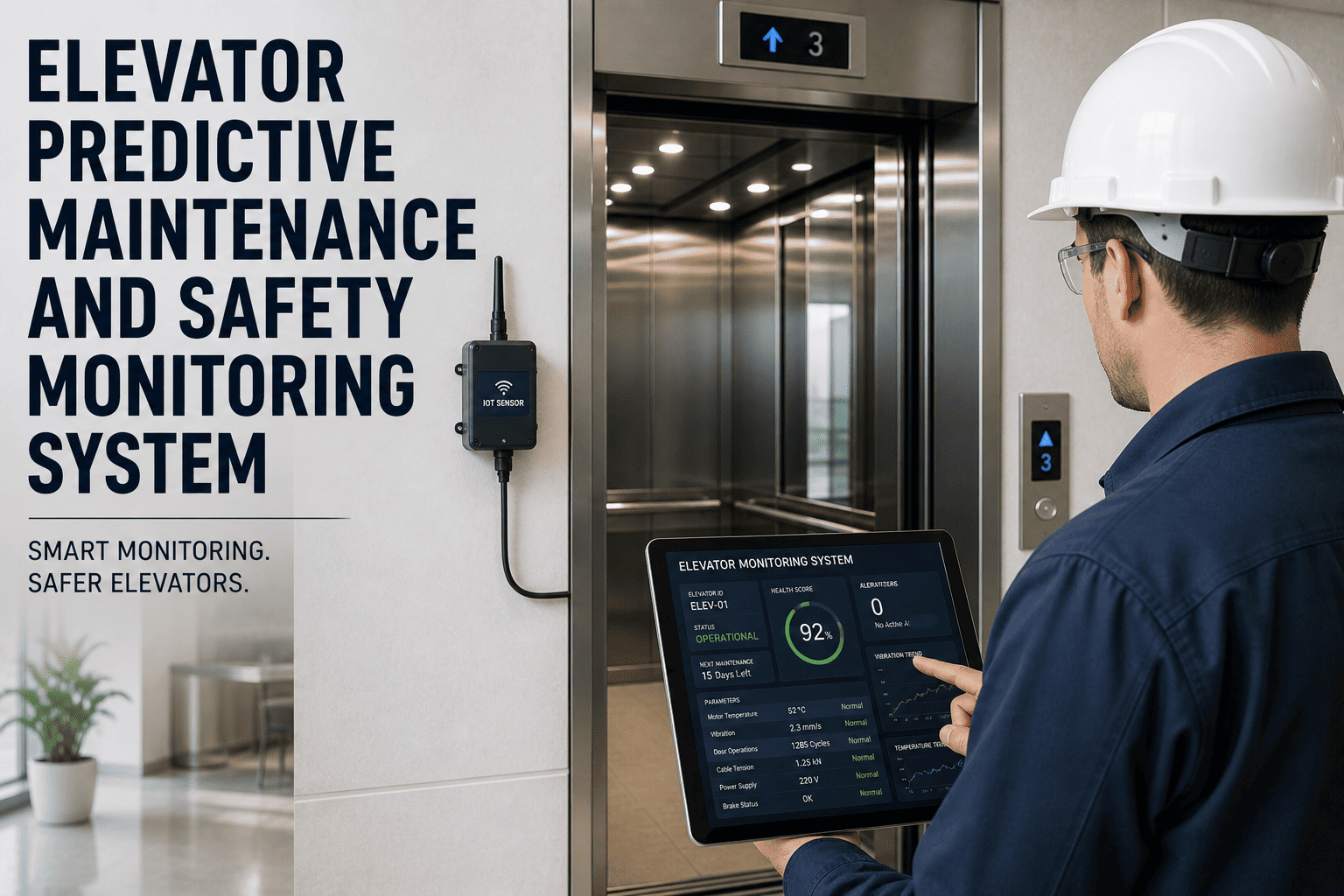
A single elevator outage in a high-rise office building or hospital affects hundreds of people and can trigger safety investigations, tenant complaints, and regulatory penalties. Yet most building managers still rely on reactive repair calls and paper-based inspection logs that miss the early warning signs. OxMaint's Predictive Maintenance AI continuously monitors elevator motor trends, door cycles, vibration, and ride quality — detecting anomalies weeks before they become breakdowns. This article explains how facility teams can move from reactive lift maintenance to a fully predictive programme.
Article · Vertical Transportation · Predictive Maintenance AI
Elevator Predictive Maintenance & Safety Monitoring System
How facility managers reduce elevator downtime by 78% using AI-powered anomaly detection, ride quality monitoring, and automated compliance tracking
3.4x
Longer Component Life
94%
Fault Detection Accuracy
60 days
Avg. Failure Prediction Lead
Why Elevator Failures Are Predictable — But Still Missed
01
Door System Wear
Door operators account for 48% of all elevator service calls. Worn door gibs, misaligned cams, and failing door motors degrade gradually — vibration data shows this trend weeks before the door jams and traps a passenger.
02
Traction Motor Degradation
Motor bearing wear produces a distinct frequency signature in vibration data long before audible noise appears. Catching this at 3 months before failure vs. reacting after breakdown saves ₹4–8 Lakhs in emergency replacement cost.
03
Rope Tension Imbalance
Unequal hoist rope tension causes cab vibration, uneven wear on sheave grooves, and eventually bouncing at floor level. Ride quality sensors detect this before it becomes a comfort complaint or safety flag.
04
Compliance Gaps
Elevator inspection certificates, statutory load tests, and government authority renewals have strict deadlines. Missed compliance creates legal liability — especially in buildings serving the public, healthcare, or elderly residents.
Live Monitoring Feed — Building Elevator Fleet
Simulated real-time events from a 12-elevator commercial building using OxMaint AI
Lift 04 — Door Motor Current Spike
Current draw 2.3x baseline on door close cycle — bearing wear pattern detected by AI model
Lift 07 — Vibration Anomaly Floor 14–18
Cab vibration 0.18 g — rope tension imbalance signature, probability of fault: 61% within 45 days
WO #EL-3341 Auto-Created — Lift 04
Door motor inspection assigned to Vertical Transport Team — scheduled next business day window
Lift 02 — Monthly Inspection Complete
All 22 checklist items passed — inspection certificate auto-generated and filed to compliance dashboard
See OxMaint predict your next elevator fault — before it happens
Live demo using your building's elevator configuration
Predictive vs. Reactive — Performance Comparison
| Metric |
Reactive Maintenance |
OxMaint Predictive AI |
Improvement |
| Annual Elevator Downtime |
42 hrs/lift/year |
9 hrs/lift/year |
78% less |
| Emergency Repair Calls |
8–12 per lift/year |
1–2 per lift/year |
83% reduction |
| Door System Failures |
Detected after passenger trap |
Detected 3–8 weeks before |
100% proactive |
| Compliance Certificate Lag |
Manual tracking — often late |
Auto-alerts 30 days before due |
Zero missed renewals |
| Maintenance Cost / Lift / Year |
₹3.8 Lakhs |
₹1.4 Lakhs |
63% savings |
Downtime Reduction — Before vs. After OxMaint AI
Average annual downtime hours per elevator unit
Without Predictive Monitoring
Reactive Only
Scheduled PM
OxMaint AI
OxMaint Elevator Monitoring — Key Capabilities
94%
Fault Detection Accuracy
AI model trained on vibration, current, and ride quality data from 15,000+ elevator units
60d
Average Failure Lead Time
Average 60-day advance warning before component failure — enough time for planned replacement
100%
Compliance Coverage
Auto-tracks all inspection due dates, test logs, and statutory certificates for every lift in your fleet
Auto
Work Order Creation
Fault detection triggers immediate CMMS work orders — assigned, scheduled, and tracked automatically
Expert Review
MK
Manoj Kulkarni
Vertical Transportation Specialist — 17 years, Commercial Real Estate & Hospital Facilities
"Elevator maintenance in most commercial buildings is still on a 3-month visit contract — which means you're paying for presence, not prediction. The real value of IoT-based predictive monitoring is catching door motor degradation, bearing wear, and rope tension issues before they create passenger incidents. In hospitals and senior living facilities, an elevator outage is a medical emergency. OxMaint changes the equation — you're not waiting for something to break, you're acting on data 60 days before it does."
78% downtime reduction documented
ROI within 90 days for 10+ lift buildings
Zero missed compliance renewals reported
Frequently Asked Questions
What sensors does OxMaint use to monitor elevators?
OxMaint integrates accelerometers (vibration and ride quality), current transformers on door motors and traction motors, temperature sensors on drive cabinets, and door cycle counters. These sensors connect to the OxMaint IoT gateway which transmits data continuously to the cloud AI engine. For most modern elevators, integration can be completed in a single day without disrupting building operations. Visit
app.oxmaint.ai for the full hardware integration guide.
How far in advance can OxMaint predict an elevator fault?
OxMaint's predictive models provide an average lead time of 60 days before component failure — giving facilities teams enough time to order parts, schedule a planned outage window, and complete maintenance with zero passenger disruption. For high-wear components like door motors and hoist ropes, AI models detect degradation patterns as early as 90 days before failure threshold. The system continuously refines its predictions as it learns your building's specific elevator behaviour.
Book a demo to see predictive accuracy on a live elevator fleet.
Can OxMaint handle elevator compliance and statutory inspection tracking?
Yes — OxMaint's compliance tracking module manages all elevator inspection due dates, government authority renewal dates, load test schedules, and insurance inspection requirements. The system sends automated alerts to facility managers 30 and 7 days before each deadline, logs completed inspection results, and generates compliance certificates. All records are stored digitally for instant retrieval during authority inspections or insurance renewals — eliminating the risk of fines from missed statutory deadlines.
Is OxMaint suitable for small buildings with only 2–4 elevators?
OxMaint is designed to scale from single assets to large multi-site portfolios. For smaller buildings with 2–4 elevators, the platform provides the same predictive monitoring, PM scheduling, and compliance tracking — often at a cost lower than one emergency service call per year. Many smaller commercial building owners find the compliance automation alone justifies the investment, as missed statutory renewals carry penalties far exceeding the platform cost. Sign up at
app.oxmaint.ai to explore plans.
78%
Less elevator downtime — with OxMaint Predictive Maintenance AI
Start monitoring your building's elevators today. Results within 30 days.