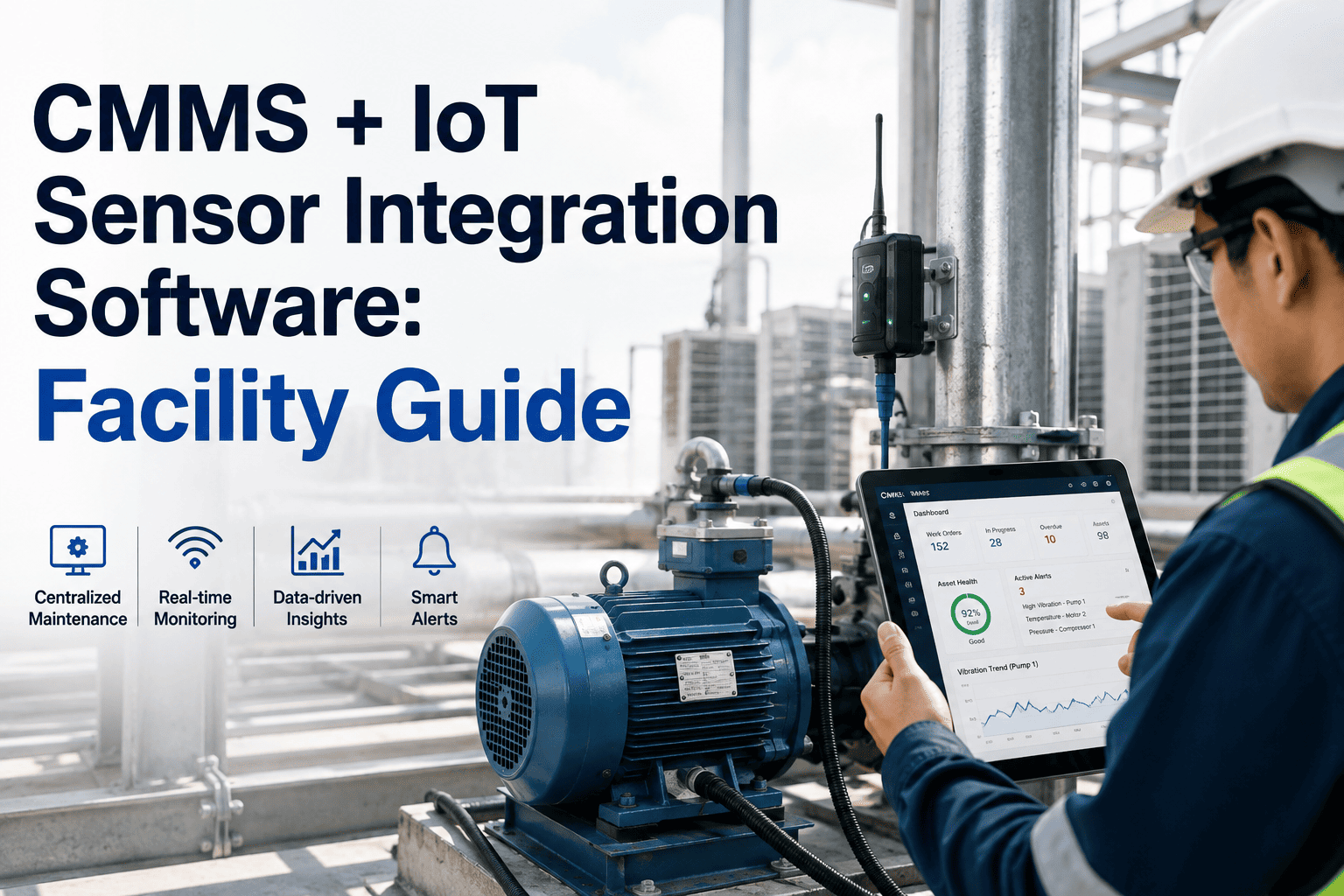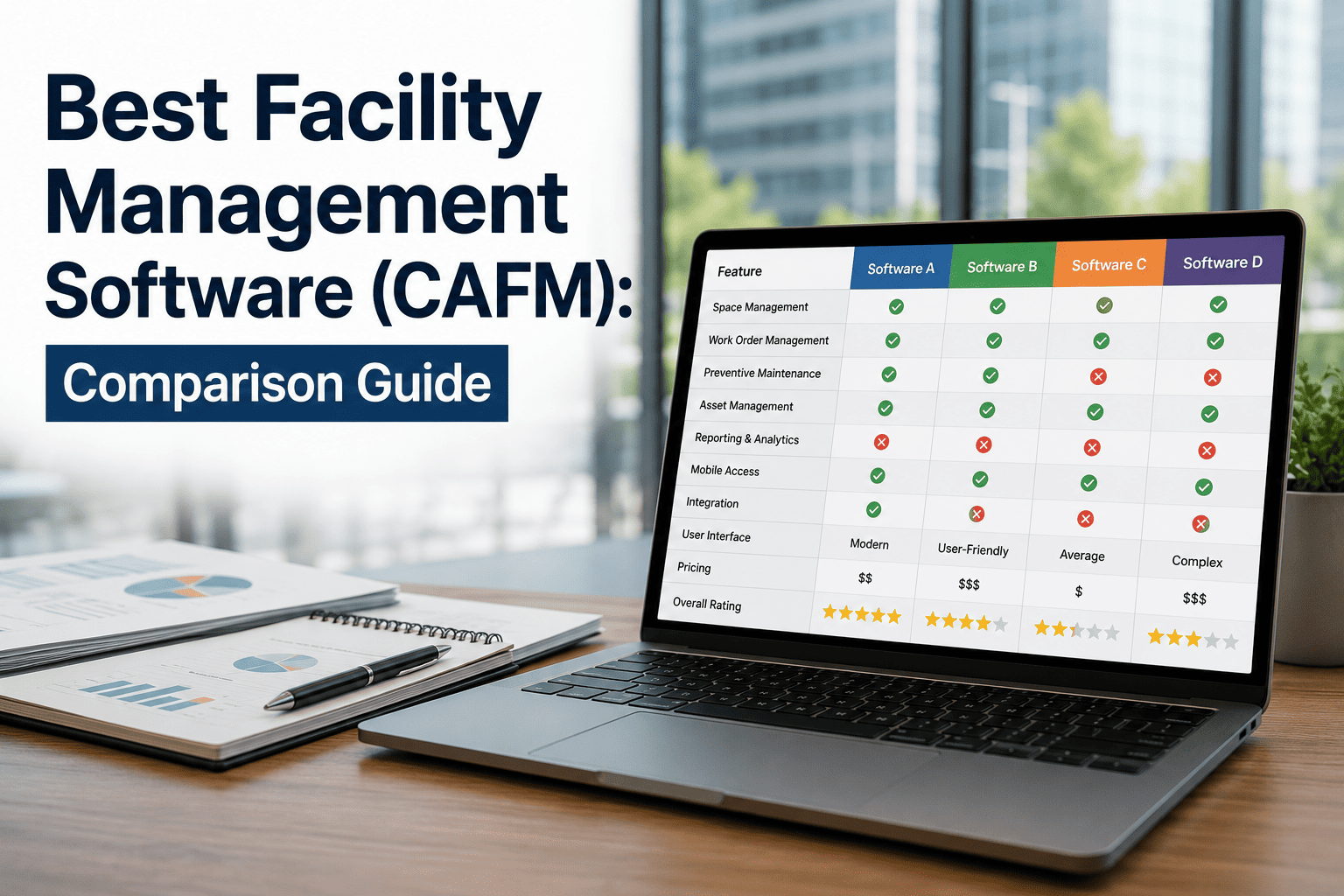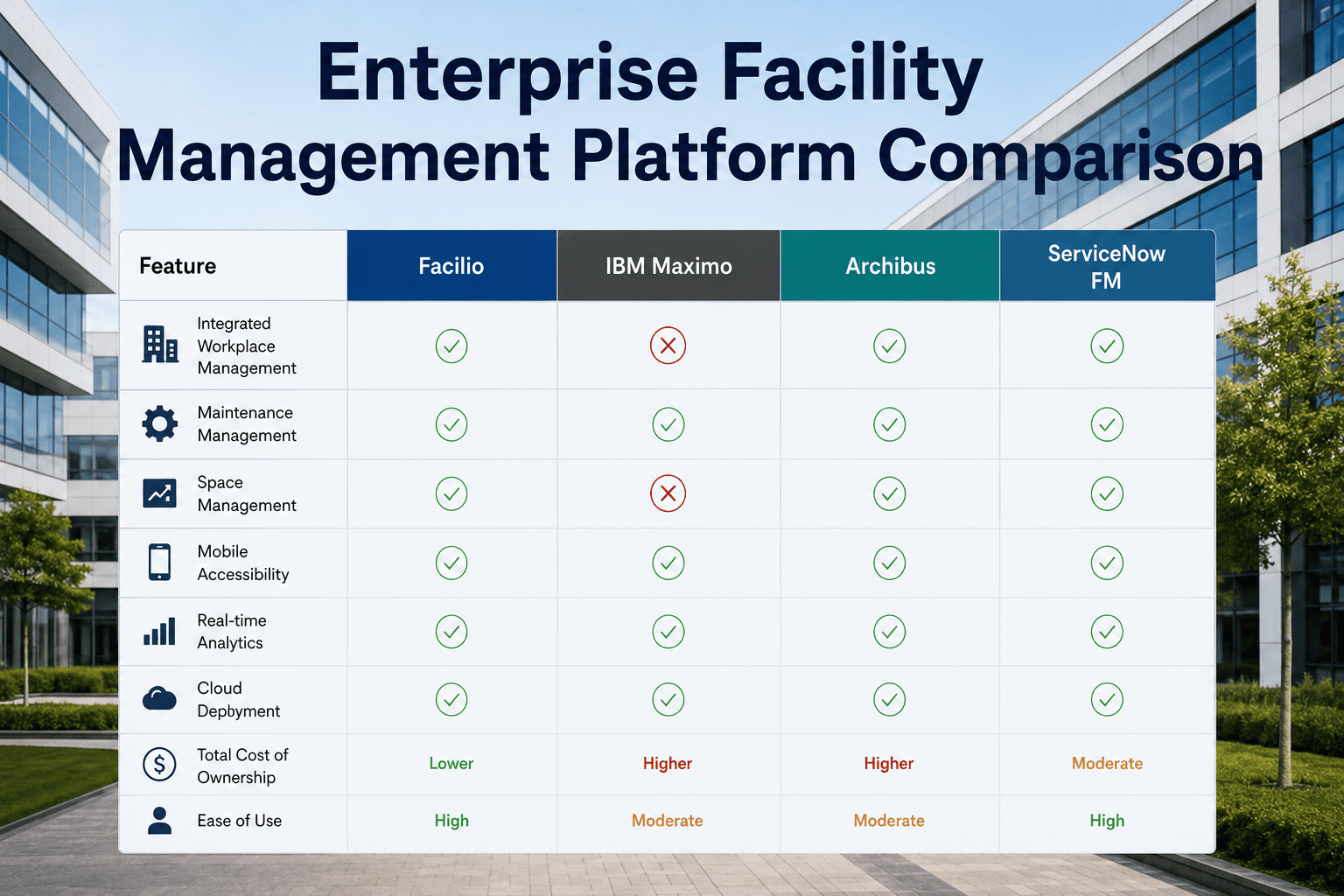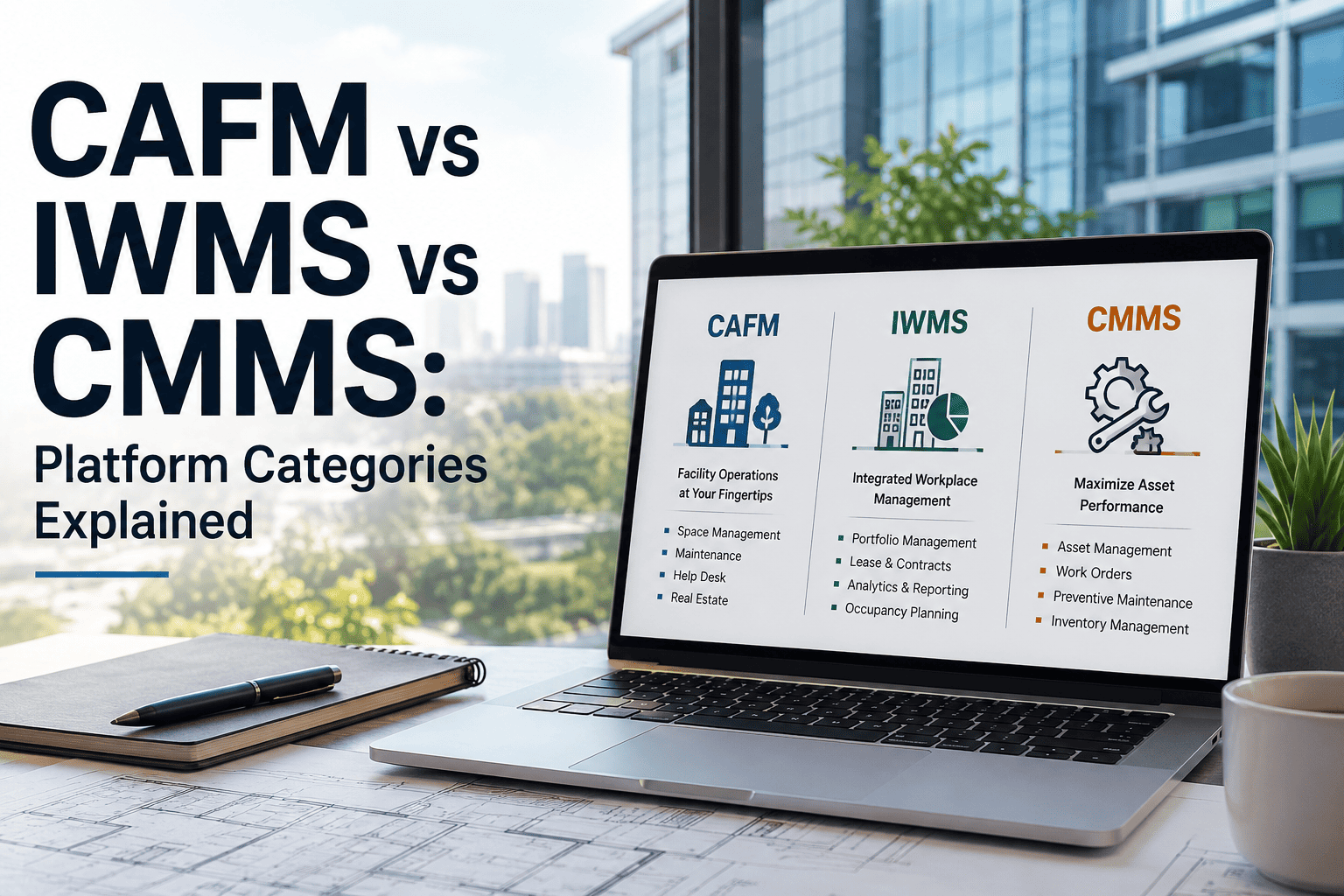
CAFM, IWMS, and CMMS are the three dominant facility management platform categories, and while they share overlapping features like asset tracking and work order management, they serve very different operational needs: CAFM focuses on space and facilities, IWMS extends that across real estate portfolios and sustainability, and CMMS zeroes in on equipment maintenance and reliability. For maintenance and reliability leaders evaluating facility software categories, choosing the wrong category can mean overpaying for unused modules or lacking the preventive maintenance depth your assets require. This comparison breaks down the CAFM IWMS CMMS landscape so you can invest with confidence — and if your priority is maintenance execution, you can Start Free Trial of OxMaint to see a purpose-built CMMS in action.
Buying facility software? Pick the category before you pick the vendor.
Three acronyms. Overlapping feature sets. Very different outcomes. A wrong category choice wastes 12–18 months and $40K–$120K in license fees, implementation, and change management. This guide eliminates the confusion.
What do CAFM, IWMS, and CMMS actually stand for?
Each platform category evolved to solve a different operational problem. Understanding the origin and core mission of each is the first step in a sound facility software category comparison.
Designed for space planning, move management, room booking, and facilities service requests within a single building or campus. CAFM platforms emerged in the late 1980s to digitize CAD drawings and space allocations, and today they excel at visualizing floor plans and managing desk utilization.
An enterprise-grade platform that integrates five core modules: real estate management, project management, facilities & maintenance management, sustainability & energy, and space management. IWMS is built for organizations managing large, multi-site portfolios where lease administration and carbon reporting matter as much as work orders.
Purpose-built for maintenance and reliability teams. A CMMS manages work orders, preventive maintenance schedules, asset hierarchies, spare-parts inventory, and maintenance analytics. The CAFM vs CMMS distinction is sharp here: CMMS is about keeping equipment running, not managing office space.
CAFM vs IWMS vs CMMS: feature-by-feature comparison
The three categories overlap on surface-level features — every platform can issue a work order — but the depth, workflows, and reporting diverge significantly. Use this table as your facility platform comparison checklist.
| Capability | CAFM | IWMS | CMMS |
|---|---|---|---|
| Space planning & floor plans | Deep — core strength | Moderate — one of five modules | Not a focus |
| Lease & real estate management | Limited or absent | Deep — core strength | Not included |
| Preventive maintenance scheduling | Basic service requests | Moderate — module dependent | Deep — core strength |
| Asset hierarchy & equipment tracking | Minimal | Moderate | Deep — parent/child hierarchies |
| Spare-parts inventory | Not included | Light stocking | Deep — multi-warehouse, reorder points |
| Predictive maintenance (IoT / condition-based) | Not available | Rarely available | Deep — sensor integration & AI analytics |
| Sustainability & energy tracking | Basic | Deep — core strength | Not a focus |
| Maintenance KPIs (MTBF, MTTR, OEE) | Not available | Limited | Deep — built-in dashboards |
| Typical implementation time | 4–8 weeks | 6–12 months | 2–6 weeks |
| Typical annual cost (mid-market) | $15K–$50K | $60K–$250K+ | $8K–$40K |
How to choose between CAFM, IWMS, and CMMS for your operation
Your primary pain point — not the vendor's pitch — should dictate the category. The following decision rows map the most common operational goals to the right platform type.
Common myths about CAFM, IWMS, and CMMS — debunked
Vendor marketing blurs category lines. Here are the most dangerous misconceptions that lead teams to buy the wrong platform.
"IWMS includes a CMMS module, so we don't need a separate maintenance platform."
IWMS maintenance modules handle basic work orders but typically lack the spare-parts management, asset hierarchy depth, condition-based triggers, and OEE/MTBF analytics that reliability teams require. Most IWMS maintenance modules are acquired add-ons, not purpose-built engines.
"CAFM and CMMS are basically the same thing — both manage work orders."
CAFM work orders are service requests (fix a light, clean a room). CMMS work orders are structured maintenance interventions tied to asset history, PM schedules, parts consumption, labor hours, and failure codes. The difference between a help desk ticket and a maintenance workflow is the difference between CAFM and CMMS.
"We should buy IWMS now so we have everything, even if we only use 30% of it."
Overbuying creates shelfware. Industry data shows that 40–60% of IWMS modules go unused after implementation. Paying $150K/year for modules your team never touches is not future-proofing — it's budget drain. Buy the category that solves today's critical problem and integrate later if needs genuinely expand.
Real-world scenario: a 180-asset manufacturing plant choosing its platform
Consider a mid-sized manufacturer with 180 tracked assets across two facilities, spending $42,000 annually on reactive repairs and losing an estimated 120 hours per quarter to unplanned downtime. Their leadership team evaluated all three categories. Here's how the numbers played out.
6 modules priced. Maintenance module was basic. 9-month implementation. 80% of cost covered real estate and sustainability features the plant didn't need. ROI horizon: 4+ years.
Strong space planning, but no spare-parts inventory, no PM scheduling engine, and no asset failure tracking. Would not solve the downtime problem. Essentially a service-request tool for a plant that needed maintenance execution.
Full preventive maintenance scheduling, 180-asset hierarchy, spare-parts inventory with reorder points, and AI-driven failure predictions. Implementation in 3 weeks. Projected 35% downtime reduction in year one — payback under 7 months.
Why OxMaint is the CMMS that maintenance teams actually want
If your evaluation of CAFM vs IWMS vs CMMS leads you to the maintenance category, OxMaint delivers the depth that CAFM and IWMS modules lack — with AI-powered features that traditional CMMS platforms can't match.
AI-powered preventive & predictive maintenance
Automate PM schedules based on meter readings, calendar intervals, or condition triggers. OxMaint's AI engine analyzes asset history and sensor data to predict failures before they happen — cutting unplanned downtime by 30–50%.
Digital work orders — zero paper, full traceability
Replace clipboards and spreadsheets with mobile work orders that capture labor hours, parts consumed, failure codes, and photos. Every asset's complete maintenance history is one tap away — audit-ready for ISO 55000, FMCSA, or internal compliance.
Spare-parts inventory with auto-reorder
Track parts across multiple warehouses, link them to asset BOMs, and set reorder points that trigger purchase requests automatically. Eliminate the "parts not available" delay that extends downtime by hours or days.
Maintenance analytics that prove ROI
Built-in dashboards for MTBF, MTTR, OEE, PM compliance, and downtime cost. Show leadership exactly how much money OxMaint saves — most teams report full payback within 4–8 months of going live.
See OxMaint on your assets — book a 30-minute demo
Stop comparing acronyms and start seeing results. We'll load your asset list, show you predictive maintenance on your equipment, and map your ROI in a live walkthrough.
Frequently asked questions about CAFM, IWMS, and CMMS
CAFM is built for space planning, room booking, and facilities service requests, while CMMS is built for equipment maintenance, preventive scheduling, and asset reliability. If your primary concern is keeping machines and production equipment running, CMMS is the correct category — CAFM does not offer the spare-parts inventory, failure-code tracking, or PM automation that maintenance teams need.
Not necessarily. IWMS includes a maintenance module, but it is typically shallow compared to a purpose-built CMMS. IWMS is ideal for multi-site real estate portfolios that need lease administration and ESG reporting alongside basic maintenance. If your core problem is unplanned downtime and PM compliance, a dedicated CMMS like OxMaint will deliver deeper maintenance functionality at a fraction of the cost and implementation time. Book a demo to see the difference on your assets.
Yes. Most modern CMMS platforms, including OxMaint, offer REST APIs and pre-built integrations that connect with leading CAFM and IWMS solutions. This best-of-breed approach lets real estate teams manage space and leases in their preferred tool while maintenance teams get the deep work-order, PM, and inventory functionality that IWMS modules can't match.
CMMS is generally the fastest and most affordable to implement, typically running 2–6 weeks and $8K–$40K annually for mid-market deployments. CAFM implementations take 4–8 weeks at $15K–$50K, while IWMS deployments can span 6–12 months and cost $60K–$250K+ due to the breadth of modules and configuration required. You can Start Free Trial of OxMaint to experience a CMMS deployment firsthand.
Probably not. IWMS is designed for organizations managing large real estate portfolios — typically 10 or more sites — where lease administration, capital project management, and enterprise-wide sustainability reporting are core requirements. For one or two facilities, a CAFM for space management plus a CMMS for maintenance will deliver better depth at lower total cost than a full IWMS suite.
Ready to move from reactive to predictive maintenance?
Join the maintenance teams using OxMaint to cut downtime, hit PM targets, and prove maintenance ROI — all in one AI-powered CMMS platform.
Free 14-day trial · No credit card