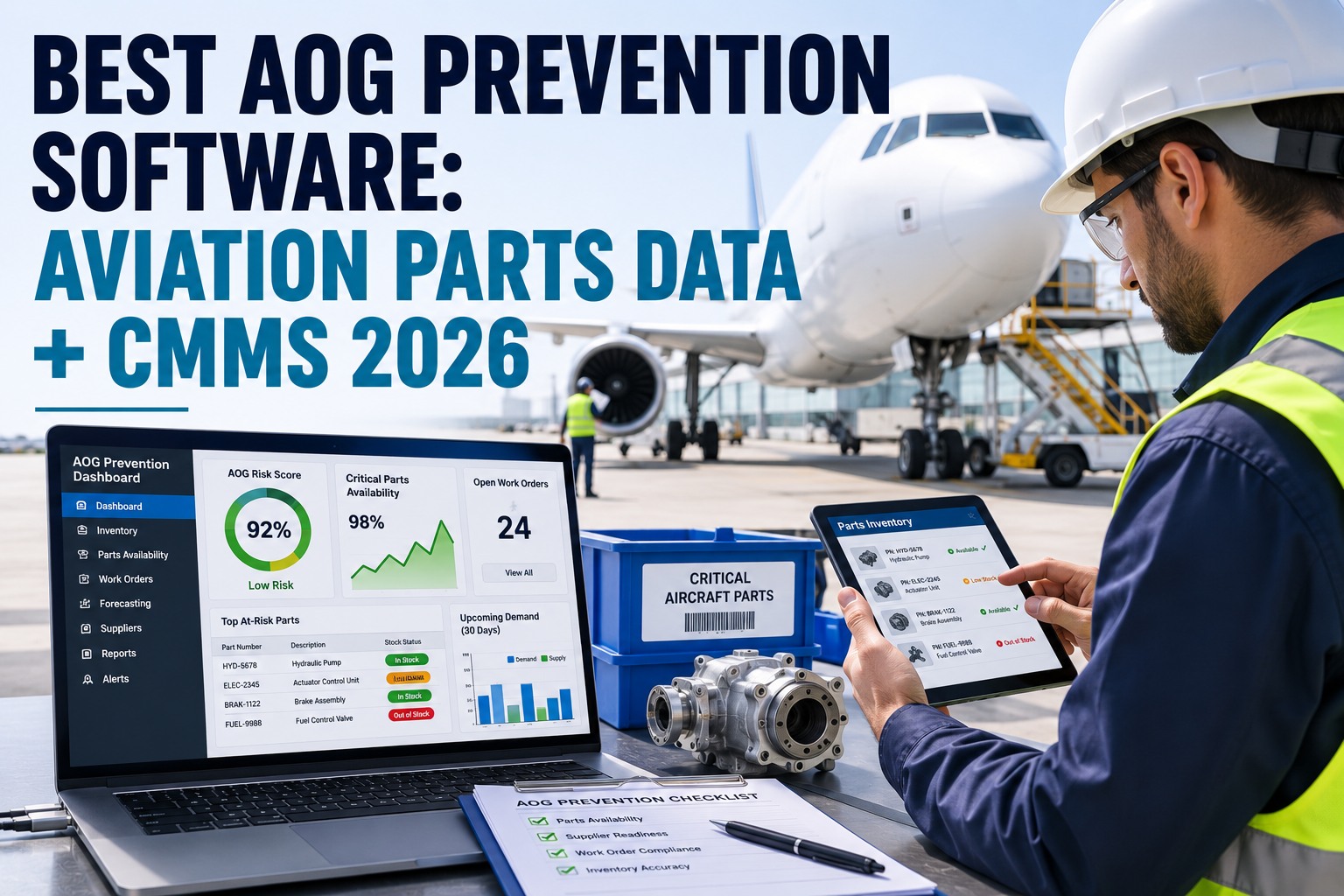
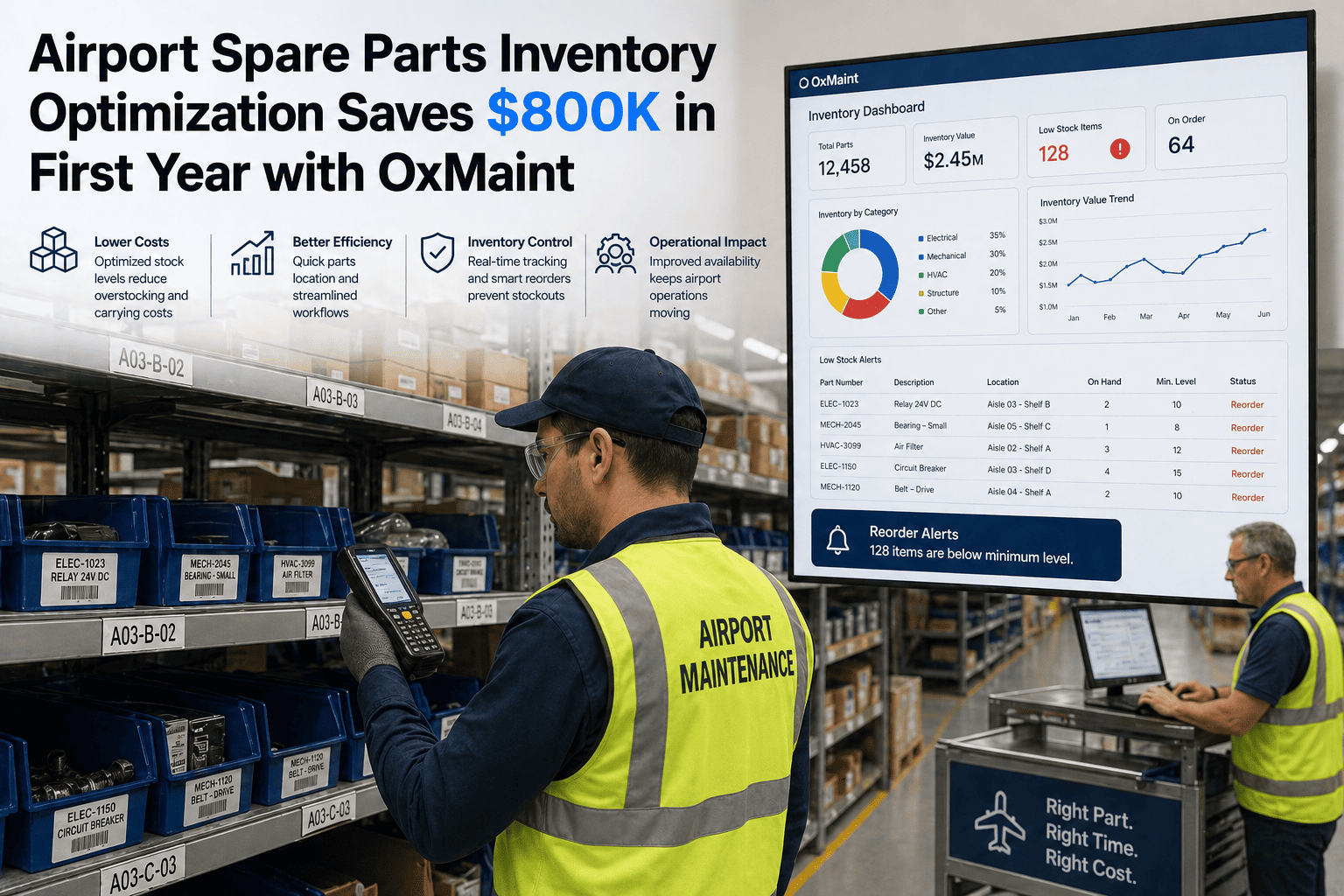
An aircraft on ground costs between $10,000 and $150,000 per hour — and the most preventable cause is not a complex technical failure. It is a missing part. Aviation inventory management is the operational discipline that stands between your maintenance schedule and that cost clock starting. The MRO facilities hitting 98%+ schedule completion rates treat their inventory system as a live operational weapon, not a warehouse ledger. Oxmaint connects parts availability directly into your work order queue, your preventive maintenance calendar, and your supplier network — so your team is never caught waiting. To see it on real data, start a free trial today or book a demo and walk the full workflow with our team.
$150K
Max hourly AOG cost
Parts stockouts are the #1 preventable cause
40%
Inventory value wasted
Tied up in slow-moving or obsolete stock
23%
Parts spend reduction
When switching to demand-driven replenishment
6.4h
Lost per stockout event
Average delay when sourcing reactively
Oxmaint Inventory Module
Your Parts Room Should Never Cause a Delay
Real-time stock visibility, demand-driven replenishment, rotable lifecycle tracking, and supplier integration — connected directly to the work orders your technicians are closing on the hangar floor right now.
FoundationThe Four Layers of Aviation Inventory
Aviation inventory management is not a single discipline — it is four completely different problems stacked in one parts room. Consumables, rotables, life-limited parts, and AOG-critical spares each have their own failure mode, their own cost risk, and their own management logic. Most inventory problems in MRO trace back to applying the same flat management approach to all four layers. Facilities that master each layer independently consistently report 98%+ work order on-time completion and 15-20% lower total parts spend than their peers. Start a free trial with Oxmaint to explore how each layer is managed on a live platform, or book a demo and let us map your current inventory structure.
01
Consumables
Expendables and Consumables
Fasteners, seals, filters, lubricants — consumed on every task. High frequency, low unit cost. The failure mode is bin depletion through under-forecasting or a single bulk-consumption event. Min-max replenishment with demand-weighted reorder points prevents 90% of consumable stockouts.
Volume Risk: HIGH
Cost Risk: LOW
02
Rotables
Rotables and Repairables
Actuators, avionics LRUs, landing gear assemblies — removed, repaired, returned. High value, low frequency. The failure mode is pool depletion when repair cycle times exceed removal intervals. Full lifecycle tracking across all five states is non-negotiable.
Volume Risk: LOW
Cost Risk: VERY HIGH
03
LLP
Life-Limited and Time-Controlled Parts
Mandatory replacement intervals — flight cycles, calendar time, operating hours. Demand is 100% predictable from the maintenance programme. Stockouts in this category are entirely avoidable. Every stockout here is a planning failure, not a supply chain failure.
Volume Risk: MEDIUM
Compliance Risk: CRITICAL
04
AOG
AOG and Critical Spares
Low frequency, catastrophic consequence. The holding cost question must be answered with a risk-weighted calculation that compares carrying cost against hourly AOG exposure per aircraft type — not gut instinct or legacy procurement habits.
Volume Risk: VERY LOW
Delay Risk: CATASTROPHIC
Pain PointsFour Problems Bleeding Your P&L Right Now
Inventory dysfunction in MRO doesn't announce itself. It accumulates through daily decisions made without system visibility — an over-order here, a missed reorder point there, a rotable in repair with no replacement in the pool. By the time it surfaces in a budget review or an AOG event, months of compounding drift have already become expensive habit.
System shows 6 units. Technician finds 0. Phantom stock builds every time a part is consumed without a transaction, moved without an update, or written off without a record. In facilities without real-time tracking, phantom stock rates of 12-18% are common — 1 in 6 picks fails on first attempt.
Daily impact per 100-technician facility
47 min wasted per incident
When parts are ordered because a technician just asked rather than because a reorder point triggered, the MRO is in permanent reactive mode. Emergency sourcing costs 40-60% more than planned procurement. Facilities spending more than 15% of parts budget on unplanned sourcing have broken logic, not bad luck.
Premium above planned procurement
40-60% cost premium per emergency order
When repair cycle times are not tracked against removal frequency, pool depletion is invisible until a task cannot proceed. A single LRU with a 45-day repair cycle removed three times per quarter will deplete any pool under two units — a calculation most MROs are not making systematically.
Average delay per pool depletion event
4.2 days delay per occurrence
Sealants, adhesives, composite repair materials — expired during storage, unusable despite physical condition. Facilities without automated expiry tracking regularly discover expired stock mid-task, triggering an emergency sourcing event for a part that was physically present but legally unusable.
Annual consumable write-off without FEFO
3.4% annual write-off rate
The SolutionHow Oxmaint Manages Inventory End-to-End
Oxmaint's inventory module is not a separate warehouse system you query occasionally. It is built into the same work order and asset management layer your technicians already use. Every task that requires a part creates a parts reservation. Every consumption updates stock instantly. Every scheduled event in the forward calendar generates a demand signal that drives replenishment automatically — always looking forward, never scrambling backward. Start a free trial to explore this integration on live data, or book a demo and see it mapped to your actual parts room structure.
Core Visibility
Real-Time Stock Ledger
Every consumption, receipt, transfer, and adjustment updates stock levels instantly. Technicians see accurate availability before they walk to the bin — not after discovering the empty shelf mid-task.
Demand Intelligence
Forward-Looking Demand Forecasting
The scheduled maintenance calendar generates forward demand signals automatically. Replenishment orders triggered by predicted future consumption — not historical depletion. Stockouts for scheduled tasks eliminated entirely.
Rotables
Full Rotable Lifecycle Tracking
Every rotable tracked across five lifecycle states — installed, removed, in-repair, serviceable, condemned. Pool depletion risk calculated automatically based on removal frequency versus repair cycle time.
Compliance
Shelf-Life and FEFO Management
Every batch-controlled item carries its expiry date. FEFO pick logic enforced automatically — shortest-dated bin first, every time. Expiry alerts at 30 and 7 days. Write-off rate drops from 3.4% to under 0.5%.
Documentation
Part Traceability Chain
Form 1, 8130-3, batch records, and receiving inspection attached at goods receipt. When issued to a work order, documentation transfers to the task record automatically. No paper chase at audit time — ever.
Procurement
Automated Purchase Order Generation
When stock reaches reorder point, Oxmaint generates a draft PO against the preferred approved supplier automatically. Procurement acts on system signals, not technician requests. Emergency sourcing spend drops in the first 90 days.
Multi-Site
Cross-Location Visibility
All inventory across all hangars, line stations, and forward stocking locations in one view. When a part is absent at one location but available at another, the system surfaces the transfer before triggering a purchase order.
Analytics
Inventory Performance Dashboard
Stockout frequency, fill rate, inventory turns, slow-mover exposure, and write-off value — tracked per part number, per location, per aircraft type. Data-driven rationalisation replaces gut-feel stock level decisions.
ComparisonReactive vs. Demand-Driven — The Operational Gap
The gap between reactive and demand-driven inventory is visible on every shift — in waiting technicians, premium freight charges, and AOG events traced to the parts room rather than the hangar floor. These figures are tracked outcomes from MRO facilities of 50-400 technicians making the transition from spreadsheet to system-managed inventory.
Best PracticesEight Practices That Separate the Best from the Rest
These are the operational behaviours consistently observed in MRO facilities hitting 95%+ on-time completion and sub-10% emergency sourcing rates. Each is directly supported by Oxmaint from day one — not a future roadmap item. Start a free trial to see how these practices apply to your specific parts room, or book a demo for a live configuration built from your current stock structure.
01
Link inventory to work order demand, not historical averages
Reorder points built on consumption history miss scheduled maintenance peaks and aircraft type transitions. Parts requirements must be pulled from the forward work order schedule.
02
Manage rotables as a pool asset, not individual line-item stock
Pool health, repair cycle time, and removal frequency must be tracked together as a single system metric — not three separate stock records that never reference each other.
03
Enforce FEFO system-wide without exception
FEFO must be system-enforced, not supervisor-dependent. The moment it becomes a habit rather than a rule, expiry write-offs begin accumulating silently in the background.
04
Set reorder points per location, not globally per part number
A part held at main base and two line stations has three demand profiles and three lead times. One global reorder point simultaneously over-stocks and under-stocks — and nobody notices until a task is already delayed.
05
Stage parts kits 24-48 hours before task commencement
Assembling all materials before the aircraft is on jacks eliminates the scenario where a missing component is discovered after the aircraft is already open — one of the highest-frequency delay causes in MRO.
06
Audit traceability at goods receipt, not at installation
A documentation gap discovered at installation — when the aircraft is open and the technician is ready — causes a longer delay than if caught at the receiving dock. The right control point is always upstream.
07
Use risk-weighted calculations for AOG spare holding decisions
The holding cost question for critical spares must be weighed against expected AOG exposure. Most facilities holding spares by instinct are simultaneously over-stocked on some items and dangerously under-stocked on others.
08
Rationalise slow-mover stock on a quarterly cadence
Parts without a consumption transaction for 18+ months represent capital being wasted or risk being held implicitly. Quarterly reviews requiring a business case for continued holding are the most effective tool for freeing working capital without increasing AOG risk.
Proven ROIWhat Optimised Inventory Delivers at 12 Months
Inventory optimisation returns are among the fastest and most measurable in MRO improvement — because the cost of poor inventory is already flowing through your P&L in emergency freight, overtime, and write-offs most facilities have accepted as normal. These are median outcomes from MRO facilities measuring results against their pre-deployment baseline over 12 months.
Total Parts Spend Reduction
Driven by elimination of emergency sourcing premiums, reduction in over-ordering, and working capital freed from slow-mover rationalisation
Parts Availability at Task Start
Versus 62-74% in manually managed operations — technicians start work when scheduled, not when parts finally arrive
Fewer Emergency Sourcing Events
Demand forecasting and automated reorder points replace reactive procurement within 90 days — premium freight charges follow immediately
Typical Payback Period
For facilities with 80+ technicians, savings typically exceed platform cost within the first four to six weeks of live operation
FAQQuestions Operations Leaders Ask First
How does Oxmaint handle parts traceability and airworthiness documentation?
Every part number in Oxmaint carries its full documentation chain — EASA Form 1 or FAA 8130-3, batch records, and receiving inspection records — attached at goods receipt, not at point of use. When issued to a work order, documentation transfers to the task record automatically. When a CAA auditor requests traceability for a specific installation, Oxmaint surfaces the complete chain — part number, batch, certificate reference, receiving inspection, and work order record — in under one minute. The manual traceability binder that consumed weeks of audit preparation is replaced by a real-time digital record that is always current and always accessible from any location.
Can Oxmaint manage inventory across multiple MRO locations with different stock structures?
Multi-location inventory is a core capability, not an add-on. Oxmaint supports any number of physical locations — main base hangars, line maintenance stations, forward stocking locations, and consignment stock held at third parties — in a single unified view. Each location maintains its own stock levels, reorder points, and supplier routing rules independently. When a stockout occurs at one location, Oxmaint checks whether the same part is available elsewhere before generating a purchase order — surfacing the inter-location transfer as the faster and cheaper resolution. Portfolio-level managers see aggregate inventory value, coverage, and slow-mover exposure across all sites simultaneously with drill-down to individual bin locations.
How does the demand forecasting engine work for scheduled maintenance events?
Oxmaint's demand forecasting is driven by the forward maintenance schedule, not historical consumption averages alone. When a check, life-limited part replacement, or scheduled task is planned in the maintenance programme, parts requirements from the task card are automatically registered as forward demand against relevant part numbers. The system calculates the gap between current stock, open purchase orders, and combined demand from all tasks in the rolling 90-day window — then generates replenishment recommendations to close shortfalls before task dates arrive. For unscheduled maintenance, historical consumption patterns per aircraft type maintain appropriate buffer stock. Together, these two modes cover over 95% of all parts requirements in a typical MRO operation.
What does implementation involve and how quickly are results visible?
Implementation requires no heavy consulting engagement. The initial configuration — stock master upload, location structure, preferred supplier mapping, and reorder point setup — is typically completed in two to three weeks using Oxmaint's guided setup tools. Most facilities run a two to four week parallel period before full cutover. The first measurable results appear in weeks two through four: emergency sourcing events begin falling as reorder points catch depletion before stockout, phantom stock discrepancies surface and are corrected through the first cycle count, and parts availability at task start begins improving as forward demand signals flow into procurement. Full ROI against the pre-deployment baseline is typically realised within four to six months for facilities of 80 or more technicians.
Ready to transform your parts room?
Stop Losing Hours to Missing Parts.
Run on a System That Looks Forward.
Oxmaint's inventory module connects real-time stock visibility, demand-driven replenishment, rotable lifecycle tracking, and airworthiness documentation into a single platform — integrated directly with the work orders and maintenance schedules your team already uses. Reduce parts spend by 23%, cut emergency sourcing events by 87%, and arrive at every task with parts already staged, certified, and documented.
23%Parts Spend Saved
87%Fewer Stockouts
4wkPayback Period