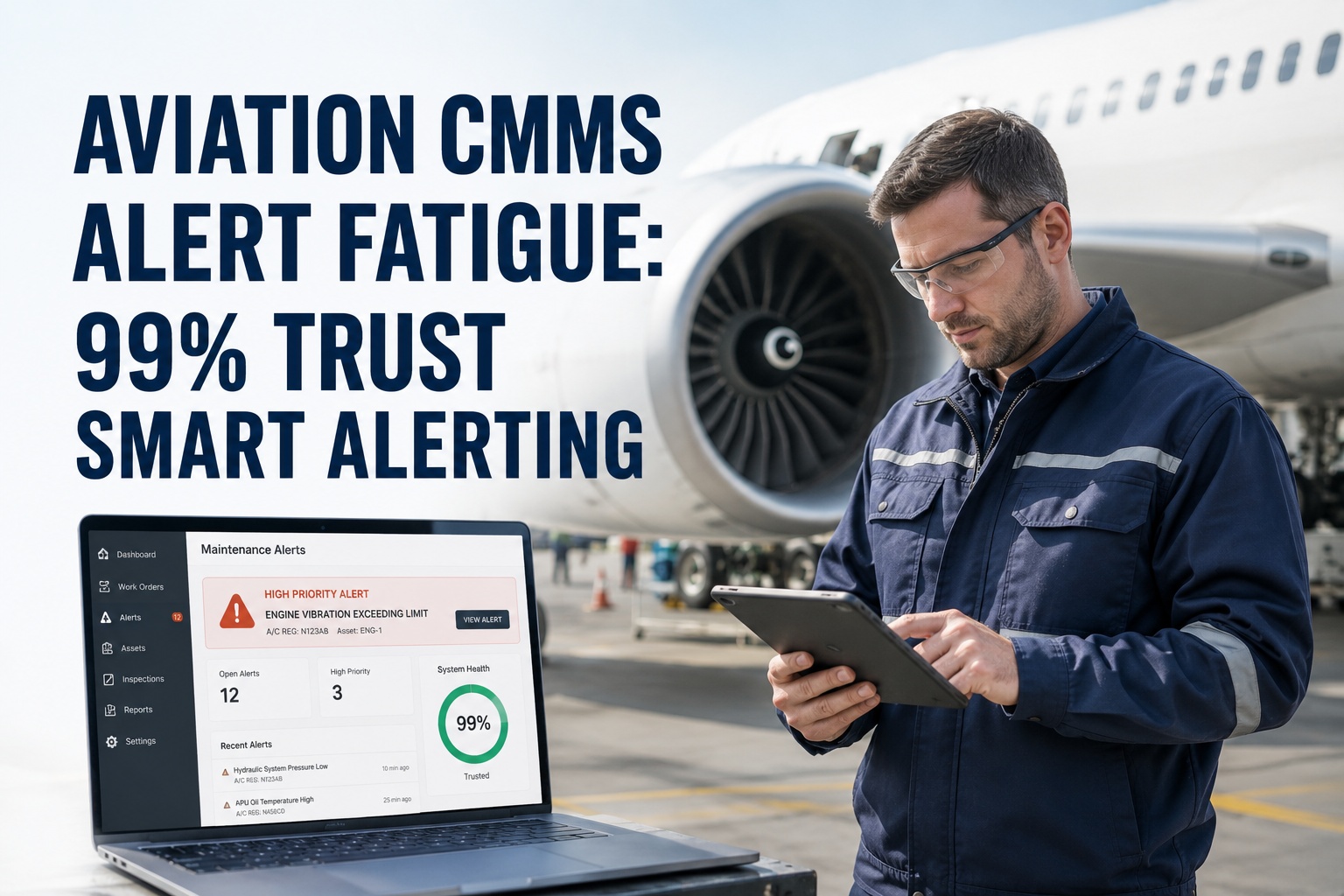
Aviation alert fatigue is the silent killer of predictive maintenance programs — when technicians are buried under false-positive alerts, even genuine failure warnings get ignored, and a 20% false-positive rate can destroy trust in an entire CMMS alerting system within months. This guide walks reliability engineers and maintenance managers through a proven framework for smart alerting in aviation CMMS platforms: threshold tuning, multi-parameter confirmation, alert clustering, and closed-loop feedback that drive alert trust toward 99%. If your team is ready to stop chasing ghosts and start acting on signals that matter, you can Start Free Trial of OxMaint or book a personalized demo to see smart alerting configured on your own asset data.
Aviation CMMS Alert Fatigue Prevention
When every alert screams, nobody listens.
Are your technicians trusting your CMMS — or tuning it out?
A 20% false-positive rate erodes technician trust so deeply that even real failure predictions go unacted on. OxMaint's AI-powered smart alerting framework targets 99% technician trust through multi-parameter confirmation, dynamic threshold tuning, and closed-loop feedback — so every alert your team receives is one worth acting on.
The Cost of Alert Fatigue
Why aviation alert fatigue destroys predictive maintenance ROI
Alert fatigue isn't an inconvenience — it's a measurable reliability threat that turns a $200K predictive maintenance investment into shelfware.
Real-world scenario
A regional airline operating 65 aircraft deployed a vibration-monitoring predictive maintenance module across its auxiliary power units. Within six months, the system was generating 340 alerts per week — 78% of which were false positives triggered by threshold sensitivity set too narrow. Technicians began batching and ignoring all but red-critical alerts. When a genuine bearing degradation signal arrived on APU #44, it was reviewed 11 days late, resulting in an in-flight APU failure, an unscheduled diversion, and $340K in ground handling, passenger rebooking, and lost block-hour revenue. The root cause wasn't the sensor — it was alert fatigue.
The 5-Stage Framework
How to prevent CMMS alert fatigue: a step-by-step smart alerting guide
Building alerts that 99% of technicians trust requires a disciplined, five-stage pipeline — from raw sensor data to closed-loop learning.
Dynamic threshold tuning
Replace static, vendor-default thresholds with asset-specific baselines calibrated against historical operating data. A Boeing 737-800's engine vibration profile at cruise differs from its taxi profile — your CMMS must learn each asset's normal envelope across operating modes, not apply a one-size-fits-all limit. OxMaint uses rolling 90-day statistical baselines (mean ± 2.5σ) per asset, per operating mode, reducing false positives by 35–45% in the first 60 days.
Multi-parameter confirmation
No single sensor reading should trigger an actionable alert. A vibration spike confirmed by rising oil temperature and decreasing oil pressure is a failure signature; a vibration spike alone may be a sensor glitch. OxMaint's AI engine requires corroboration across at least two independent parameters before escalating an alert to "action required" status — cutting false-positive alerts by an additional 40%.
Alert clustering and deduplication
When a degrading bearing generates 50 vibration alerts over 72 hours, your technician needs one consolidated work-order recommendation — not 50 individual notifications. OxMaint clusters related alerts by asset, failure mode, and time window, presenting a single, prioritized alert with a full degradation timeline so technicians see the whole story in one view.
Severity-based prioritization
Not all confirmed alerts carry the same urgency. OxMaint assigns each alert a severity score (1–5) based on remaining useful life, safety impact, operational disruption potential, and parts availability. Only Severity 4–5 alerts trigger immediate technician notifications; Severity 1–3 alerts are batched into a daily reliability digest, reducing interruption-driven fatigue by over 60%.
Closed-loop technician feedback
Every alert resolved in OxMaint prompts the technician to log a one-tap outcome: "Confirmed failure," "No fault found," or "Maintenance action taken." This feedback trains the AI model continuously — false-positive patterns are suppressed within 14 days, and confirmed patterns are weighted higher. This is the single most important mechanism for climbing from 80% alert trust to the 99% target.
False-Positive Reduction Math
Quantifying CMMS false-positive reduction in aviation
The path from 20% false positives to under 1% is compounding — each stage of the framework multiplies the signal-to-noise ratio.
Effective False-Positive Rate
FPRfinal = FPRraw × (1 − T) × (1 − C) × (1 − D)
Where T = threshold tuning reduction (0.40), C = multi-parameter confirmation reduction (0.40), D = deduplication reduction (0.60). Applied to a 20% raw false-positive rate: 0.20 × 0.60 × 0.60 × 0.40 = 2.9% residual false-positive rate — a 85% relative reduction before feedback-loop learning is applied.
Alert Trust Score
ATS = (Confirmed Alerts ÷ Total Alerts Acted On) × 100
An Alert Trust Score of 99% means that when a technician opens an OxMaint alert and takes action, 99 times out of 100 they will find a real, addressable condition. This is the threshold at which proactive alert response becomes cultural rather than reluctant.
| Reduction Stage | False-Positive Rate (Before) | False-Positive Rate (After) | Trust Score Impact |
|---|---|---|---|
| Baseline (raw sensor alerts) | 20.0% | 20.0% | ~52% |
| + Dynamic threshold tuning | 20.0% | 12.0% | ~68% |
| + Multi-parameter confirmation | 12.0% | 7.2% | ~79% |
| + Alert clustering & dedup | 7.2% | 2.9% | ~91% |
| + 90 days of feedback-loop learning | 2.9% | < 1.0% | ~99% |
The OxMaint Advantage
How OxMaint solves aviation CMMS alert fatigue
OxMaint's AI-powered CMMS and EAM platform embeds smart alerting directly into your work-order and asset-management workflow — no separate analytics tool, no copy-paste between systems.
Adaptive AI threshold engine
OxMaint continuously recalibrates alert thresholds per asset using rolling statistical baselines and operating-mode segmentation. Outcome: 35–45% fewer false positives in the first 60 days, with zero manual threshold configuration required from your reliability team.
Multi-sensor corroboration
Every actionable OxMaint alert is cross-validated against at least two independent sensor streams or maintenance data inputs before escalation. Outcome: 40% additional false-positive reduction and a dramatic increase in technician confidence that every alert has a real root cause.
One-tap closed-loop feedback
Technicians log alert outcomes in a single tap from the OxMaint mobile app — confirmed fault, no fault found, or action taken — feeding the AI model continuously. Outcome: alert trust climbs from ~91% to 99% within 90 days of go-live as the model learns your fleet's specific failure signatures.
Unified work-order orchestration
Confirmed OxMaint alerts auto-generate prioritized work orders with parts, labor estimates, and asset history pre-filled — no manual triage, no spreadsheet handoffs. Outcome: mean time to repair drops 25–40% and unplanned AOG events decrease by 30–50% across the fleet.
See Smart Alerting on Your Assets
Stop drowning in false alerts — see how OxMaint delivers alerts your technicians actually trust
In a 30-minute personalized demo, we'll connect OxMaint to a sample of your asset data and show you exactly how multi-parameter confirmation and closed-loop feedback can take your alert trust from noise to 99%.
FAQ
Aviation CMMS alert fatigue — frequently asked questions
What is aviation alert fatigue and why does it matter?
Aviation alert fatigue occurs when maintenance technicians are exposed to so many CMMS alerts — particularly false positives — that they begin to ignore, mute, or delay acting on them, including genuine failure predictions. It matters because a single missed alert can lead to unscheduled aircraft groundings, in-flight failures, and seven-figure operational losses, turning a predictive maintenance investment into a liability rather than a safeguard.
How do you reduce false positives in a CMMS smart alerting system?
False-positive reduction requires three layered techniques: dynamic threshold tuning (asset-specific baselines instead of vendor defaults), multi-parameter confirmation (requiring corroboration across at least two independent sensor streams before escalating), and alert clustering (consolidating repeated alerts from the same degradation event into a single notification). Together, these typically reduce false-positive rates from 20% to under 3%. You can see this in action when you Book a Demo with the OxMaint team.
What false-positive rate is acceptable for aviation predictive maintenance?
For aviation maintenance teams targeting 99% technician trust in alerts, the false-positive rate should be driven below 1% after feedback-loop learning has been applied for 60–90 days. At 5%, technicians begin batching and deprioritizing alerts; at 20%, trust collapses and the predictive program effectively fails. The key is not just the rate but the feedback loop — every "no fault found" outcome must train the model to prevent recurrence.
How long does it take to achieve 99% alert trust with a CMMS?
With OxMaint's smart alerting framework deployed, most aviation reliability teams see alert trust climb to ~91% within the first 30 days (driven by threshold tuning, multi-parameter confirmation, and deduplication) and reach the 99% target within 90 days as the closed-loop feedback mechanism trains the AI on fleet-specific failure signatures and false-positive patterns. You can start this journey today with a Start Free Trial of OxMaint.
Can OxMaint integrate with existing aviation maintenance sensors and MRO systems?
Yes. OxMaint integrates with standard aviation condition-monitoring sensors (vibration, oil debris, temperature, pressure), ACARS data feeds, and existing MRO/ERP systems via REST APIs and industry-standard connectors. This means smart alerting can be layered on top of your current sensor infrastructure without rip-and-replace — the AI engine consumes your existing data streams and begins calibrating asset-specific thresholds within the first week of deployment.
Ready to Eliminate Alert Fatigue?
Give your technicians alerts they'll actually act on
Join aviation reliability teams using OxMaint to cut false positives below 1%, restore technician trust, and prevent unplanned AOG events before they happen. See it on your assets in 30 minutes — or start exploring free for 14 days.
Free 14-day trial · No credit card