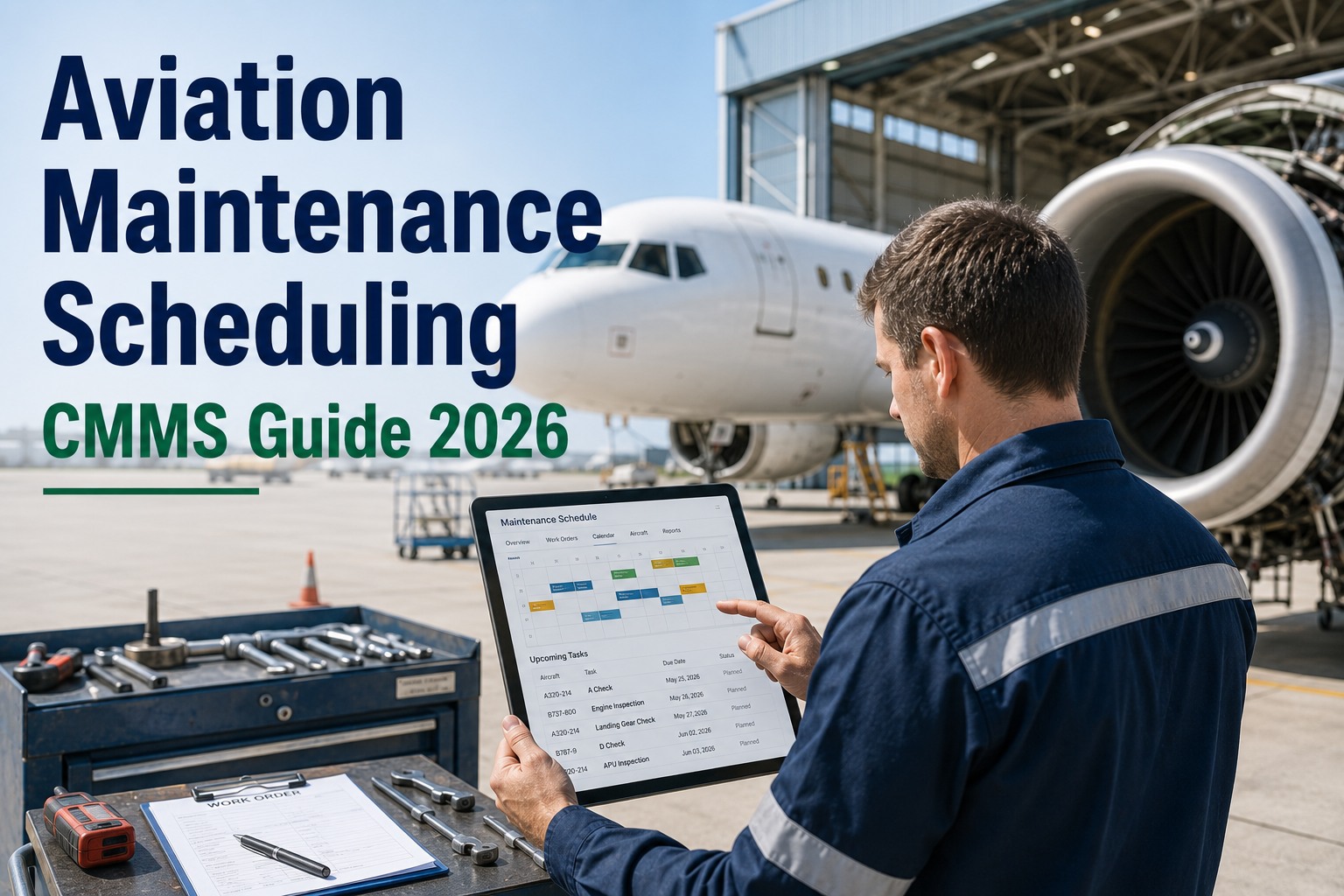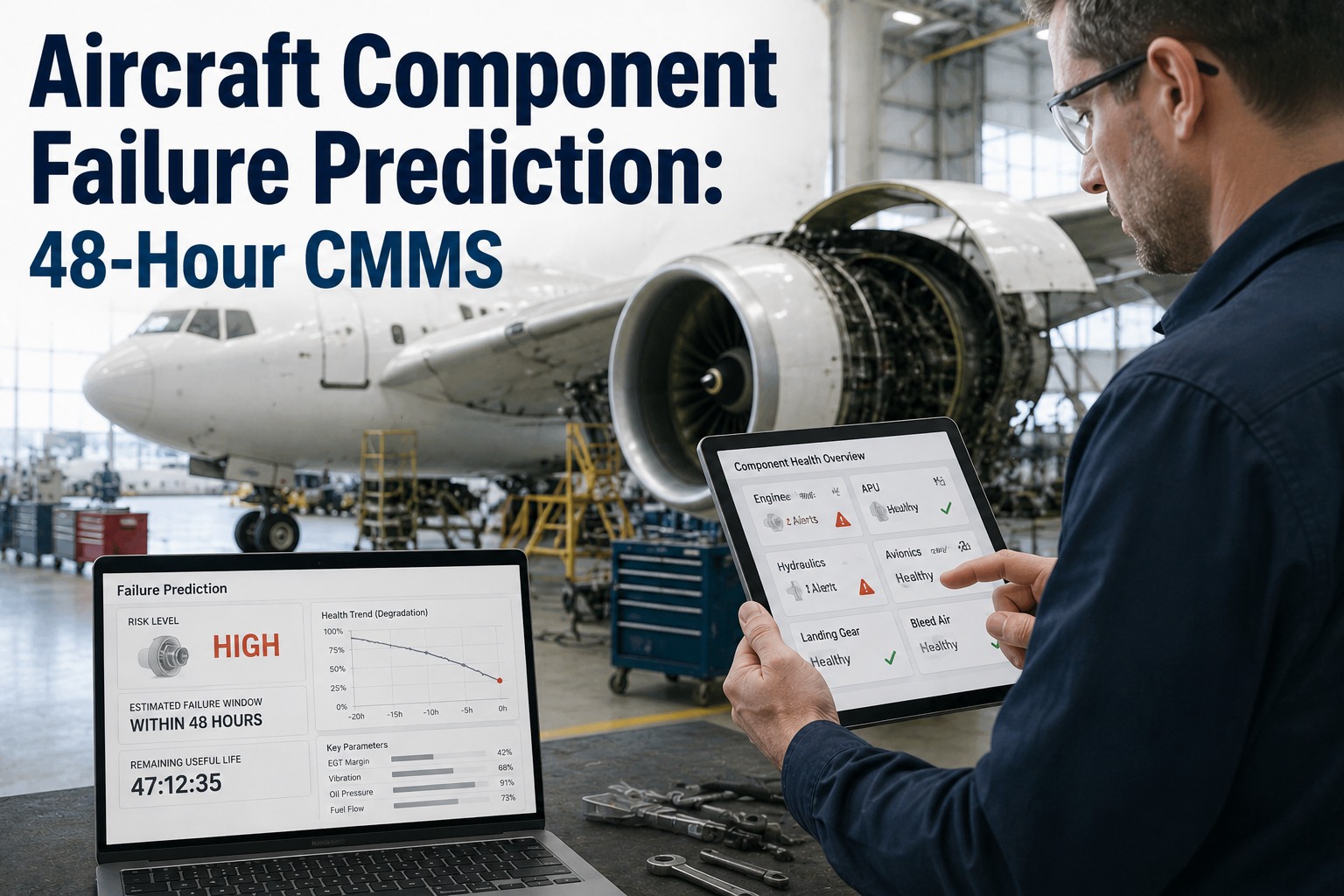
Aircraft component failure prediction that gives maintenance teams 48 hours or more of advance warning is the threshold where predictive maintenance transforms from a pilot project into measurable dispatch reliability at airline scale. By fusing ACMS (Aircraft Condition Monitoring System) data feeds, ML-driven degradation models, and confidence-scored alerts directly into a CMMS, operators can convert early-warning signals into planned work orders — long before a fault cascades into an AOG event. This guide walks through the architecture, prediction thresholds, and dispatch integration patterns that make a 48-hour CMMS early warning system work in real airline operations — and how OxMaint's AI-powered CMMS puts that capability into production. You can Start Free Trial today or book a tailored demo to see it mapped to your fleet.
48-Hour Prediction · Aviation CMMS
Can your CMMS predict an aircraft component failure 48 hours before it grounds a flight?
A 48-hour early warning window is the minimum viable horizon for line maintenance to pull parts, assign technicians, and re-plan dispatch without cancelling a single departure. OxMaint turns ACMS telemetry into confidence-scored predictions — so your team acts on what will fail, not what already did.
The 48-Hour Window
Why 48 hours is the breaking point for airline dispatch reliability
Airlines running a mature component failure prediction program typically target a 48-hour early warning horizon — the minimum time needed to source parts, brief a line station, and slot maintenance into an overnight check without touching the departure schedule.
Prediction surfaces in CMMS
ML model flags a degrading hydraulic seal at 76% confidence. OxMaint auto-generates a predicted-failure work order tagged to the tail number and dispatch impact window.
Parts reservation triggered
Inventory module checks rotable stock at the destination station. If the seal kit is below safety stock, OxMaint fires a transfer request or vendor PO automatically.
Technician assignment confirmed
Shift planner assigns a B1-licensed technician. Work order includes fault history, AMM reference, required tooling, and estimated downtime — all inside the CMMS.
Maintenance executed in overnight check
Seal replaced during scheduled ground time. Prediction closed, actual hours logged, and the component degradation model updated with the post-removal findings.
A 120-aircraft narrowbody fleet operating 650 daily sectors spends roughly $3.2M per year on AOG recoveries — ferry flights, cancelled legs, passenger disruption, and hotac. With a 48-hour CMMS prediction window covering the top 15 component failure modes (hydraulic seals, bleed air valves, IDG bearings, cargo door actuators), the airline avoids an estimated 22 AOG events annually, cutting disruption cost by 35–40% and recovering ~$1.1M in the first year. That is the payback threshold where predictive maintenance stops being an experiment and starts funding itself.
Prediction Architecture
How CMMS component prediction ingests ACMS data for early warning
A production-grade aircraft component failure prediction pipeline in a CMMS environment has four distinct stages. Each stage feeds the next, and each adds a layer of confidence that the alert reaching the line maintenance controller is actionable — not noise.
ACMS telemetry ingestion
Aircraft Condition Monitoring System records engine vibration, hydraulic pressure deltas, bleed air temps, cycle counts, and oil debris data. OxMaint ingests via ACARS downlink or ground-based WiFi post-flight, normalising to a per-tail, per-component time series.
Degradation model scoring
ML models trained on removal history and fail-safe thresholds score each component's remaining useful life (RUL). The model outputs a failure probability percentage and an estimated failure window — e.g., 82% probability within 72 flight hours.
Confidence threshold gating
Only predictions above the operator-set confidence threshold (typically 70–80%) generate a CMMS work order. Below threshold, the component is flagged for increased monitoring — not action. This filtering is what separates signal from nuisance alerts.
Dispatch impact integration
The prediction is cross-referenced against the flight schedule. If the projected failure window intersects with an upcoming dispatch, OxMaint flags the conflict and recommends a maintenance slot — turning an abstract RUL score into a concrete operational decision.
Degradation Patterns
Aircraft component degradation patterns the CMMS must predict
Not every failure mode is predictable 48 hours out. The highest-value predictions cluster around components with measurable degradation signatures — gradual wear that ACMS data captures before functional failure occurs.
| Component | ACMS Signal | Typical Lead Time | Confidence Range | Dispatch Impact if Missed |
|---|---|---|---|---|
| Hydraulic seal (actuator) | Pressure delta, micro-leak rate | 48–96h | 78–88% | System 1A MEL dispatch restriction |
| Bleed air valve | Temp deviation, valve transit time | 48–72h | 74–85% | Engine bleeds-off departure delay |
| IDG bearing | Vibration spectrum, oil debris count | 60–120h | 80–90% | In-flight generator disconnect |
| Cargo door actuator | Cycle time, motor current draw | 48–84h | 72–82% | Gate return, door fault |
| APR fuel control unit | Acceleration profile, fuel flow | 72–168h | 76–86% | APU inop, ETOPS dispatch hit |
| Brake wear pins | Brake temp trend, cycle count | 48–72h | 85–92% | Brake overheat, turnback |
The components above share a common trait: their failure signatures develop over dozens of flight hours, not seconds. That window is what makes CMMS component degradation prediction operationally viable — and financially defensible. Components that fail instantaneously (e.g., bird strike damage) will always remain in the reactive domain; the goal is not to predict everything, but to predict the predictables with enough confidence to act.
The Cost of Not Acting
What delayed prediction actually costs an airline per AOG event
The financial case for a 48-hour CMMS warning window is not abstract — it is the difference between a planned overnight component swap and a cascading schedule disruption that can cost six figures per event.
Example: 22 avoided AOG events × $150K recovery cost − $220K planned swap cost = $3.08M annual net avoidance for a 120-aircraft fleet. Most OxMaint aviation deployments achieve payback within 4–6 months on this equation alone.
How OxMaint Helps
How OxMaint delivers 48-hour aircraft component failure prediction
OxMaint is built as an AI-powered CMMS and EAM platform — which means prediction, work order orchestration, parts, and analytics live in a single system. There is no integration gap between the model that flags a degrading component and the technician who replaces it.
AI-driven degradation scoring
OxMaint's prediction engine ingests ACMS telemetry and historical removal data to score each tracked component's failure probability and remaining useful life — refreshed every flight cycle.
Auto-generated prediction work orders
When a prediction crosses your confidence threshold, OxMaint creates a work order pre-filled with tail number, component, fault history, AMM reference, and required parts — no manual data entry.
Dispatch-aware scheduling
Predictions are cross-referenced with your live flight schedule. OxMaint flags dispatch conflicts and recommends the optimal maintenance window — overnight, turn, or A-check slot.
Closed-loop model feedback
Post-removal findings are logged back into the prediction model, continuously improving confidence scores. Every component swap makes the next prediction sharper for the entire fleet.
See OxMaint predict failures 48 hours before they ground your fleet
Book a 30-minute demo and we will map the top 5 component failure modes in your fleet to a live 48-hour prediction workflow — using your own ACMS data patterns.
FAQ
Aircraft component failure prediction: common questions
What is aircraft component failure prediction in a CMMS?
It is the use of machine learning models inside a CMMS to analyse ACMS telemetry, cycle counts, and removal history to forecast when a specific component will fail — typically expressed as a failure probability and an estimated remaining useful life. The CMMS then converts that prediction into a work order, parts reservation, and maintenance slot before the failure affects dispatch. OxMaint integrates this end-to-end so the prediction never sits in a disconnected analytics tool.
Why is a 48-hour warning window important for airlines?
Forty-eight hours is the practical minimum for line maintenance to source rotable parts, assign licensed technicians, and slot the work into an existing ground time without cancelling a departure. Shorter windows — 4 to 12 hours — typically force AOG recoveries, ferry flights, or schedule disruptions. You can explore the full workflow when you Start Free Trial, or see a live prediction-to-work-order flow on a 30-min demo.
How accurate are CMMS component degradation predictions?
For components with gradual degradation signatures — hydraulic seals, bleed valves, IDG bearings — well-tuned models achieve 74–92% prediction confidence at a 48-hour horizon. Accuracy depends on data quality, historical removal depth, and whether post-removal findings are fed back into the model. OxMaint's closed-loop feedback improves accuracy 8–12% per quarter as the model learns from your fleet's actual maintenance outcomes.
What ACMS data feeds does the prediction model require?
The highest-value feeds include engine vibration spectra, hydraulic pressure differentials, bleed air temperature trends, oil debris counts, valve transit times, and cycle/flight-hour accumulations. OxMaint ingests these via ACARS downlink or post-flight WiFi transfer and normalises them into per-tail, per-component time series for the degradation model to score.
How does OxMaint integrate predictions with dispatch and scheduling?
When a prediction crosses the confidence threshold, OxMaint cross-references the projected failure window with your live flight schedule. If the window intersects an upcoming dispatch, it flags a conflict and recommends the optimal maintenance slot — overnight check, turn, or A-check — so the component is replaced before it impacts a departure. Book a demo and we will show this on your fleet's actual route structure.
Stop reacting to failures. Start predicting them.
OxMaint's AI-powered CMMS gives your maintenance team 48+ hours of advance warning — enough to plan parts, people, and slots without touching your departure schedule.
Free 14-day trial · No credit card