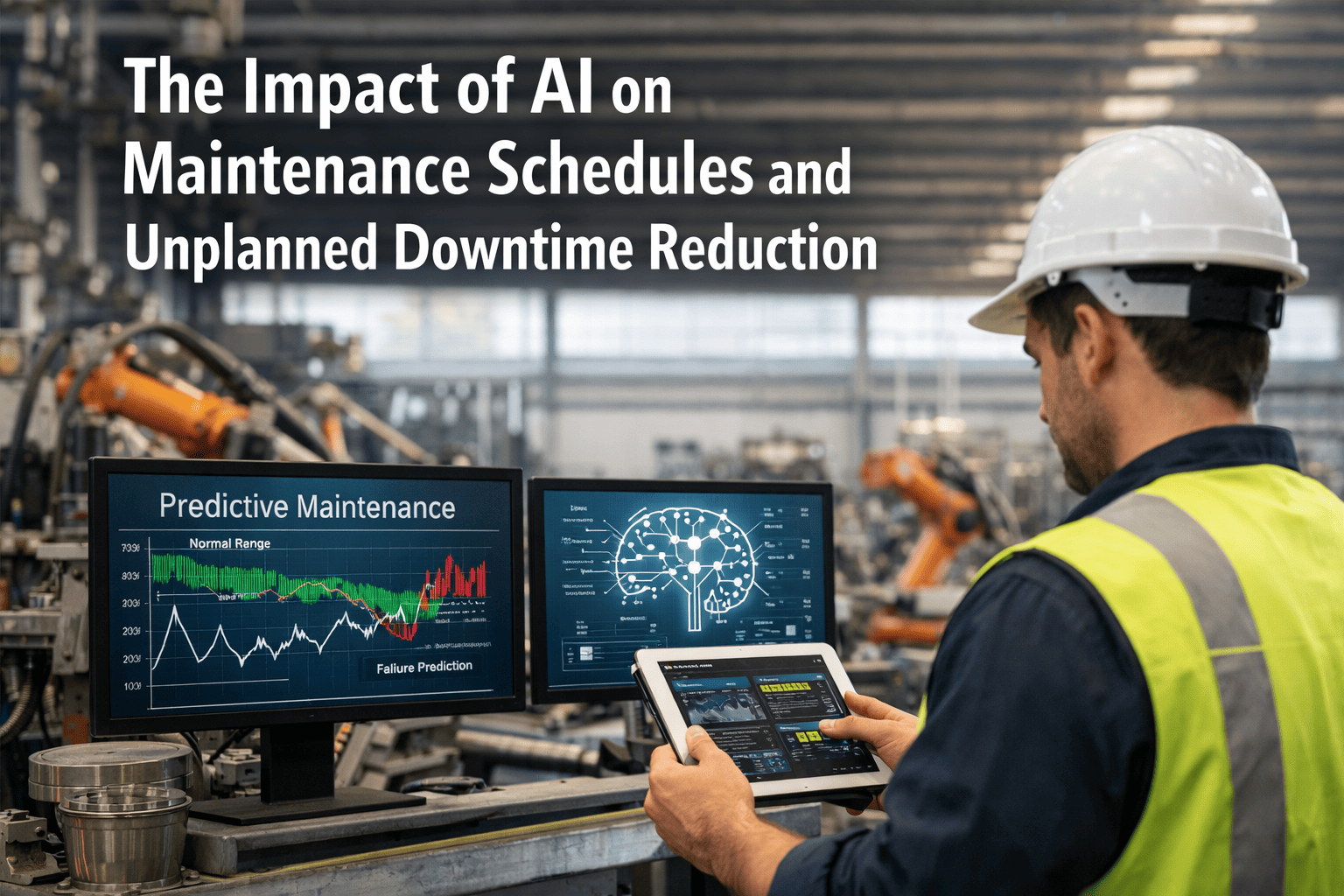
Your maintenance schedule is probably wrong. Fixed 90-day PM intervals treat every asset the same — whether it ran 10 hours or 10,000 hours that quarter. The result: over-maintained equipment that didn't need service and under-monitored assets that fail before the next scheduled visit. PM compliance on manual systems averages just 54%. Emergency repairs cost 4.8× more than planned work. And maintenance teams spend only 35–50% of their time actually turning wrenches — the rest is spent traveling, hunting for parts, waiting for instructions, and fighting fires. AI is reshaping all of this. It replaces the calendar with live condition intelligence, generates work orders automatically when intervention is actually needed, and ensures every maintenance hour is spent on work that matters. Schedule a demo to see how OxMaint transforms your maintenance schedule with AI.
UPCOMING OXMAINT EVENT
AI Predictive Maintenance: Eliminate Downtime Before It Starts
Join OxMaint's expert-led session covering how AI-native predictive maintenance — including real-time anomaly detection, sensor-to-work-order automation, and CMMS-driven reliability — transforms your maintenance strategy from reactive to predictive.
✓ Live AI anomaly detection walkthrough
✓ Q&A with OxMaint's maintenance AI specialists
✓ Real-world breakdown prevention case studies
✓ Actionable predictive maintenance roadmap you can use immediately
54%
PM Compliance Avg.
Industry average PM completion rate on calendar-based manual systems
4.8×
Emergency Cost Multiplier
Emergency repairs cost nearly 5× more than planned maintenance work
35–50%
Actual Wrench Time
Time technicians spend on actual repair work — rest is travel, waiting, admin
50%
Schedule Reduction
AI reduces time needed for maintenance scheduling by up to 50%
The Scheduling Problem: Why Your Calendar-Based Plan Fails Every Monday
Every Friday, maintenance planners build the perfect schedule for next week. By Monday morning, a breakdown on Line 3 destroys it. Emergency work consumes the team. Planned PMs get deferred. Parts reserved for scheduled work get consumed by the emergency. Deferred PMs accumulate until another asset fails — creating a vicious cycle of reactive firefighting that no static schedule can solve. AI breaks this cycle by replacing fixed calendars with live condition intelligence.
✕Fixed 90-day intervals — same schedule regardless of actual equipment condition
✕54% PM compliance — half of planned work never gets completed
✕Over-maintains healthy assets, under-monitors deteriorating ones
✕Schedule destroyed by first Monday morning emergency
✕Wrench time: 35–50% — techs spend half their day on non-repair tasks
✓Each asset maintained at its own optimal frequency based on live condition data
✓Auto-generated work orders with pre-staged parts and procedures
✓Intervention only when AI detects actual need — zero wasted maintenance
✓Dynamic rescheduling adapts to shop-floor reality in real time
✓Wrench time: 60–65% — AI eliminates travel, waiting, and admin overhead
How AI Transforms the Work Order Lifecycle
In a traditional system, a human notices a problem, writes a work order, assigns a technician, hopes parts are in stock, and schedules repair around production. Each step adds delay and introduces error. AI collapses this entire lifecycle into seconds — from anomaly detection to fully-populated work order to technician notification, with parts pre-reserved and procedures pre-loaded.
Manual Process
Hours–DaysOperator notices issue, reports verbally
30–60 minPlanner creates work order manually
HoursChecks parts availability, orders if needed
DaysSchedules technician around production
VariableTech searches for procedures, travels to asset
Total: 2–14 days from detection to repair
AI-Automated Process
<10msSensor anomaly detected by AI model
<60sWO auto-created with fault, asset, action, parts
InstantParts auto-reserved from inventory; shortage flagged
InstantScheduled in next optimal maintenance window
InstantTech receives mobile alert with full procedure loaded
Total: <60 seconds from detection to dispatched work order
Your Schedule Should Adapt to Reality — Not the Other Way Around. OxMaint auto-generates work orders from AI anomaly detection, pre-stages parts, assigns the right technician, and schedules repairs in the next optimal window — in seconds.
Start Free Trial
Schedule a Demo
The 5 Scheduling Shifts AI Makes Possible
AI doesn't just speed up scheduling — it fundamentally changes what scheduling means. These five shifts transform maintenance from reactive calendar-following to proactive, condition-driven asset management.
Calendar intervals
→
Condition-triggered timing
Each asset maintained at its own optimal frequency based on live sensor data — not OEM documentation averages. A pump running 24/7 gets serviced before one running 4 hours/day.
Manual work orders
→
Auto-generated from AI
When condition thresholds are breached, CMMS creates work order with asset ID, fault classification, recommended action, parts reservation, and procedure — in under 60 seconds.
Static weekly plans
→
Dynamic real-time adaptation
When production runs extend or emergencies arise, AI instantly recalculates the optimal maintenance window. Drag-and-drop replanning with live OEE context.
Reactive backlog growth
→
Predictive backlog shrinking
AI-driven backlog is proactive — work orders generated from predictions, not failures. Backlog composition shifts from "emergency" to "planned," reducing total volume and cost.
Skill-blind assignment
→
AI-optimized crew allocation
AI matches each work order to the technician with the right skill set, proximity, and availability — reducing travel time and maximizing wrench time to 60–65%.
The Downtime Impact: What AI Scheduling Eliminates
Unplanned downtime isn't one problem — it's five problems hitting simultaneously. AI scheduling attacks each one through a different mechanism, which is why the combined impact exceeds what any single improvement could deliver.
Problem: 82% of companies experienced unplanned downtime in the last 3 years. Average incident lasts 4 hours.
AI fix: Predicts failures 14–90 days ahead. Repairs scheduled during planned windows. Emergency breakdowns reduced 70–75%.
Problem: MTTR has increased from 49 to 81 minutes average — driven by skills gaps and parts delays.
AI fix: Parts pre-staged, procedures pre-loaded, right technician pre-assigned. MTTR cut by 30–50% through preparation.
Problem: 55% of maintenance professionals cite higher parts costs as the top driver of rising downtime costs.
AI fix: Predicted failures trigger just-in-time ordering weeks ahead. Parts out-of-stock incidents down 55% at AI adopters.
Problem: One emergency displaces multiple planned PMs. Deferred PMs accumulate until another asset fails — creating a vicious cycle.
AI fix: Dynamic rescheduling adapts instantly. Deferred work auto-rescheduled into the next available window with no manual intervention.
Measured Results: What AI Scheduling Delivers
Reduction in unplanned downtime with AI scheduling
Less time spent on maintenance scheduling and planning
Increase in runtime through optimized maintenance timing
Reduction in total maintenance costs vs. reactive approach
Week 1–2
Digitize & Baseline
- Deploy CMMS — digitize all work orders, asset hierarchy, and parts inventory
- Import existing PM schedules and maintenance history
- Baseline current MTBF, MTTR, PM compliance, and wrench time
- Identify your "repeat offenders" causing 80% of unplanned downtime
Month 1–3
Connect & Predict
- Connect IoT sensors on top 5–10 critical assets to CMMS
- Activate AI anomaly detection in advisory mode — validate predictions
- Enable auto work order generation from confirmed anomalies
- Begin dynamic scheduling around production windows
Month 3–12
Automate & Scale
- Full AI-driven scheduling replacing calendar-based PM across plant
- Automated technician assignment based on skill, location, availability
- Integrated parts forecasting with just-in-time auto-ordering
- Document results: PM compliance, MTBF improvement, cost reduction
By month 6, your maintenance schedule adapts to reality in real time. By month 12, every work order is data-driven, every repair is planned, and your team spends their time on work that matters — not firefighting. Start your free trial and digitize your maintenance schedule this week.
Stop Publishing Schedules That Won't Survive Monday Morning.
OxMaint replaces static maintenance calendars with AI-driven, condition-based scheduling that adapts in real time — auto-generating work orders, pre-staging parts, assigning the right technician, and keeping your team focused on work that actually prevents failures.
Frequently Asked Questions
How does AI change maintenance scheduling specifically?
AI replaces fixed calendar intervals with condition-triggered scheduling. Instead of servicing every pump every 90 days, ML models analyze live vibration, temperature, pressure, and runtime data to calculate when each specific asset actually needs intervention. Work orders are auto-generated with full context (fault, parts, procedures) the moment a condition threshold is crossed. The result: maintenance happens at the right time for each asset, not on a generic schedule.
Start free and see condition-based scheduling on your assets within the first week.
What is wrench time and how does AI improve it?
Wrench time is the percentage of a technician's day spent actually performing maintenance work. World-class is 60–65%, but most teams average only 35–50%. The rest is spent traveling to assets, hunting for parts, searching for procedures, waiting for approvals, and handling administrative tasks. AI improves wrench time by auto-assigning the closest qualified technician, pre-staging parts, pre-loading procedures on mobile devices, and eliminating manual work order creation.
Book a demo to see wrench time optimization in action.
Can AI scheduling work alongside our existing PM program?
Yes. The most successful facilities run a hybrid strategy: AI condition-based scheduling for critical and high-value assets (where failure cost justifies sensor investment) and traditional calendar-based PM for routine, low-risk equipment. OxMaint manages both strategies within a single unified platform — 66% of manufacturers use this hybrid approach in 2026. You don't need to abandon calendar PMs overnight; you phase in AI scheduling starting with your highest-impact assets.
How fast can AI-generated work orders be created?
Under 60 seconds from anomaly detection. When AI detects a condition threshold breach, OxMaint auto-creates a work order with the specific asset ID, diagnosed fault classification, recommended repair action, pre-populated parts list (with stock verification), and standard operating procedure — then sends a mobile notification to the assigned technician. No human intervention needed between detection and dispatch. Compare this to the typical 2–14 day manual process.
Start free to experience automated work order generation.
What happens when production disrupts the maintenance schedule?
This is exactly where AI scheduling excels. When a production run extends, an emergency arises, or a machine's availability changes, AI instantly recalculates the optimal maintenance window for all affected work orders. Deferred PMs are auto-rescheduled into the next available window with no manual intervention. The system continuously balances maintenance urgency against production priority — ensuring PMs actually get completed instead of perpetually deferred.