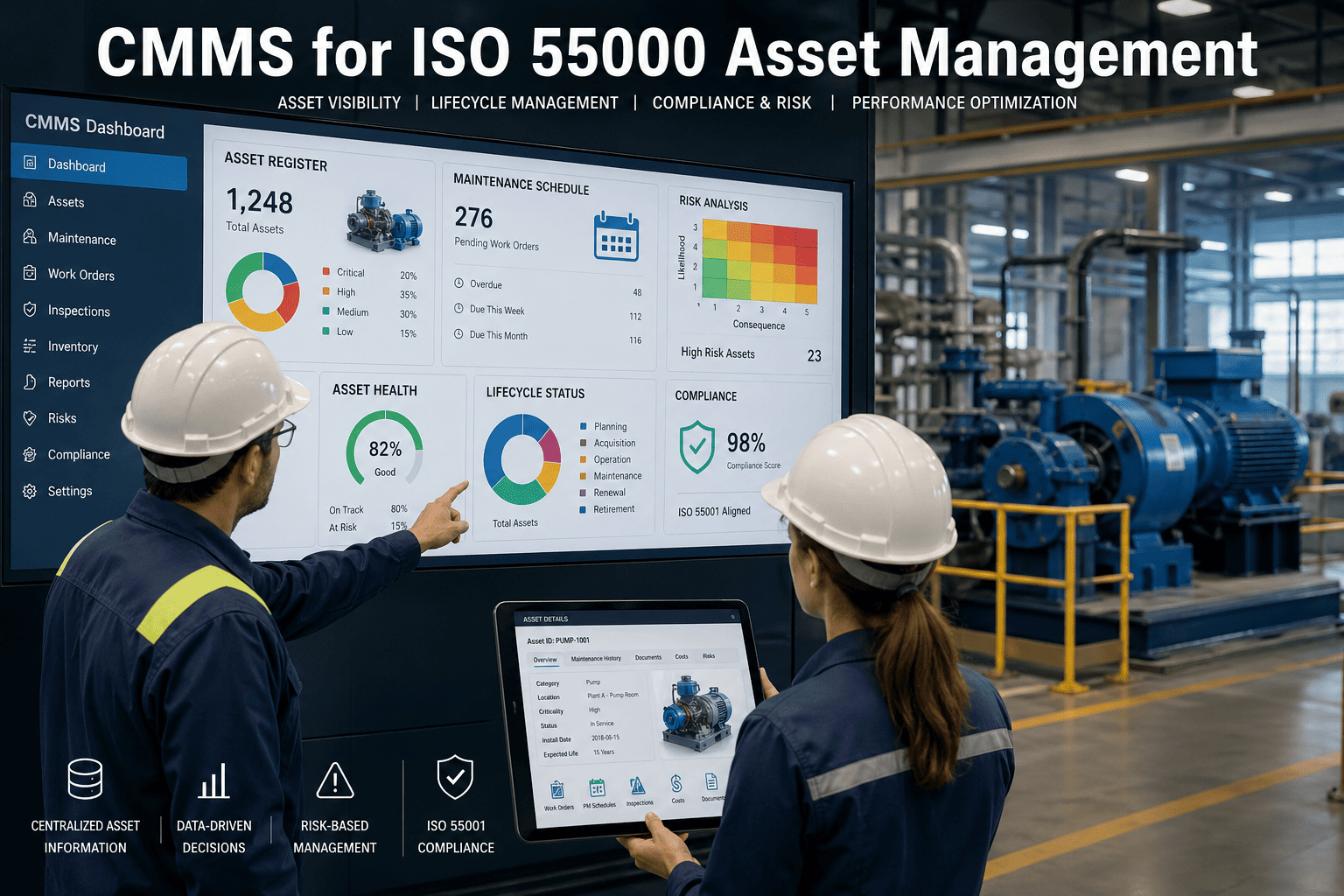
In regulated manufacturing, a missed maintenance record isn't a minor oversight — it's a compliance violation that triggers audits, fines, product recalls, and lost certifications. Pharmaceutical plants face FDA 21 CFR Part 11 data integrity requirements. Aerospace suppliers must satisfy AS9100 traceability standards for every component that goes into a flying aircraft. General manufacturers navigate OSHA, ISO, and environmental regulations simultaneously. AI predictive maintenance doesn't just prevent equipment failure — it auto-generates the audit-ready documentation these regulators demand, tags every maintenance action to its regulatory domain, and ensures nothing falls through the cracks. Schedule a demo to see compliance-integrated predictive maintenance for your regulatory environment.
UPCOMING OXMAINT EVENT
AI Predictive Maintenance: Eliminate Downtime Before It Starts
Join OxMaint's expert-led session covering how AI-native predictive maintenance — including real-time anomaly detection, sensor-to-work-order automation, and CMMS-driven reliability — transforms your maintenance strategy from reactive to predictive.
✓ Live AI anomaly detection walkthrough
✓ Q&A with OxMaint's maintenance AI specialists
✓ Real-world breakdown prevention case studies
✓ Actionable predictive maintenance roadmap you can use immediately
80%
Audit Prep Reduction
Achieved by aerospace MROs using AI-integrated QMS vs. manual documentation
40%
Faster Regulatory Response
AI-driven compliance frameworks cut inquiry response time dramatically
32%
Fewer Nonconformances
Reduction in recurring nonconformities with predictive quality monitoring
ALCOA+
Data Integrity Standard
AI-CMMS auto-enforces attributable, legible, contemporaneous, original, accurate data
The Compliance Problem: Maintenance Records Are Regulatory Evidence
Regulators don't audit your equipment — they audit your documentation. Every maintenance action, every calibration record, every deviation from procedure is evidence of whether your facility maintains the control required by law. Paper-based and disconnected digital systems create three fatal compliance gaps that AI predictive maintenance eliminates.
Missing or Incomplete Records
Manual logs have gaps, illegible entries, and missing timestamps. In FDA inspections, incomplete maintenance records are cited under 21 CFR 211.68 (equipment maintenance) and trigger Form 483 observations.
✅ AI Fix: Every sensor reading, work order, and repair action is auto-logged with timestamps, technician ID, and asset context — no manual entry required.
No Traceability Chain
When your DCS, CMMS, and QMS don't connect, auditors can't trace a deviation back to its root cause. AS9100 requires end-to-end traceability for every component touching an aircraft.
✅ AI Fix: Unified platform links sensor anomaly → prediction → work order → repair → verification in one auditable chain.
Missed Deadlines & Escalations
Regulatory maintenance tasks (calibrations, inspections, certifications) buried in spreadsheets get missed. A single overdue OSHA inspection can trigger a facility-wide audit.
✅ AI Fix: Automated regulatory calendar with escalation alerts weeks before deadlines. Zero-miss compliance tracking.
Compliance by Industry: What Each Regulator Demands
Every regulated industry has specific documentation requirements that AI predictive maintenance must satisfy. Here's what regulators in pharma, aerospace, and general manufacturing actually look for during audits — and how AI-integrated CMMS addresses each requirement.
Standards: FDA 21 CFR Part 11, EU GMP Annex 11 & 22, cGMP, ALCOA+ data integrity
Electronic signatures with full audit trails
Validated computerized systems (CSV/CSA)
Data integrity — attributable, legible, contemporaneous, original, accurate
Change control for AI model updates (SOPs documented)
Predictive models must be static & deterministic for critical processes
AI Advantage: Auto-generates ALCOA+ compliant records for every maintenance action. Validated AI models detect equipment drift before it affects product quality — preventing batch rejection and FDA Form 483 observations.
Standards: AS9100D (transitioning to IA9100 in 2026), AS9110 (MRO), FAA, EASA, ITAR
End-to-end component traceability & configuration management
Counterfeit parts prevention with documented supplier chains
Operational risk management integrated across all processes
Human factors consideration in maintenance procedures
Predictive analytics for quality control (new IA9100 requirement)
AI Advantage: Predictive failure detection creates full traceability from anomaly through repair. AI-driven logs helped one MRO reduce audit prep time by 80% and pass surveillance with zero major nonconformities.
Standards: ISO 9001/14001/45001, OSHA, EPA, NERC (energy), industry-specific requirements
Documented maintenance procedures with evidence of execution
Safety inspection records (LOTO, confined space, hot work permits)
Environmental monitoring & emissions compliance tracking
Equipment calibration records with traceability to standards
Corrective action records linked to root cause analysis
AI Advantage: Auto-tags every work order to its regulatory domain (OSHA, EPA, ISO). Generates one-click audit reports. Overdue items escalate automatically weeks before deadlines.
Compliance Shouldn't Be a Quarterly Fire Drill. OxMaint auto-tags every maintenance action to its regulatory standard and keeps your facility in a state of continuous audit-readiness — not reactive scrambling.
Start Free Trial
Schedule a Demo
The AI Audit Trail: From Sensor Signal to Compliance Record
AI predictive maintenance creates a complete, unbroken chain of evidence that auditors can follow from the moment an anomaly is detected to the moment the repair is verified. Every step is timestamped, attributed, and immutable — meeting the strictest data integrity standards across all three regulated sectors.
01
Anomaly Detected
Sensor data triggers AI alert. Timestamped log records asset ID, parameter, deviation magnitude, and AI confidence score. Meets ALCOA+ "contemporaneous" requirement.
02
Work Order Generated
CMMS auto-creates work order with failure diagnosis, regulatory tag (FDA/AS9100/OSHA), parts list, and recommended repair window. Full traceability to triggering anomaly.
03
Repair Executed
Technician completes work with mobile app — electronic signature, photos, time log, parts used (with serial/lot tracking for aerospace). Meets 21 CFR Part 11 e-signature requirements.
04
Verification & Close
Post-repair sensor data confirms recovery to baseline. AI validates repair effectiveness. Complete audit trail generated — one-click report for any regulatory inquiry.
2026 Regulatory Landscape: What's Changing
2026 marks a turning point for AI in regulated environments. New standards and guidance are explicitly addressing AI — creating both obligations and opportunities for manufacturers who act now.
FDA
AI in Drug Manufacturing Guidance
FDA's 2025 draft guidance introduces a risk-based credibility assessment for AI models. Emphasizes validation with independent test data, documented acceptance criteria, and continuous monitoring. Early engagement with regulators is encouraged.
EU GMP
Annex 22 — AI in GMP
Draft published mid-2025. Requires AI models to be static and deterministic for critical processes. Human-in-the-loop controls mandatory for non-critical tasks. Explainability and manageable complexity are new requirements.
IAQG
AS9100 → IA9100 Transition
Major overhaul published in 2026. Adds predictive analytics requirements, data-driven quality systems, cybersecurity provisions, and sustainability mandates. Organizations must predict and control outcomes, not just validate processes.
EU AI Act
High-Risk AI Classification
AI in manufacturing quality control and safety systems classified as high-risk under the EU AI Act. Requires transparency, bias detection, human oversight, and documented risk management aligned with NIST AI RMF and ISO 42001.
Compliance Is Not Optional. Manual Documentation Is.
OxMaint gives regulated manufacturers AI-powered predictive maintenance with built-in compliance — electronic signatures, regulatory auto-tagging, ALCOA+ data integrity, and one-click audit reports that satisfy FDA, AS9100, and ISO inspectors.
Frequently Asked Questions
Does AI predictive maintenance satisfy FDA 21 CFR Part 11 requirements?
Yes, when implemented correctly. AI-integrated CMMS platforms like OxMaint generate electronic records with full audit trails, electronic signatures with unique user attribution, and timestamped entries meeting ALCOA+ data integrity principles. The key requirements are: validated computerized system, immutable audit trails, version-controlled records, and documented change control procedures for any AI model updates. The FDA's 2025 draft guidance encourages a risk-based credibility assessment for AI models used in manufacturing.
Start free to evaluate OxMaint's compliance capabilities in your environment.
How does AI maintenance support AS9100 / IA9100 certification?
AS9100 (transitioning to IA9100 in 2026) requires end-to-end traceability, operational risk management, and configuration control. AI predictive maintenance creates unbroken audit chains from anomaly detection through repair verification, with electronic signatures and timestamped logs at every step. The new IA9100 standard explicitly requires predictive analytics capabilities — making AI maintenance not just helpful but a compliance requirement for aerospace suppliers. One MRO reported 80% reduction in audit prep time after implementing AI-integrated QMS.
What is ALCOA+ and how does AI ensure data integrity?
ALCOA+ is the FDA's framework for data integrity: Attributable (who), Legible (readable), Contemporaneous (real-time), Original (source record), Accurate (correct), plus Complete, Consistent, Enduring, and Available. AI-CMMS enforces ALCOA+ automatically — every record is attributed to a specific user, timestamped at creation, stored as an original unalterable record, and validated against sensor data for accuracy. No manual entry means no human-error data integrity gaps.
Book a demo to see ALCOA+ enforcement in action.
Can AI maintenance documentation satisfy multiple regulatory frameworks simultaneously?
Yes. OxMaint auto-tags every maintenance action with its applicable regulatory domain — FDA, AS9100, ISO, OSHA, EPA — from a single record. One work order can carry multiple compliance tags. This means your maintenance team documents once, and the system generates compliance-specific reports for whichever auditor walks through the door. This eliminates the duplication and inconsistency that comes from managing separate systems for separate regulations.
What happens when AI models need to be updated in a validated environment?
AI model updates in GxP-validated environments must follow documented change control procedures — the same SOPs used for any computerized system change. This includes risk assessment, independent validation testing, documented acceptance criteria, and approval before deployment. OxMaint maintains version control on all AI models, with full change history and validation documentation. The EU GMP Annex 22 specifically requires that AI models used in critical processes remain static and deterministic, with human oversight for any model changes.
Start free and explore validated AI deployment in your regulated environment.