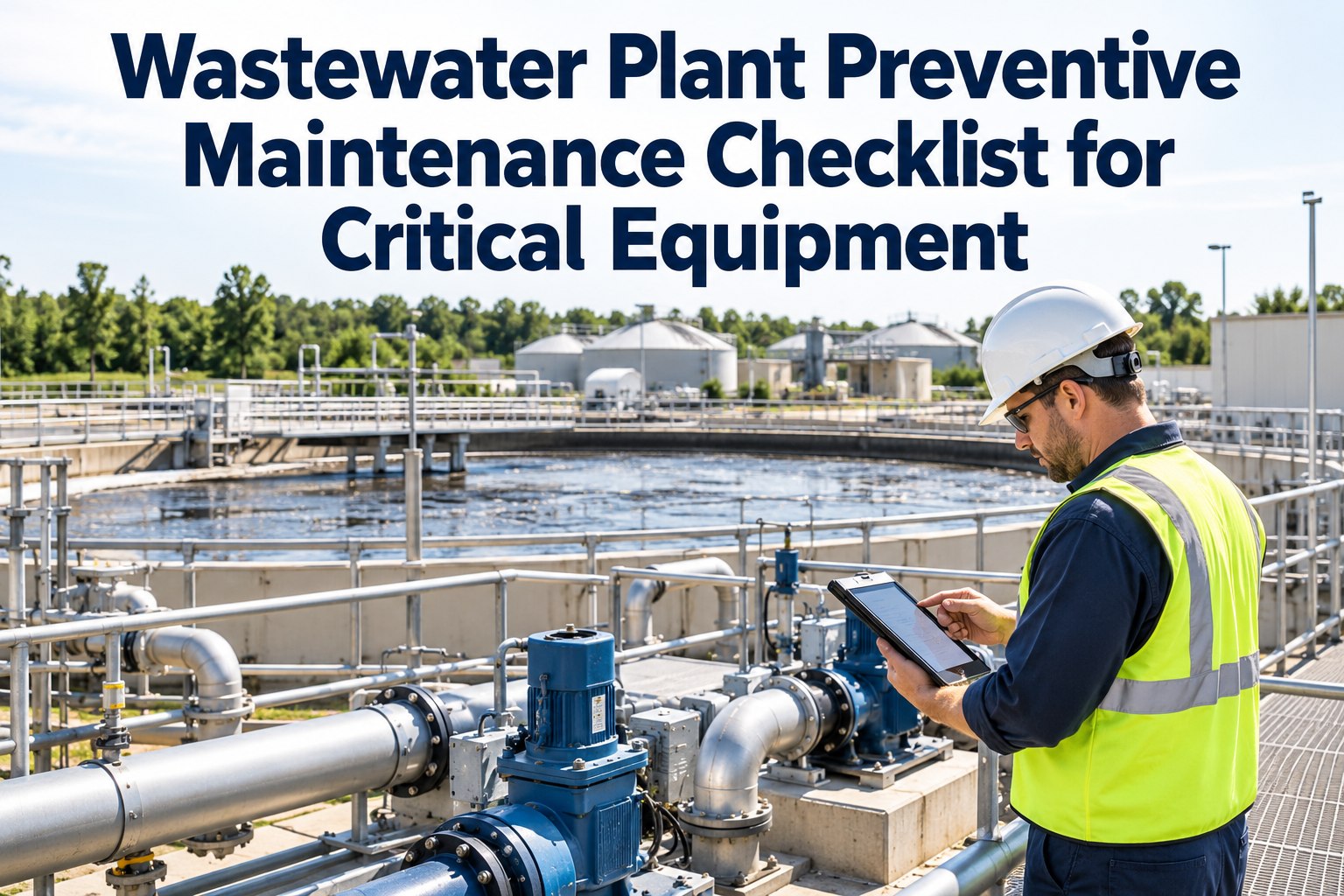
A water treatment plant is not a building with equipment in it. It is a continuously operating public health system where every pump failure, every missed chemical dosing check, and every uncalibrated chlorine analyser is a potential pathway for unsafe water to reach a consumer's tap. The Safe Drinking Water Act and EPA regulations make this explicit: documented maintenance is not a best practice at water treatment facilities — it is a legal requirement. Pump station preventive maintenance records are reviewed during NPDES permit inspections. Analytical instrument calibration logs are required evidence during sanitary surveys. Equipment failure records feed the discharge monitoring reports that determine permit compliance status. A plant that does the maintenance but cannot produce the documentation is, for regulatory purposes, a plant that did not do the maintenance. Missing a single chlorine residual test or chemical feed pump inspection can result in inadequate disinfection, contaminated water reaching the distribution system, and immediate regulatory violations with financial penalties. Facilities that implement preventive maintenance supported by digital CMMS consistently report 18–25% reductions in maintenance costs and 30–50% decreases in unplanned downtime compared to reactive approaches. The gap between a compliant plant and a plant with violations is rarely the quality of the operators — it is the quality of the documentation system behind them. Sign up for Oxmaint to build a water treatment maintenance programme that is both operationally effective and audit-ready.
Five Treatment Process Zones — What Oxmaint Schedules and Documents in Each
Water treatment plant maintenance is organised around the treatment process — each zone has distinct equipment types, failure modes, and regulatory documentation requirements that determine its PM programme. Oxmaint structures maintenance by process zone, with asset-specific PM templates and compliance data fields for each. Book a demo to see zone-by-zone configuration.
Raw water pumps are the entry point of the entire treatment chain. A pump failure here stops the plant. Bearing temperature, motor amperage trending, and vibration signatures are the three leading indicators — all detectable 30–60 days before failure when tracked systematically in Oxmaint. Sign up to configure pump PM schedules.
Chemical feed pump failure is a direct route to an EPA violation — inadequate chlorination or coagulation is a treatment technique violation under the Safe Drinking Water Act regardless of whether the operator knew the pump had failed. Chemical feed systems require the most frequent inspection of any water plant equipment class. Book a demo to see chemical feed PM templates.
Filter media condition directly determines effluent turbidity — and turbidity is a surrogate compliance parameter under the Surface Water Treatment Rule. A filter that has not been backwashed on schedule, or whose media has not been inspected for mudballing and cracking, is a filter that may be passing pathogens. Oxmaint schedules filter backwash events, media inspections, and underdrain condition checks as independent recurring work orders. Sign up to configure filtration PM.
The disinfection system is the final barrier between treatment and the distribution network. EPA requires daily CT value documentation — disinfectant Concentration multiplied by contact Time — as proof that pathogen inactivation requirements are being met continuously. Every missed CT log is a daily monitoring violation. Oxmaint schedules chlorine residual readings and CT calculations as mandatory daily work orders with no override capability. Book a demo to see CT compliance tracking.
Analytical instruments — turbidimeters, pH analysers, chlorine residual analysers, flow meters — are the measurement foundation of both process control and regulatory compliance. An instrument that has drifted from its calibrated state is not producing compliant measurements. EPA requires documented calibration schedules and calibration certificates as evidence of measurement programme validity. Oxmaint tracks each instrument individually, with calibration due dates, calibration results, and certificate attachments all stored in the asset record. Sign up to configure instrument calibration PM.
Regulatory Compliance Documentation — What Oxmaint Produces for Safe Drinking Water Act and NPDES Audits
Water treatment plant regulatory compliance is a documentation discipline as much as an operational one. The inspector who arrives for an NPDES permit review or a sanitary survey is not watching operators work — they are reading records. Oxmaint produces the records that turn a compliance inspection from a liability into a demonstration of operational discipline. Sign up for Oxmaint to build your EPA-audit-ready maintenance record.
| Regulation / Requirement | Documentation Needed | Oxmaint PM Method | Frequency |
|---|---|---|---|
| Safe Drinking Water Act — SWTR | Daily CT value documentation | Daily operator work order with chlorine residual field and CT calculation | Daily |
| SDWA — Turbidity MCL | Continuous turbidity monitoring with calibration records | Turbidimeter calibration PM work order with certificate attachment | Weekly / Monthly |
| NPDES Permit — Discharge Monitoring | Effluent quality measurements and DMR submission | Effluent sampling work orders; results feed DMR report generation | Per permit schedule |
| NPDES Inspection — Pump Station PMs | Pump maintenance history and overhaul records | Pump PM work orders with measured data fields; overhaul records per asset | Weekly / Quarterly / Annual |
| EPA Sanitary Survey | Instrument calibration log, operator logs, corrective actions | All calibration work orders with certificates; corrective action chain records | At survey request |
| Chemical Feed — Treatment Technique | Chemical dosing records; pump output verification | Daily chemical feed check work orders; pump output measured and logged | Daily |
| Storage Tank Inspection | Annual inspection with condition documentation | Annual tank inspection PM work order with photos and condition fields | Annual |
Swipe to view full table
How Oxmaint Manages Water Treatment Plant Maintenance — Four Capabilities That Matter
Water treatment maintenance has specific requirements that differentiate it from general facility management: mandatory daily operational logs that constitute regulatory compliance evidence, chemical feed equipment that requires inspection at the highest frequency of any industrial process, and a staffing environment where operator turnover cannot be allowed to create knowledge gaps in safety-critical maintenance. Sign up for Oxmaint to deploy these capabilities at your treatment plant.
Daily operator tasks in Oxmaint are not optional reminders — they are required compliance records. Each daily work order captures the chlorine residual reading, CT calculation, chemical feed pump output verification, and process condition observations with a mandatory timestamp and operator digital signature. The completed work order is immediately part of the facility's permanent compliance record. When the NPDES inspector or sanitary surveyor requests the last 90 days of CT documentation, Oxmaint exports the complete timestamped record in 30 seconds. Book a demo to see daily operator work orders configured.
Raw water pumps, high-service pumps, and booster station pumps are the highest-consequence assets at any water treatment facility. Oxmaint tracks motor amperage, bearing temperature, and vibration readings at each PM inspection — building the trending database that identifies developing failures 30–60 days before they produce emergency shutdowns. When amperage creeps above the baseline trend, Oxmaint flags the asset for inspection before the next PM cycle rather than waiting for the failure to confirm the problem. Sign up to activate pump trend tracking.
Oxmaint maintains a calibration record per analytical instrument — each turbidimeter, chlorine analyser, pH meter, and flow meter has its own PM schedule with calibration frequency, last calibration date, next calibration due date, and a permanent record of all calibration certificates. Certificates are attached to the calibration work order as photos or PDF uploads. When the EPA sanitary surveyor asks for the turbidimeter calibration history, the facility operator opens the instrument's asset record in Oxmaint and presents the complete calibration chain on a tablet. Book a demo to see instrument tracking.
Oxmaint's mobile work order application works in areas of the treatment plant with limited WiFi coverage — operators complete inspections, record readings, and attach photos on their mobile device, with records syncing when connectivity is available. When staff turnover occurs, new operators log into Oxmaint and find their shift work queue already populated with the correct tasks — chemical feed checks, chlorine readings, and equipment inspections — without any knowledge transfer from the departing operator. The compliance programme survives staff changes intact because it lives in Oxmaint, not in anyone's memory. Sign up to activate mobile operator workflows.
CT Documentation, Chemical Feed Records, Pump PM Histories, Calibration Certificates — All in One Platform, All Audit-Ready.
Oxmaint manages the complete water treatment maintenance and compliance documentation programme — daily operator logs that constitute regulatory evidence, equipment PM schedules across all five process zones, and instrument calibration records retrievable in 30 seconds when the inspector arrives.
Water Treatment Plant Maintenance Software — Common Questions
Oxmaint generates a daily operator work order that includes chlorine residual and contact time as mandatory data entry fields — the work order cannot be submitted without both values. The CT calculation is performed automatically from the entered values, and the result is logged with a timestamp and the operator's digital signature. If a daily work order is not completed by the configured end-of-shift time, Oxmaint flags it as an overdue compliance task and escalates to the plant supervisor. Over the course of a month or quarter, the completed daily CT work orders become the immutable digital record that satisfies EPA daily monitoring requirements — exportable as a report at any point for NPDES compliance review or sanitary survey preparation. Sign up for Oxmaint to configure daily CT compliance work orders.
Staff turnover is one of the most damaging conditions for paper-based compliance programmes at water treatment plants — institutional knowledge about which daily checks are due, which instruments are overdue for calibration, and which chemical feed pumps are on quarterly overhaul cycles leaves with the departing operator. Oxmaint eliminates this vulnerability entirely. The complete PM schedule, daily operator task queue, instrument calibration due dates, and open corrective action list all live in the system. The new operator logs into Oxmaint on day one and sees their complete shift work queue populated with the correct tasks — chemical feed output check, chlorine residual reading, filter turbidity log — without any briefing from the departing staff. The compliance programme is continuous regardless of personnel change. Book a demo to see the operator onboarding workflow.
Oxmaint schedules chemical feed pump maintenance as a multi-level PM programme: daily output verification work orders, quarterly overhaul work orders (covering O-ring, check valve, and diaphragm replacement), and calibration work orders triggered automatically after each overhaul completion. The calibration work order is linked to the overhaul work order — it is generated as a follow-on task when the overhaul is closed, ensuring the calibration step is never skipped. The chemical feed rate recorded in the calibration work order is compared to the dosing setpoint, and any deviation above the configured tolerance triggers a corrective action work order before the pump returns to service. All chemical feed maintenance records are stored per pump serial number and retrievable by date range for NPDES inspection review. Sign up for Oxmaint to configure chemical feed pump PM.
The Missed CT Log That Becomes a Violation, the Chemical Feed Pump That Was Never Calibrated After Overhaul, the Turbidimeter With an 8-Month Calibration Gap — Oxmaint Closes Every One of These.
Daily operator compliance work orders, chemical feed pump overhaul-to-calibration chains, instrument calibration tracking with certificate storage, pump trend data for predictive maintenance, and 30-second audit record export — built for the Safe Drinking Water Act and NPDES compliance reality of water treatment plant operations.